James Watt
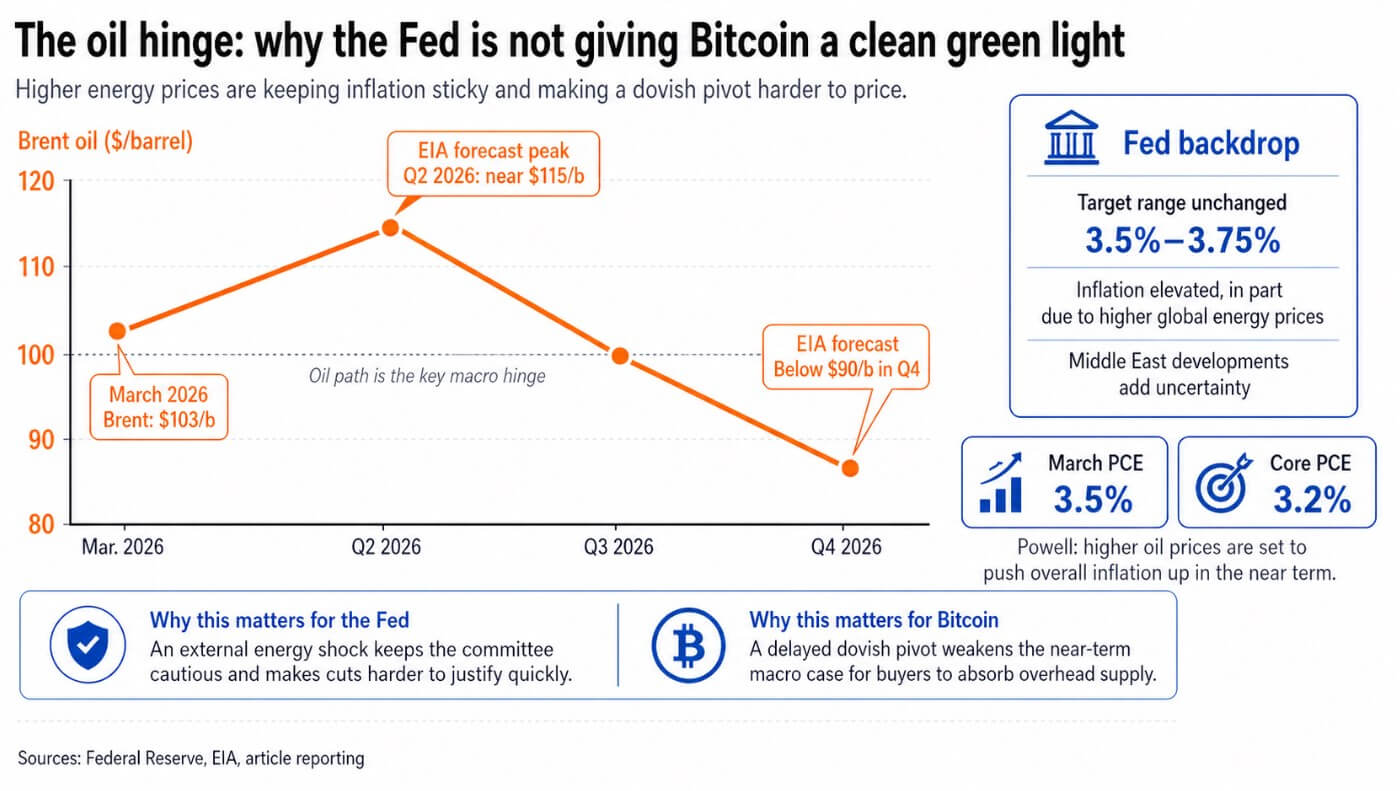
The digital asset market faced a significant test of resilience this week as Bitcoin entered the latest Federal Reserve policy decision capped beneath a formidable on-chain supply zone, a barrier that remained intact following Fed Chair Jerome Powell’s cautious press conference. In a move that reflected the growing complexity of the global macroeconomic landscape, the Federal Open Market Committee (FOMC) elected to maintain the target range for the federal funds rate at 3.5% to 3.75%. This decision was underscored by an explicit acknowledgment of the role that elevated global energy prices and geopolitical tensions in the Middle East have played in sustaining inflationary pressures, creating a cloud of uncertainty for the economic outlook through the remainder of 2026.
The Federal Reserve’s stance comes at a time when the central bank is grappling with a multi-front inflation battle. During his opening remarks, Chair Powell provided sobering estimates for inflation metrics through March, noting that the total Personal Consumption Expenditures (PCE) price index ran at an annual rate of 3.5%, while the core PCE, which excludes volatile food and energy components, stood at 3.2%. Powell signaled that the immediate future offers little reprieve, as higher oil prices are anticipated to exert upward pressure on headline inflation figures in the near term. This data-driven caution has effectively dampened the hopes of market participants who were looking for a clear "green light" to push Bitcoin through its current overhead resistance.
The Most Divided Fed Since 1992
Perhaps the most striking revelation from the latest FOMC meeting was the degree of internal dissent among officials, marking the most fractured vote the committee has seen since 1992. While eight officials voted to hold the current rate, the consensus was challenged by a rare and public split in philosophy. One dissenter advocated for an immediate rate cut to stimulate growth, while three other prominent officials—Beth Hammack, Neel Kashkari, and Lorie Logan—objected to the inclusion of any "easing bias" in the official statement.
This internal friction highlights a significant pivot in the central bank’s internal dynamics. The hawks on the committee argued that the current language remains too accommodating given the stickiness of inflation, while the broader committee attempted to maintain a posture that keeps the door open for future easing. For Bitcoin and the broader cryptocurrency markets, this division complicates the "macro" environment. A dovish pivot, which many investors had hoped would catalyze a fresh bull run, has become increasingly difficult to price into the market. Despite this, the March Summary of Economic Projections still pointed toward a median fed funds rate of 3.4% by 2026, suggesting that at least one rate cut remains a possibility before the end of the year.
However, futures markets have reacted with skepticism. Traders are currently pricing in a diminishing probability of a cut materializing by year-end, with a small but growing segment of the market even placing bets on the possibility of a rate hike within the next twelve months if inflation fails to cool. This shift in sentiment has left Bitcoin in a precarious position, as the asset often thrives in environments of high liquidity and falling interest rates.
The Energy Hinge: Oil as a Macro Catalyst
The Federal Reserve’s current predicament is inextricably linked to an external energy shock—a variable that Chair Powell admitted the central bank has limited power to control. Brent crude oil averaged $103 per barrel in March 2026, driven largely by supply chain disruptions and regional conflicts. According to the Energy Information Administration (EIA), prices are expected to peak near $115 per barrel in the second quarter of the year before potentially retreating below $90 by the fourth quarter.

This "oil hinge" creates a two-channel inflation problem for the Fed. On one hand, rising energy costs are directly pushing up the headline PCE. On the other hand, the core goods sector is still absorbing the effects of various trade tariffs, which keep prices elevated even when energy is excluded. This dual-channel setup prevents the FOMC from "looking through" the oil shock. Before the committee can justify a rate cut, it must be certain that higher energy costs are not becoming embedded in long-term inflation expectations.
For Bitcoin, this means the macro-economic case for absorbing the current supply glut has lost its near-term traction. As long as inflation expectations remain elevated due to energy costs, the "cheap money" narrative that often fuels crypto rallies remains sidelined.
On-Chain Resistance and the Glassnode Analysis
Technical and on-chain data further illustrate the challenges facing Bitcoin. According to the latest market report from Glassnode, Bitcoin is currently struggling against a "dense on-chain supply zone." Key resistance levels have been identified at the True Market Mean, which sits near $78,000, and the short-term holder (STH) cost basis, which is hovering around $79,000.
The convergence of these two levels between $78,000 and $80,000 has created a formidable barrier. Bitcoin has already tested this range and was subsequently rejected, forming a pattern that Glassnode describes as a "classic bear-market rally structure." In this scenario, the price rallies to the breakeven point for recent buyers, who then choose to distribute their holdings into the strength of the move. When incoming demand fails to absorb this sudden influx of supply, the price is forced lower.
As of late April 2026, spot Bitcoin was trading near $75,900, placing it just below a critical "short-gamma" zone at $76,000. In the world of derivatives and market-making, this level acts as a volatility trigger. At $76,000, dealer hedging flows carry a structural bias that can amplify price movements in either direction. If the price slips, dealers may be forced to sell to hedge their positions, accelerating the downside. Conversely, a break above this level could force a wave of buying, providing the momentum needed to challenge the $80,000 mark.
Support Levels and the Trial of Market Structure
Should the current resistance hold, analysts are looking toward the $65,000 to $70,000 range as the primary support cluster. Specifically, the -1 standard deviation band near $68,000 is viewed as the first meaningful structural floor.
A test of the $68,000 level would be a pivotal moment for the market. Glassnode identifies this as the threshold below which "distribution accelerates." If Bitcoin falls and stays below $68,000, it would suggest that the broader investor base is weakening and that the short-term market structure is under severe duress. Such a move could open the path toward deeper accumulation zones, potentially erasing much of the gains seen in the current rally.
Two Paths Forward: The Bull and Bear Scenarios
The trajectory of the market over the next two quarters appears to hinge on two distinct scenarios, both of which are heavily influenced by the path of energy prices and Fed policy.
In the Bull Case, the EIA’s forecast holds true, and Brent crude begins to trend lower after its second-quarter peak. As energy pressures fade, headline inflation begins to cool, making the Fed’s projected rate cut more credible. In this environment, if Bitcoin can reclaim and hold the $80,000 resistance band, the $82,000 short-gamma zone could force dealers into a "gamma squeeze," buying into the strength and propelling the price toward the $84,000 overhead supply cluster. This move would likely be supported by a stabilization in ETF flows and a reversal of the current record-negative perpetual futures positioning, which currently provides significant "fuel" for an upside squeeze.
In the Bear Case, oil prices remain elevated through the end of the year, keeping headline inflation "sticky" and forcing the Fed to postpone any rate cuts until late 2027. In this scenario, Bitcoin continues to face rejection at the $78,000–$80,000 level. As spot demand remains thin and ETF flows fail to provide a sufficient cushion, the market would likely retreat toward the $65,000–$70,000 support cluster. A failure to hold $68,000 would signal a more profound deterioration in market structure, potentially leading to a sustained correction.
Broader Impact and Implications
The current state of the Bitcoin market reflects its growing integration with traditional financial systems and global macroeconomics. No longer an isolated asset class, Bitcoin’s price action is now a barometer for investor sentiment regarding central bank policy and global commodity cycles.
The stabilization of ETF Assets Under Management (AUM) and the easing of spot selling are early signs that the current distribution phase may be losing momentum. However, the "deciding variable" remains the path of oil. As Chair Powell noted, the Fed cannot calibrate its way out of an external energy shock. Therefore, Bitcoin bulls may find that they are as dependent on geopolitical stability and energy production as they are on the central bank’s interest rate decisions.
As the market moves into the second half of 2026, the focus will remain on whether real demand can arrive in the $78,000–$80,000 zone. Until that supply is absorbed, Bitcoin remains in a state of high-stakes equilibrium, waiting for a catalyst—be it a cooling PCE print or a softening of oil prices—to dictate its next major move. For now, the "wait and see" approach adopted by the Fed seems to have been mirrored by the market, setting the stage for a period of heightened sensitivity to every new piece of economic data.