admin
admin
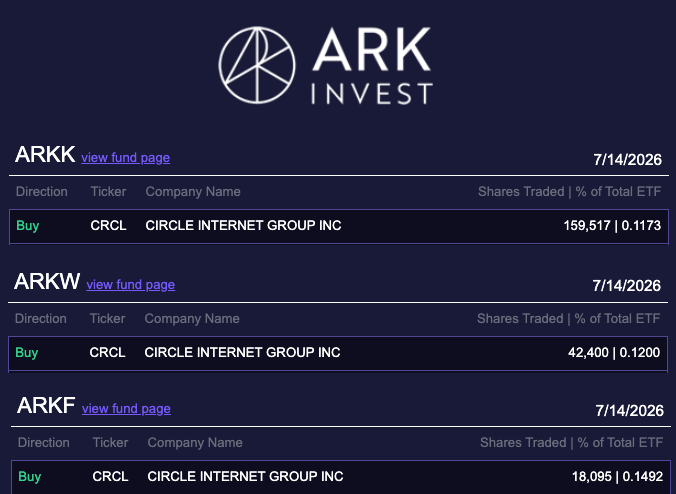
Cathie Wood’s ARK Investment Management has significantly increased its exposure to Circle Internet Group (CRCL), the issuer of the USDC stablecoin, signaling a robust vote of confidence in the company’s long-term value despite a period of pronounced stock price underperformance and shifting analyst sentiment. According to the firm’s daily trade disclosure for Tuesday, ARK Invest acquired an additional 220,000 shares of Circle across three of its flagship actively managed exchange-traded funds (ETFs). This move comes at a critical juncture for the digital asset infrastructure provider, as it navigates a complex regulatory environment and a competitive stablecoin market.
The latest acquisition, valued at approximately $13.9 million based on Tuesday’s closing price of $63.22 on the New York Stock Exchange, marks the continuation of an aggressive accumulation strategy that has characterized ARK’s activity throughout the month of July. As the stock remains under significant pressure—trading roughly 22% lower year-to-date and 76% below its post-initial public offering (IPO) peak—Wood’s firm appears to be leveraging the price correction to lower its average cost basis and cement Circle’s position as a cornerstone of its fintech and innovation portfolios.
A Detailed Chronology of ARK’s July Accumulation
The July 2024 trading activity reveals a calculated effort by ARK Invest to bolster its position in Circle Internet Group. The Tuesday purchase of 220,000 shares follows two other substantial buys earlier in the month. On July 1, ARK disclosed the purchase of 287,609 shares, followed by a subsequent buy of 217,896 shares on July 9. In total, ARK has added 725,517 shares of Circle to its holdings within the first three weeks of the month.
These acquisitions have been distributed across ARK’s diverse fund offerings, most notably the ARK Innovation ETF (ARKK) and the ARK Fintech Innovation ETF (ARKF). The persistence of these buys, even as the stock price struggled to find a floor, underscores a fundamental divergence between ARK’s internal valuation models and the current market sentiment. For Cathie Wood, whose investment philosophy centers on "disruptive innovation," the decline in Circle’s share price likely represents a temporary disconnect between market price and intrinsic value rather than a structural failure of the company’s business model.
As of the latest reporting period, Circle has ascended to a prominent position within the ARK ecosystem. In the ARK Fintech Innovation ETF (ARKF), Circle now accounts for 4.37% of the total fund weight, making it the seventh-largest holding with a valuation of approximately $33 million. In the broader ARK Innovation ETF (ARKK), Circle represents .35% of the portfolio, ranking as the ninth-largest holding with a market value of roughly $218 million.
The Divergent Path of Circle Stock and USDC Market Performance
The aggressive buying from ARK Invest stands in stark contrast to the performance of Circle’s stock on the public markets. Since its transition to a public entity, Circle Internet Group has faced a volatile trajectory. The 76% decline from its peak reflects broader concerns regarding the profitability of stablecoin issuers in a fluctuating interest rate environment and the competitive pressures from other dollar-pegged assets.

Circle’s primary product, USDC, is the second-largest stablecoin by market capitalization, trailing only Tether (USDT). However, USDC’s market cap has seen a slight contraction of 3% year-to-date, settling at approximately $73 billion. While this figure is 17% higher than it was one year ago, indicating long-term growth, the recent stagnation has raised questions among analysts.
The stablecoin landscape is currently bifurcated. Data suggests that while Tether continues to dominate the global payments and remittance sectors—particularly in emerging markets—USDC has carved out a dominant niche within the decentralized finance (DeFi) ecosystem and among institutional users who prioritize regulatory transparency and audits. This institutional focus is a key pillar of ARK’s investment thesis, as the firm views the professionalization of the crypto industry as an inevitable trend that will favor compliant domestic issuers like Circle.
Analyst Skepticism and the "Fundamentals" Debate
The recent round of purchases by ARK Invest occurred as professional analysts began to sour on Circle’s immediate prospects. 10x Research, a prominent digital asset research platform, recently updated its outlook on CRCL, stating that it no longer considers the stock a "buy." The research firm noted that while it previously viewed the stock as attractive below the $80 threshold, the "fundamentals have meaningfully deteriorated" in recent months.
The primary concerns cited by 10x Research include a decline in active addresses utilizing USDC and a general slowdown in network activity. In the world of digital assets, network effects and velocity of use are often seen as leading indicators of a company’s revenue-generating potential. If fewer users are transacting with USDC, the demand for Circle’s infrastructure services could theoretically wane.
Furthermore, 10x Research characterized the current price action as a "survival test." The report suggested that the recent decline could either be a precursor to a prolonged downturn or a "generational buying opportunity" for those with a high risk tolerance. ARK Invest clearly falls into the latter camp, betting that the infrastructure Circle has built for the digital dollar will become indispensable as the traditional financial system integrates with blockchain technology.
Regulatory Milestones and Institutional Validation
Despite the stock’s lackluster performance, Circle has achieved several significant regulatory milestones that provide a counter-narrative to the bearish outlook. Recently, Circle received final approval for a U.S. national trust bank charter from the Office of the Comptroller of the Currency (OCC). This is a landmark achievement, as it places Circle under the direct supervision of federal banking regulators, potentially easing the path for deeper integration with traditional banking rails.
Additionally, Circle became the first global stablecoin issuer to comply with the European Union’s Markets in Crypto-Assets (MiCA) regulation. By securing an Electronic Money Institution (EMI) license in France, Circle has positioned USDC as a compliant asset for the European market, a move that could provide a significant competitive advantage over non-compliant rivals as European authorities begin to enforce stricter digital asset standards.
These regulatory wins are often overlooked by short-term price action but are central to ARK’s long-term strategy. Cathie Wood has frequently argued that the "winner-take-most" dynamics of the digital age favor companies that are the first to achieve regulatory clarity and institutional trust. From ARK’s perspective, Circle’s compliance-first approach creates a "moat" that will eventually be reflected in its valuation.
Implications for the Fintech Sector and the Future of Money
ARK Invest’s doubling down on Circle is more than just a bet on a single company; it is a bet on the future of the global financial architecture. Stablecoins like USDC serve as the bridge between legacy fiat currencies and the programmable nature of blockchain technology. As more financial institutions explore the tokenization of real-world assets (RWA), the need for a stable, regulated medium of exchange becomes paramount.
Circle’s business model is also highly sensitive to interest rates. A significant portion of the company’s revenue is derived from the interest earned on the cash and short-term U.S. Treasuries that back USDC. In a high-interest-rate environment, Circle generates substantial yield on its reserves. However, if the Federal Reserve begins a cycle of rate cuts, Circle may face margin compression, requiring the company to diversify its revenue streams through transaction fees and infrastructure services.
The broader implications of ARK’s investment also touch upon the ongoing competition between the U.S. dollar and other digital currencies. By supporting a U.S.-based, regulated issuer, ARK is effectively betting that the digital dollar—represented by USDC—will maintain its status as the world’s reserve currency in the digital age.
Conclusion: A High-Stakes Bet on Digital Infrastructure
The recent actions of ARK Invest highlight the firm’s willingness to go against the grain of prevailing market trends. While 10x Research and other market participants express caution regarding Circle’s declining activity and stock price, Cathie Wood is positioning her funds to benefit from what she perceives as a foundational shift in how money moves across the globe.
The $13.9 million purchase on Tuesday, bringing the July total to over 725,000 shares, reflects a high-conviction play on the institutionalization of crypto. Whether Circle can overcome the current "survival test" and regain its post-IPO momentum remains to be seen. However, with its recent regulatory victories and the continued backing of one of the world’s most famous innovation investors, Circle Internet Group remains a pivotal player in the evolving landscape of fintech and digital finance. For now, the market remains divided, with the stock price acting as a real-time barometer for the tension between short-term fundamental concerns and long-term visionary optimism.