James Watt
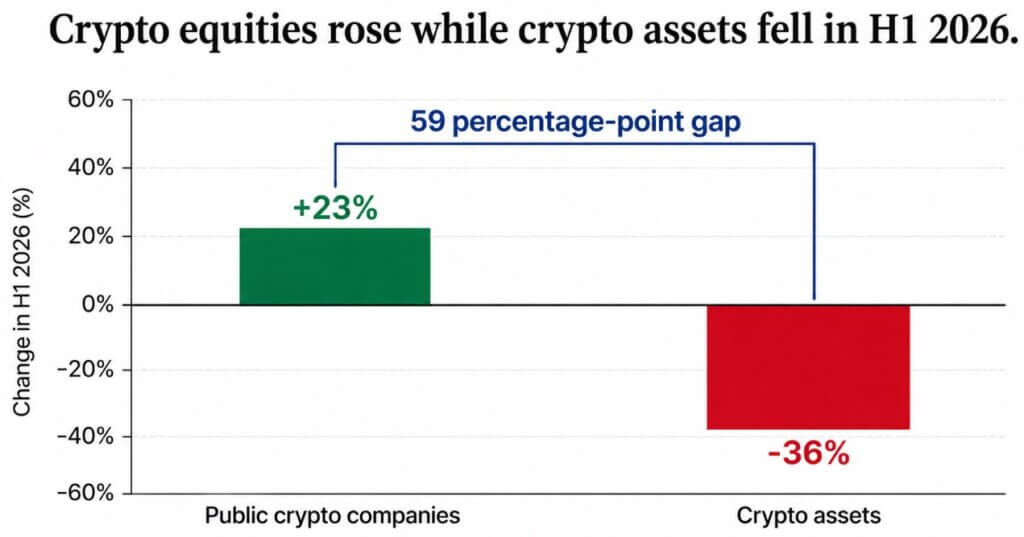
The digital asset landscape underwent a significant structural transformation during the first half of 2026, characterized by a historic divergence between the performance of publicly traded cryptocurrency companies and the underlying digital tokens they support. According to a comprehensive market report released by Bitwise, crypto-related equities surged by 23% during the first six months of the year, even as the broader crypto asset market experienced a sharp 36% decline. This 59-percentage-point gap represents the widest performance disparity in the industry’s history, signaling a potential decoupling of corporate profitability from speculative token valuations.
The data suggests that institutional and retail equity investors may be pricing in a long-term recovery that surpasses current token trading levels. Alternatively, the trend indicates that public companies are successfully capturing the revenue generated by crypto adoption—through transaction fees, interest on reserves, and service-based yields—regardless of whether token prices are rising, falling, or stagnating. As the industry matures, the traditional correlation between Bitcoin’s price and the stock prices of sector leaders is being tested by new revenue streams and diversified business models.
The Statistical Reality of the H1 2026 Divergence
The performance gap identified by Bitwise is rooted in two distinct indices. The Bitwise Crypto Innovators 30 Index, which tracks the largest and most liquid companies in the crypto ecosystem, saw a robust climb, particularly in the second quarter where it gained 30.6%. In contrast, Bitwise’s large-cap crypto index, which monitors the price action of major tokens like Bitcoin and Ethereum, fell 15.4% in the same quarter and 36% across the entire half-year period.
This divergence is a departure from previous market cycles. In 2017 and 2021, crypto equities and tokens generally moved in lockstep. When Bitcoin rallied, exchange volumes increased, miners expanded their operations, and venture capital flooded the sector, lifting the valuations of all participants. However, the first half of 2026 has demonstrated that the "infrastructure" of the crypto economy is now capable of generating significant wealth even during periods of asset-price depression.
The "equity basket" driving this 23% gain includes a diverse range of companies. Among the top holdings in Bitwise’s crypto-equity theme (BITQ) are Coinbase, MicroStrategy, IREN, BitMine, Marathon Digital (MARA), Galaxy Digital, Figure, Cipher Mining, Hut 8, and Riot Platforms. This mix includes fee-based platforms, Bitcoin treasury-holding companies, and industrial-scale miners. While some of these valuations remain sensitive to Bitcoin’s price, the aggregate gain suggests that investors are valuing these firms based on their operational resilience and diversified income rather than simple exposure to token volatility.
The Stablecoin Sector: A Case Study in Yield-Driven Revenue
The clearest evidence of the disconnect between token prices and corporate revenue can be found in the stablecoin sector. Data from DeFiLlama indicates that the total stablecoin market capitalization approached $310 billion in the first half of 2026. While these assets are designed to remain pegged to the US dollar and do not offer capital appreciation to holders, the companies issuing them have become some of the most profitable entities in the financial world.
Tether reported 30-day revenue of approximately $482 million, while its primary competitor, Circle, generated roughly $193 million in the same period. This income is primarily derived from the yield on the high-quality liquid assets—such as US Treasury bills—that back the tokens. Circle’s recent financial disclosures revealed $653 million in reserve income for the last quarter, representing a 17% increase year-over-year. Furthermore, Circle recently received final approval from the Office of the Comptroller of the Currency (OCC) to operate a national trust bank, a move that further integrates the company into the traditional federal banking system.

This revenue model is immune to the price fluctuations of Bitcoin or Ethereum. As long as there is demand for "dollar-on-a-chain" for payments, remittances, or decentralized finance (DeFi) liquidity, these issuers continue to accrue interest on their massive reserve holdings. This "dollar plumbing" aspect of the industry treats crypto as a technology stack for value transfer rather than a speculative asset class.
Institutional Diversification: From Mining to AI Data Centers
Another factor contributing to the equity-token gap is the aggressive diversification of Bitcoin mining firms. Facing reduced block rewards and fluctuating token prices, several major miners have pivoted toward High-Performance Computing (HPC) and Artificial Intelligence (AI) infrastructure.
TeraWulf serves as the most prominent example of this shift. In the first half of 2026, the company signed a landmark 20-year data-center lease with the AI firm Anthropic. The deal is estimated to be worth $19 billion in contracted revenue. This agreement provides TeraWulf with a massive, stable income stream that is entirely independent of Bitcoin’s market recovery. By leveraging their access to low-cost power and existing electrical infrastructure, miners are transforming into essential providers for the AI revolution.
Other miners, including IREN and Riot, have similarly expanded their "compute-as-a-service" offerings. This transition has allowed their stock prices to benefit from the broader AI investment boom, shielding shareholders from the 36% drawdown seen in the underlying crypto assets they continue to mine.
Exchange Resilience and the Rise of Prediction Markets
Publicly traded exchanges and brokerage firms have also shown remarkable adaptability. Coinbase, the leading US-based exchange, reported that its retail derivatives revenue surpassed an annualized rate of $200 million in the first quarter of 2026. Additionally, its newly launched prediction market business reached $100 million in annualized revenue within just two months of its US debut.
Robinhood’s financial results further illustrate this trend. The company’s total net revenue grew 15% year-over-year to $1.07 billion in the first quarter, despite a 47% collapse in crypto transaction revenue, which fell to $134 million. The decline in crypto trading was more than offset by record volumes in options, equities, and "event contracts." Robinhood customers traded a record 8.8 billion event contracts during the quarter, highlighting a shift in user behavior toward prediction markets and structured financial products.
The emergence of prediction markets as a major volume driver—reaching $43.2 billion in quarterly volume—suggests that users are increasingly interested in utilizing crypto rails for betting on real-world outcomes (e.g., elections, economic data, sports) rather than simply holding tokens for appreciation.
Official Responses and Macroeconomic Integration
The growing importance of the crypto industry’s infrastructure has not gone unnoticed by federal regulators and international financial institutions. In June 2026, US Treasury Secretary Scott Bessent stated that stablecoins, tokenization, and modern payment systems "will shape the future of money." Bessent’s comments reflect a policy shift that views blockchain technology as a critical component of national financial infrastructure rather than a peripheral speculative market.
The European Central Bank (ECB) has also contributed research highlighting the systemic importance of the sector. A study cited by the ECB found that a $3.5 billion inflow into dollar-backed stablecoins can lower three-month US Treasury bill yields by approximately 2.5 to 3.5 basis points. This finding provides concrete evidence that the growth of crypto equities and their associated products is now exerting tangible influence on traditional interest rate markets.
Value Capture Mechanisms: Tokens vs. Equity
The Bitwise report raises a fundamental question for investors: Do tokens possess the necessary mechanisms to capture the value generated by network activity?
While public companies capture revenue for their shareholders through dividends, buybacks, and capital expenditures, many protocol tokens lack a direct link to the underlying business’s success. There are notable exceptions, however. Ethereum continues to utilize a "burn" mechanism, where a portion of every transaction fee is removed from the total supply, theoretically tying network usage to token scarcity. Similarly, the Hyperliquid protocol routes the majority of its fees into a fund dedicated to buying back its native token.
For most other assets, the connection is more tenuous. Stablecoin holders do not receive a share of the reserve interest, and many exchange-based tokens do not grant a claim on the company’s corporate earnings. As usage of the technology expands—evidenced by tokenized real-world assets (RWA) climbing toward $33 billion—the profits are increasingly staying at the corporate level.
Implications for the Second Half of 2026
The resolution of this 59-point gap remains the primary focus for market analysts heading into the second half of the year. Bitwise outlines three potential scenarios for how this divergence might conclude:
- The Token Catch-Up: If risk appetite returns to the broader market and inflows into spot Bitcoin and Ethereum ETFs improve, DeFi and application-layer revenue could begin to translate into token price appreciation. This would validate the "old adoption thesis" that network growth eventually benefits the asset holder.
- Structural Disconnect: If stablecoins, exchanges, and AI-linked miners continue to expand while tokens remain weak, the gap could persist or even widen. This would signal that crypto has succeeded as an industrial technology while failing as a speculative investment class for many of its native assets.
- Partial Convergence: A moderate recovery in major assets like Bitcoin could narrow the gap, though the structural advantages held by diversified public companies may prevent a full return to the high correlations seen in previous years.
The first half of 2026 has proven that the cryptocurrency industry is capable of building robust, multi-billion-dollar businesses that can thrive in a "crypto winter" for asset prices. The open question for the remainder of the year is whether the tokens themselves carry the necessary economic architecture to participate in that success, or if the industry has perfected a model that keeps the profits for the companies and leaves the assets on the sidelines.