admin
admin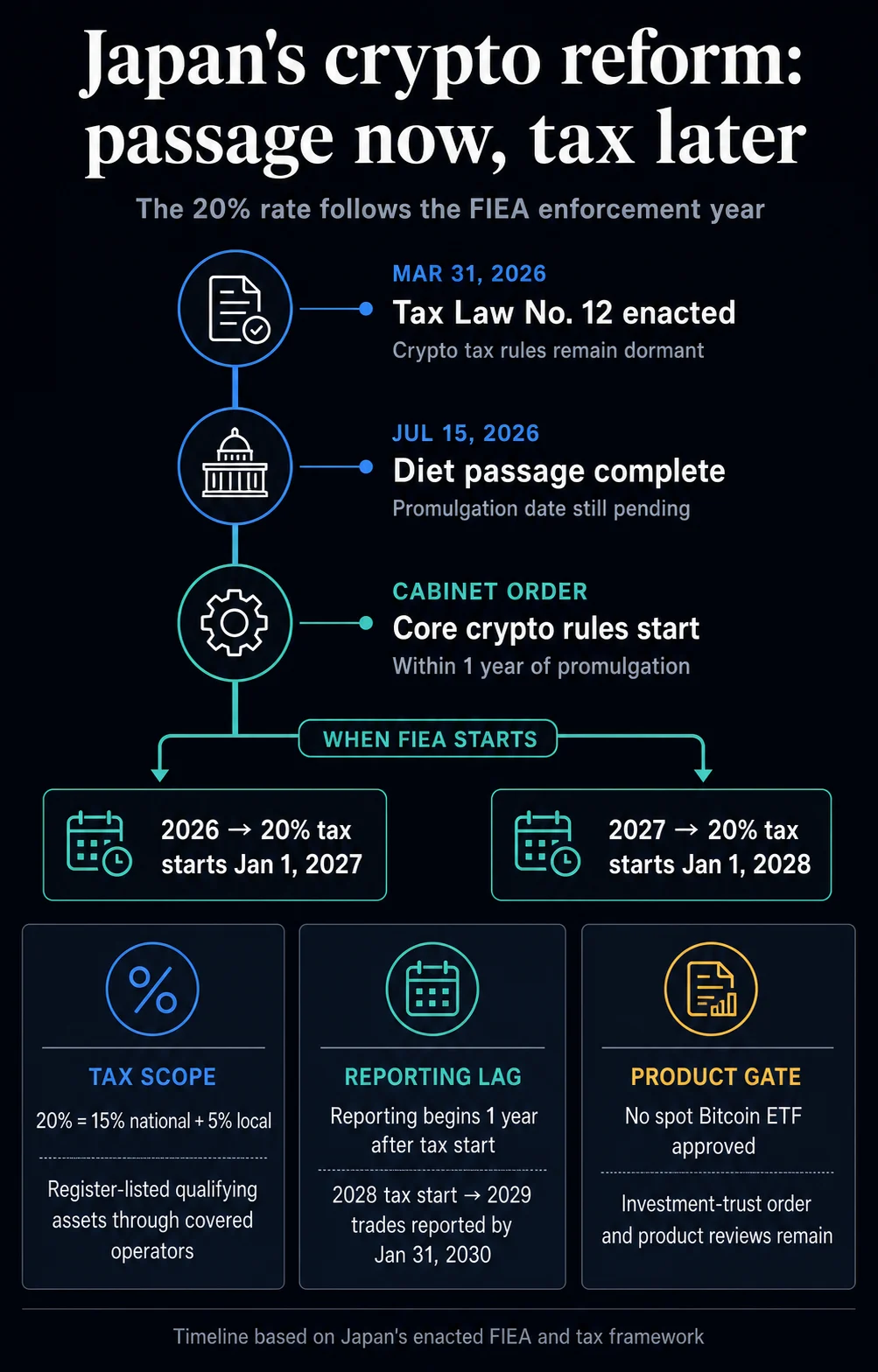
Japan’s House of Councilors has given its final approval to Cabinet Bill 57, a pivotal piece of legislation that will integrate regulated cryptocurrency activities into the nation’s stringent Financial Instruments and Exchange Act (FIEA). This move marks a significant step in Japan’s journey to establish a comprehensive and robust framework for the digital asset industry. While the legal scaffolding is now in place, the full benefits, particularly the much-anticipated 20% tax rate for eligible crypto gains, may not be fully realized until 2027 or even 2028, contingent on the timing of enforcement and subsequent regulatory actions.
The core provisions of this new legal framework are set to take effect on a date determined by a Cabinet order, which must be issued within one year of the law’s promulgation. If the Cabinet opts for enforcement during 2026, the new tax rules would commence on January 1, 2027. Conversely, if enforcement is delayed until 2027, the tax implications would begin on January 1, 2028. This decision rests solely with the Cabinet, underscoring the executive branch’s crucial role in shaping the immediate future of Japan’s crypto landscape.
Transitioning Crypto Under the Financial Instruments and Exchange Act
The fundamental shift brought about by this legislation is the relocation of regulated crypto activities from the Payment Services Act to the FIEA. This reclassification means that while cryptocurrencies will retain their distinct legal status separate from traditional securities, the operational and compliance standards for exchanges and intermediaries will now mirror those applied to the securities market. This move is widely seen as an effort to enhance investor protection, promote market integrity, and foster greater confidence in the burgeoning digital asset sector.
According to explanatory materials released by the Financial Services Agency (FSA), the new framework mandates enhanced disclosure and registration requirements for a range of activities. This includes crypto sales, token offerings controlled by issuers, and borrowing activities. Furthermore, stringent protocols will be implemented for asset screening, custody services, customer safeguards, and measures to prevent insider trading. These provisions aim to create a more transparent and secure environment for both businesses operating in the space and the consumers engaging with digital assets.
Exchanges and other crypto-related businesses can begin aligning their operations with these impending requirements. The detailed operational guidelines and specific duties will be further elaborated through subsequent Cabinet orders and FSA ordinances, providing a more granular roadmap for compliance. The FSA’s proactive approach in issuing such guidance is crucial for ensuring a smooth transition and minimizing disruptions to the market.
The Road to a 20% Tax Rate: A Phased Implementation
The tax implications of this reform have been a focal point for traders and investors. Japan’s parliament has already enacted the necessary tax amendments, but these provisions remain dormant until the FIEA trigger is satisfied. The fiscal year 2026 tax amendments, designated as Law No. 12, were passed and promulgated on March 31. Once activated, qualifying gains from cryptocurrency transactions are slated to be taxed at a combined rate of 20%, comprising a 15% national income tax and a 5% local inhabitant tax.

However, this favorable 20% rate is not universally applicable. It will only come into effect when investors sell eligible tokens through registered crypto businesses, and importantly, when these assets are officially listed on Japan’s designated register. This stipulation suggests a curated approach to taxation, potentially incentivizing participation in regulated channels and discouraging over-the-counter or unregistered transactions.
A significant benefit for traders is the provision for carrying forward unused losses within the same tax-defined crypto category. These losses can be carried forward for up to three years, subject to specific conditions. This measure aims to mitigate the inherent volatility of the crypto market and provide a more equitable tax treatment for investors who experience fluctuating returns. It is a departure from previous tax regimes where crypto gains were often treated as miscellaneous income, subject to higher marginal rates.
Transactions, tokens, and venues that fall outside this newly defined channel will continue to be subject to existing tax treatments, maintaining a distinction between regulated and unregulated crypto activities.
Reporting Requirements and Future Tax Obligations
The reporting obligations under the new regime are scheduled to commence a year after the tax-and-loss rules become active. As outlined by the Ministry of Finance’s framework, businesses will be required to furnish tax authorities with essential information, including customer identities, Japan’s unique My Number identifier, and detailed transaction data. This reporting must be submitted by January 31st of the year following the trading year.
For instance, if the 20% tax regime begins in 2028, the reporting requirements would encompass transactions conducted in 2029, with the initial reports due by January 31, 2030. This phased approach to reporting allows businesses and individuals time to adapt to the new data collection and submission protocols. The objective is to enhance transparency and facilitate more accurate tax collection by the authorities.
Paving the Way for Crypto Investment Products
Beyond trading and taxation, the reform package also lays the groundwork for the potential introduction of crypto investment products. The legislation brings crypto investment management and advisory services under the purview of the FIEA. Crucially, it anticipates the establishment of investment trusts that hold tax-qualifying, registered crypto assets. This development could open doors for more traditional financial products to incorporate digital assets.
However, this aspect of the reform is not yet fully realized. The treatment of crypto investment products will necessitate a separate amendment to the enforcement order of the Investment Trusts Act. This indicates that further regulatory steps are required before such products can be widely available.

It is important to note that the current legislative text does not explicitly mention spot Bitcoin ETFs, nor does it grant immediate approval for any specific crypto investment products. The FSA clarified in October 2025 that the creation and sale of domestic crypto ETFs were prohibited under the previous regulatory framework. Sponsors seeking to launch such products will still need to navigate applicable product and listing reviews once the new regulatory routes are clearly defined and implemented. This process may involve extensive due diligence and adherence to strict listing standards, similar to those for traditional ETFs.
A Look at the Timeline and Key Dependencies
The precise implementation dates for these significant changes hinge on several critical junctures. The official enactment of the law is the first step. Following this, the Cabinet’s decision on the FIEA enforcement date will be a major determinant. Subsequently, the FSA’s completion of the detailed rules and ordinances will be essential. Once these administrative processes are concluded, the 20% tax rate would then take effect from the commencement of the following tax year.
The initial passage of this bill by the House of Councilors on July 15 represents a substantial leap forward. The law’s journey through the Japanese legislative system, from initial proposals to final approval, reflects a growing recognition of the importance of digital assets within the global financial ecosystem. The government’s intention appears to be a measured and controlled integration, prioritizing stability and investor protection while fostering innovation.
Broader Implications for Japan’s Financial Sector
The integration of crypto under the FIEA is expected to have far-reaching implications for Japan’s financial sector. By aligning crypto regulation with existing securities laws, Japan aims to attract legitimate institutional investment and foster a more mature market. This could lead to increased capital inflows, technological advancements, and the development of new financial services.
Furthermore, the clear regulatory framework is likely to boost consumer confidence. As investors gain greater assurance regarding the safety and legitimacy of crypto platforms and assets, participation in the market is expected to grow. This, in turn, could stimulate broader economic activity and contribute to Japan’s digital transformation goals.
The move also positions Japan as a potentially leading jurisdiction in the Asia-Pacific region for regulated digital asset activities. As other countries continue to grapple with establishing comprehensive crypto regulations, Japan’s proactive approach could set a precedent and attract businesses seeking a stable and predictable regulatory environment. The commitment to a 20% tax rate, while conditional, also signals an effort to balance revenue generation with the desire to make Japan an attractive destination for crypto investment and innovation.
The successful implementation of these reforms will be closely watched by global regulators and industry participants alike. Japan’s experience will offer valuable insights into how established financial markets can effectively integrate and regulate nascent digital asset technologies, paving the way for a more secure and prosperous future for both traditional and decentralized finance.