admin
admin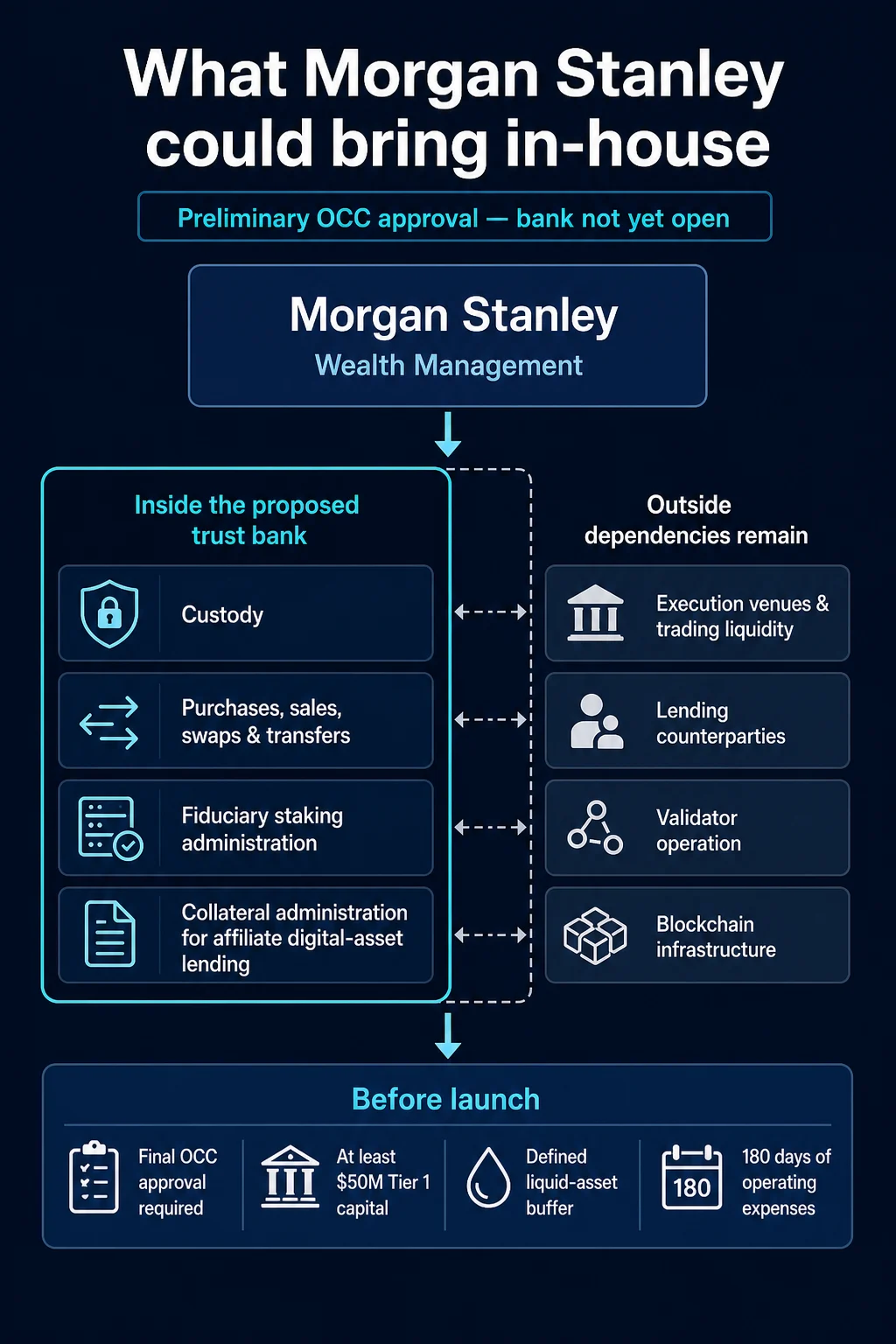
In a significant development poised to reshape the institutional digital asset landscape, Morgan Stanley has received preliminary conditional approval from the Office of the Comptroller of the Currency (OCC) to establish a national trust bank dedicated to digital assets. This landmark decision, made in June, paves the way for Morgan Stanley Digital Trust to internalize critical cryptocurrency functions, including custody, transaction administration, fiduciary staking, and collateral support for lending activities. This move signals a strategic pivot for the Wall Street giant, aiming to bring a comprehensive suite of digital asset services directly under its regulated umbrella, potentially impacting the role of specialized third-party providers in the ecosystem.
The OCC’s Conditional Approval: A New Era for Institutional Digital Assets
The OCC’s conditional approval, detailed in a decision document, grants Morgan Stanley a regulated framework to manage a broad spectrum of digital asset operations. The proposed subsidiary, Morgan Stanley Digital Trust, is envisioned as a wholly-owned national trust bank. This structure allows the firm to offer services that have traditionally been outsourced to specialist cryptocurrency intermediaries. The filing with the OCC categorizes this initiative as a request for a new bank charter under a holding company, underscoring the seriousness and regulatory scrutiny accompanying this endeavor.
The scope of services outlined in the application is extensive, encompassing the safeguarding of digital assets, the administration of purchases, sales, swaps, and transfers, as well as fiduciary staking and collateral management. This latter function is particularly noteworthy as it directly supports affiliate digital asset lending, suggesting an integrated approach to both the front-end and back-end of crypto-based financial products. By bringing these capabilities in-house, Morgan Stanley aims to enhance control, potentially improve operational efficiency, and deepen its client relationships within the burgeoning digital asset space.
A Timeline of Key Milestones
The journey toward this significant approval began with Morgan Stanley’s strategic evaluation of the evolving digital asset market and its potential to serve its sophisticated client base. While the exact initial internal discussions remain private, the public application process with the OCC marks a critical phase.

- Early 2026 (Estimated): Morgan Stanley likely began its internal strategic planning and initial outreach to regulatory bodies, including the OCC, to understand the feasibility and requirements for establishing a digital asset trust bank. This phase would involve extensive legal, compliance, and operational assessments.
- Q1 2026 (Estimated): Formal application submission to the OCC. This would have been a meticulously prepared document detailing the proposed structure, services, risk management protocols, capital requirements, and operational plans for Morgan Stanley Digital Trust.
- June 18, 2026: The OCC officially lists the charter action as approved in its application record. This date signifies the granting of preliminary conditional approval, subject to the fulfillment of specific requirements. The Corporate Decision 1378, referenced in the OCC’s documentation, lays out these conditions.
- Present (July 15, 2026): The news breaks, detailing the implications of the OCC’s conditional approval and the potential impact on the broader cryptocurrency industry. Morgan Stanley now enters a phase of meeting the stringent conditions set forth by the OCC before full operationalization.
Key Functions to be Internalized by Morgan Stanley Digital Trust
The OCC filing provides a clear delineation of the functions Morgan Stanley intends to bring under the purview of its new trust bank:
- Custody: The secure storage and safeguarding of clients’ digital assets. This is a foundational service for any institutional player in the crypto space, requiring robust security protocols and regulatory compliance.
- Transaction Administration: Managing the day-to-day operations related to client transactions, including purchases, sales, swaps, and transfers of digital assets. This involves the seamless execution and record-keeping of all asset movements.
- Fiduciary Staking: Engaging in staking activities on behalf of clients in a fiduciary capacity. This allows clients to earn rewards from proof-of-stake networks while entrusting the operational complexities to Morgan Stanley.
- Collateral Support for Affiliate Lending: Providing the necessary collateral management services to support lending activities within the Morgan Stanley group that involve digital assets. This integration suggests a sophisticated approach to leveraging digital assets for credit facilities.
Supporting Data and Regulatory Framework
The OCC’s oversight is crucial for building trust and stability in the digital asset market. The requirements for Morgan Stanley Digital Trust underscore the high standards expected of such an institution.
- Minimum Tier 1 Capital: Morgan Stanley Digital Trust must maintain at least $50 million in Tier 1 capital. This is a substantial amount, reflecting the significant financial commitment and regulatory buffer required for a national trust bank. Tier 1 capital is a measure of a bank’s financial strength, including common stock and disclosed reserves.
- Liquid Assets: The bank needs to hold a set pool of liquid assets, ensuring it can meet its short-term obligations and manage market volatility effectively.
- Liquidity Coverage: Sufficient liquidity must be available to cover 180 days of operating costs. This stringent requirement ensures the bank can withstand prolonged periods of operational stress without jeopardizing its solvency or its clients’ assets.
- National Trust Bank Charter: Obtaining a national trust bank charter from the OCC provides a robust and federally recognized regulatory framework, distinct from state-level charters. This often implies a higher level of scrutiny and compliance but also grants broader operational authority across states.
The OCC’s role as a prudential regulator for national banks and federal savings associations means it meticulously reviews applications to ensure they meet rigorous safety and soundness standards, consumer protection mandates, and compliance with anti-money laundering (AML) and Bank Secrecy Act (BSA) regulations. For digital assets, this includes ensuring that the proposed infrastructure and operational procedures adequately address the unique risks associated with blockchain technology, such as cybersecurity, private key management, and transaction finality.
Implications for Third-Party Providers and the Broader Market
Morgan Stanley’s strategic move to internalize these functions is likely to exert considerable pressure on existing third-party crypto custodians, staking administrators, and collateral service providers. These entities have historically filled the gap for traditional financial institutions seeking to engage with digital assets.
- Increased Competition: The entry of a global financial titan like Morgan Stanley into these service areas will intensify competition. Specialized providers will need to differentiate themselves through superior technology, niche expertise, or highly competitive pricing.
- Consolidation Potential: Smaller or less specialized firms may find it challenging to compete with the scale, capital, and established client base of Morgan Stanley. This could lead to a wave of consolidation within the crypto infrastructure sector.
- Focus on Niche Services: Third-party providers might increasingly focus on highly specialized services that Morgan Stanley’s trust bank does not cover, or on catering to clients with different risk appetites or regulatory needs.
- Client Relationship Shift: By bringing core functions in-house, Morgan Stanley can consolidate the client relationship, offering a more integrated and potentially seamless experience. This could reduce the number of intermediaries involved in a client’s digital asset activities, simplifying operations and potentially lowering costs for the end-user, while also capturing more of the value chain.
External Infrastructure Remains Crucial
Despite the ambition to internalize key functions, the OCC filing implicitly acknowledges that several critical layers of the digital asset ecosystem will remain external to Morgan Stanley’s direct control. These include:

- Execution Venues and Trading Liquidity: Access to robust and liquid trading platforms remains paramount for executing client orders efficiently. Morgan Stanley will likely continue to rely on external exchanges and liquidity providers for this crucial function.
- Lending Counterparties: While collateral support for lending might be managed internally, the actual lending counterparties and the broader credit markets for digital assets will still involve external entities.
- Validator Operations: For staking services, the underlying validator infrastructure and network participation will still require engagement with external node operators and blockchain protocols.
- Broader Blockchain Infrastructure: The fundamental technology underpinning digital assets – the blockchains themselves – along with network security, consensus mechanisms, and ongoing development, are inherently external and require ongoing adaptation and interaction with the broader crypto ecosystem.
These external dependencies highlight that while Morgan Stanley is building a comprehensive in-house capability, it will still operate within the broader, decentralized framework of the cryptocurrency world. The success of Morgan Stanley Digital Trust will depend not only on its internal capabilities but also on its ability to navigate and leverage these external components effectively and securely.
Looking Ahead: A New Benchmark for Institutional Crypto Services
The conditional approval granted by the OCC to Morgan Stanley represents a significant milestone in the maturation of the institutional cryptocurrency market. It signals a clear regulatory pathway for traditional financial institutions to engage more deeply with digital assets. The stringent capital and liquidity requirements underscore the OCC’s commitment to ensuring the stability and integrity of the financial system as it incorporates new asset classes.
As Morgan Stanley Digital Trust moves towards final approval and operationalization, its success will be closely watched by regulators, competitors, and the broader financial industry. This development could set a new benchmark for how major financial institutions offer digital asset services, potentially accelerating mainstream adoption while simultaneously reshaping the competitive landscape for existing crypto-native service providers. The ability of these external firms to demonstrate continued value proposition will be critical in an environment where a global banking leader is increasingly bringing core functions under its own roof.