James Watt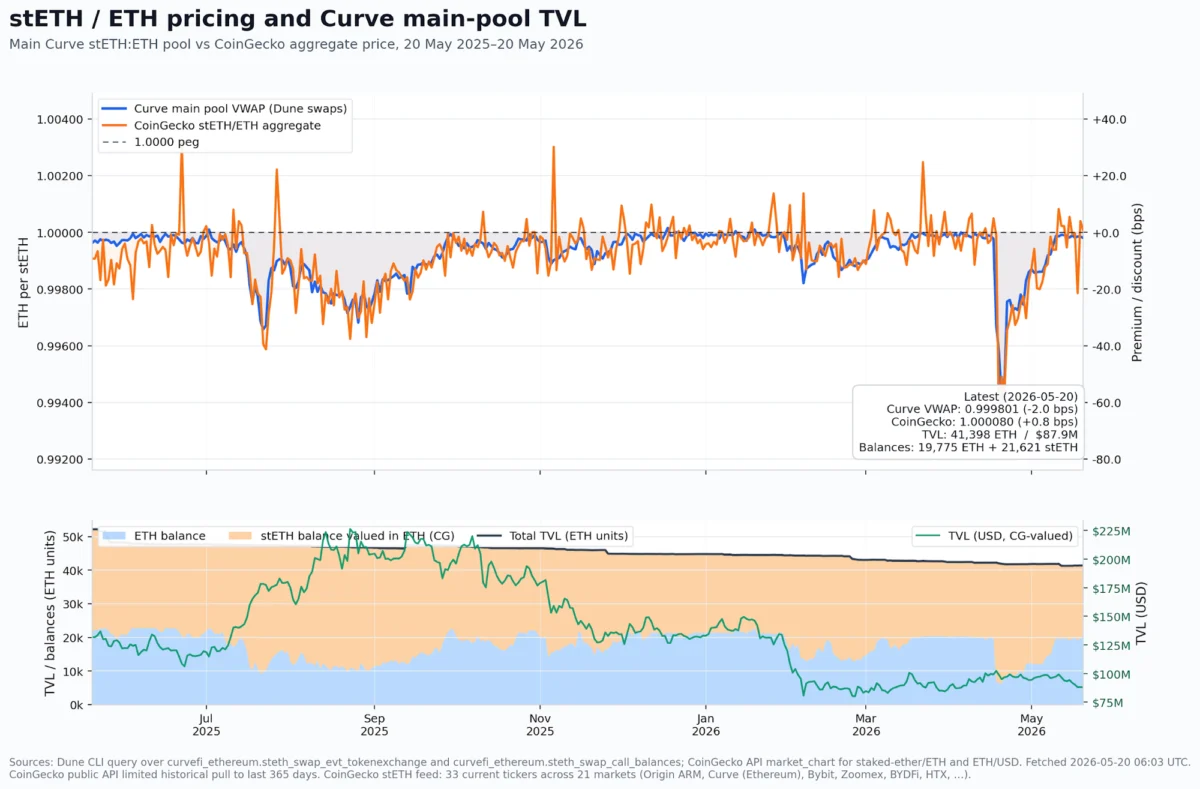
The digital asset landscape witnessed a significant stress test in April 2026, when a major exploit targeting KelpDAO’s rsETH, a restaked Ethereum derivative, sent ripples through the decentralized finance (DeFi) ecosystem. This incident, centered on a critical cross-chain bridge vulnerability, underscored the inherent risks within interconnected protocols but also provided a crucial demonstration of resilience for foundational assets like stETH and wstETH. While the exploit impacted specific restaking and ETH-denominated lending markets, data analysis reveals that stETH and its wrapped counterpart maintained functional and resilient market depth, proving their robustness even under severe external pressure. This article delves into the specifics of the KelpDAO incident, its immediate market effects, and the steadfast performance of stETH liquidity, offering a journalistic account of a pivotal moment in DeFi’s ongoing maturation.
The KelpDAO Incident: A Cross-Chain Vulnerability Unveiled
On April 18, 2026, the DeFi community was alerted to a critical security breach affecting KelpDAO, a prominent restaking protocol. The exploit specifically targeted the LayerZero-based bridge path for KelpDAO’s rsETH token, a liquid restaking token designed to represent staked ETH and its accumulated rewards across various restaking protocols. Public post-incident analyses quickly identified the root cause as a sophisticated cross-chain verification failure, where attackers manipulated the bridge to mint approximately 116,500 rsETH tokens on the Ethereum mainnet without a corresponding burn on the source chain. This unauthorized issuance, valued at roughly $292 million at the time, flooded the market and immediately triggered a crisis within the restaking and ETH-denominated lending sectors.
The incident’s nature was critical: it was a direct compromise of KelpDAO’s specific implementation of a LayerZero bridge, not a general vulnerability in LayerZero’s core technology or a flaw within Ethereum’s foundational staking mechanisms. This distinction proved paramount in how the broader market reacted, especially concerning core liquid staking tokens (LSTs) like Lido’s stETH. Restaking, a relatively nascent but rapidly growing sector, allows users to re-hypothecate their staked ETH or LSTs to secure other decentralized networks, promising additional yield but introducing new layers of complexity and risk. The KelpDAO exploit highlighted the amplified systemic risks inherent in such layered financial products, particularly when cross-chain bridges, often critical points of failure, are involved.
Understanding the Ecosystem: stETH, rsETH, and Restaking
To fully grasp the implications of the KelpDAO exploit, it is essential to delineate the roles of the key assets involved. stETH (staked ETH) is Lido Finance’s liquid staking token, representing staked Ether and its daily accruing rewards. It is the largest LST by market capitalization and Total Value Locked (TVL), playing a foundational role across numerous DeFi protocols as collateral, liquidity, and a yield-bearing asset. wstETH, or wrapped stETH, is a non-rebasing version of stETH, making it more compatible with various DeFi applications that prefer a static balance. Lido’s protocol is designed for decentralization and security, with its internal mechanics having consistently functioned as intended, even during periods of high market stress.
rsETH, on the other hand, is a liquid restaking token (LRT) issued by KelpDAO. It represents users’ deposits of ETH, stETH, or other LSTs into KelpDAO’s platform, which are then restaked across multiple AVSs (Actively Validated Services) within the EigenLayer ecosystem. rsETH aims to provide liquidity to illiquid restaked assets, similar to how stETH provides liquidity to staked ETH. The exploit on KelpDAO’s rsETH bridge path thus represented a failure at a higher layer of abstraction within the DeFi stack, affecting a derivative of a derivative, rather than a core asset like stETH directly. This structural difference was key to stETH’s relative stability.
A Detailed Chronology of the Stress Event
The KelpDAO exploit unfolded rapidly, triggering a series of events that tested the resilience of related markets:
- April 18, 2026 – Exploit Discovery and Initial Shock: The exploit was detected early on April 18th, with security firms and on-chain analysts quickly identifying the unauthorized minting of rsETH. News spread rapidly through social media and security alerts, causing immediate panic and a flight to safety across the restaking and broader DeFi lending markets. Protocols exposed to rsETH as collateral faced liquidation risks, and users rushed to de-risk positions.
- April 18 – April 20, 2026 – Market Repricing and Contagion Fears: In the immediate aftermath, a cascade of selling pressure hit assets perceived as having direct or indirect exposure to the exploit. While stETH was not directly compromised, its close association with the broader ETH-denominated lending and restaking ecosystem led to a repricing of risk. The stETH/ETH peg, a crucial indicator of market confidence in liquid staking, began to widen.
- April 20 – April 28, 2026 – The Stress Window and Lido’s Response: This ten-day period marked the peak of market stress. StETH experienced one of the largest periods of net outflows in Lido’s history, as users reacted to the broader market uncertainty. However, Lido’s core protocol mechanics, designed to handle large-scale withdrawals, functioned precisely as intended, processing these outflows without a hitch. This operational stability provided a crucial counter-narrative to the panic, allowing market participants to differentiate between a specific protocol exploit and the fundamental soundness of Lido and stETH.
- April 28 – May 20, 2026 – Gradual Stabilization and Recovery: Following the initial shock and the market’s realization that stETH itself was not compromised, confidence began to return. Selling pressure eased, and the stETH/ETH peg started to narrow. By May 20, less than a month after the exploit, market metrics for stETH had largely normalized, signaling a robust recovery and reaffirming its status as a resilient asset.
Market Impact: stETH Pricing and the Peg’s Resilience
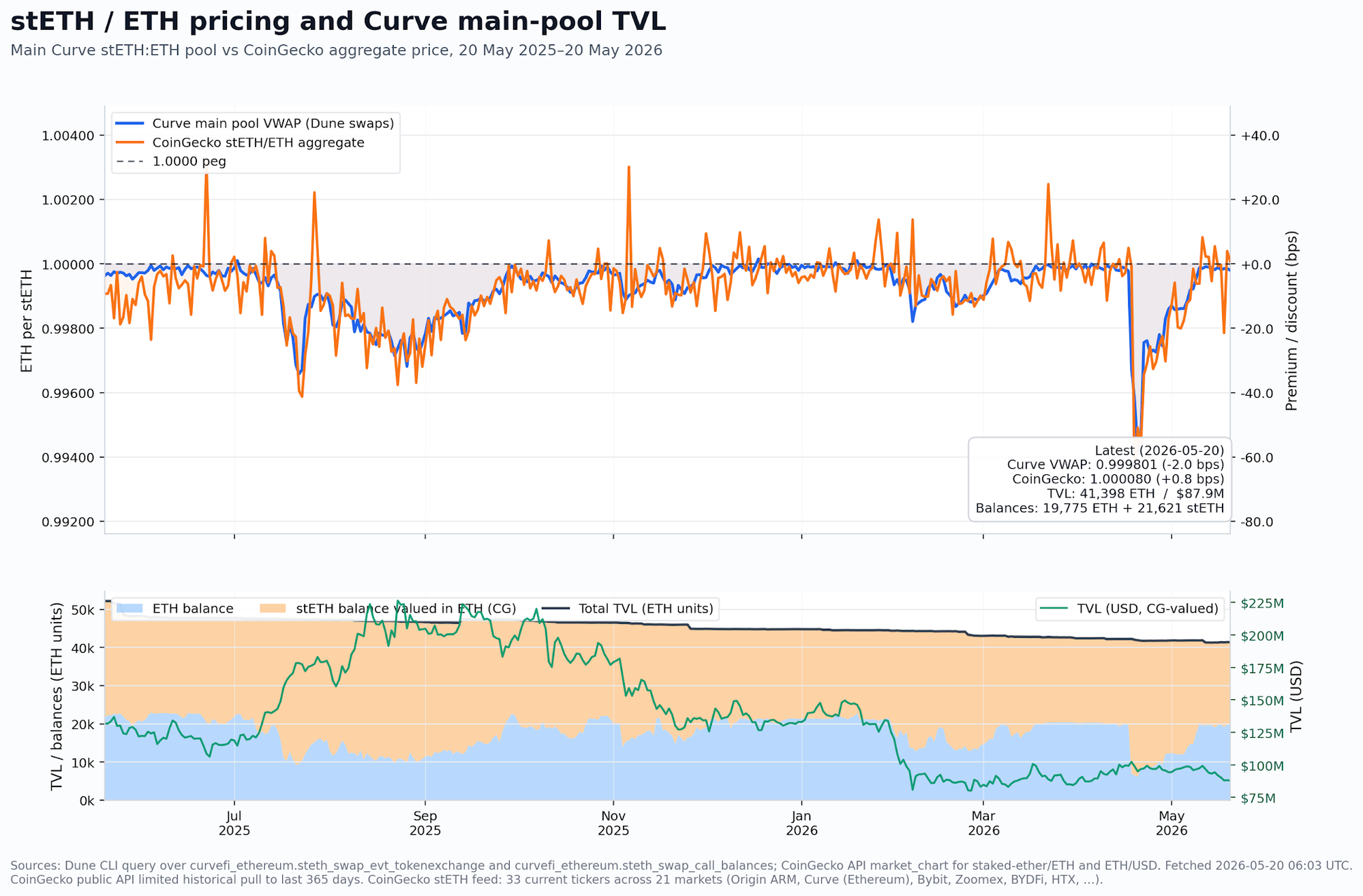
Despite the significant external shock, the stETH/ETH peg demonstrated remarkable resilience, recovering swiftly after an initial dip. During the intense stress window from April 18 to April 28, 2026, the daily Volume-Weighted Average Price (VWAP) for the Curve main pool, a primary liquidity venue for stETH, reached a low of approximately 0.9941 ETH per stETH. This represented a deviation of about -59 basis points (bps) from parity. Concurrently, CoinGecko’s aggregate stETH/ETH pricing registered a comparable low of approximately 0.9934.
While a 59 bps deviation is noteworthy in stablecoin-like pairs, it remained relatively contained given the magnitude of the $292 million exploit and the ensuing market fear. For comparison, previous severe market events or broader crypto downturns have seen stETH de-peg by significantly wider margins, sometimes exceeding 3-5%. The swiftness of the recovery further underscored the market’s underlying confidence. By May 20, just over three weeks post-exploit, the Curve VWAP had nearly returned to parity at 0.99980, with CoinGecko reporting 1.00008, indicating a complete rebound and restoration of market equilibrium. This quick re-pegging demonstrated that market participants were able to accurately assess the localized nature of the KelpDAO exploit and distinguish it from any fundamental issues with stETH.
Deep Dive into Liquidity Depth: Actionable at $1 Million Notional
Beyond headline prices, the true test of an asset’s resilience under stress lies in its liquidity depth – how much capital can be moved without significantly impacting execution quality. A stable price on paper can mask severely deteriorated execution costs if liquidity vanishes. The KelpDAO incident provided a real-world stress test for wstETH/ETH liquidity depth, particularly for large-volume trades.
Prior to the exploit, the median daily quote impact for a $1 million fixed-sell wstETH order on Ethereum mainnet was a mere -0.1 basis points across 236 observations, indicative of exceptionally deep and efficient markets. This meant that a $1 million sale would typically incur a negligible slippage of just $100.
During the 10-day stress window following the exploit, this median quote impact rose to -5.0 bps. More tellingly, the 7-day moving average of this metric reached a trough of -15.9 bps. While this represented a noticeable increase in execution cost – a $1 million sale would now incur approximately $1,590 in slippage – it was far from a disappearance of liquidity. For an external exploit of such scale, directly affecting restaking collateral and the broader lending market, the ability to execute a $1 million trade with a slippage under 0.2% demonstrated remarkable market functionality.
This data indicates that wstETH/ETH execution remained measurable, routable through various decentralized exchanges, and interpretable by market makers and large institutional players. Unlike instances where liquidity dries up entirely, leading to catastrophic slippage or unfillable orders, the wstETH market remained consistently actionable. This capability is paramount for sophisticated participants, ensuring that even in times of crisis, capital can be efficiently reallocated or de-risked.
Why stETH Remained Comparatively Resilient
Several factors contributed to stETH’s ability to weather the KelpDAO storm with relative stability:
- Isolation of the Exploit: The critical distinction that the exploit targeted KelpDAO’s specific rsETH bridge implementation, rather than Lido’s core protocol or stETH directly, was crucial. Market participants quickly understood that stETH itself was not compromised, nor were the underlying ETH stakes managed by Lido.
- Robust Lido Protocol Mechanics: Lido’s protocol functioned flawlessly throughout the crisis, processing one of its largest periods of net outflows without any issues. This operational integrity reinforced trust in the fundamental security and reliability of stETH.
- Deep and Diversified Secondary Markets: Years of strategic liquidity building around stETH, particularly on platforms like Curve Finance, ensured that significant capital pools were available. These deep liquidity venues, coupled with widespread integration across numerous DeFi protocols, provided ample opportunity for traders to buy and sell stETH, even under pressure.
- Transparent On-Chain Pricing: The transparent nature of on-chain pricing for stETH/ETH, readily verifiable by anyone, fostered confidence. There was no ambiguity regarding the true market value, which helped prevent speculative spirals based on opaque or manipulated pricing.
- Market Participant Sophistication: The DeFi market has matured to a point where participants, including institutional players and sophisticated retail investors, possess a greater ability to analyze and differentiate between various types of risk. They could distinguish between a cross-chain restaking asset failure and the core liquidity profile of Ethereum’s largest liquid staking token.
- "Flight to Quality" within LSTs: In times of uncertainty, capital often flows towards perceived safer, more established assets. Within the LST ecosystem, stETH, given its market dominance and proven track record, likely benefited from a "flight to quality" as some investors sought refuge from newer, riskier derivatives like rsETH.
Industry Reactions and Broader Implications
The KelpDAO incident prompted swift reactions and initiated broader discussions across the DeFi ecosystem.
KelpDAO and LayerZero: KelpDAO acknowledged the exploit, initiated a thorough forensic investigation, and communicated transparently about the recovery efforts and potential compensation strategies for affected users. While LayerZero clarified that the vulnerability was specific to KelpDAO’s bridge implementation rather than a flaw in their core generalized messaging protocol, the incident nonetheless put a spotlight on the critical need for robust security audits and careful integration practices for all protocols utilizing cross-chain infrastructure.
Lido Finance: Lido, while not directly affected, used the opportunity to reinforce the resilience of stETH and the robustness of its protocol. Public statements from Lido emphasized the distinction between core liquid staking tokens and more complex, layered derivatives, advocating for continued focus on security and decentralization at the foundational LST layer.
Market Analysts and Observers: Analysts widely praised the market’s ability to contain the contagion. The incident served as a stark reminder of the "composability risks" inherent in DeFi, where the failure of one protocol can propagate through interconnected systems. However, the quick recovery of stETH’s peg and liquidity demonstrated that the ecosystem’s risk assessment mechanisms are improving, allowing for more nuanced differentiation between various asset classes and their associated risks. The event further fueled calls for enhanced security audits, formal verification of smart contracts, and more robust risk management frameworks, especially for nascent and complex protocols like those in the restaking sector.
The Takeaway: Resilience Where It Matters
The April 2026 KelpDAO exploit, while a significant and costly event, ultimately served as a critical real-world stress test for the DeFi ecosystem. For stETH, the incident provided compelling evidence that deep secondary markets, transparent on-chain pricing, and wide ecosystem integration are not merely theoretical advantages but crucial components that enable an asset to absorb a severe external shock without compromising its core functionality. Pricing did move, and execution costs did rise, reflecting the natural market repricing of risk. Yet, critically, the market for stETH remained functional, liquid, and recoverable.
This outcome is a testament to years of diligent liquidity building and strategic integration around stETH, establishing it as a foundational Ethereum asset. It underscores the vital importance of evaluating liquidity not just in tranquil market conditions, but specifically when markets are under duress. For users, integrators, and protocols relying on staking collateral, the proven resilience of stETH offers a powerful advantage, ensuring that this essential asset remains useful and dependable when stability is most needed. As the DeFi landscape continues to evolve, the lessons from the KelpDAO incident will undoubtedly shape future security practices, risk assessments, and the ongoing development of robust, interconnected financial systems on the blockchain.