admin
admin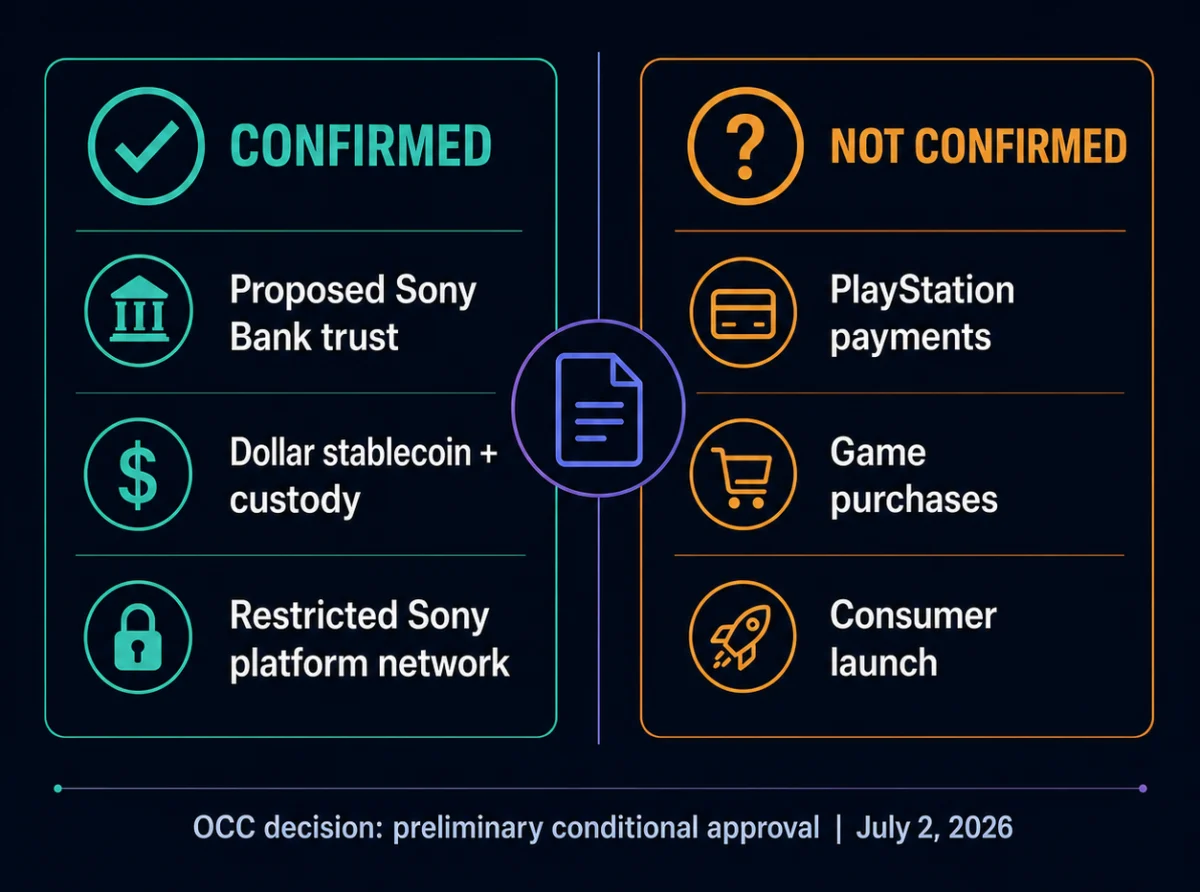
The cryptocurrency community is buzzing with speculation following a preliminary conditional approval granted by the U.S. Office of the Comptroller of the Currency (OCC) to a proposed Sony Bank-owned trust bank, Connectia Trust. While online chatter has rapidly jumped to the conclusion that this move paves the way for PlayStation users to purchase games using a Sony-issued cryptocurrency, a closer examination of the official documentation and Sony’s own disclosures reveals a more nuanced picture, suggesting the crypto community may be prematurely celebrating.
The OCC’s decision, dated July 2, and a subsequent announcement from Sony Bank on July 7, meticulously detail the establishment of a financial-services structure designed to operate within a restricted, permissioned network. Crucially, neither document explicitly mentions PlayStation, the PlayStation Store, or the direct purchase of video games as immediate applications for this new entity. Instead, the approval outlines a framework for a dollar-backed stablecoin, reserve maintenance, custody services, and intra-network transfers, all intended for use by U.S. retail customers with existing relationships with Sony Group or its subsidiaries, as well as Sony Group companies themselves.
This architectural design points towards a closed-loop payment system, confined to approved Sony properties and defined user bases, rather than an open-source cryptocurrency accessible across the broader internet. While such a system could undoubtedly be leveraged for consumer-facing applications within Sony’s vast ecosystem, the public record thus far does not commit any specific product, such as PlayStation, to this innovative payment rail.
The Genesis of Connectia Trust: A Strategic Financial Endeavor
The genesis of Connectia Trust can be traced back to Sony’s strategic financial planning. In October 2025, Sony completed a partial spin-off of its financial services business, retaining a significant 16.40% stake in the newly formed Sony Financial Group. This move, documented in Sony’s corporate records, signaled a strategic shift in how the conglomerate approached its financial operations. While not maintaining full control as a consolidated subsidiary, this retained stake allows for continued coordination and strategic alignment.
The OCC’s preliminary conditional approval for Connectia Trust represents a critical step in establishing a U.S.-based stablecoin and custody operation. This venture is envisioned as a wholly owned subsidiary of Sony Bank, designed to issue a dollar-backed stablecoin and manage associated reserves. The OCC’s detailed assessment, available in their interpretive decision document CD1380, lays out the operational parameters and regulatory considerations for such a financial institution. The framework is specifically designed to cater to a "restricted, permissioned closed-loop network," which implies a controlled environment for transactions.
The OCC’s mandate is to ensure the safety and soundness of the U.S. banking system. Their conditional approval signifies that, based on the submitted proposal, Connectia Trust has met initial regulatory requirements for its operational structure. However, it is imperative to understand that this is not a final green light. The trust must still satisfy a series of pre-opening requirements and secure final regulatory approval before it can commence operations. Sony Bank has indicated a potential opening timeline of 2027, contingent on obtaining all necessary approvals, while explicitly cautioning that neither the opening date nor the issuance of the stablecoin is guaranteed.
Dissecting the Speculation: From Stablecoin to PlayStation Payments
The leap from a Sony Bank-backed stablecoin to a PlayStation-centric payment system has been rapid and widespread across social media platforms. Given PlayStation’s status as Sony’s most recognizable consumer platform, it’s a natural inference that a controlled financial infrastructure would be applied to its massive user base. The prospect of a closed-loop ecosystem, where transactions are confined within Sony’s digital borders, has fueled discussions about how such a system could streamline game purchases, potentially offer exclusive digital assets, or even integrate with future metaverse initiatives.
However, the official filings are notably devoid of any direct linkage to gaming or the PlayStation brand. The OCC’s decision and Sony Bank’s announcement focus on the establishment of a financial entity and its operational capabilities. The language used is deliberately broad, outlining a potential financial service structure that could support payments on various Sony properties in the future, but without concrete commitments to specific products or services.

The Mechanics of Connectia Trust: A Closer Look
Connectia Trust’s proposed operational model is designed for a specific purpose: to create a secure and controlled digital asset environment. The trust would issue a stablecoin, pegged to the U.S. dollar, ensuring price stability. This stablecoin would be backed by reserves, a crucial element for maintaining trust and confidence in the digital currency. The custody services would allow customers to securely hold their digital assets, while the transfer mechanism would facilitate transactions within the designated closed-loop network.
The target customer base is clearly defined: U.S. retail customers who already have a relationship with Sony Group or its subsidiaries, and Sony Group companies themselves. This segmentation is key to understanding the restricted nature of the proposed network. It suggests a system designed for internal efficiencies and potentially for enhancing the value proposition for existing Sony customers, rather than a public-facing cryptocurrency for general use.
The "restricted, permissioned closed-loop network" is a critical differentiator. Unlike open-source cryptocurrencies that operate on public blockchains and can be transacted globally, Connectia Trust’s network would be akin to a private ledger, accessible only to authorized participants and for approved purposes. This level of control offers Sony significant advantages in terms of regulatory compliance, fraud prevention, and potentially in managing the user experience.
Regulatory Hurdles and Future Possibilities
The preliminary conditional approval from the OCC is a significant milestone, but it is far from the finish line. Connectia Trust faces substantial regulatory hurdles before it can officially launch. The pre-opening requirements are stringent and designed to ensure the trust is operationally sound, financially stable, and compliant with all applicable regulations. The final approval from the OCC is contingent upon the successful fulfillment of these requirements.
Furthermore, even if Connectia Trust secures final approval and launches its stablecoin operations, its integration with PlayStation or any other Sony product would require subsequent, separate decisions and approvals. Sony would need to formally designate specific products, define eligible customer segments for those products, and clearly articulate what consumers could purchase using the stablecoin. This would likely involve further regulatory scrutiny and internal strategic planning.
The possibility of a PlayStation-integrated payment system, while not currently confirmed, remains a logical future application given the nature of Connectia Trust’s proposed framework. The ability to create a seamless payment experience within the PlayStation ecosystem, potentially offering loyalty rewards or exclusive digital content tied to stablecoin usage, could be a powerful driver for adoption. This could also extend to other Sony platforms, such as its entertainment streaming services or its burgeoning presence in the automotive sector through its Sony Honda Mobility joint venture.
Broader Implications for the Digital Economy
The development of Connectia Trust, even with its currently undefined link to PlayStation, has broader implications for the digital economy. It represents a significant move by a major global corporation into the stablecoin and digital asset space, signaling a growing acceptance of these technologies by traditional financial institutions and large enterprises.
The focus on a "closed-loop" system also highlights a potential trend in how major corporations might leverage blockchain technology and digital currencies. Instead of aiming for widespread public adoption of their own tokens, they may prioritize creating proprietary networks that enhance their existing business models and customer relationships. This approach allows for greater control over the user experience, regulatory compliance, and the overall value proposition.
The crypto community’s enthusiastic response underscores the demand for more integrated and user-friendly digital payment solutions. While the immediate excitement surrounding PlayStation payments might be premature, the underlying interest points to a fertile ground for innovation. Sony Bank’s move, therefore, could be seen as a calculated step towards exploring this potential, laying the groundwork for future integration that could redefine digital commerce within its vast entertainment and technology empire. The coming years will be crucial in observing whether Connectia Trust evolves from a carefully constructed financial entity into a transformative payment solution for millions of PlayStation users worldwide.