admin
admin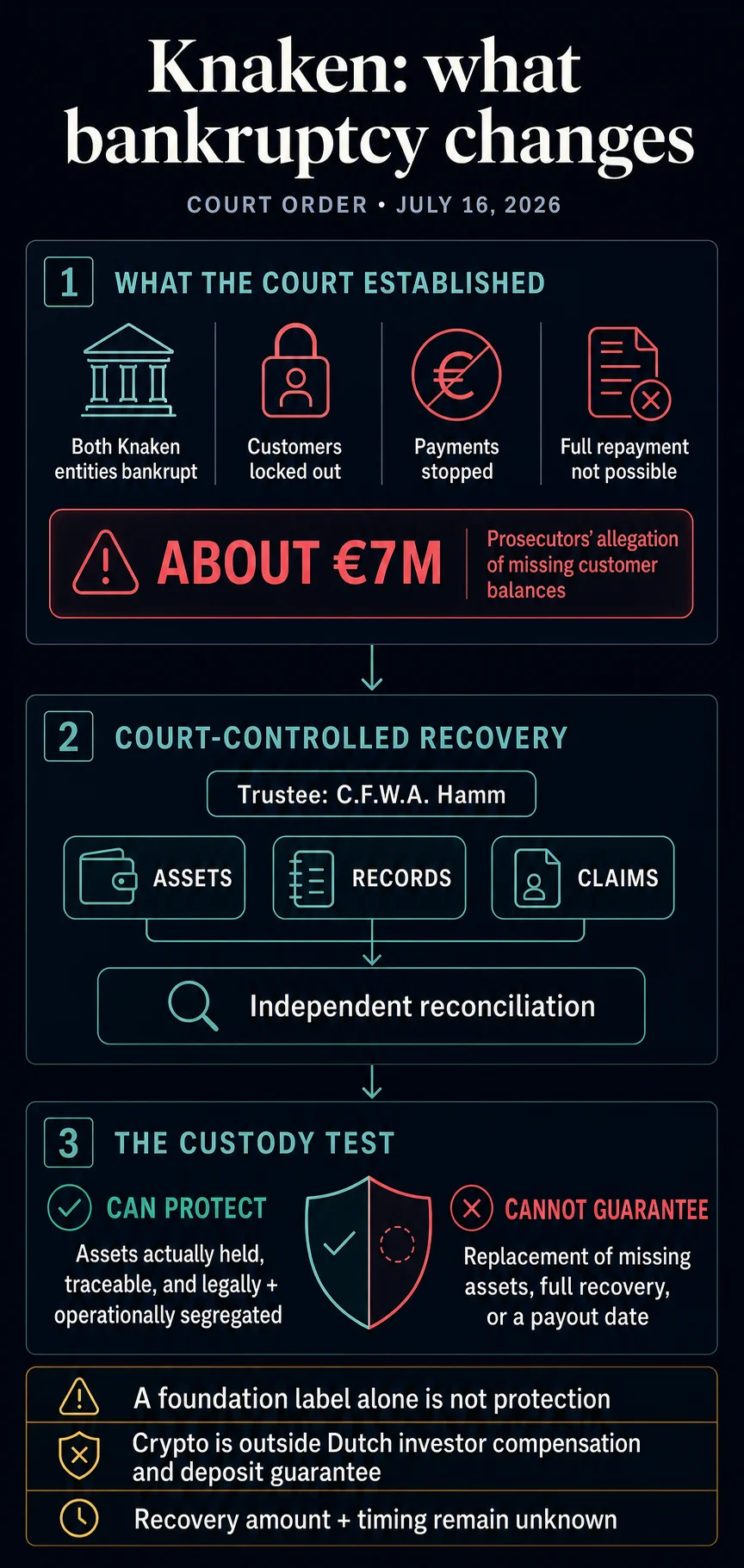
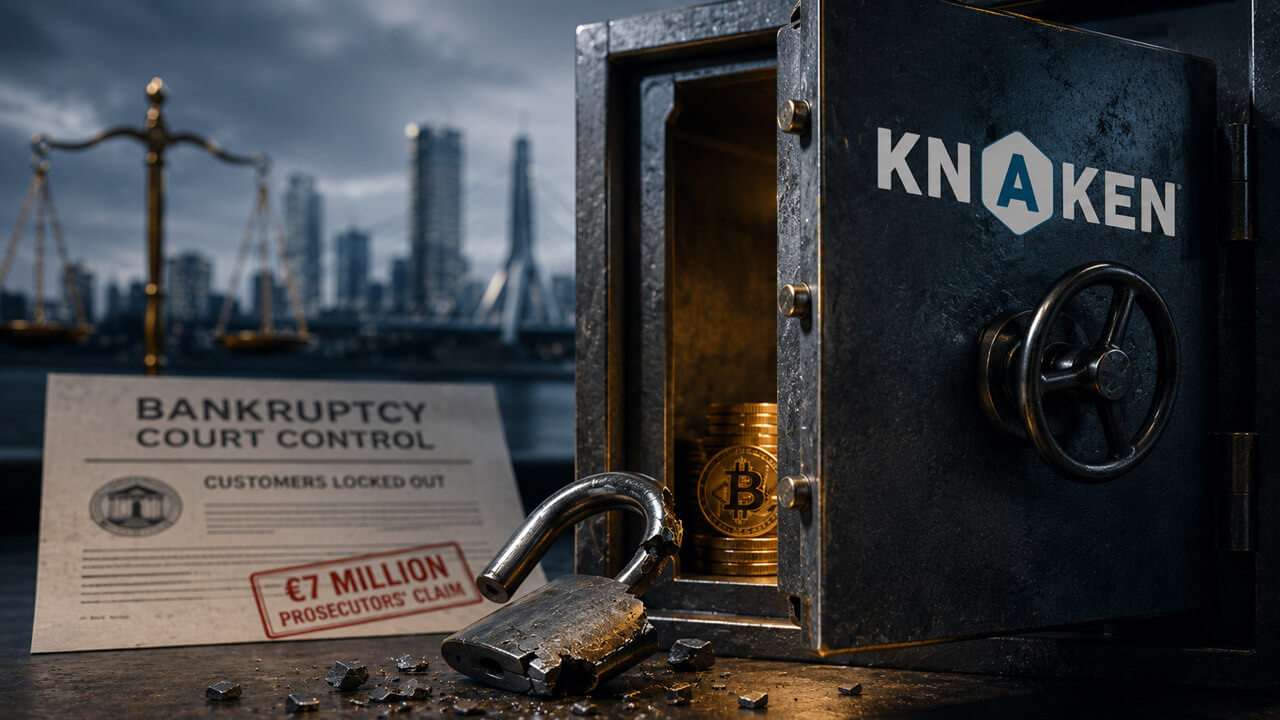
The Dutch cryptocurrency exchange Knaken, operating through its entity Knaken Cryptohandel B.V. and its affiliated payments foundation, Stichting Knaken Payments, has been declared bankrupt by the Rotterdam District Court on July 16. This drastic measure follows a court finding that the exchange is incapable of repaying its customers in full, leaving an estimated €7 million in customer balances unaccounted for. The court’s decision effectively wrests control from Knaken’s management, placing the winding-down process under the authority of an appointed trustee, C.F.W.A. Hamm, who now holds sway over both the operating company and the payments foundation.
The court’s ruling highlights a critical inability of Knaken to meet its financial obligations to its user base. Customers have reported being locked out of their accounts, with all payment services ceasing operations. Compounding these issues, the exchange failed to disclose a "substantial coverage deficit," a crucial piece of information that would have alerted users and regulators to the precarious financial state of the platform. This lack of transparency, coupled with the inability of customers to access their funds, prompted an unusual intervention by the Dutch Public Prosecution Service.
A Chronicle of Collapse: From Operations to Insolvency
The downfall of Knaken appears to have accelerated in late June. On June 29, the Fiscal Intelligence and Investigation Service (FIOD), the Dutch financial investigative body, conducted searches in connection with possible criminal conduct. During these searches, digital data carriers and company assets were seized. However, as of a statement released by the Public Prosecution Service on June 30, no arrests had been made. This criminal investigation ran parallel to the civil proceedings that ultimately led to the bankruptcy.
The Public Prosecution Service’s involvement was pivotal. Recognizing that blocked accounts and inadequate disclosures had left customers in an untenable position – unable to ascertain their standing or initiate meaningful bankruptcy proceedings themselves – prosecutors petitioned the court for intervention. This public-interest petition bypassed the traditional route where creditors initiate bankruptcy filings, underscoring the severity of the situation and the potential for widespread customer harm. The court’s decision to place the entities under its control provided a framework for an independent process, outside of Knaken’s own accounting and proposed distribution mechanisms.
Knaken’s management had contested the necessity of bankruptcy, proposing an alternative solution. They argued that criminal asset seizures, the service shutdown, and their existing custody structure already offered customer protection. Their proposed plan involved an independent verification process followed by their own distribution protocol. However, the court found these arguments insufficient, rejecting the exchange’s proposed path and opting instead for the appointment of an external trustee to manage the liquidation.
The Role of the Trustee and the Custody Conundrum
Under Dutch law, a bankruptcy trustee operates under the supervision of a judge, acting in the collective interest of creditors. Their mandate is extensive, encompassing the inventory of all assets and claims, a thorough examination of company records for any irregularities, the protection and liquidation of the estate, and the proposal of distributions based on established claim priorities, as outlined in Dutch judiciary guidance and the Bankruptcy Act.
For Knaken, this means the trustee, C.F.W.A. Hamm, will undertake the complex task of reconciling platform ledgers with actual wallet holdings, access controls, bank accounts, and other property held by both Knaken Cryptohandel B.V. and Stichting Knaken Payments. A key challenge will be to ascertain which entity is legally responsible for each customer’s debt and whether assets described as customer property were genuinely held outside the exchange’s own corporate estate. While the trustee’s appointment offers independent verification, it does not inherently resolve the substantial deficit or predetermine the recovery percentage for customers.
The bankruptcy of Stichting Knaken Payments is particularly significant, as it brings the exchange’s custody structure to the forefront of customer recovery efforts. The establishment of a separate foundation is intended to create legal separation between the operating company and client property. However, the effectiveness of this structure hinges on whether sufficient assets were actually held, accurately recorded, and readily available for return at the time of the platform’s failure.
Regulatory Landscape and Custody Safeguards
The Dutch Authority for the Financial Markets (AFM) has previously noted that Dutch law lacks a statutory segregation regime for custodied crypto assets that is as robust as the protections afforded to securities held by traditional financial institutions. Consequently, crypto providers in the Netherlands have often resorted to creating separate entities, such as foundations, to establish a semblance of legal separation.
However, effective protection requires more than just a separate legal entity. It necessitates that the provider actually holds client crypto and funds, maintains precise records of positions, utilizes distinct wallets for client and proprietary assets, implements rigorous recovery-key controls, limits the foundation’s activities solely to client custody interests, and operates a functional return procedure.
Crucially, neither the court nor the prosecutors have publicly disclosed the nature or location of Knaken’s remaining assets, nor have they confirmed whether the platform’s internal ledgers align with the foundation’s records, or if customer balances were indeed legally and operationally segregated. The concurrent bankruptcy of both entities means the trustee must first establish these fundamental facts before any account entry can be definitively linked to identifiable property or an accepted claim.
Adding another layer of complexity, prosecutors indicated that Knaken had not obtained the required authorization from the AFM. This is particularly relevant in light of the Markets in Crypto-Assets Regulation (MiCA), which is setting a new benchmark for the safeguards expected from authorized crypto custody providers.
MiCA, specifically Article 70, mandates that authorized providers safeguarding client crypto assets or their means of access must protect client ownership rights, especially in insolvency situations. Subject to specific institutional exceptions, eligible client funds are generally required to be deposited in a separately identifiable account at a credit institution or central bank by the next business day. Furthermore, MiCA Article 75 imposes obligations on custody providers to maintain per-client position records, establish a clear custody policy, and implement effective return procedures. The regulation emphasizes that client holdings must be legally and operationally separate from the provider’s own assets, ensuring that properly custodied crypto remains beyond the reach of the provider’s creditors in the event of insolvency. It is important to note that MiCA’s provisions focus on preventive custody controls rather than mechanisms to replace assets that have already disappeared.
In June, the European Securities and Markets Authority (ESMA) issued a directive to unauthorized providers, instructing them to cease onboarding new clients, limit remaining activities to an orderly exit, safeguard client interests, and clearly communicate their plans for asset handling. The operational risks associated with such transitions have already surfaced in other contexts. Recent reports indicated that AscendEX, another crypto platform, warned that some withdrawals might not be processed following its own regulatory adjustments. Knaken’s situation, however, is distinct and more legally advanced due to the court’s explicit finding of a coverage deficit and the imposition of bankruptcy control.
Investor Compensation and Future Outlook
For customers of Knaken, the absence of a safety net is a stark reality. De Nederlandsche Bank (DNB), the Dutch central bank, has stated that crypto-assets and crypto service providers fall outside the scope of the Dutch investor compensation scheme. Similarly, DNB’s deposit-guarantee guidance explicitly excludes cryptocurrencies such as Bitcoin. Any potential recovery of cash held at a bank would be contingent on the determination of account ownership and structure, which, as noted, remain unestablished for Knaken.
The Path Forward for Locked-Out Customers
The immediate next step for customers and the trustee will be the creation of a reconciled inventory. This inventory will detail the crypto, cash, and any other property that the trustee can secure or recover, cross-referenced with the financial records of both Knaken entities. While a customer’s displayed balance on the platform serves as evidence of the exchange’s purported liability, actual recovery hinges on the trustee’s ability to locate and link corresponding assets to a legally recognized right.
It is plausible that the foundation may have held some assets on behalf of customers, while the operating company might owe other financial obligations. The bankruptcy proceedings are designed to determine whether identifiable client property exists outside the general pool of creditors, whether any shortfalls will be treated as claims against either estate, and how these accepted claims will be ranked according to Dutch insolvency rules.
The seized property and information held by investigators could be crucial to the estate. However, the court’s announcement does not specify what was confiscated, who its legal owner is, or how it will be treated. The coordination between the trustee and criminal authorities will significantly influence the evidence and assets available for the bankruptcy process, without necessarily turning the insolvency case into a determination of criminal liability.
Only after these complex questions are resolved can the trustee provide a defensible estimate of what customers might receive and within what timeframe. For users who remain locked out of their funds, the court-controlled bankruptcy process offers an independent mechanism to differentiate between a reported account balance and actual, traceable property that can be returned. This supervised accounting and collective claims procedure effectively replaces Knaken’s own proposed payout system with a structured legal framework aimed at maximizing recovery for all creditors. The outcome will serve as a critical case study in the application of insolvency laws to the nascent and often opaque world of cryptocurrency exchanges, particularly in light of evolving regulatory frameworks like MiCA.