admin
admin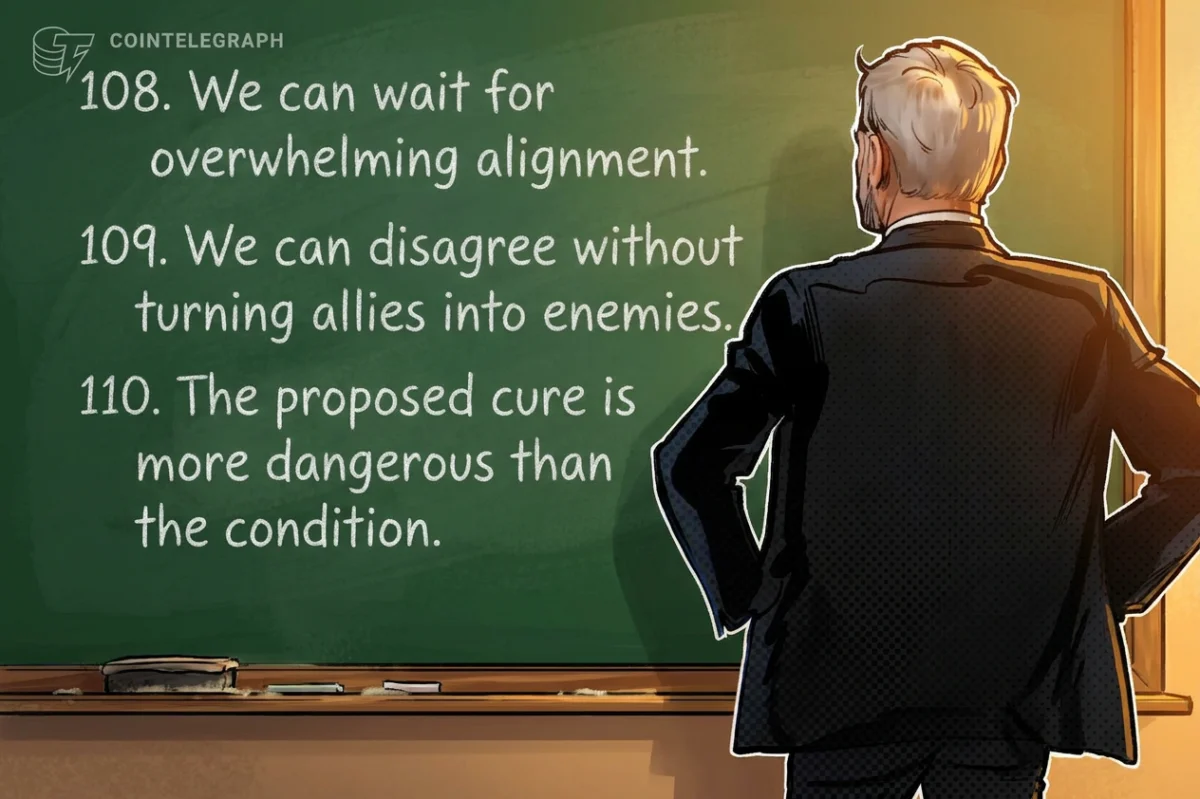
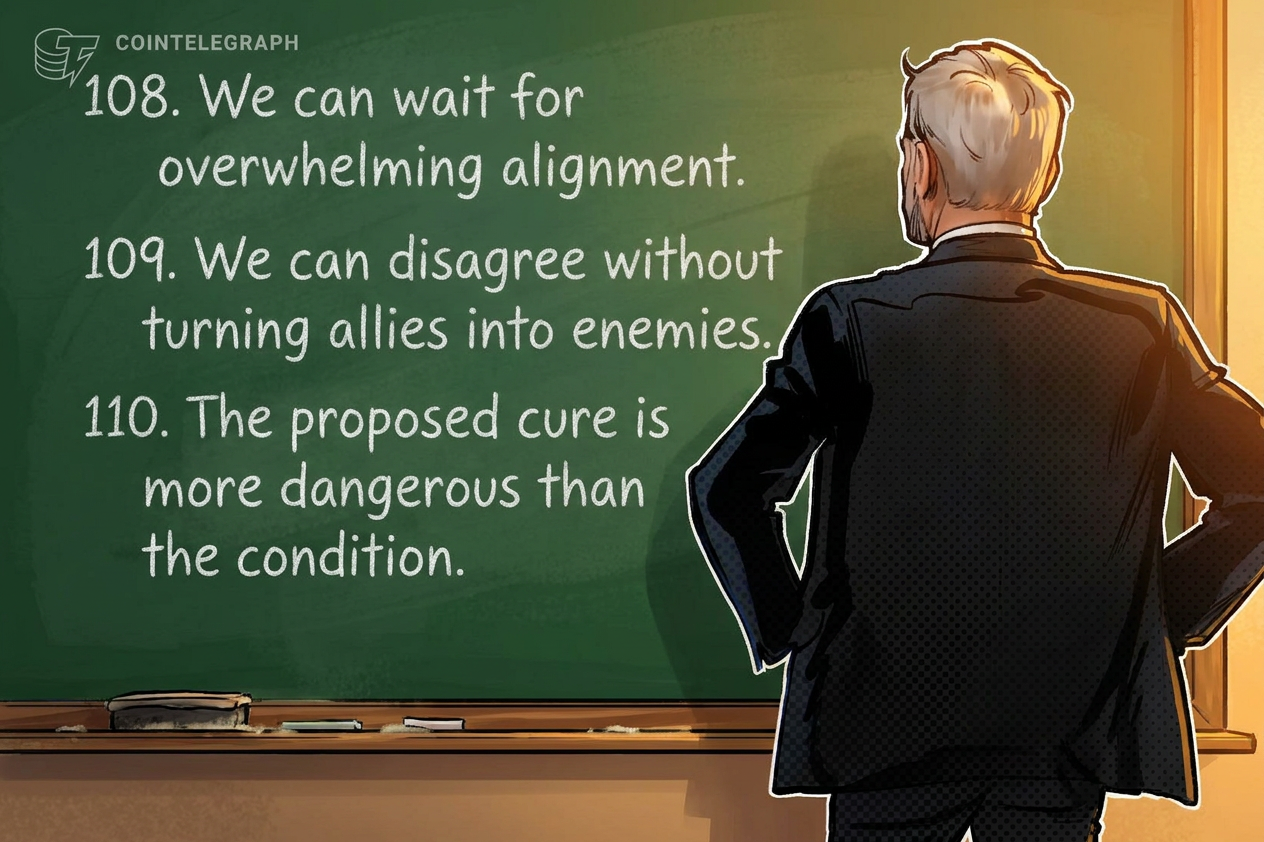
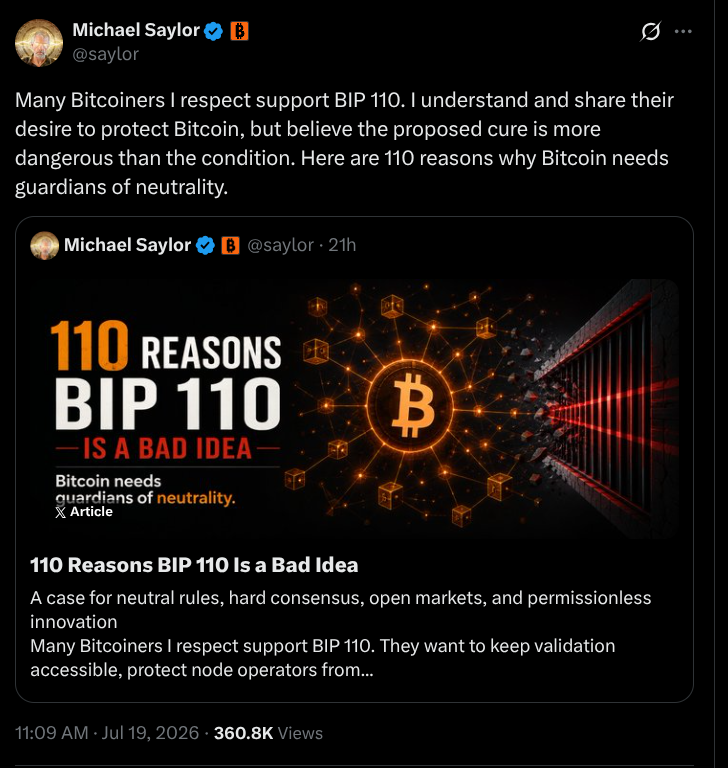
Michael Saylor, the executive chairman of MicroStrategy and a prominent advocate for Bitcoin, has intensified the ongoing debate within the cryptocurrency ecosystem by releasing a comprehensive critique of Bitcoin Improvement Proposal 110 (BIP-110). In a detailed social media post spanning approximately 3,700 words, Saylor enumerated "110 reasons" why he believes the proposed temporary fork to limit non-monetary transactions is a detrimental move for the network’s long-term health. The proposal, which has sparked significant friction among developers, miners, and institutional holders, seeks to address the proliferation of Ordinals and other forms of arbitrary data inscriptions that some argue are "spamming" the blockchain. Saylor’s intervention carries substantial weight, given his position as the leader of the company holding the world’s largest corporate Bitcoin treasury.
The Genesis of BIP-110 and the Quest for Protocol Purity
Introduced in December 2025, BIP-110 was authored by a pseudonymous developer known as "Dathon Ohm," with the vocal support of Luke Dashjr, the founder of Ocean protocol and a long-time Bitcoin Core contributor. The primary objective of the proposal is to preserve Bitcoin’s functionality as a peer-to-peer electronic cash system by filtering out non-monetary data. Specifically, the proposal targets "Ordinals," a protocol that allows for the inscription of digital assets, including non-fungible tokens (NFTs) and BRC-20 tokens, directly onto the Bitcoin blockchain.
Proponents of BIP-110 argue that the influx of arbitrary data has led to several negative externalities. These include increased costs for node operators, longer synchronization times for new nodes, and a "bloated" blockchain that may eventually price out users in developing nations who rely on low-cost validation. By implementing a temporary limit—suggested as a one-year "cooling-off" period—supporters believe they can discourage the use of Bitcoin as a general-purpose data storage layer and refocus the community on "sound money" principles.
Saylor, however, views the remedy as worse than the perceived ailment. While acknowledging the concerns regarding node accessibility and network costs, he argued that Bitcoin’s strength lies in its "neutral rules, hard consensus, open markets, and permissionless innovation." His critique suggests that any attempt to curate which transactions are "worthy" of inclusion on the ledger sets a dangerous precedent for censorship and centralized governance.
A Chronology of the Bitcoin Data Debate
The tension surrounding data inscriptions did not emerge in a vacuum. It is the culmination of several years of technical evolution and shifting usage patterns on the Bitcoin network.
- Late 2021 (Taproot Activation): The Taproot upgrade was implemented, inadvertently making it cheaper and easier to store data within Bitcoin transactions by removing certain size limits for witness data.
- January 2023 (The Rise of Ordinals): Developer Casey Rodarmor launched the Ordinals protocol, utilizing the Taproot upgrade to "inscribe" data onto individual satoshis. This led to a massive surge in network activity and transaction fees.
- August 2023 (Peak Inscription Activity): Daily Ordinals inscriptions reached an all-time high of over 400,000, significantly boosting miner revenue but drawing criticism from "Bitcoin maximalists" who viewed the activity as an attack on the network’s primary mission.
- December 2025 (Introduction of BIP-110): Following years of internal debate, BIP-110 was officially proposed as a mechanism to programmatically discourage non-monetary data through a temporary soft fork.
- July 2026 (Saylor’s 110 Reasons): As node support for BIP-110 fluctuated, Michael Saylor entered the fray with his exhaustive critique, signaling institutional resistance to the proposal.
Technical Mechanics and Activation Thresholds
BIP-110 is not a mandatory change but rather a proposal that requires a high degree of consensus to become active. For the proposal to be triggered, it requires the support of 55% of the Bitcoin nodes that are actively validating blocks within a specific "period." A period typically consists of a set number of blocks, such as the 2,016 blocks used for difficulty adjustments.
Recent data indicates that the proposal is far from achieving this threshold. In the most recent evaluation period (Period 475, spanning blocks 955,584 to 957,599), only 1% of the blocks signaled support for the change. While some proponents point to a slight uptick in node signaling—briefly crossing the 2% mark in certain monitoring tools—the overall momentum appears stalled.
The lack of urgency may be attributed to a significant decline in Ordinals activity. According to data from Dune Analytics, daily inscriptions have plummeted from their peak of 400,000 to fewer than 10,000 in the last month. This decline suggests that the market may be self-regulating; as transaction fees rise or interest in specific digital artifacts wanes, the "spam" naturally subsides without the need for protocol-level intervention.
Divergent Perspectives: Saylor, Back, and Dashjr
The dispute over BIP-110 has created unusual alliances and divisions within the Bitcoin elite. Adam Back, the CEO of Blockstream and a figure cited in the Bitcoin whitepaper, has aligned with Saylor in opposing the proposal. Back has characterized BIP-110 as a "quest to police other people," arguing that the essence of Bitcoin’s decentralization is that no single group should be able to impose their aesthetic or philosophical views on how others use the network.
"You can’t impose your views on others," Back stated, emphasizing that the cypherpunk ethos of Bitcoin is rooted in permissionless and censorship-resistant money. From this perspective, if a user is willing to pay the market rate for block space, the content of their transaction should be irrelevant to the network’s protocol.
Conversely, Luke Dashjr and the supporters of BIP-110 maintain that Ordinals represent a technical exploit of the Taproot upgrade. They argue that the developers of Taproot never intended for the upgrade to be used as a backdoor for massive data storage. Dashjr has described the current state of "bloat" as a "serious threat" to the decentralization of the network. He contends that if the cost of running a full node becomes too high, Bitcoin will inevitably centralize around a few large data centers, undermining its security model.
Saylor’s Philosophical and Economic Case
In his "110 reasons," Saylor touched upon the economic implications of limiting transactions. He noted that Bitcoin’s long-term security depends on a robust fee market, especially as block rewards continue to halve every four years. By artificially restricting a class of fee-paying transactions (even those deemed "non-monetary"), the network could be depriving miners of essential revenue.
Saylor’s post on X.com, which garnered nearly 900,000 views within hours, emphasized that Bitcoin is at its strongest when the community can "disagree vigorously without mistaking allies for enemies." He assumed "good faith" on the part of the BIP-110 proponents but insisted that the proposal’s remedy—a fork to filter data—is a step toward a "permissioned" system.
He argued that "neutral rules" are the bedrock of institutional trust. If the rules of Bitcoin can be changed to exclude certain types of valid data based on a temporary consensus of node operators, it introduces a level of social and political risk that could deter large-scale capital allocators. For Saylor, Bitcoin is not just a payment system; it is a "global, immutable ledger of record," and its value is derived from its refusal to discriminate.
Historical Parallels: The Blocksize Wars
Analysts have frequently compared the BIP-110 debate to the "Blocksize Wars" of 2015–2017. During that era, the community was split over whether to increase the block size limit to allow for more transactions (the "Big Blockers") or to keep the limit small to prioritize node decentralization (the "Small Blockers").
That conflict eventually led to a hard fork and the creation of Bitcoin Cash (BCH). However, the "Small Blockers" largely won the narrative war within the main Bitcoin (BTC) chain, leading to the implementation of Segregated Witness (SegWit) and the development of Layer 2 solutions like the Lightning Network.
BIP-110 represents a modern inversion of that conflict. While the Blocksize Wars were about how much legitimate payment data could fit in a block, the current dispute is about whether non-payment data should be allowed at all. The fear of a "chain split" remains a significant deterrent for many stakeholders, as a split could dilute the brand and market cap of Bitcoin.
Analysis of Broader Implications and Future Outlook
The outcome of the BIP-110 debate will likely define the governance of Bitcoin for the next decade. If the proposal fails to gain traction—as currently seems likely given the 1% support level—it will signal a victory for the "market-based" approach to block space. This approach posits that the fee market is the only legitimate "policing" mechanism for the network.
However, if Ordinals activity returns to record highs and causes sustained network congestion, the pressure to "do something" will mount. This could lead to the development of alternative filtering methods or the emergence of "filtered" mining pools that refuse to process inscriptions, even without a formal protocol change.
Furthermore, the debate highlights a growing tension between Bitcoin as "Digital Gold" (a simple, secure store of value) and Bitcoin as a "Global Computer" (a secure layer for various data applications). While Saylor and Back advocate for a neutral platform that can accommodate both, the purists fear that the latter will eventually destroy the former.
For now, the network remains in a state of "hard consensus." The high bar for activation set by BIP-110 ensures that Bitcoin remains resistant to rapid changes, for better or for worse. As the industry watches the signaling periods closely, the "110 reasons" provided by Michael Saylor serve as a manifesto for those who believe that Bitcoin’s greatest feature is its inability to be controlled by the whims of its users or its developers.