Lina Irawan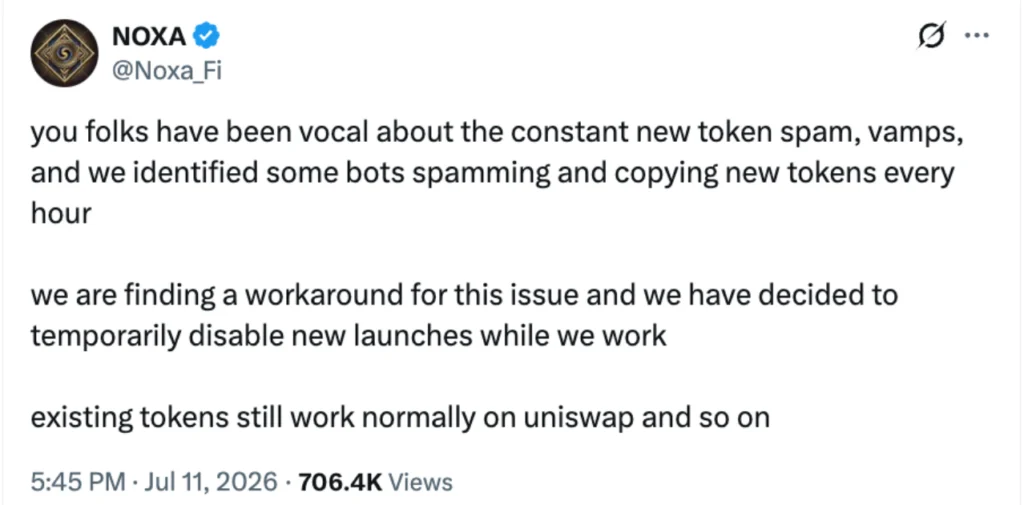
The burgeoning cryptocurrency ecosystem on Robinhood Chain has been jolted by the abrupt cessation of operations by Noxa, the network’s dominant token launchpad. Mid-July saw Noxa cease new token launches, a move that has sent ripples through the chain’s vibrant memecoin economy and brought into sharp focus questions about the true drivers of its early activity. While Robinhood Chain was conceived with the ambitious goal of facilitating the tokenization of real-world assets (RWAs), the rapid ascent and subsequent disruption of Noxa highlight a significant reliance on speculative token trading, particularly memecoins, for initial traction.
According to data aggregated by DefiLlama, Noxa facilitated token launches that generated an estimated $12 million in cumulative fees for the platform. Some independent trackers place this figure even higher, approaching $14.5 million. This substantial fee generation underscores Noxa’s pivotal role in the nascent Robinhood Chain network since its launch. The shutdown has not only impacted creators and investors but also cast a shadow of uncertainty over the long-term viability of Robinhood Chain’s RWA-centric vision.
The Unfolding Collapse of a Dominant Launchpad
Robinhood Chain, an Arbitrum-based Layer 2 scaling solution, officially went live on July 1, 2026. Its core proposition revolves around the tokenization of traditional financial instruments such as stocks and other tangible assets, aiming to bridge the gap between traditional finance and decentralized applications. However, within days of its launch, Noxa emerged as the undisputed leader in the token launchpad sector on the network. The platform quickly became the go-to venue for new token creations, deploying an impressive volume of over 60,000 tokens. This rapid adoption meant Noxa accounted for approximately 75% of all token launches on Robinhood Chain during its operational peak.
The success of Noxa was not merely measured in the number of tokens launched but also in its ability to generate significant network activity and fees. For five consecutive days, Noxa’s daily protocol fees surpassed those of Pump.fun, a prominent Solana-based launchpad long considered the benchmark for this category. This surge in activity contributed to Robinhood Chain achieving over $4 billion in cumulative decentralized exchange (DEX) volume within a mere two weeks of its inception.
The turning point arrived on July 11, 2026. At a time when CASHCAT, the chain’s most prominent memecoin, was experiencing its peak trading volume, Noxa made a surprise announcement. The platform declared it would halt the acceptance of new token launches. The stated reasons for this drastic measure were the overwhelming influx of bot-driven spam and a deluge of low-quality, copycat tokens that were inundating the platform. Renowned data analyst Tom Wan corroborated this, noting that close to 60,000 tokens had been launched on Noxa prior to the freeze, with no new tokens being added the following day.
The situation escalated rapidly. On July 13, Noxa’s primary website became inaccessible. Initially, the team attributed the outage to a technical issue with Cloudflare. However, subsequent reports revealed a more concerning underlying problem: the platform had lost control of its original domain. This occurred due to the domain registrar reportedly reselling or reclaiming the domain, effectively severing Noxa’s centralized point of access.

In response to the domain issue and the ongoing operational challenges, Noxa announced on July 14 that it would transition to a decentralized interface. This new access point, fun.noxa.eth, was made accessible through Brave browser’s integrated ENS support and via gateway services such as eth.limo and eth.link. The team assured users that creator earnings would remain available for withdrawal. Later that same evening, Noxa delivered another significant announcement: it would cease collecting fees entirely. All ongoing transaction revenue was to be redirected directly to token creators. Concurrently, the Noxa team reportedly executed a 40% burn of its native NOXA token supply, which had been initially issued on the DBK Chain. This series of events marked a dramatic and swift end to Noxa’s reign as the dominant launchpad on Robinhood Chain.
Market Fallout and Community Reaction
The abrupt news of Noxa’s operational halt triggered an immediate and sharp downturn in the market. CASHCAT, the memecoin that had become the de facto flagship token of the Noxa ecosystem and Robinhood Chain, experienced a significant price correction. Within a 24-hour period, CASHCAT plummeted by over 33%. The broader spectrum of memecoins on Robinhood Chain also saw substantial declines, dropping more than 30% from their recent peaks. While CASHCAT managed a partial recovery in the immediate aftermath, the broader sentiment remained shaken.
At its zenith, CASHCAT had achieved a market capitalization exceeding $150 million. This valuation was a striking twelve times the combined value of all tokenized real-world assets on Robinhood Chain, which at the time collectively amounted to approximately $12.66 million. This stark disparity underscored the speculative fervor driving much of the network’s early activity, overshadowing the platform’s foundational goals.
The reaction on social media platforms was sharply divided. Traders and commentators expressed contrasting viewpoints on the implications of Noxa’s shutdown. Some, like trader and commentator @zubic_eth, characterized the event as a necessary purge of spam and low-quality projects, viewing the shutdown as a justified response to an unsustainable ecosystem. Conversely, a segment of the community decried the move as a costly misstep that jeopardized early investors and creators.
Prominent trader 0xAvast, who had reportedly seen a five-figure investment grow into a seven-figure profit as CASHCAT surged from a $10,000 market cap to approximately $230 million, dismissed the ensuing crash as unwarranted panic. He argued that the price drop presented a buying opportunity. However, this perspective was not borne out by subsequent price action, as the token continued its downward trend.
The disruption at Noxa created an immediate vacuum, which rival platforms were quick to fill. On July 13 alone, an estimated 20,000 new tokens were launched on other platforms within the Robinhood Chain ecosystem. Ventures such as flap.sh, trensh.today, and bankr saw increased activity and market share as they absorbed the displaced users.
Adding to the volatility and concerns about infrastructure reliability, Pons, a launchpad that had briefly held the top spot on the chain after existing for only two days, faced its own set of issues. During this period, Pons was reportedly dealing with reports of a front-end token-approval bug. Further compounding the instability, another rival launchpad, Vlad.fun, also went offline within days, citing an unspecified internal integrity issue. In the span of roughly a week, the token creation layer of Robinhood Chain experienced critical failures across three separate platforms that had, at different points, held the leading position. This pattern of instability raised significant concerns about the robustness and reliability of the underlying infrastructure supporting these new ventures.

Implications for Token Holders and Creators
For existing token holders, the direct liquidity of their assets launched through Noxa remained largely unaffected. These tokens continue to be tradable on established decentralized exchanges, including Uniswap, and are accessible through data aggregators like DexScreener and trading bots. The operational shutdown of Noxa did not, therefore, lead to an immediate evaporation of liquidity for existing assets.
Creators who had launched their tokens via Noxa now have the ability to claim their accrued trading fees. The transition to the decentralized interface at fun.noxa.eth facilitates this process, allowing creators to access 100% of their earned fees. However, for aspiring project creators looking to launch new tokens on Robinhood Chain through Noxa, the path forward remains uncertain. The Noxa team has provided no definitive timeline for reopening new token launches, leaving a significant gap in the market for new projects.
The Noxa episode has significantly intensified the scrutiny on Robinhood Chain’s fundamental objectives. The network’s core design and stated purpose are centered on the tokenization of RWAs, aiming to bring traditional financial assets onto the blockchain in a secure and regulated manner. However, the overwhelming dominance of memecoin trading, facilitated by Noxa, has demonstrated that this speculative segment has, thus far, been the primary driver of on-chain activity.
Early data from Robinhood Chain indicates that tokenized RWAs constitute a mere fraction, around 4%, of the total on-chain activity. In contrast, a single memecoin like CASHCAT, at its peak, commanded a market value twelve times greater than the entire RWA sector combined. This stark contrast poses a critical challenge to the long-term vision of Robinhood Chain.
Robinhood CEO Vlad Tenev had, in early July, articulated a clear stance: assets lacking genuine utility would not endure. This statement has drawn particular attention in light of the fact that the very ecosystem Tenev alluded to, characterized by speculative trading, produced its first major casualty just days after his pronouncement. The collapse of Noxa serves as an early and significant test of Robinhood Chain’s resilience. The central question that now looms is whether the network’s ambitions in the real-world asset space can ultimately sustain its growth and stability once the speculative fervor surrounding memecoins inevitably cools. The ability of Robinhood Chain’s infrastructure to withstand pressure and adapt to evolving market dynamics will be crucial in determining its success in the subsequent phases of its development.