James Watt
The global financial landscape witnessed a complex interplay between traditional energy markets and the burgeoning digital asset sector on July 20, as Brent crude futures surged to a multi-week high of $91.42 per barrel. This price action, the highest recorded since June 11, initially sparked concerns regarding a renewed inflationary spiral that could necessitate a more hawkish stance from the Federal Reserve. However, the energy market saw a subsequent cooling to $88.28 as international mediators introduced a 10-day ceasefire proposal between the United States and Iran, offering a temporary reprieve from geopolitical anxieties. Amidst this volatility in the commodities sector, Bitcoin demonstrated notable resilience, trading above the $65,000 threshold. During the session, the primary cryptocurrency reached an intraday high of $65,666 and a low of $63,100, eventually climbing to $66,313 at the time of reporting, even as Brent crude remained anchored near the $90 mark.
This divergence in price action suggests that market participants are currently assigning a short duration to the latest "energy premium." Bitcoin’s stability indicates that traders expect diplomatic efforts, the restoration of tanker traffic, or an influx of additional supply to suppress oil prices before they can trigger a systemic repricing of inflation expectations, Treasury yields, and Federal Reserve monetary policy. The relationship between oil, inflation, and interest rates remains a critical pillar of the current macroeconomic environment, and Bitcoin’s performance serves as a high-frequency barometer for how investors perceive these risks.
The Transmission of Energy Costs to Consumer Inflation
The mechanism by which oil prices influence the broader economy is multifaceted and direct. Crude oil enters the consumer price index (CPI) primarily through refined products such as gasoline, diesel, jet fuel, and heating oil. Beyond these immediate consumer touchpoints, energy costs permeate the supply chain via freight charges, food production, and manufacturing processes, driven by higher transport and power expenses. Central banks, particularly the Federal Reserve, closely monitor these "first-round effects" on headline inflation. However, their primary concern lies in the persistence of these shocks. If energy costs remain elevated for an extended period, they can become embedded in wages, service prices, and long-term inflation expectations, thereby filtering into "core" inflation—the metric that excludes volatile food and energy prices and serves as a key guide for interest rate decisions.
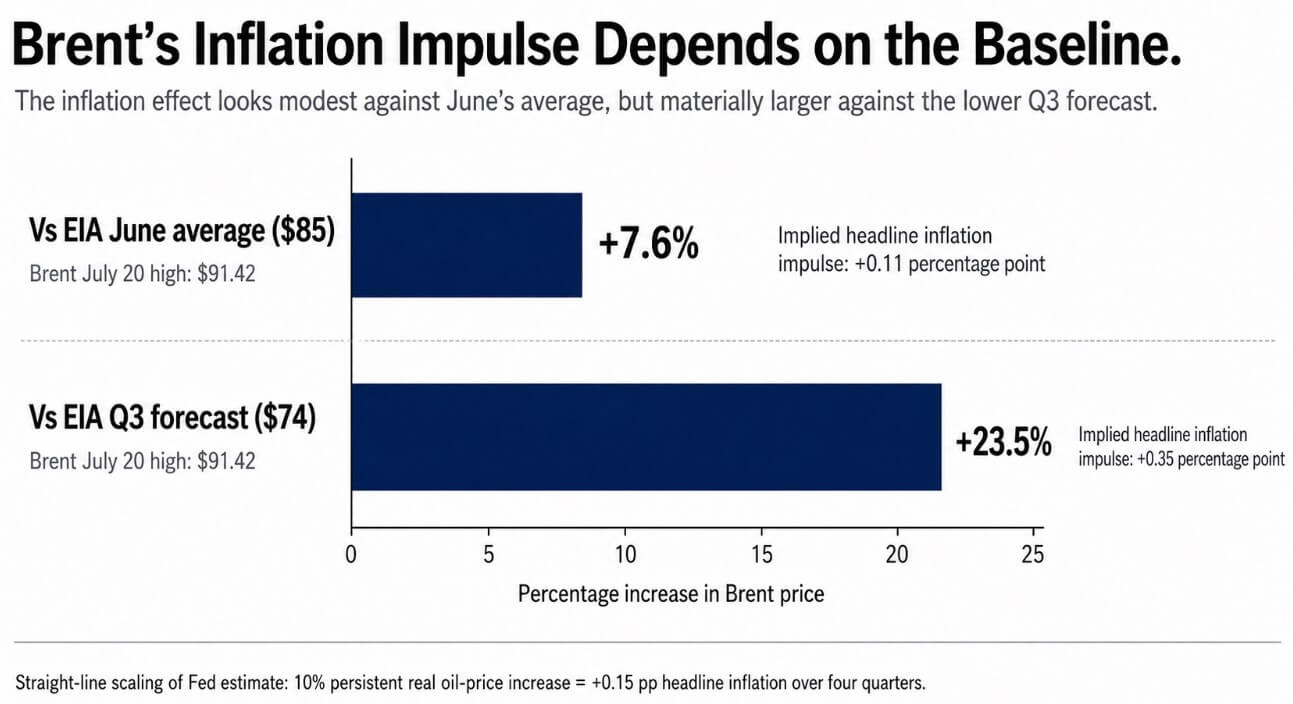
Recent research from the Federal Reserve provides a quantitative framework for assessing these risks. Estimates suggest that a persistent 10% increase in the real price of oil adds approximately 0.15 percentage points to U.S. headline inflation over a four-quarter period, while contributing roughly 0.06 percentage points to core inflation. When applying this model to current market conditions, the implications become clear. Using the Energy Information Administration’s (EIA) June average for Brent crude of $85 as a baseline, the July 20 peak of $91.42 represents a 7.6% increase. A linear scaling of the Fed’s estimates suggests that if oil were to hold at this level for a full year, it would create an inflationary impulse of approximately 0.11 percentage points.
The outlook becomes more concerning when measured against the EIA’s July forecast, which projected Brent to average just $74 in the third quarter. The July 20 high sat a staggering 23.5% above this baseline. Under the same simplified scaling method, such a sustained price level would imply an upward impulse of 0.35 percentage points to headline inflation. Because the Federal Reserve’s models prioritize persistent real-price shocks, the duration of the current energy spike carries significantly more weight in policy deliberations than a single intraday price candle.
Chronology of Geopolitical Volatility and Market Response
The recent escalation in oil prices is deeply rooted in a series of geopolitical disruptions that have threatened global supply chains. The timeline of these events highlights the fragility of the current energy balance:

- Early July: Reports of increased tanker incidents near the Strait of Hormuz began to circulate. The Strait is a critical maritime chokepoint through which approximately 20% of the world’s total oil consumption passes daily. Any disruption here is viewed by markets as a high-impact event.
- Mid-July: Tensions escalated as Houthi naval forces issued threats of a blockade against Saudi Arabian shipping routes. This added a layer of regional instability, prompting a risk premium to be priced into Brent crude.
- July 13-17: While energy markets tightened, the cryptocurrency market saw significant internal movement. Farside Investors reported a substantial $424.7 million outflow from spot Bitcoin ETFs on July 13. However, this was followed by four consecutive sessions of positive inflows totaling over $500 million, signaling robust institutional demand despite the looming macro uncertainty.
- July 20: Brent crude reached its peak of $91.42. Simultaneously, Bitcoin hit an intraday high of $65,666, later surging past $66,000. The introduction of the 10-day US-Iran ceasefire proposal late in the day provided the catalyst for oil’s retreat to the $88 level.
Each additional disruption in this sequence has the potential to extend the duration of the price shock, potentially transforming a temporary geopolitical premium into a multi-week input for inflation data.
Federal Reserve Policy and the "Zero-Yield" Asset Challenge
The Federal Reserve’s July Monetary Policy Report highlighted the ongoing struggle to contain price pressures, noting that energy costs contributed to a 12-month Personal Consumption Expenditures (PCE) inflation rate of 4.1% in May, with core PCE at 3.4%. Consequently, investors have begun pricing in a more restrictive path for the federal funds rate starting in 2026, which has pushed real interest rates and Treasury yields higher. Currently, the Federal Open Market Committee (FOMC) maintains its target range at 3.5% to 3.75%.
Historically, an environment of rising interest rates and a strengthening dollar presents a significant headwind for Bitcoin. As a non-yielding asset, Bitcoin often struggles to compete with cash and Treasury securities when their yields increase. Furthermore, higher real rates and tighter financing conditions generally reduce the appetite for volatile, "risk-on" assets. Academic research supports this sensitivity; one study indicated that Bitcoin typically declines by 24 basis points for every one-standard-deviation surprise in inflation data. Another 2026 research paper found that hawkish communication from the Federal Reserve consistently produces negative price responses in the cryptocurrency markets.
Current interest rate futures reflect a cautious but expectant market. For the upcoming July 29 Fed meeting, there is an 83.4% probability that rates will remain steady, with a 16.6% chance of a quarter-point hike. Looking further ahead to September, the probability of at least one rate increase rises to 60.3%, suggesting that while there is no immediate urgency to hike in July, the medium-term path is firming toward tighter conditions.
Institutional Demand as a Market Buffer
One of the most significant developments in the current cycle is the role of institutional capital, specifically through spot Bitcoin ETFs, in providing a price floor. The data from Farside Investors illustrates a "buy the dip" mentality among institutional players. The recovery from a massive $424.7 million outflow to over $500 million in fresh inflows within a single week suggests that Bitcoin is being increasingly viewed as a strategic allocation, independent of short-term macro fluctuations.
Bond and currency markets have provided partial confirmation of this shifting sentiment. The 10-year Treasury yield recently traded near 4.56%, an increase of approximately 2 basis points, while the U.S. Dollar Index (DXY) eased slightly by 0.1% to 100.69 during Asian trading sessions. This suggests that while the "inflation trade" is active, it has not yet reached a level of panic that would trigger a mass liquidation of digital assets.
The EIA’s long-term outlook remains relatively optimistic, forecasting that Brent will average $74 in the third quarter of this year and decline further to $65 by 2027 as production increases and trade routes stabilize. The swift retreat from $91.42 toward $88 upon the news of ceasefire diplomacy demonstrates how quickly the geopolitical premium can evaporate if the threat to physical supply is perceived to be diminishing.
Analyzing the $90 Persistence Test: Four Scenarios
The future trajectory of both oil and Bitcoin depends heavily on whether the $90 per barrel price point for Brent crude becomes a floor or a ceiling. The following scenarios outline the potential market paths:
The Bull Case: Diplomacy and De-escalation
In this scenario, diplomatic efforts succeed, tanker traffic in the Strait of Hormuz returns to normal, and Brent crude retreats toward the $74-$80 range. The Federal Reserve maintains a steady hand in July, and the odds of a September hike begin to recede. As the dollar weakens, Bitcoin’s defense of the $65,000 level is validated as a "macro duration trade," where investors bet on the eventual easing of financial conditions. Institutional ETF inflows remain a steady tailwind, potentially pushing Bitcoin toward new highs.
The Base Case: Volatile Consolidation
Under the base case, Brent crude remains volatile but fails to sustain a weekly average above $90. Treasury yields drift without a major repricing of the Fed’s terminal rate. In this environment, Bitcoin likely continues to trade in a range around $65,000. The asset remains sensitive to liquidity but is shielded from a full-scale macro shock as long as ETF demand remains positive.
The Bear Case: Persistent Energy Inflation
If Brent averages above $90 for several consecutive weeks due to prolonged shipping disruptions, the energy shock will likely transition into a financial-conditions shock. A 2-year Treasury yield climbing above 4.30% and a DXY rising above 102 would signal that the market is bracing for "higher for longer" rates. In this scenario, Bitcoin’s $65,000 support would likely weaken as the opportunity cost of holding the asset becomes too high, potentially triggering a retreat to lower liquidity zones.
The Stress Case: Systemic Supply Disruption
In a stress case involving a total blockade of the Strait of Hormuz or significant damage to regional energy infrastructure, oil prices could spike well into triple digits. This would lead to a sharp rise in real yields and a "flight to safety" into the U.S. dollar. Under such extreme conditions, Bitcoin would likely trade as a high-beta liquidity asset rather than an inflation hedge, facing significant downward pressure as global financial conditions tighten abruptly.
Conclusion: Bitcoin as a Barometer of Macro Duration
The current market dynamic suggests that Bitcoin is effectively "pricing the expiration date" of the current oil shock. The asset’s ability to hold the $65,000 level while oil flirts with $91 is a testament to the market’s belief that the energy spike is transitory. However, the Federal Reserve’s focus on persistence remains the ultimate arbiter of value. If the energy premium refuses to compress, the resulting rate shock will test the limits of Bitcoin’s institutional support.
For now, the convergence of geopolitical diplomacy and steady ETF demand has allowed Bitcoin to decouple from the immediate inflationary fears associated with the energy market. Holding these levels through a sustained period of $90+ oil, rising yields, and a stronger dollar would constitute an unprecedented display of resilience for the digital asset class. As the July 29 Fed meeting approaches, all eyes will remain on the Strait of Hormuz and the persistence of Brent crude, as these factors will ultimately dictate the next major move in the global liquidity cycle.