James Watt
The global cryptocurrency market witnessed a significant resurgence during the third week of July as Bitcoin (BTC) surged past the $66,000 mark, achieving its highest valuation in more than 30 days. This bullish momentum, characterized by a 3.3% intraday gain, has effectively dismantled the restrictive trading range that stifled several recovery attempts earlier in the month. As of the latest market data, the premier digital asset reached a peak of $66,277 before stabilizing near $66,181, signaling a potential shift in investor sentiment following a tumultuous second quarter.
This price action was accompanied by a massive wave of liquidations across decentralized and centralized trading platforms. According to data provided by CoinGlass, the sudden upward volatility forced the closure of positions held by approximately 78,126 traders within a 24-hour window. Total liquidations reached an estimated $260.3 million, with the vast majority consisting of short positions. While these forced liquidations provided the mechanical "fuel" to propel the price higher as exchanges automatically closed under-collateralized bets, market analysts remain divided on whether the move is supported by sustainable spot-market demand or is merely a temporary squeeze of over-leveraged bears.
Institutional Resurgence: A Five-Day Inflow Streak
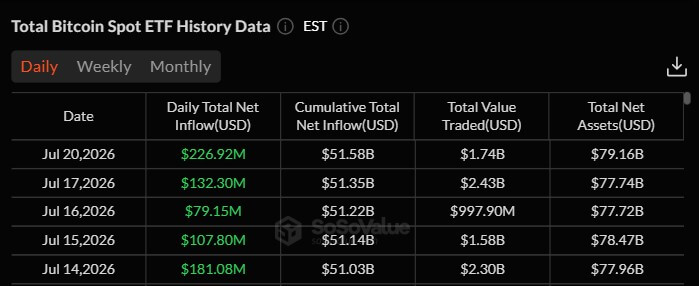
The primary catalyst for the current rally appears to be a renewed appetite for Bitcoin among institutional investors. US-based spot Bitcoin exchange-traded funds (ETFs) recorded their fifth consecutive session of net inflows, a streak not seen since the peak of the market’s enthusiasm in early May. Data from SoSoValue indicates that these investment vehicles attracted approximately $727 million over the five-day period, marking a decisive pivot from the persistent withdrawals that defined much of June and early July.

This influx of capital provides a critical buffer for Bitcoin, which had previously struggled to maintain momentum when ETF demand faltered. Simon-Peter Massabni, head of business development at XS.com, noted that while the streak is a positive signal, it must be viewed in the context of the broader year-to-date trend. Bitcoin and Ether-linked funds recently concluded an eight-week period of combined outflows totaling nearly $9.46 billion. Consequently, the recent $727 million inflow represents only a fraction of the capital that exited the ecosystem during the second-quarter downturn.
Industry observers suggest that for the current recovery to transform into a sustained bull run, institutional participation must not only continue but accelerate. The market is currently looking for evidence that institutional players have moved from "intermittent opportunistic buying" to "strategic long-term accumulation." Without this transition, the rally risks being vulnerable to profit-taking at key psychological resistance levels.
Supply-Side Dynamics: The Great Exchange Exodus
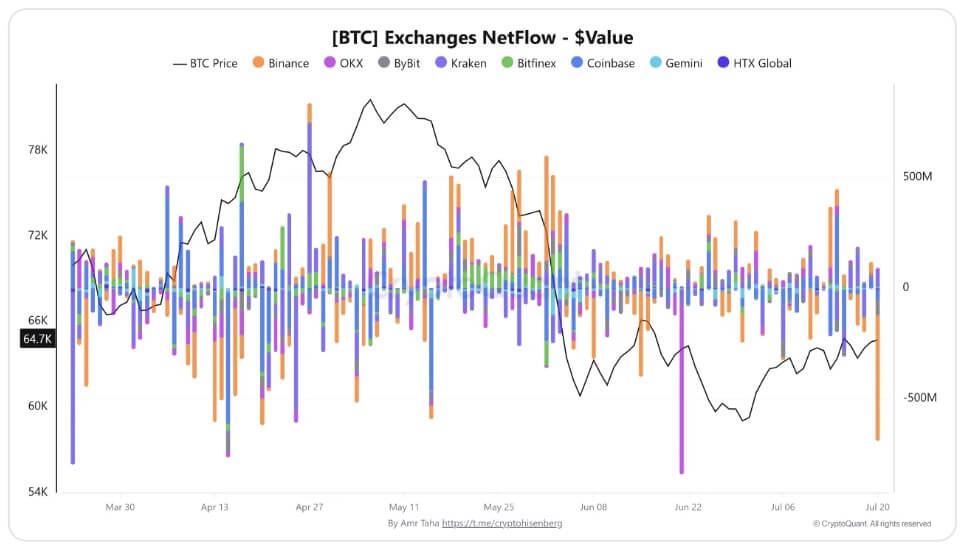
Parallel to the rise in ETF demand is a notable contraction in the available supply of Bitcoin on major cryptocurrency exchanges. On July 20, on-chain data from CryptoQuant revealed a sharp withdrawal of Bitcoin from several prominent trading platforms, totaling roughly $686 million. This "exchange net-flow" is often interpreted as a bullish indicator, as it suggests that investors are moving their assets into private "cold storage" for long-term holding, thereby reducing immediate sell-side pressure.
Binance, the world’s largest cryptocurrency exchange by volume, accounted for the lion’s share of these withdrawals, with approximately $570 million leaving its wallets—the largest single-day net outflow for the platform since April. Other exchanges also saw significant activity:
- Bybit: $65 million in net outflows.
- Coinbase: $48 million in net outflows.
- HTX: $3 million in net outflows.
While the reduction in exchange balances limits the liquid supply available for short-term trading, analysts caution against over-interpreting a single day of data. Axel Adler, an analyst at CryptoQuant, pointed out that the 30-day exchange net-flow indicator remains relatively close to its baseline. This suggests that while the July 20 event was significant, it has not yet shifted the broader monthly trend toward the deep, sustained outflows seen during the massive accumulation phases of 2023 and early 2024. As long as Bitcoin balances on exchanges remain near historical averages, the potential for sudden sell-offs remains a factor for market participants to consider.
The Liquidity Conundrum: Stablecoin Deficits
Despite the encouraging price action and supply-side constraints, a critical component of market health—purchasing power—remains tepid. Stablecoins, such as USDT and USDC, serve as the primary liquidity bridge for traders looking to enter Bitcoin positions. Recent data indicates that these dollar-pegged tokens are currently leaving exchanges faster than they are arriving.
The 30-day moving average of stablecoin net flows has recently dipped below negative $100 million. This drain on exchange-based liquidity implies that there is less "dry powder" available to absorb new Bitcoin supply or to support an extended push toward previous all-time highs. This shortage of crypto-native buying power could become a bottleneck if the current rally triggers a wave of profit-taking.
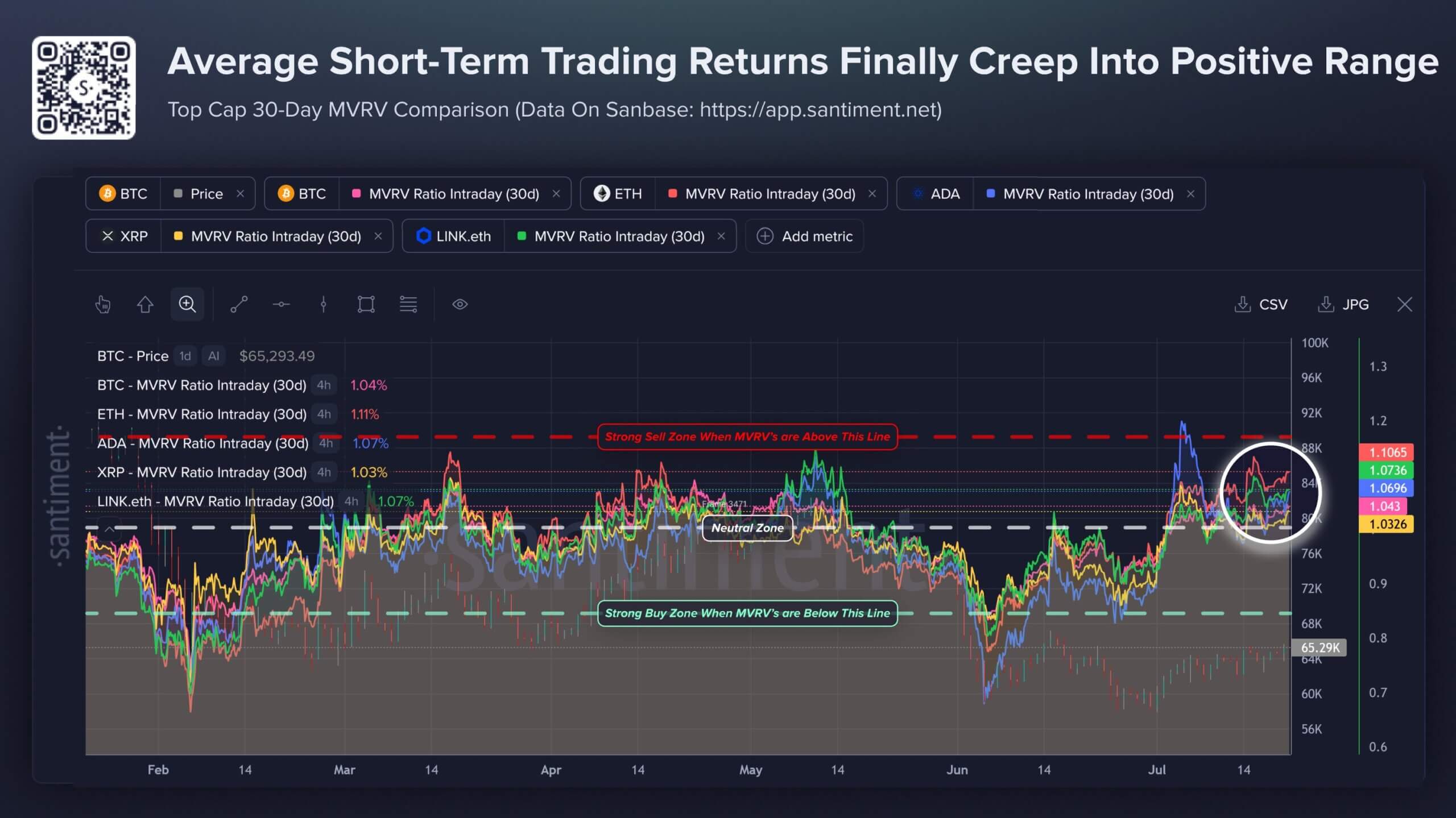
According to Santiment, Bitcoin’s 30-day market-value-to-realized-value (MVRV) ratio has moved back into positive territory. This means that the average wallet that acquired Bitcoin over the past month is now holding an unrealized gain. While the ratio is not yet at the "overheated" levels that typically precede a market crash, the move above neutral removes the "underwater" pressure that usually discourages short-term holders from selling. If these profitable traders begin to liquidate their holdings before stablecoin liquidity returns to the exchanges, the recovery could face a significant hurdle.
Geopolitical Headwinds and the Inflationary Threat
Beyond the internal mechanics of the digital asset market, Bitcoin is facing a complex external environment dominated by geopolitical tensions and macroeconomic uncertainty. The ongoing conflict in the Middle East has re-emerged as a primary concern for risk-on assets. On July 21, US Central Command (CENTCOM) confirmed a series of military strikes against Iranian-backed infrastructure, targeting command centers and missile launch sites. The operation was specifically designed to protect commercial shipping routes in the Strait of Hormuz, a narrow waterway through which approximately 20% of the world’s oil supply transits.
The potential for a sustained disruption in oil flows has significant implications for global inflation. While Brent crude recently traded near $88 a barrel amid hopes for a mediator-backed 10-day ceasefire, investment banks like Goldman Sachs have warned that prices could spike above $120 if the conflict escalates or the Strait of Hormuz remains contested.
For Bitcoin, a surge in energy prices represents a dual threat:
- Inflationary Pressure: Higher oil prices drive up transportation and production costs, complicating the path toward lower interest rates. If inflation expectations remain elevated, central banks—including the US Federal Reserve—may be forced to keep borrowing costs high for longer.
- Liquidity Contraction: High interest rates increase the yield on "safe" assets like government bonds, thereby reducing the pool of speculative capital available for high-risk assets like cryptocurrencies.
This macro-liquidity environment is particularly critical now, as Bitcoin requires a robust influx of capital to break through its next major technical resistance levels.
Technical Outlook: The Path to $72,200
As Bitcoin attempts to consolidate its gains above $66,000, technical analysts are focusing on two key price levels that define the current "transitional" market. The first is an adjusted market cost basis near $57,700, which acted as a reliable floor during the recent correction. The second is a recovery threshold situated near $72,200.
To reach this upper bound, Bitcoin would need to appreciate by approximately 9% from its current levels. Achieving this breakout would likely require a "perfect storm" of positive factors: continued institutional ETF inflows, a reversal of the negative stablecoin flow trend, and a stabilization of the geopolitical situation in the Middle East.
In summary, the Bitcoin market is currently in a state of fragile recovery. While the asset has successfully navigated the selling pressure that dominated the second quarter, the lack of robust buying liquidity and the looming threat of an energy-driven inflation shock suggest that the road to a new all-time high remains fraught with obstacles. Investors are advised to monitor exchange net flows and stablecoin movements closely as the market tests the durability of this latest advance.