James Watt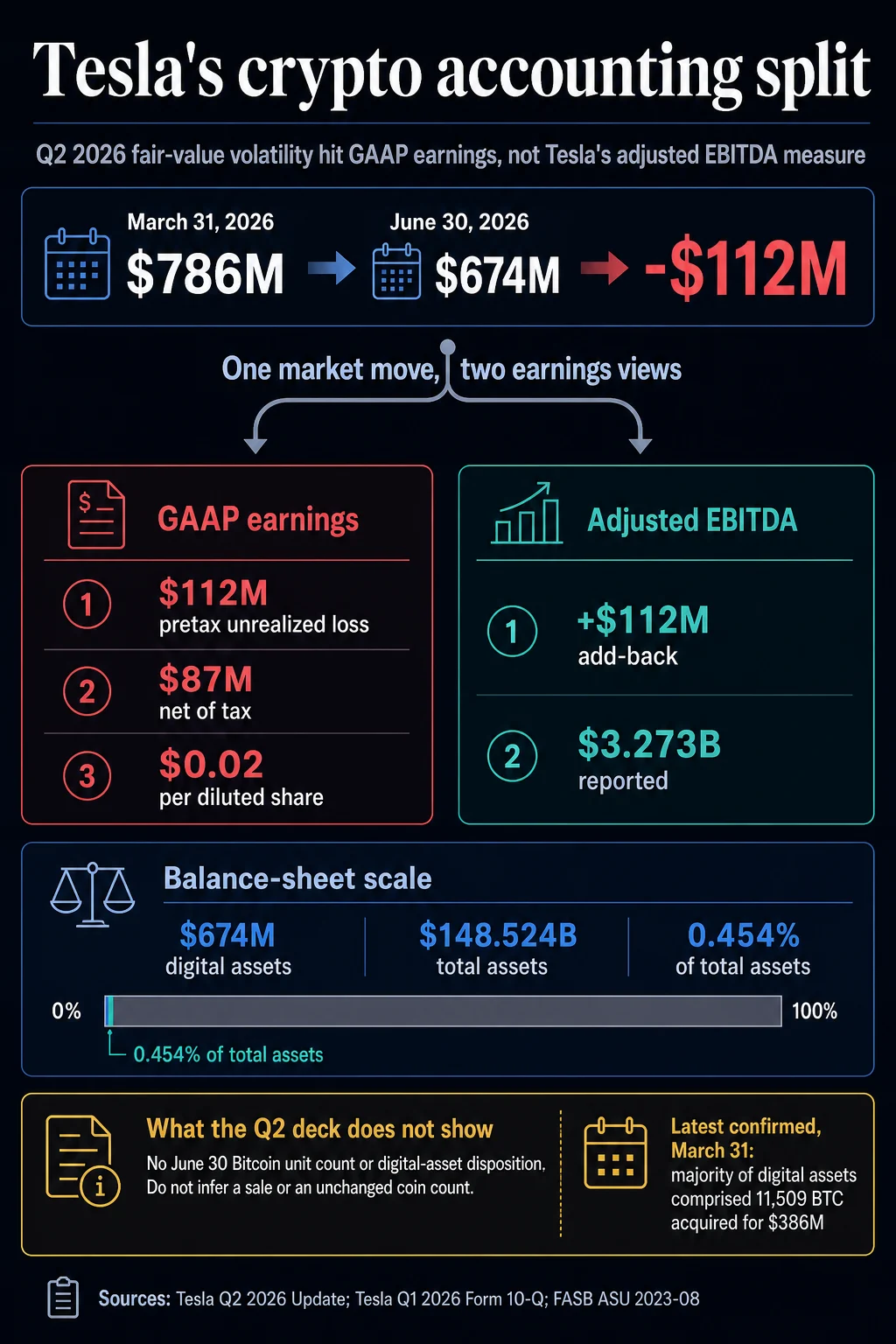
The automotive and clean energy giant Tesla Inc. disclosed a significant shift in the valuation of its digital asset holdings for the second quarter of 2026, recording a $112 million pretax unrealized loss attributed to a broader downturn in the cryptocurrency market. According to the company’s Q2 2026 shareholder update released on July 23, 2026, the carrying value of its digital assets—comprised primarily of Bitcoin—retreated to $674 million as of June 30, 2026. This represents a 14.2% decline from the $786 million valuation reported at the conclusion of the first quarter on March 31, 2026.
The financial impact of this market volatility was felt directly on the company’s bottom line under Generally Accepted Accounting Principles (GAAP). The $112 million pretax loss translated to a reduction in earnings for common stockholders of $87 million after taxes. On a per-share basis, the accounting adjustment resulted in a $0.02 drag on diluted earnings. Despite this headline-grabbing figure, the company’s operational performance metrics remained insulated through specific accounting reconciliations, highlighting the complex relationship between corporate treasuries and volatile digital assets.
The Accounting Mechanism: GAAP vs. Adjusted EBITDA
The reported loss is a direct consequence of the Financial Accounting Standards Board’s (FASB) updated crypto-asset standard, specifically ASU 2023-08. Under these regulations, companies holding certain digital assets must measure them at fair value during each reporting period. Unlike the previous "impairment-only" model—where companies could only record losses when the price dropped but could not record gains until an asset was sold—the current fair-value symmetry requires companies to recognize both unrealized gains and losses in their net income.
This accounting treatment introduces a degree of volatility into Tesla’s GAAP earnings that is decoupled from its core business of manufacturing electric vehicles and energy storage systems. To provide investors with a clearer view of its operational health, Tesla utilized a non-GAAP reconciliation. In its Q2 report, the company added the full $112 million digital-asset loss back into its calculation for adjusted EBITDA (Earnings Before Interest, Taxes, Depreciation, and Amortization).
By excluding the "paper loss," Tesla’s adjusted EBITDA reached $3.273 billion for the quarter. This maneuver emphasizes that the decline in Bitcoin’s price did not result in a cash outflow from the business, nor did it impact the company’s ability to fund its research, development, or manufacturing expansions. For institutional investors, this distinction is critical, as it separates the speculative nature of the company’s treasury holdings from its fundamental industrial output.
Chronology of Tesla’s Bitcoin Strategy
Tesla’s journey into the cryptocurrency space has been one of the most closely watched corporate treasury experiments in history. The timeline of their involvement provides essential context for the current Q2 2026 results:

- February 2021: Tesla announced a landmark $1.50 billion investment in Bitcoin, signaling a major shift in corporate adoption. At the time, the company also stated it would begin accepting Bitcoin as payment for its vehicles, a policy that was later suspended due to environmental concerns regarding Bitcoin mining.
- Q1 2021: Shortly after its initial purchase, Tesla sold approximately 10% of its holdings to "prove liquidity," netting a small profit.
- Q2 2022: Amidst a broader market contraction and the need for cash during COVID-related lockdowns in China, Tesla sold approximately 75% of its Bitcoin holdings. This sale added $936 million in cash to its balance sheet.
- 2023–2025: The company maintained a relatively stable position, holding roughly 11,509 BTC. During this period, the accounting treatment shifted toward fair-value reporting, leading to significant fluctuations in reported net income.
- Q4 2024: Tesla benefited from a massive crypto rally, which added a $600 million lift to its GAAP net income, illustrating the "double-edged sword" of the fair-value accounting standard.
- Q2 2026: The current reporting period marks a reversal of previous gains, with the $112 million loss reflecting the cyclical nature of the digital asset market.
Analyzing the Scale of Exposure
While a $112 million loss is substantial in absolute terms, it remains a relatively minor component of Tesla’s overall financial architecture. As of June 30, 2026, Tesla reported total assets of $148.524 billion. The $674 million in digital assets represents only 0.454% of the company’s total asset base.
This percentage indicates that Tesla is not operating as a "Bitcoin treasury" company in the vein of MicroStrategy, where the corporate strategy is fundamentally linked to the accumulation and performance of Bitcoin. Instead, Tesla treats its digital assets as a diversified component of its cash management strategy. The company’s primary focus remains on its capital-intensive projects, including the ramp-up of the Cybertruck, the development of its next-generation vehicle platform, and the expansion of its artificial intelligence and robotics divisions.
Data derived from the March 31, 2026, filing indicated that Tesla’s 11,509 BTC were originally acquired for an aggregate cost of $386 million. Despite the $112 million paper loss in the most recent quarter, the total carrying value of $674 million suggests that Tesla’s Bitcoin position remains significantly "in the money" compared to its initial acquisition cost. The company has essentially realized a massive theoretical gain since 2021, though the quarterly reporting cycle forces it to acknowledge short-term price retractions.
Market Context and Investor Reaction
The Q2 2026 crypto slump was not unique to Tesla. The broader digital asset market faced headwinds during this period, driven by shifting macroeconomic indicators and regulatory uncertainty. While Tesla’s shareholder update did not disclose the specific reasons for the market decline, analysts have pointed toward a cooling of institutional appetite and a "risk-off" sentiment in global markets during the early summer months of 2026.
Investor reaction to the news has been largely muted, as the market has become accustomed to the "accounting noise" generated by Tesla’s crypto holdings. Financial analysts typically strip out these unrealized gains and losses when evaluating Tesla’s price-to-earnings (P/E) ratio and other valuation metrics. The focus for Wall Street remains on Tesla’s automotive gross margins and its progress in Full Self-Driving (FSD) technology.
However, the disclosure serves as a reminder of the inherent risks of corporate crypto adoption. While Bitcoin offers the potential for high returns and a hedge against fiat currency debasement, it also introduces a level of volatility that can obscure a company’s true financial performance in GAAP-compliant reports.
Implications for Corporate Treasuries
Tesla’s experience in Q2 2026 provides a case study for other CFOs considering digital asset allocations. The adoption of FASB’s fair-value rules has made the financial reporting of Bitcoin more transparent but also more volatile. For many conservative corporations, this volatility remains a significant barrier to entry.

The fact that Tesla added the loss back to its adjusted EBITDA suggests a standard path forward for other public companies: acknowledge the market-driven fluctuations in GAAP filings but emphasize "cash-flow-neutral" metrics in communications with shareholders. This approach allows companies to maintain exposure to the digital economy without being penalized by analysts for price swings that do not affect the core business’s solvency.
Furthermore, the lack of a Form 10-Q filing at the time of the Q2 update leaves some questions unanswered. Investors are awaiting the primary filing to see if there were any changes to the actual unit count of Bitcoin held by the company. The change in carrying value from $786 million to $674 million could theoretically be caused by a sale of assets, though the magnitude of the drop aligns closely with the general market decline during that window, suggesting the position size remained static.
Future Outlook
As Tesla moves into the second half of 2026, its digital asset portfolio will continue to be a source of variability in its quarterly earnings reports. If the cryptocurrency market recovers in the third quarter, Tesla is likely to report an unrealized gain of similar or greater magnitude, which will once again boost its GAAP net income while being excluded from adjusted EBITDA.
The company’s long-term commitment to Bitcoin remains a subject of speculation. While Elon Musk has historically been a proponent of digital assets, Tesla’s management has shown a willingness to liquidate holdings when cash needs arise. For now, the 11,509 BTC represent a "wait-and-see" position. The $674 million balance is a testament to the company’s early entry into the space, yet its small share of the total balance sheet ensures that the "Technoking" of Tesla is not betting the entire farm on the future of decentralized finance.
In summary, the $112 million paper loss is a significant accounting event that reflects the current state of the crypto market, but it does not signal a change in Tesla’s fundamental business strategy or its financial stability. As long as Tesla continues to hold Bitcoin, its quarterly reports will serve as a barometer for the intersection of traditional corporate finance and the emerging digital asset class.