James Watt
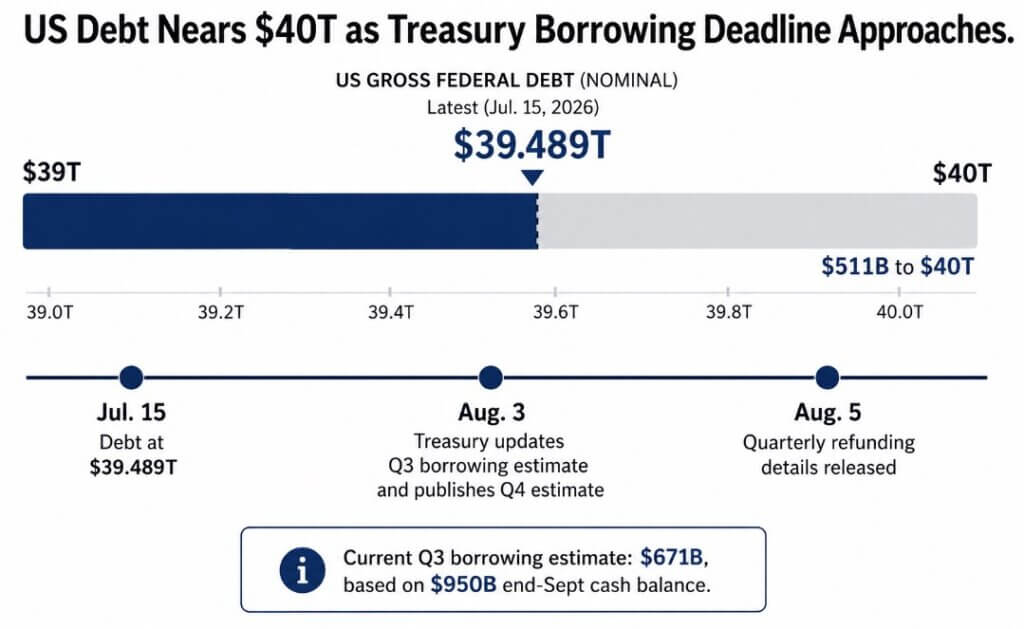
The United States gross federal debt reached a historic $39.489 trillion on July 15, moving the nation within approximately $511 billion of the psychologically and economically significant $40 trillion threshold. This rapid accumulation of sovereign obligations comes at a critical juncture for global financial markets, as the Department of the Treasury prepares to release updated borrowing estimates and refunding plans that will dictate the flow of liquidity for the remainder of the year. For proponents of digital assets, this escalating debt serves as a primary catalyst for the "fixed-supply" argument surrounding Bitcoin, positioning the cryptocurrency as a potential hedge against the long-term devaluation of fiat currency and the systemic risks associated with fiscal expansion.
The current debt total reflects a complex web of financial obligations, including outstanding marketable securities, intragovernmental holdings, and the ongoing effects of Federal Reserve portfolio adjustments. As the Treasury navigates these requirements, the upcoming quarterly refunding cycle is expected to provide clarity on how the government intends to manage its massive funding needs. The intersection of record-breaking debt levels and the tightening of global liquidity has created a high-stakes environment for investors, who must now weigh the contractual returns of government bonds against the scarcity-driven appeal of decentralized assets.
The Treasury’s Strategic Borrowing Framework
The Department of the Treasury currently anticipates borrowing $671 billion in privately held net marketable debt during the July-to-September quarter. This projection is fundamentally linked to a targeted end-of-September cash balance of $950 billion in the Treasury General Account (TGA). The TGA serves as the government’s primary operating account at the Federal Reserve; when the Treasury increases its cash balance through borrowing, it effectively removes liquidity from the private banking system until that capital is redeployed through federal spending.
On August 3, the Treasury is scheduled to revise this third-quarter figure and provide its inaugural estimate for the October-through-December period. This update is more than a mere accounting exercise; it establishes the expected borrowing total that the market must absorb. Following this, on August 5, the full quarterly refunding package will be released, detailing the specific distribution of financing across various instruments, including Treasury bills, notes, bonds, floating-rate notes, and Treasury Inflation-Protected Securities (TIPS).
The composition of this issuance is vital for market stability. A higher concentration of "coupons"—longer-duration notes and bonds—requires investors to take on more duration risk, which is the sensitivity of a bond’s price to changes in interest rates. If the volume of securities exceeds what private investors are willing or able to absorb at current prices, yields must rise to attract buyers, potentially exerting downward pressure on risk assets like Bitcoin.
Understanding the Transmission Mechanism to Bitcoin
The relationship between Treasury supply and Bitcoin is primarily facilitated through bond yields and the "term premium." According to Federal Reserve research published in May, a one-percentage-point increase in the expected US debt-to-GDP ratio adds approximately 2 to 3 basis points to the 10-year Treasury term premium. As the total debt nears $40 trillion, the sheer scale of supply can drive yields higher regardless of the Federal Reserve’s benchmark interest rate policy.

Higher Treasury yields present a direct challenge to Bitcoin because the cryptocurrency is a non-yielding asset. When the 10-year Treasury yield sits near 4.60%, as it did in late July, the opportunity cost of holding Bitcoin increases. Investors who might otherwise allocate capital to BTC may instead opt for the "risk-free" contractual returns offered by the US government. Furthermore, a heavy borrowing requirement often strengthens the US dollar by tightening dollar liquidity. Because Bitcoin is globally priced against the dollar, a firmer greenback acts as a mathematical and psychological headwind for the digital asset’s price.
As of late July, the two-year Treasury yield stood at 4.16%, the 10-year at 4.57%, and the 30-year at 5.09%. These levels offer substantial competition for capital. Bitcoin, which recently touched $66,190—its highest level since mid-June—remains highly sensitive to any upward shifts in the yield curve that might result from the Treasury’s early-August announcements.
Liquidity Dynamics and the Treasury General Account
The source of the Treasury’s funding is as important as the amount being borrowed. When the government issues short-term Treasury bills, it often draws on cash held in money-market funds. Historically, these funds have utilized the Federal Reserve’s Overnight Reverse Repurchase (ON RRP) facility. However, the Fed has reported near-zero ON RRP usage on many days in 2026, indicating that the "buffer" of idle cash has largely been depleted.
With approximately $3.1 trillion in bank reserves remaining, the market must now rely more heavily on bank deposits and asset sales to fund Treasury auctions. If the Treasury raises its cash target above the current $950 billion assumption, it could lead to a "liquidity drain" from the banking system. This tightening of the monetary environment usually correlates with lower volatility but also lower price appreciation for speculative assets.
Bitcoin’s saving grace in this environment has been the consistent demand from US-traded spot Bitcoin ETFs. Between July 14 and July 17, these funds saw net inflows of $500.2 million, reversing a significant outflow from earlier in the month. This institutional demand provides a "buffer" against macro-driven sell-offs, as it represents a structural shift in how capital enters the Bitcoin ecosystem. If ETF inflows remain robust, they may offset the liquidity pressure generated by the Treasury’s borrowing needs.
Chronology of Key Fiscal Events in August
Investors are closely monitoring a specific timeline of events that will likely dictate market direction for the remainder of the third quarter:
- August 3: Borrowing Estimate Revision. The Treasury will announce if the $671 billion requirement for Q3 needs to be increased. A significant upward revision would likely signal higher yields.
- August 3: Q4 Projections. The first look at the October-December borrowing requirement. If this figure exceeds market expectations, it suggests a prolonged period of supply-side pressure.
- August 5: Refunding Details. This announcement specifies the "issuance mix." Markets prefer a higher percentage of short-term bills over long-term bonds to minimize duration risk.
- Mid-August: Auction Results. The actual performance of the auctions following the refunding announcement will reveal the depth of investor appetite for US debt.
Long-Term Fiscal Projections and the Scarcity Thesis
The immediate market volatility surrounding borrowing estimates is set against a backdrop of deteriorating long-term fiscal health. The Congressional Budget Office (CBO) currently projects a $1.9 trillion federal deficit for the 2026 fiscal year. Looking further ahead, the CBO estimates that publicly held federal debt will reach 120% of the US Gross Domestic Product (GDP) by 2036.
These projections are the primary drivers of the "Bitcoin as digital gold" narrative. Unlike the US dollar, which can be expanded through Treasury issuance and central bank policy, Bitcoin has a hard cap of 21 million coins. As the debt-to-GDP ratio climbs, the risk of "fiscal dominance"—a situation where the central bank must keep interest rates low or purchase debt to prevent government insolvency—increases. In such a scenario, traditional currency loses purchasing power, whereas fixed-supply assets theoretically retain or gain value.
Market Implications: Bull and Bear Scenarios
The early-August Treasury announcements will likely lead to one of two primary outcomes for the broader financial markets and Bitcoin specifically.
The Bullish Path:
In the bullish scenario, the Treasury maintains its Q3 borrowing estimate at or below $671 billion and keeps the TGA cash target at $950 billion. If the Q4 estimate also comes in lower than expected, it would signal that the government’s cash needs are stabilizing. A financing package that favors short-term bills would keep long-term yields from rising, potentially allowing the 10-year yield to fall. This would weaken the dollar and provide a tailwind for Bitcoin, allowing it to hold the $65,000 support level and continue its upward trajectory toward previous all-time highs.
The Bearish Path:
Conversely, the bearish scenario involves an upward revision of the Q3 estimate and a large Q4 requirement. If the Treasury decides to increase the TGA target above $950 billion, it would signal an aggressive withdrawal of liquidity from the markets. Furthermore, if the August 5 issuance mix includes larger-than-expected coupon sizes, the 10-year yield could spike above 4.6%, raising the opportunity cost for Bitcoin. Combined with a strengthening dollar and potential ETF redemptions, this could force Bitcoin to break below its recent support ranges, testing the resolve of late-cycle buyers.
Conclusion
The march toward $40 trillion in gross federal debt is more than a symbolic milestone; it is a testament to the escalating scale of the US fiscal challenge. As the Treasury prepares its next round of borrowing, the mechanical impact on yields, liquidity, and the US dollar will serve as a rigorous test for the global financial system. For Bitcoin, the coming weeks represent a pivotal moment. The digital asset must prove that its scarcity value can withstand the gravity of rising interest rates and the liquidity-draining effects of massive sovereign debt issuance. Whether Bitcoin holds its ground or succumbs to macro pressure, the events of early August will provide a clear window into the future of the relationship between traditional fiscal policy and the burgeoning world of digital finance.