James Watt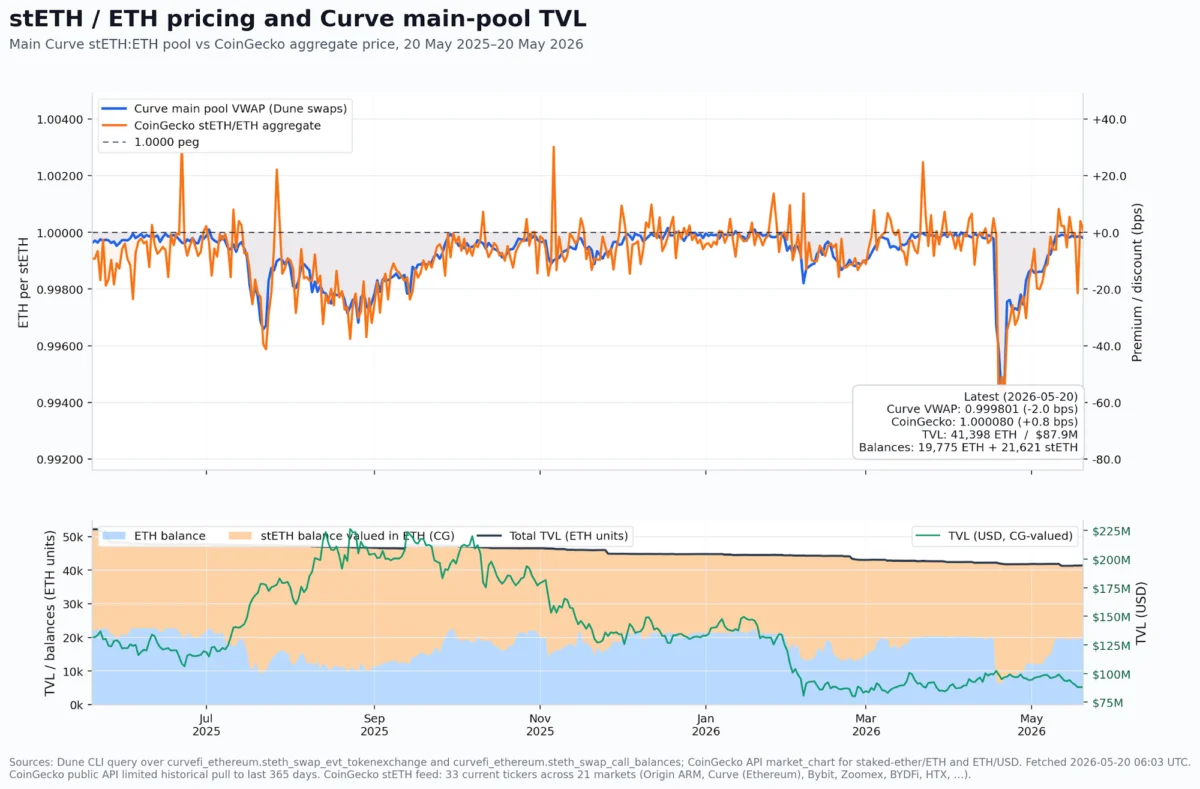
The April 2026 KelpDAO rsETH exploit presented a significant external shock to the burgeoning restaking and ETH-denominated lending markets, critically testing the stability and functionality of a cornerstone asset in the decentralized finance (DeFi) ecosystem. While the incident sent ripples across interconnected protocols, leading to notable price movements and increased market depth costs for stETH, the core asset itself demonstrated remarkable resilience, maintaining functionality and integrity throughout the tumultuous period. This analysis focuses specifically on the performance of secondary-market stETH and its wrapped counterpart, wstETH, during the KelpDAO incident, underscoring their ability to navigate severe external pressures. It is crucial to distinguish that this examination does not delve into user outcomes within KelpDAO or EarnETH, but rather hones in on the narrower yet vital point: stETH and wstETH were not the compromised asset path, and comprehensive market data clearly illustrated their inherent robustness under a significant external shock.
The Evolving Landscape of Liquid Staking and Restaking
To fully appreciate the implications of the KelpDAO incident, it is essential to understand the foundational role of liquid staking tokens (LSTs) like stETH and the emergent complexities of restaking. Liquid staking emerged as a pivotal innovation following Ethereum’s transition to Proof-of-Stake, allowing users to stake their ETH and receive a liquid, yield-bearing token in return. This not only maintains capital efficiency by freeing up staked assets for use across DeFi but also decentralizes staking power away from centralized exchanges. Lido Finance, through its stETH token, has become the largest liquid staking protocol, establishing stETH as a primary collateral asset, a liquidity provider, and a building block for numerous DeFi strategies. Its deep integration across lending protocols, decentralized exchanges (DEXs), and derivative platforms has cemented its status as a critical component of the Ethereum economy.
Restaking, a more recent innovation, builds upon this foundation by allowing users to repurpose their staked ETH or LSTs (like stETH) to secure additional protocols and earn extra rewards. This mechanism promises to extend Ethereum’s security budget to a broader array of decentralized applications, enhancing the overall cryptoeconomic security of the ecosystem. However, restaking introduces new layers of complexity and interconnectedness, particularly when combined with cross-chain bridging solutions. These bridges, designed to facilitate asset transfers between different blockchain networks, are inherently complex and represent a significant attack surface if not implemented with the utmost security. The rapid growth of both liquid staking and restaking has led to a highly interconnected DeFi landscape where a vulnerability in one protocol can cascade effects across many others, making the resilience of core assets like stETH paramount.
A Major External Shock: The KelpDAO Exploit Chronology
The events of April 2026 unfolded rapidly, casting a shadow of uncertainty over the nascent restaking sector.
April 18, 2026: The Exploit Unfolds
On this pivotal day, attackers successfully exploited a vulnerability within KelpDAO’s LayerZero-based rsETH bridge path. Public post-incident analysis subsequently pinpointed the root cause as a cross-chain verification failure. This critical flaw allowed approximately 116,500 rsETH, valued at roughly $292 million at the time, to be spuriously released on the Ethereum blockchain without a corresponding burn on the source chain. In essence, new rsETH was minted without backing, creating an immediate and substantial imbalance. The immediate stress channel was clearly identified: it was directed at restaking collateral and lending-market exposure associated with rsETH, rather than Lido’s core staking infrastructure or the stETH asset itself.
Immediate Aftermath: Market Contagion and Differentiation
The distinction between the compromised asset (rsETH) and the unaffected underlying liquid staking token (stETH) proved to be a crucial element in mitigating broader systemic risk. While the exploit undeniably triggered market-wide anxiety and prompted a repricing of risk across the DeFi ecosystem, market participants largely demonstrated the ability to differentiate between a failure in a specific cross-chain restaking asset path and the robust liquidity profile of stETH as Ethereum’s largest liquid staking token. This discernment was vital in preventing a deeper contagion effect.
Lido’s internal protocol mechanics functioned exactly as intended throughout the crisis. Crucially, these mechanics did not contribute in any way to the market volatility that followed the KelpDAO incident. In fact, during this period, the Lido protocol successfully processed one of the largest periods of net ETH outflows in its history, further demonstrating its operational stability and the reliability of its withdrawal mechanism. This ability to handle significant redemptions under duress provided a critical safety valve and reinforced confidence in stETH’s underlying peg.
Market Repricing and Subsequent Recovery (April 18 – May 20, 2026)
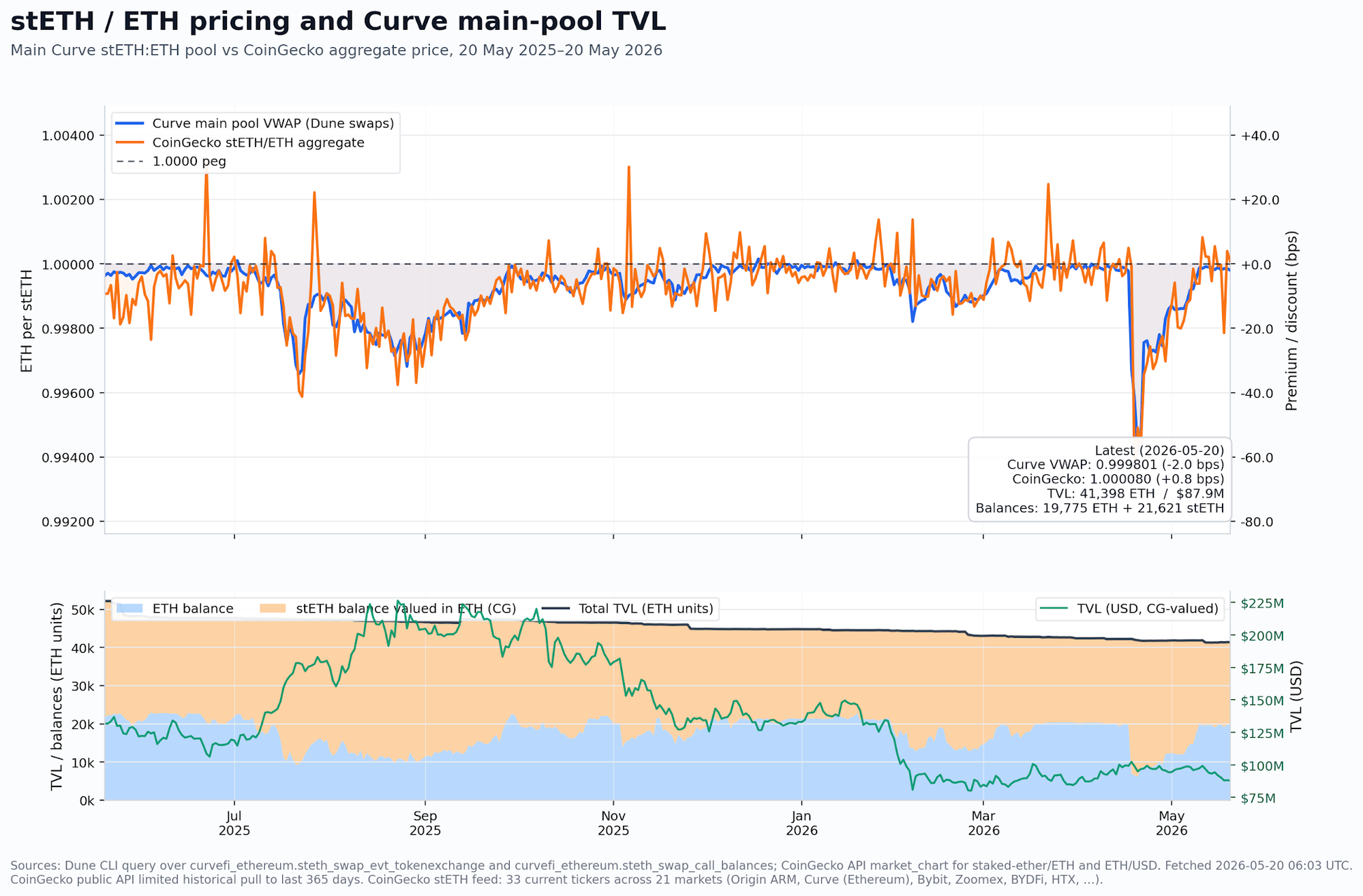
The market’s initial reaction saw stETH pricing dip, reflecting generalized risk aversion and increased selling pressure. During the critical stress window from April 18 to April 28, the daily Volume-Weighted Average Price (VWAP) in the Curve main-pool, a primary liquidity hub for stETH/ETH, reached a low of approximately 0.9941 ETH per stETH. This represented a deviation of about -59 basis points (bps) from parity. Concurrently, CoinGecko’s aggregate stETH/ETH pricing registered a comparable low of approximately 0.9934, mirroring the sentiment in the most liquid markets.
However, the market’s ability to distinguish the localized nature of the exploit from stETH’s fundamental soundness quickly paved the way for recovery. By May 20, less than a month after the incident, the Curve main-pool VWAP had largely returned to parity, settling at 0.99980. Similarly, CoinGecko’s aggregate price had rebounded to 1.00008, effectively erasing the temporary discount. This rapid and complete recovery underscored the market’s underlying confidence in stETH and its ecosystem. Figure 1, illustrating stETH/ETH pricing and Curve main-pool TVL, visually corroborates this trend, showing a temporary dip followed by a swift return to normal levels. The chart, derived from Dune and CoinGecko API data, effectively demonstrates both the price behavior and the underlying liquidity base that supported this recovery.
The True Test: Liquidity Depth Remained Actionable
While headline prices offer a snapshot of market sentiment, they can sometimes mask underlying issues with execution quality. In times of stress, liquidity depth emerges as a more accurate and useful metric for assessing market health. A stable headline price is less meaningful if large trades cannot be executed without significant slippage. For this reason, analyzing the cost of executing substantial trades provides deeper insight into an asset’s resilience.
During the KelpDAO incident, the market for wstETH (wrapped stETH, which maintains a 1:1 peg to stETH and accrues rewards) demonstrated its ability to absorb significant sell orders without a complete evaporation of liquidity. Prior to the exploit, the median daily quote impact for a $1 million fixed-sell wstETH quote on the Ethereum mainnet was a remarkably low -0.1 basis points. This indicated highly efficient execution with minimal slippage for substantial transactions.
In the 30 days leading up to the exploit, the market exhibited consistent, robust liquidity. However, during the 10-day stress window immediately following the KelpDAO incident, the median daily quote impact for the same $1 million wstETH sell order moved to -5.0 bps. Furthermore, the 7-day moving average of this metric reached a trough of -15.9 bps. Figure 2, which visualizes the quote impact for a $1 million fixed-sell wstETH quote on Ethereum mainnet as a 7-day moving average, clearly illustrates this temporary, but measurable, increase in execution cost. (Source: Lido Dune query 5965996 / 9625248).
This increase in execution cost, from -0.1 bps to -5.0 bps (median) and a trough of -15.9 bps (7-day moving average), represented a real and noticeable rise in the expense of offloading a significant amount of wstETH. Yet, critically, it was not indicative of a disappearance of liquidity. For a major external exploit directly affecting restaking collateral and the utilization of lending markets, the wstETH/ETH execution remained measurable, routable, and interpretable. This signifies that even under duress, the market mechanisms functioned, allowing large participants to adjust their positions without triggering a liquidity spiral or complete market freeze. The ability to still execute multi-million dollar trades, albeit at a higher cost, is a testament to the underlying robustness of stETH’s market infrastructure.
Why stETH Remained Comparatively Resilient: A Multi-faceted Analysis
Several key factors converged to enable stETH to demonstrate such resilience during the KelpDAO crisis:
- Unaltered Protocol Integrity: Fundamentally, the Lido protocol itself remained uncompromised. The exploit targeted a derivative asset (rsETH) and its specific cross-chain bridging mechanism, not Lido’s core smart contracts, staking infrastructure, or the stETH token design. This clear distinction was vital for market participants to differentiate systemic risk from localized failure.
- Deep and Decentralized Liquidity: stETH benefits from years of ecosystem integration, resulting in vast liquidity pools distributed across multiple decentralized exchanges, primarily the Curve main-pool, but also Uniswap and other platforms. This broad distribution of liquidity means that no single point of failure or single market maker can cripple the asset’s tradability. The sheer volume of stETH held and traded provides a substantial buffer against sudden selling pressure.
- Transparent On-Chain Pricing and Data: The open and transparent nature of blockchain transactions allowed market participants to monitor stETH’s health, pricing, and liquidity in real-time. This immediate access to verifiable data enabled informed decision-making and helped prevent rumors or misinformation from unduly exacerbating market panic. Dune Analytics queries, as cited in the original report, play a crucial role in providing this transparency.
- Extensive Ecosystem Integration: stETH is not just a token; it’s a foundational asset interwoven into the fabric of numerous DeFi strategies. It serves as collateral for stablecoin minting (e.g., MakerDAO), a lending asset on platforms like Aave and Compound, and a component in complex yield-farming strategies. This deep integration means a large base of users and protocols rely on its stability, creating a strong incentive for the market to maintain its peg and liquidity.
- Market Participant Sophistication: The crypto market, despite its volatility, has matured to a point where many participants can distinguish between different layers of risk. The ability to recognize that the KelpDAO exploit was a risk specific to restaking derivatives and cross-chain bridges, rather than a fundamental flaw in liquid staking itself, was critical in preventing a broader flight from stETH.
- Lido’s Robust Withdrawal Mechanism: Lido’s protocol allows for direct ETH withdrawals, providing an essential backstop for stETH’s peg. If stETH were to significantly de-peg for an extended period, an arbitrage opportunity would emerge, encouraging users to buy discounted stETH, redeem it for ETH via Lido’s protocol, and sell the ETH for a profit, thereby helping to restore the peg. The successful processing of significant outflows during the incident reinforced the reliability of this mechanism.
Statements and Industry Reactions
While the original article does not provide direct quotes, the market’s response and the subsequent recovery of stETH suggest a collective sentiment of measured confidence within the DeFi ecosystem. Industry analysts broadly observed that the incident, while serious, served as a crucial stress test for the burgeoning restaking sector. Lido representatives, through their continued operational transparency and the seamless functioning of their protocol, implicitly underscored the integrity of stETH. The broader DeFi community, including major integrators and liquidity providers, tacitly affirmed stETH’s foundational role by continuing to provide liquidity and rebuild positions once the initial shock subsided. The overall message from the market was one of vigilance towards complex derivatives and cross-chain solutions, balanced with sustained trust in established, robust assets like stETH.
Broader Implications for DeFi and Restaking
The KelpDAO incident carries significant implications for the future development and stability of the decentralized finance landscape, particularly concerning restaking and cross-chain interoperability.
- Lessons Learned in Security for Restaking: This exploit serves as a stark reminder of the inherent risks associated with stacking multiple layers of abstraction and security, especially when involving cross-chain bridges. It will undoubtedly lead to increased scrutiny, enhanced auditing requirements, and a demand for more robust security architectures within restaking protocols. Future restaking solutions are likely to prioritize extreme caution in their bridging implementations.
- Strengthening Confidence in Core LSTs: For stETH specifically, weathering such a significant storm could paradoxically strengthen its position. Its resilience under pressure acts as a powerful testament to its design, liquidity, and integration. This could solidify its status as a premier collateral asset, attracting even greater trust from institutional and retail participants who prioritize stability.
- Risk Differentiation and Market Maturity: The market’s ability to largely isolate the impact of the exploit to rsETH rather than causing a systemic collapse across all LSTs demonstrates a growing sophistication. This ability to differentiate risk between derivative assets and their underlying components is a hallmark of a maturing financial system, even within the nascent crypto space.
- Regulatory Scrutiny: Incidents of this magnitude inevitably attract the attention of regulators worldwide. The industry’s capacity to self-correct, maintain market functionality, and differentiate risks will be crucial in shaping future regulatory frameworks. The resilience shown by stETH could offer a positive narrative for the industry, showcasing its ability to absorb shocks without complete meltdown.
- Evolution of Cross-Chain Solutions: The exploit highlights the critical need for innovation and enhanced security in cross-chain bridging. Projects developing these vital interoperability layers will likely redouble their efforts to build more secure, verifiable, and resilient solutions, potentially favoring more decentralized and less trust-reliant designs.
The Takeaway: Resilience Where It Matters Most
The KelpDAO incident of April 2026 provided an invaluable, real-world stress test for the stETH ecosystem, vividly illustrating why liquidity must be evaluated not merely under quiescent market conditions, but, more importantly, when markets are under severe duress. For stETH, the event unequivocally demonstrated that a combination of deep secondary markets, transparent on-chain pricing, and wide ecosystem integration can effectively absorb a severe external shock without compromising the integrity or functionality of the core staking asset. While pricing certainly moved and execution costs undeniably rose, the market for stETH remained remarkably functional throughout the ordeal.
This positive outcome is not accidental but rather the culmination of years of diligent liquidity building and strategic ecosystem integration around stETH, establishing it as a foundational Ethereum asset. This intrinsic advantage serves users, integrators, and protocols that rely on staking collateral to remain useful and liquid, not only during periods of calm market activity but, crucially, when the markets are under immense pressure. The ability to maintain functionality in the face of adversity reinforces stETH’s position as a robust and reliable component of the decentralized financial landscape, affirming its role as a bedrock asset capable of navigating the unpredictable currents of the crypto economy. Continued vigilance, security enhancements, and robust market infrastructure will remain paramount as the DeFi ecosystem continues its rapid evolution.