James Watt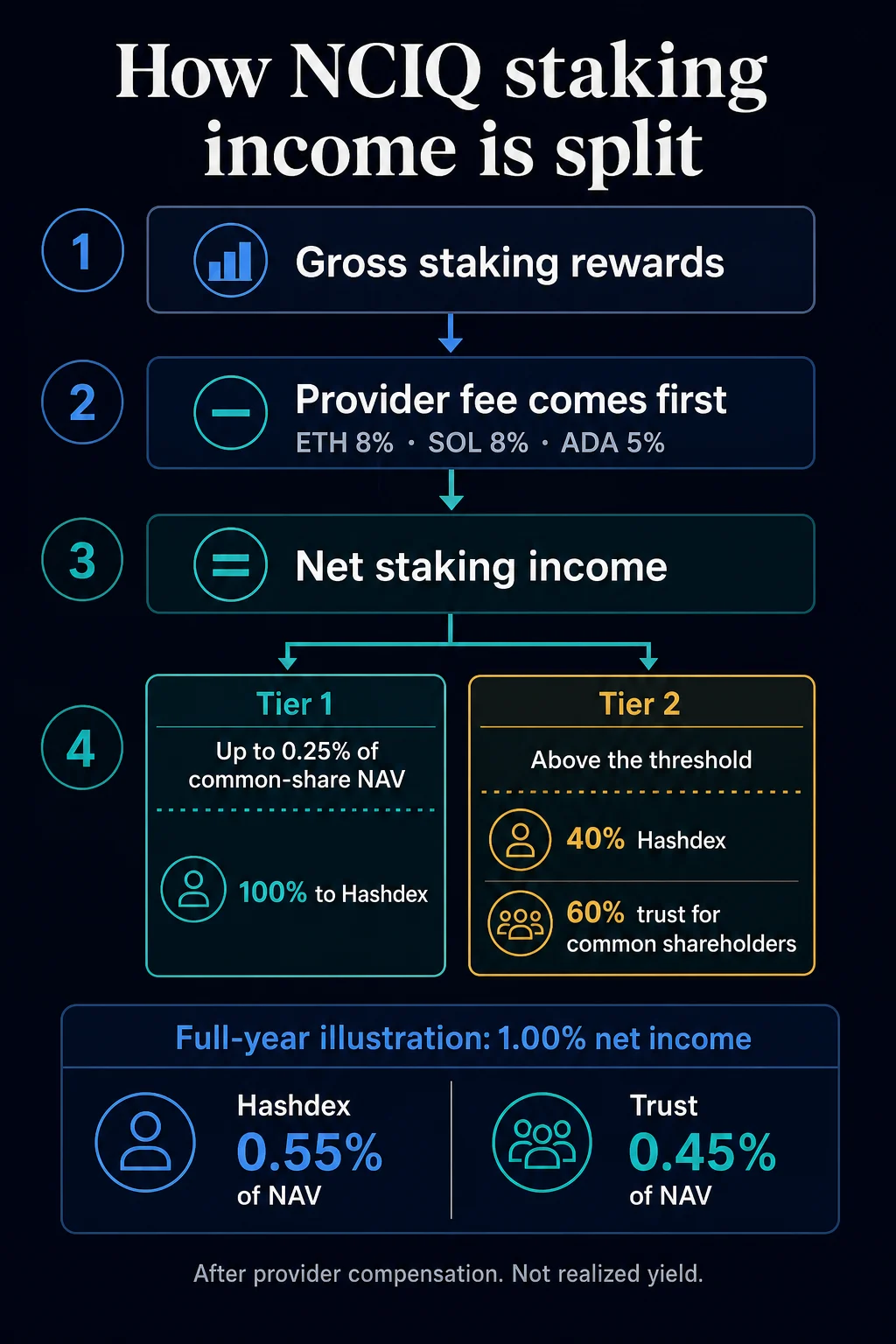
Hashdex, a prominent digital asset management firm, has introduced a sophisticated and novel revenue-sharing model for its Nasdaq CME Crypto Index ETF (NCIQ), marking a significant evolution in how exchange-traded funds handle the rewards generated from Proof-of-Stake (PoS) digital assets. According to recent regulatory filings, the fund manager intends to utilize a portion of the cryptocurrency held within the trust to participate in network staking, a process that generates rewards for securing blockchain networks. However, the distribution of these rewards follows a tiered structure that prioritizes the fund sponsor and operational costs before common shareholders receive any portion of the yield. This development comes as the competitive landscape for crypto ETFs shifts from simple price tracking to "yield-enhanced" products that seek to capture the native returns of the underlying protocols.
The Mechanics of the NCIQ Staking Reward Structure
The operational framework for NCIQ’s staking activities is governed by a specific hierarchy of payments. Before any income is allocated to the trust or the sponsor, the staking provider—initially identified as Coinbase Cloud—retains a predetermined percentage of the gross rewards. These provider fees vary depending on the specific asset: 8% for Ether (ETH) and Solana (SOL), and 5% for Cardano (ADA). These fees cover the technical infrastructure, validator maintenance, and security measures required to participate in network consensus.
Once the provider fees are deducted, the remaining "net staking income" enters a multi-stage allocation process involving Hashdex and the public shareholders. Under the terms of a July 23 prospectus supplement, Hashdex is entitled to receive 100% of the net staking income up to an annual threshold equal to 0.25% of the common-share Net Asset Value (NAV). This income is directed to Hashdex through a specialized "Sponsor Share," an unlisted class of equity held exclusively by the manager.
Crucially, this 0.25% threshold is calculated on a fiscal-year basis and is prorated for partial years. If the net staking income generated by the fund’s assets fails to exceed this 0.25% mark, common shareholders receive no portion of the staking rewards. If, however, the income exceeds this threshold, the surplus is divided, with 40% going to Hashdex and the remaining 60% flowing back into the trust for the benefit of NCIQ common shareholders. This "excess" income effectively acts as a performance-based incentive for the manager while providing a secondary yield stream for investors.
Illustrating the Economic Impact on Shareholders
To understand the practical implications of this fee structure, it is necessary to examine an illustrative scenario. If the NCIQ fund manages to generate a net staking income of 1.00% of the common-share NAV over a full year after all provider fees have been paid, the distribution would be bifurcated. Hashdex would first claim the initial 0.25% through its Sponsor Share. The remaining 0.75% would then be split: 40% (or 0.30% of NAV) would go to Hashdex, and 60% (or 0.45% of NAV) would be allocated to the trust.
In this specific 1% yield scenario, Hashdex would collect a total of 0.55% of the NAV in staking-related income, while the common shareholders would see an accrual of 0.45%. It is important to note that this Sponsor Share income is entirely separate from the fund’s standard 0.25% annual management fee. The management fee is charged regardless of staking performance, and the staking income is not used to offset or "net out" the management costs. This structure ensures that Hashdex maintains a baseline revenue stream while participating heavily in the upside of the fund’s staking activities.

Asset Composition and Staking Targets
As of late July 2026, the NCIQ portfolio consists of a basket of digital assets, but only a fraction are eligible for staking under the current proposal. Ethereum remains the largest PoS component, representing approximately 11.75% of the fund’s holdings. Solana follows at 3.17%, with Cardano making up a smaller 0.49% sliver. Together, these three assets account for roughly 15.41% of the total fund NAV.
Hashdex has established a target staking range, indicating that it intends to put between 10% and 20% of the total fund NAV to work in staking protocols. This range suggests that the manager intends to stake nearly all of its ETH, SOL, and ADA holdings, while maintaining enough liquidity to handle daily redemptions and rebalancing. Because the fund also holds non-stakeable assets like Bitcoin, the overall yield generated relative to the entire fund’s NAV will naturally be diluted compared to the native staking rates of the individual protocols.
Chronology of Regulatory Filings and Operational Readiness
The path toward NCIQ’s staking implementation has been marked by a series of strategic regulatory moves. On July 23, 2026, Hashdex filed a Form 8-K with the Securities and Exchange Commission (SEC), naming Coinbase Cloud as the primary staking provider. This filing was accompanied by a prospectus supplement that detailed the intricate fee-sharing arrangements and the creation of the Sponsor Share class.
The timeline for implementation is described as "prompt," contingent upon operational readiness. This suggests that the technical integration between the fund’s custodians and Coinbase Cloud’s validator infrastructure is in its final stages. The move by Hashdex follows a broader industry trend where ETF issuers are seeking ways to differentiate their products in an increasingly crowded market. While early spot Bitcoin ETFs focused solely on price exposure, the second generation of crypto ETFs—particularly those involving Ethereum and other PoS tokens—has faced intense scrutiny regarding how staking rewards are handled.
Historical Context: The SEC and the Staking Dilemma
The inclusion of staking in a U.S.-listed ETF represents a major milestone in the evolution of digital asset regulation. Historically, the SEC expressed significant reservations about allowing ETFs to stake their underlying assets. During the initial approval process for spot Ethereum ETFs in early 2024, several major issuers, including Fidelity and Grayscale, were forced to remove staking language from their proposals to secure regulatory sign-off. The primary concerns cited by regulators included the "lock-up" or unbonding periods associated with staking, which could interfere with the T+1 or T+2 redemption cycles required for ETFs, as well as the risks of "slashing"—a protocol-level penalty where a validator’s stake is partially confiscated due to malicious behavior or technical failure.
Hashdex’s approach appears to navigate these concerns by utilizing a sophisticated share-class structure and clear disclosures regarding the potential for tracking errors. By creating the Sponsor Share, Hashdex has isolated the staking income stream, providing a clear accounting trail that separates the core NAV performance from the auxiliary staking yields.
Implications for Institutional and Retail Investors
For investors, the NCIQ staking model presents a "glass half-full" scenario. On one hand, NCIQ becomes one of the few regulated vehicles in the U.S. market that passes through a portion of staking rewards to shareholders. In a traditional spot ETF, the native yield of the asset is essentially "left on the table," benefiting the network but not the fund’s investors. By capturing 60% of the yield above the 0.25% threshold, NCIQ can potentially outperform its benchmark index, or at least offset some of its internal management fees.

On the other hand, the high "take rate" by the sponsor may draw criticism from cost-conscious investors. With Hashdex keeping the first 0.25% and 40% of the remainder, the effective fee on the staking yield is significantly higher than what a sophisticated investor might pay by staking directly through a liquid staking provider or a personal validator. However, for institutional investors who are restricted from holding crypto directly due to compliance or custodial requirements, the NCIQ structure offers a convenient, albeit expensive, way to access total-return exposure to the crypto market.
Risks and Operational Constraints
Despite the potential for enhanced returns, Hashdex has been transparent about the risks inherent in this strategy. The primary concern is the potential for a "tracking difference" or "tracking error." Because staked assets are often subject to unbonding periods—which can range from a few days to several weeks depending on the network—the fund may face challenges during periods of heavy redemptions. If a significant number of shareholders exit the fund simultaneously, Hashdex might be forced to sell non-staked assets (like Bitcoin) or wait for the unbonding period to conclude, potentially causing the ETF’s price to deviate from the underlying index.
Furthermore, the risk of "slashing" remains a technical reality. If Coinbase Cloud’s validators were to suffer a major outage or a security breach leading to protocol penalties, the fund’s NAV would be directly impacted. While Coinbase Cloud typically offers institutional-grade service-level agreements (SLAs), the decentralized nature of blockchain protocols means that some level of risk is irreducible.
Analysis of the Broader Market Impact
The Hashdex NCIQ model likely serves as a blueprint for the future of digital asset ETFs. As the "fee war" for spot Bitcoin ETFs drove management fees toward zero, issuers are looking for alternative revenue streams. Staking rewards represent a massive, untapped pool of capital. If Hashdex successfully demonstrates that staking can be integrated into an ETF without compromising liquidity or regulatory compliance, it is highly probable that other major players like BlackRock, Franklin Templeton, and Bitwise will attempt to implement similar structures.
This transition toward "yield-bearing ETFs" could also have a profound impact on the underlying blockchain networks. If billions of dollars worth of ETF-held ETH and SOL are moved into staking, it increases the overall security and decentralization of those networks. However, it also concentrates significant voting power in the hands of a few large ETF custodians and their staking providers, a development that continues to be a topic of debate within the crypto community.
In conclusion, Hashdex’s NCIQ ETF is a pioneering effort to bridge the gap between traditional fund management and the unique incentive structures of decentralized finance. By implementing a tiered reward-sharing model, Hashdex is attempting to balance the operational risks and costs of staking with the demand for higher-yielding investment products. Whether investors will embrace this 40/60 split or demand more favorable terms remains to be seen, but the launch of this framework undoubtedly marks the beginning of a new chapter in the institutionalization of digital assets.