
 admin
admin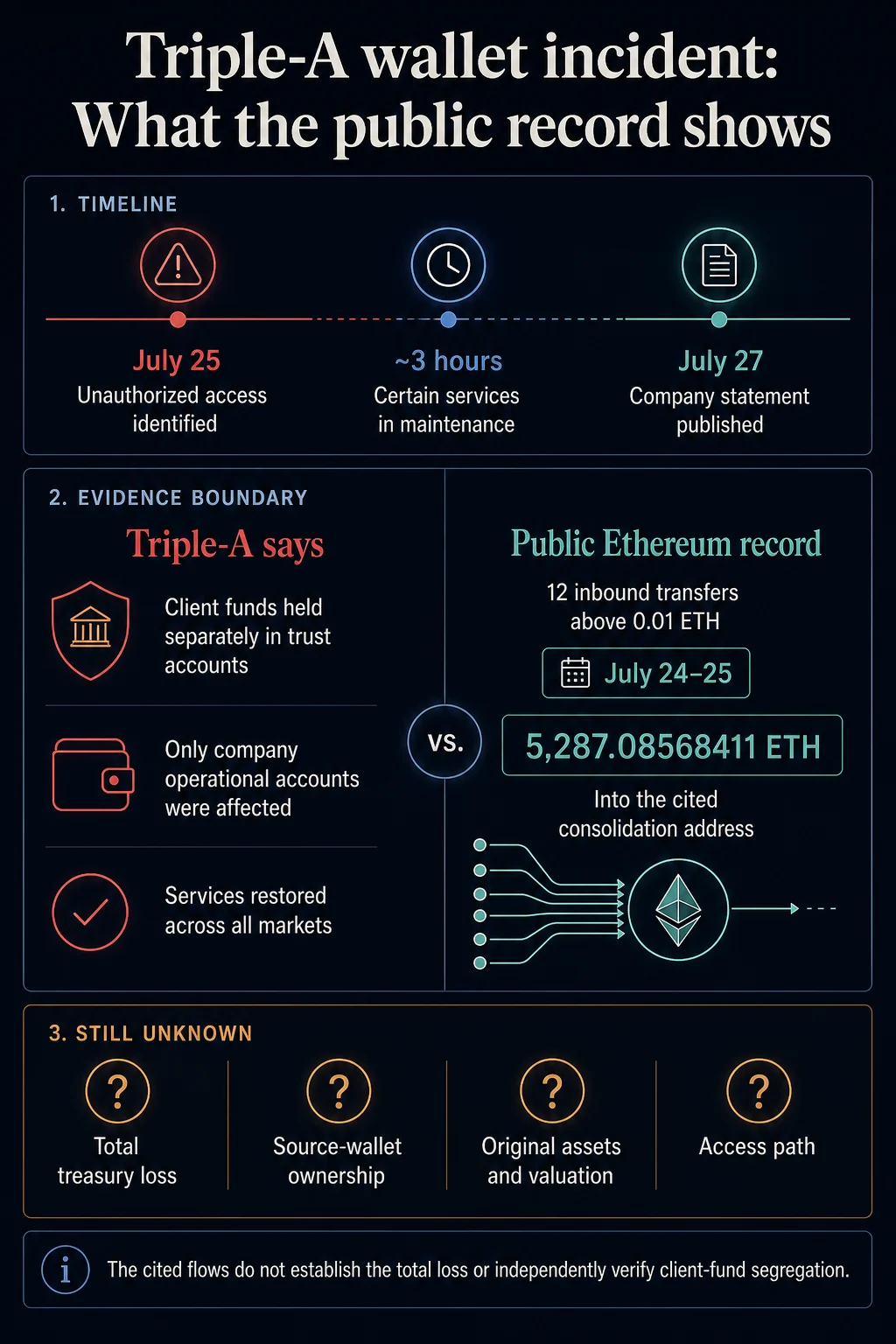
Singapore-based stablecoin payments firm Triple-A has disclosed an incident of unauthorized access to its digital asset wallets, resulting in the significant outflow of approximately 5,287 Ether (ETH) to a single, publicly identifiable address. While the company asserts that client funds remain segregated and unaffected, the breach raises critical questions about the security of corporate treasuries and the transparency of incident reporting within the cryptocurrency sector. The full extent of the treasury loss and the precise method of the breach remain undisclosed, leaving a significant information gap for stakeholders and the broader market.
The incident, identified by Triple-A on July 25th, prompted a temporary three-hour maintenance period for certain services. In an official statement released on July 27th, the company emphasized its robust client fund segregation protocols. Triple-A stated that it does not custody digital assets directly for its clients. Instead, client funds are held separately in trust accounts managed by safeguarding institutions, which were reportedly not compromised during the breach. This distinction is crucial, as it aims to reassure clients that their assets were not at risk.
Despite the assurance regarding client funds, the financial impact on Triple-A’s own operational accounts is confirmed. The company has stated that the losses are being "fully absorbed from treasury reserves." However, the specific value of these reserves and the exact amount of ETH drained have not been publicly quantified. This lack of concrete figures has fueled speculation and concern among industry observers and investors who rely on transparent reporting to assess the financial health and operational integrity of crypto firms.
The publicly visible on-chain trail, meticulously analyzed by blockchain forensics experts, offers a partial glimpse into the movement of funds. On-chain analyst Specter identified a specific Ethereum address, 0x01F83B5d4fb30E8AA3daC1681B4048D9135253b1, as the destination for a substantial consolidation of Ether. Etherscan records indicate that between July 24th and July 25th, twelve inbound transfers, each exceeding 0.01 ETH, flowed into this address. The aggregate amount meticulously documented on the blockchain amounts to 5,287.08568411 ETH. At the time of the incident’s disclosure, this sum represented a significant value, fluctuating with market volatility but estimated to be in the tens of millions of dollars.
While these on-chain movements confirm the outflow from Triple-A’s wallets to a single aggregation point, they do not definitively establish the timeline of the unauthorized access or the total quantum of the loss. The public data does not reveal the original source wallets, their specific roles within Triple-A’s infrastructure, or the initial assets held before any potential swaps or cross-chain transfers. This absence of granular detail prevents independent verification of the precise scope of the breach and its immediate aftermath, leaving the company’s narrative as the primary source of information regarding the incident’s parameters.

Triple-A Technologies Pte. Ltd., the Singapore entity implicated in the breach, is a registered Major Payment Institution with the Monetary Authority of Singapore (MAS). This license grants the company authorization to conduct domestic and cross-border transfers, merchant acquisition, and digital payment token services. MAS mandates that institutions holding such licenses adhere to stringent customer-money protection requirements. While the regulatory framework is established, the incident necessitates a thorough review of how these requirements were met and whether any systemic vulnerabilities were exploited.
The company has indicated that it is actively collaborating with a range of entities to address the aftermath of the breach. This includes engaging cybersecurity and blockchain forensics specialists, who are crucial for tracing the movement of the stolen assets and identifying potential recovery avenues. Furthermore, Triple-A has stated its cooperation with the Singapore Police Force and other relevant authorities, signaling a commitment to a comprehensive investigation and potential legal recourse.
Chronology of the Incident and Public Disclosure
The events surrounding the Triple-A breach can be pieced together through the company’s statements and on-chain data, although some gaps remain.
- July 24th: On-chain data indicates the commencement of Ether transfers into the address
0x01F83B5d4fb30E8AA3daC1681B4048D9135253b1. The exact origin of these transfers and the precise timing of the unauthorized access remain unconfirmed by Triple-A. - July 25th: The flow of Ether into the identified address continues, with the majority of the 5,287 ETH being consolidated on this day, according to Etherscan records. Triple-A claims to have identified the unauthorized access on this date.
- July 25th (later): Triple-A initiates a period of maintenance for certain services, reportedly lasting approximately three hours, to secure affected infrastructure and conduct security checks.
- July 27th: Triple-A issues an official statement detailing the incident, confirming unauthorized access to its corporate treasury wallets. The company reiterates that client funds were not affected and announces the restoration of all services, with transactions and settlements processing normally. The statement also outlines the ongoing investigation and collaboration with authorities.
This timeline highlights a critical period of unconfirmed activity before the official identification and disclosure by Triple-A. The delay between the initial fund movements and the company’s public announcement raises concerns about the speed and effectiveness of internal detection mechanisms and incident response protocols.
Supporting Data and Blockchain Analysis
The address 0x01F83B5d4fb30E8AA3daC1681B4048D9135253b1 serves as a central hub for the suspicious outflows. Analysis of this address reveals a consistent pattern of inbound ETH transactions, aggregating to the reported 5,287 ETH. The nature of these transactions – a series of relatively small, frequent transfers – can sometimes be indicative of attempts to evade detection by automated monitoring systems that might flag larger, singular movements.
Further blockchain analysis would ideally involve tracing the subsequent movements of the 5,287 ETH from this aggregation address. Sophisticated forensic tools can track these funds through various exchanges, decentralized finance (DeFi) protocols, and other wallet addresses, aiming to identify where the stolen assets might be laundered or cashed out. The success of such tracing efforts is often dependent on the sophistication of the perpetrators and their ability to obscure the trail.

The original source of the drained ETH also remains a critical piece of the puzzle. If the drained ETH originated from Triple-A’s operational reserves, which were distinct from client funds, it implies a potential weakness in the company’s internal asset management and security controls for its own holdings. The lack of confirmation on the exact number of wallets compromised or the specific security vulnerabilities exploited leaves room for conjecture. Was it a phishing attack, a compromised private key, a smart contract exploit, or an insider threat? Without official clarification, the market is left to speculate.
Official Responses and Regulatory Scrutiny
Triple-A’s official statement aims to project an image of control and client protection. The emphasis on segregated client funds and the absorption of losses from treasury reserves are key messages designed to maintain confidence. The company’s proactive engagement with cybersecurity experts and law enforcement signals a commitment to resolving the issue and potentially recovering assets.
However, the regulatory implications are significant. As a Major Payment Institution in Singapore, Triple-A operates under the watchful eye of the MAS. The breach will likely trigger a review of Triple-A’s compliance with the Payment Services Act, particularly concerning safeguarding of customer property and robust internal controls. MAS has a history of enforcing strict regulations in its financial sector, and any perceived lapse in security could lead to significant penalties or operational restrictions.
Other entities within the broader cryptocurrency ecosystem will also be scrutinizing this event. Payment processors, stablecoin issuers, and exchanges all rely on the security and trustworthiness of their partners. A breach at a firm like Triple-A, even if client funds are untouched, can cast a shadow of doubt over the overall security posture of companies handling digital assets. The incident underscores the persistent challenges in securing digital assets against increasingly sophisticated cyber threats.
Broader Impact and Implications for the Crypto Industry
The Triple-A treasury breach, while framed by the company as contained and non-impactful to clients, serves as another cautionary tale in the volatile world of cryptocurrency. The event highlights several critical issues:
- Treasury Management Security: Corporate treasuries, especially those holding significant amounts of digital assets, are increasingly becoming targets for cybercriminals. The incident emphasizes the need for robust, multi-layered security protocols specifically designed for digital asset management, going beyond standard IT security practices. This includes secure key management, multi-signature solutions, and regular internal audits.
- Transparency in Incident Reporting: The discrepancy between the publicly visible on-chain data and the limited information provided by Triple-A underscores the ongoing challenge of achieving full transparency in crypto incidents. While companies have legitimate reasons to protect sensitive investigation details, the market thrives on clear and timely communication. The lack of clarity on the exact loss and the method of the breach can erode trust.
- Regulatory Oversight Effectiveness: The MAS license signifies a level of regulatory compliance. However, this incident prompts questions about the efficacy of existing regulations in preventing such breaches and the mechanisms for ensuring ongoing adherence to security standards. Regulators worldwide are grappling with how to effectively oversee the rapidly evolving digital asset space.
- Interconnectedness of the Ecosystem: Even if client funds were not directly compromised, a breach at a payments firm can have ripple effects. Disruptions to services, reputational damage, and the potential for asset recovery challenges can impact the broader financial ecosystem that relies on such intermediaries.
The path forward for Triple-A involves not only recovering any potential losses and reinforcing its security infrastructure but also rebuilding trust with its clients, partners, and the wider market. The resolution of this incident will likely be closely watched as an indicator of how effectively companies in the digital asset space can navigate security threats while maintaining operational integrity and transparency. The ultimate impact will hinge on the thoroughness of the investigation, the effectiveness of asset recovery efforts, and the company’s commitment to enhanced security practices moving forward.








