
 admin
admin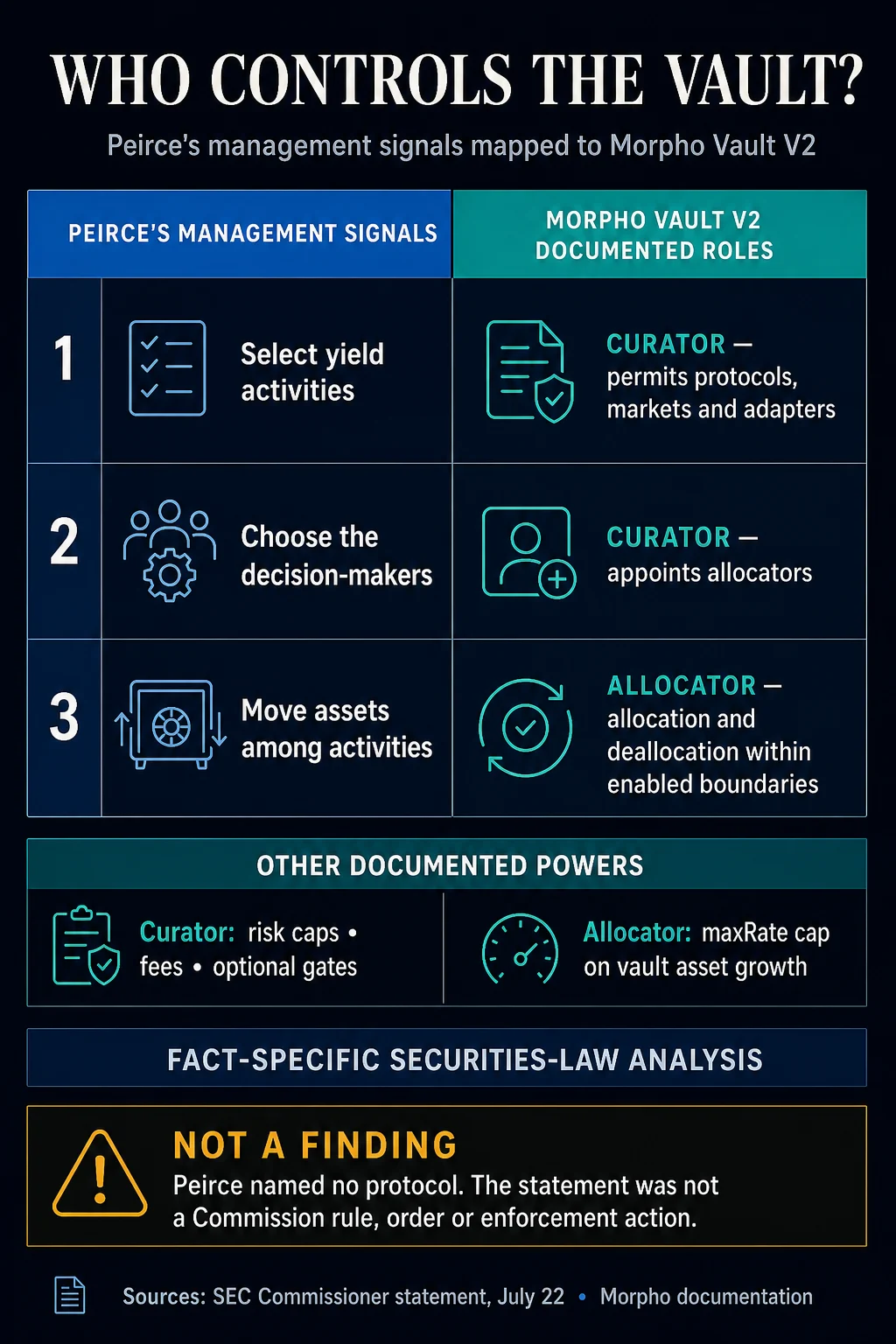
The U.S. Securities and Exchange Commission (SEC) is increasingly scrutinizing decentralized finance (DeFi) protocols, with a recent warning from Commissioner Hester Peirce casting a spotlight on crypto yield vaults. The core of the concern lies in the human element within these seemingly automated systems. When individuals actively manage how digital assets generate yield, the SEC may view these operations as unregistered investment funds, potentially subjecting them to federal securities laws. This development could have significant implications for a wide array of DeFi products that rely on human oversight for strategy selection and asset allocation.
The Morpho Vault V2 Case Study: A Closer Look at Human Control
The architecture of Morpho Vault V2 presents a clear illustration of the very powers that Commissioner Peirce highlighted in her recent statement. In this innovative DeFi lending protocol, the creation of curated lending strategies is packaged into on-chain vaults. While users interact with smart contracts, the underlying control mechanisms reveal a nuanced interplay between automation and human decision-making.
Morpho, a prominent decentralized lending protocol, introduced Vault V2 to encapsulate curated lending strategies within user-friendly on-chain vaults. These vaults allow users to deposit assets and earn yield, ostensibly through automated smart contract execution. However, the operational framework of Vault V2 designates specific roles—curators and allocators—who wield significant influence over how capital is deployed and the associated risk parameters.
Commissioner Peirce’s Stance: Defining the Line Between Code and Management
In a public statement released on July 22, 2026, SEC Commissioner Hester Peirce articulated a spectrum of crypto vaults, differentiating between those governed purely by immutable code and those that involve human intervention in their operational processes. Her statement emphasized that federal securities law questions arise when individuals or entities are responsible for selecting yield-generating strategies and actively managing asset movements. Furthermore, even the process of determining who possesses such authority can be a critical factor in regulatory assessment.
It is crucial to note that Commissioner Peirce’s statement addressed crypto vaults generically and did not name any specific protocol, including Morpho. Her remarks were not a formal rule, order, or enforcement action by the Commission. Instead, she articulated a framework for analysis, indicating that the ultimate legal determination would hinge on the specific structure and activities of each individual vault. This approach suggests a fact-intensive inquiry by the SEC, where the details of implementation will be paramount.
Dissecting Control in Morpho Vault V2: The Curator and Allocator Roles
Within the structure of Morpho Vault V2, the "curator" plays a pivotal role in defining the operational landscape of the vault. The curator is empowered to designate which protocols, markets, and assets the vault can engage with. This includes the technical ability to enable these routes through specific adapters and to establish the risk limits within which the vault must operate. Crucially, the curator also holds the authority to appoint the "allocators," individuals or entities responsible for executing asset movements within the parameters set by the curator.
These defined powers directly align with two key areas highlighted by Commissioner Peirce: the selection of available yield routes and the designation of parties responsible for making allocation decisions. Beyond these, Morpho Vault V2 also grants curators control over performance and management fees, the selection of fee recipients, and the implementation of optional compliance gates. While Commissioner Peirce did not explicitly identify fee-setting as a standalone trigger for regulatory concern, its inclusion within the curator’s purview adds another layer of human-directed financial management.
The Allocator’s Function: Executing Strategy and Managing Growth
The day-to-day execution of strategies within Morpho Vault V2 is largely delegated to the allocators. These entities are responsible for the routine allocation and deallocation of assets among the enabled adapters. They also possess the ability to set a parameter known as maxRate. Morpho describes this as the maximum rate at which the vault’s assets are permitted to grow. It is important to clarify that this control does not equate to directly setting a borrower’s interest rate or providing the Vault V2 curator with direct authority over underlying loan-to-value limits or liquidation thresholds. Commissioner Peirce had discussed these specific aspects of lending strategies separately.
Immutability vs. Dynamic Management: A Complex Regulatory Landscape
Even when the underlying smart contract code of a vault is immutable, the actual portfolio and its operational dynamics can remain fluid. Curators retain the ability to update the settings that shape the vault’s behavior. Actions that introduce increased risk typically undergo a process involving function-specific timelocks, which can sometimes be set to zero, allowing for rapid implementation. In certain scenarios, such as cap cuts or sentinel interventions, actions can be executed immediately. Furthermore, a curator can permanently disable selected timelocked powers through a process of abdication.
This distribution of control mechanisms raises significant questions about which regulatory analogies might apply. Commissioner Peirce suggested that some vaults could resemble fixed unit investment trusts, while others might be more akin to management investment companies or separately managed accounts. Her statement also noted that involvement in managing vaults or lending strategies could potentially trigger obligations related to investment adviser regulations.
For Morpho Vault V2, a thorough regulatory assessment would necessitate examining several factual elements. These include the specific types of assets held by a vault, the configuration powers that remain actively configurable, and the precise manner in which curators and allocators exercise their distinct roles. Commissioner Peirce’s statement effectively frames these critical questions, prompting a deeper analysis without providing definitive answers for any specific protocol.
Broader Implications for the DeFi Ecosystem
The SEC’s intensified focus on the human element in crypto yield vaults signals a potential shift in how regulatory bodies perceive and approach decentralized finance. For years, DeFi has operated under the assumption that its automated, code-driven nature inherently placed it outside the purview of traditional financial regulations. However, Commissioner Peirce’s comments suggest a re-evaluation of this paradigm, particularly when human discretion and active management are involved in generating returns for investors.
This development could force DeFi protocols to re-examine their operational structures. Protocols that rely heavily on human curators or fund managers to select strategies, manage risk, or allocate assets may find themselves in the crosshairs of regulatory scrutiny. The implications extend beyond simply identifying unregistered funds; it could also involve considerations related to investor protection, transparency, and fiduciary duties, all of which are central to securities regulation.

Potential Regulatory Pathways and Industry Reactions
The SEC’s approach, as outlined by Commissioner Peirce, suggests a nuanced regulatory framework that is unlikely to be a blanket prohibition. Instead, it points towards a case-by-case analysis based on the specific characteristics of each DeFi product. This could lead to a bifurcated DeFi landscape: one segment that operates with fully automated, code-governed strategies, and another that embraces human management but seeks to comply with securities regulations, potentially through registration or by operating under specific exemptions.
Industry participants are likely to react in several ways. Some may accelerate efforts to further decentralize governance and remove human decision-making from critical operational functions. Others might engage proactively with regulators to understand the compliance requirements and adapt their models accordingly. There is also the possibility of increased legal challenges as protocols and users grapple with the evolving regulatory landscape.
The SEC’s stance underscores a broader trend: as DeFi matures and its integration with traditional finance deepens, regulators are compelled to apply existing legal frameworks to novel technological structures. The challenge lies in adapting these frameworks effectively without stifling innovation. The ongoing dialogue and potential enforcement actions stemming from Commissioner Peirce’s warning will be closely watched by the entire cryptocurrency and blockchain industry. The future of DeFi yield generation may well depend on how these protocols navigate the delicate balance between decentralization, human oversight, and regulatory compliance.
Supporting Data and Context
The DeFi lending market has experienced significant growth, with total value locked (TVL) in lending protocols reaching hundreds of billions of dollars at its peak. This vast pool of assets, combined with the promise of high yields, has attracted a substantial number of retail and institutional investors. The complexity of these protocols, however, often outpaces the understanding of the average user, making regulatory oversight increasingly important.
Morpho Protocol, as of mid-2026, has consistently ranked among the top DeFi lending platforms, demonstrating its significant market share and user base. The introduction of Vault V2 was intended to simplify the process of accessing curated lending strategies, making it more accessible to a wider audience. This move, while beneficial for user experience, has inadvertently placed it at the forefront of regulatory discussions concerning human control within DeFi.
Chronology of Events (Inferred and Publicly Available)
- Prior to July 2026: Numerous DeFi protocols, including lending platforms and yield aggregators, have operated with varying degrees of human oversight in their yield-generating strategies. Regulatory bodies, including the SEC, have been monitoring the DeFi space, with a particular interest in investor protection and market integrity.
- July 22, 2026: SEC Commissioner Hester Peirce delivers a statement addressing the regulatory implications of crypto vaults and lending strategies, highlighting the significance of human control in determining whether such operations fall under federal securities laws.
- July 27, 2026: CryptoSlate publishes its initial report on Commissioner Peirce’s warning and its potential impact, using Morpho Vault V2 as a case study to illustrate the concepts discussed.
- Ongoing (Post-July 2026): Industry participants, legal experts, and regulatory bodies will likely engage in further discussions and analyses to interpret the implications of Commissioner Peirce’s statement. Potential for SEC inquiries or enforcement actions against specific protocols exhibiting characteristics of unregistered investment funds may arise, depending on their operational structures and responses.
The evolving regulatory landscape for DeFi presents both challenges and opportunities. As protocols like Morpho continue to innovate, understanding and adapting to these regulatory shifts will be crucial for their long-term success and the broader maturation of the decentralized finance ecosystem. The SEC’s clear articulation of its concerns serves as a significant marker, urging a more deliberate approach to integrating human discretion within automated financial systems.








