admin
admin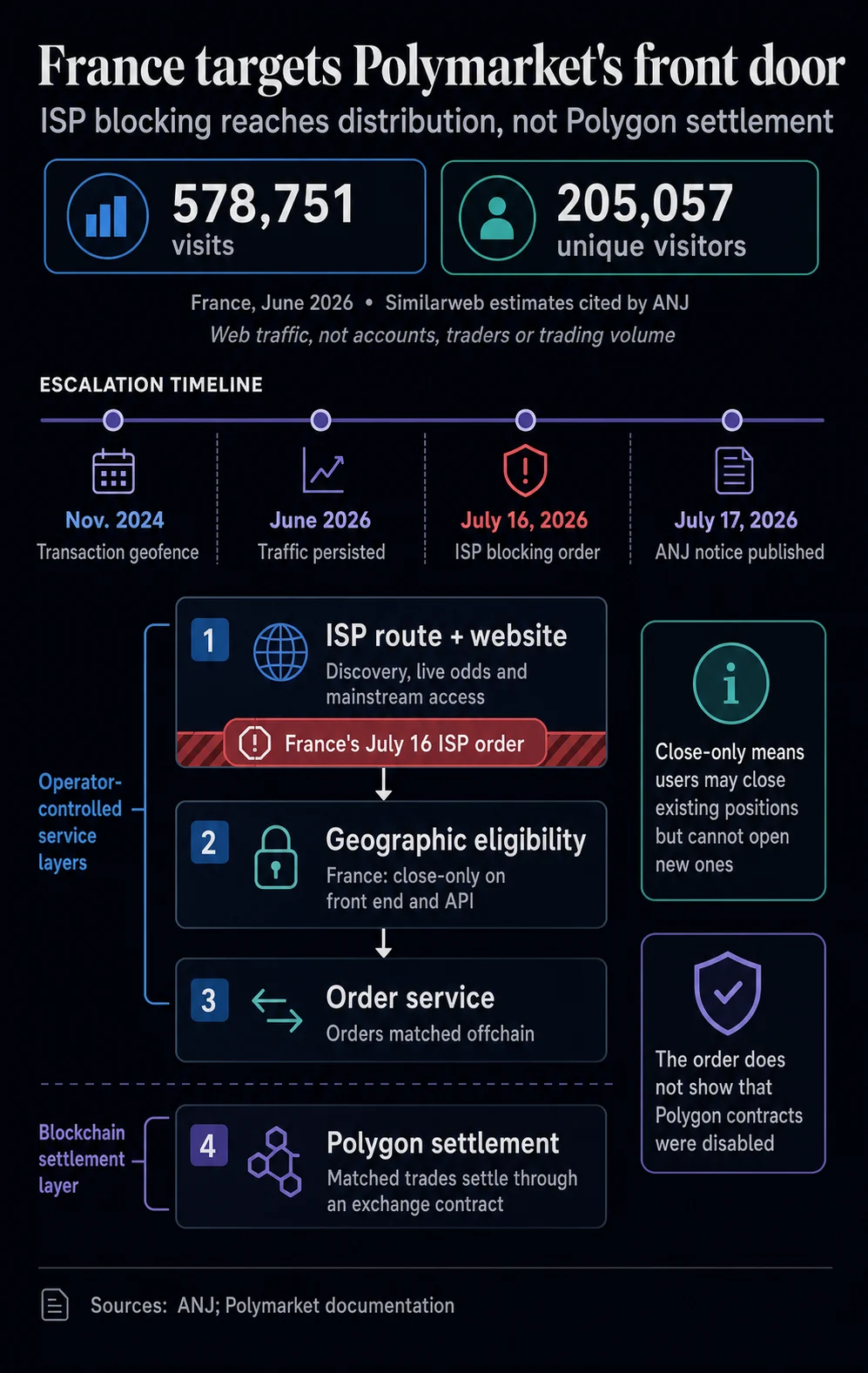
France’s gambling regulator, the Autorité nationale des jeux (ANJ), has escalated its enforcement against the cryptocurrency prediction-market platform Polymarket, ordering internet service providers (ISPs) to block access to its entire website. This move signifies a significant shift from the previous strategy of implementing transactional geofencing, which regulators determined had been effectively circumvented by users. The ANJ’s directive, published on July 17, 2026, asserts that Polymarket’s online presence actively promotes an unauthorized gambling offering, even when earlier measures were intended to prevent financial transactions originating from France.
The ANJ’s decision follows a substantial surge in French engagement with the platform. Citing data from Similarweb, the regulator reported that Polymarket garnered an impressive 578,751 visits and attracted 205,057 unique visitors from France during June 2026 alone. These figures underscore the growing popularity of prediction markets among French citizens and provide a clear rationale for the ANJ’s decision to move beyond merely restricting financial flows to outright blocking the primary access point to the platform. This escalation highlights a critical challenge in regulating decentralized financial technologies: while settlement can occur on a blockchain, mainstream users continue to rely on operator-controlled websites and systems for market discovery and order submission.
A Geofence That Failed to Deter Audience Engagement
This is not the first instance of French authorities intervening in Polymarket’s operations. In November 2024, the ANJ initially contacted Adventure One QSS Inc., a Panamanian entity identified as Polymarket’s operator. At that time, the ANJ had concluded that Polymarket’s services could potentially constitute unauthorized gambling under French law. In response to this initial inquiry, Adventure One implemented a geoblock, which the ANJ initially characterized as a measure to prevent bets from being placed within French territory.
However, the ANJ’s July 2026 notice clearly frames the new, more stringent order as a direct consequence of the ineffectiveness of the prior restriction. The regulator stated that the earlier control, while successful in preventing new financial transactions from France, had been bypassed in practice. Crucially, the Polymarket homepage continued to display live odds, thereby maintaining its appeal to a substantial French audience. The ANJ’s assessment emphasized that a control mechanism that rejects new transactions, while potentially reducing direct participation, did not diminish the platform’s capacity to attract users and disseminate betting prices. The regulator specifically pointed to the dynamically updated odds on the homepage as a significant channel for promoting an activity it deems illegal.
French law provides the ANJ with a clear legal framework to act against such online interfaces. Following statutory notice and response periods, Article 61 of the relevant legislation empowers the ANJ to issue orders to access providers, compelling them to block access to specified illegal online interfaces. Furthermore, the ANJ can require search engines and directories to cease referencing these sites. The regulator’s report indicated that in 2025 alone, it utilized this process to block 1,290 URLs associated with illegal gambling activities.
The current directive represents a broader application of sanctions. Instead of relying on the platform operator to self-police and reject specific transactions, France is now leveraging its authority to pressure domestic networks and discovery services that connect a mainstream audience to the platform. This strategy effectively targets the infrastructure that makes the platform accessible and appealing to the general public.
The ANJ’s legal basis for this action firmly rests on gambling law, rather than on the specific use of cryptocurrency. The regulator’s initial 2024 notice explicitly stated that the intervention pertained to the broader gambling nature of the offering. This stance was further elaborated in the ANJ’s policy statement released in February 2026. In this document, the ANJ officially classified prediction markets as unauthorized gambling within France. The regulator articulated concerns that these platforms combine continuous accessibility and viral distribution with significantly fewer consumer protections than licensed operators. Specific reasons cited for restricting access included risks of addiction and integrity issues, alongside the absence of identity and age verification mechanisms.
The ANJ’s detailed arguments underscore its perspective that an odds-displaying homepage is far from a neutral component of the platform. From the regulator’s viewpoint, live odds function as direct product marketing. Consequently, the identity verification, age control, and integrity systems surrounding the market are critical determinants of whether authorities perceive the service as acceptable for domestic users.
Website Block Targets Service, Not Blockchain Settlement
Polymarket’s own technical documentation clearly delineates the separation between its user-facing distribution channels and its on-chain settlement mechanisms. The platform’s current geographic restrictions page lists France as a region where users can only close existing positions ("close-only") on both the front-end interface and via its API. This means that while French users may be able to liquidate their current holdings, they are prohibited from opening new positions. The platform’s enforcement of these geographic access restrictions is managed through infrastructure controlled by the operator, specifically at polymarket.com, which hosts its IP eligibility checks.

Concurrently, Polymarket describes its core trading mechanism as a hybrid system. Orders are matched off-chain, a process that allows for rapid execution. Once trades are matched, they are settled atomically through smart contracts deployed on the Polygon blockchain. According to the platform’s disclosures, this trading process is non-custodial, meaning users retain control over their assets throughout the transaction lifecycle.
The ANJ’s recent order directly targets access to Polymarket’s website and its associated service interfaces. It does not, however, aim to disable or interfere with Polymarket’s separate settlement layer on the Polygon network. There is no indication within the ANJ’s directive that France has taken steps to disable the underlying smart contracts. Instead, the ANJ’s practical leverage is concentrated on the layers that facilitate the platform’s usability and discoverability for ordinary customers.
Reaching a broad audience for any online service, including prediction markets, is heavily dependent on a recognizable front-end interface, reliable mechanisms for submitting orders, efficient off-chain matching processes, robust geographic eligibility checks, and a compliance posture that enables seamless interaction for both users and distribution partners. An ISP block, as mandated by the ANJ, directly disrupts this commercial pathway. The ability to settle transactions on-chain does not inherently render distribution permissionless. The accessible "front door" of the platform remains a point where national regulators can exert significant leverage.
A Patchwork of European Regulatory Responses
The regulatory response to prediction markets across Europe remains a fragmented landscape, characterized by individual national actions rather than a unified EU-wide ban. The ANJ has identified at least 12 European jurisdictions that have reportedly implemented restrictions or outright blocks on prediction markets. These countries include Germany, Belgium, Romania, Switzerland, Poland, the Netherlands, Greece, Italy, Portugal, Spain, Ukraine, and the Czech Republic.
The specific nature of these interventions varies significantly by jurisdiction. Spain offers a recent illustration of this divergence. On May 26, 2026, the Directorate General for Gambling Regulation in Spain issued an interim order to block the websites of Polymarket and Kalshi. This measure was enacted while the Directorate pursued formal proceedings concerning potential unlicensed gambling operations. The Spanish regulator highlighted key concerns such as licensing requirements, identity verification protocols, access controls for minors, and the availability of self-exclusion protections as central to its assessment.
This varied regulatory approach creates a complex operational environment for prediction market platforms. While implementing stronger geographic gating might reduce immediate regulatory exposure in certain markets, France’s experience demonstrates that a restriction solely focused on transactions may not satisfy authorities who view the platform’s visible odds and audience reach as integral components of the gambling offering.
Addressing regulatory concerns could involve implementing more extensive identity checks and robust consumer protection measures. However, gaining licensed access to operate within national jurisdictions would necessitate that these platforms conform to legal categories that often differ from one country to another.
The immediate challenge for prediction markets lies in determining whether platforms like Polymarket will adapt their front-end controls, adjust their regulatory posture, or modify their distribution models sufficiently to maintain mainstream access. This becomes increasingly critical as more European jurisdictions formally classify prediction markets as a form of gambling.
France’s recent action has clearly delineated the locus of its regulatory leverage. A national gambling regulator does not necessarily need to alter the complex settlement logic of an on-chain market. Instead, by making the platform’s website more difficult to access and by increasing the compliance costs associated with serving a national audience through operator-controlled access and distribution layers, regulators can exert significant pressure. This strategy effectively targets the commercial viability and user accessibility of such platforms within their sovereign borders.