
 admin
admin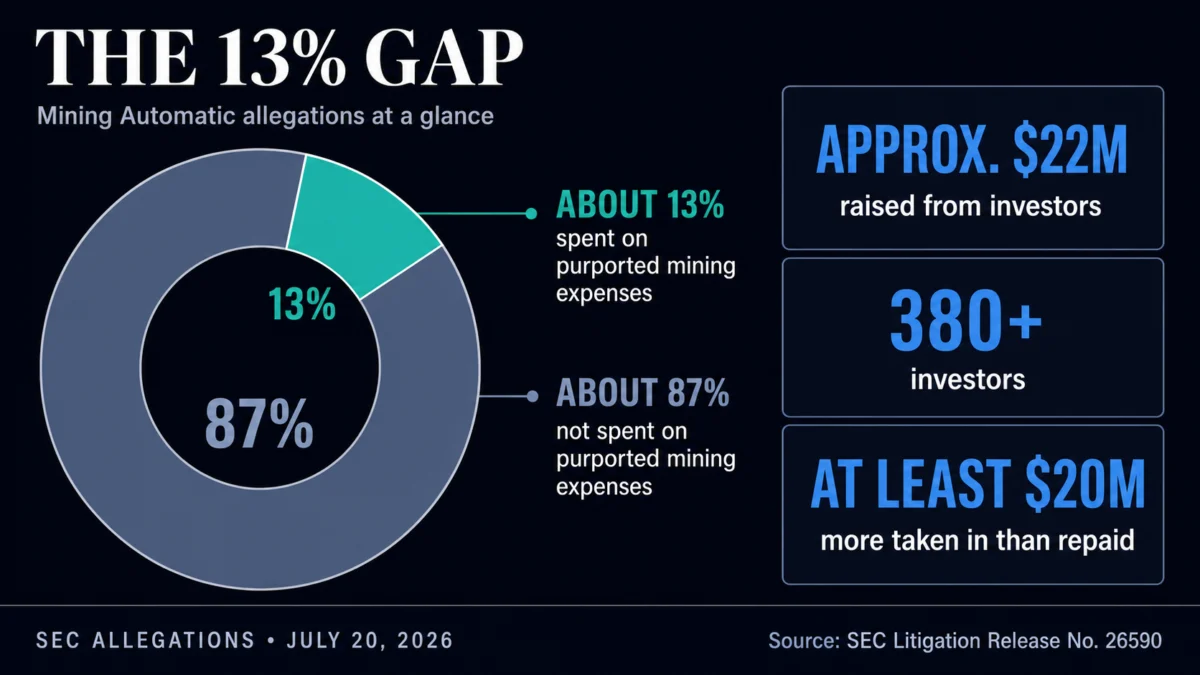
A United States-based cryptocurrency mining venture, operating under the name Mining Automatic and doing business as Bright Vision Distribution LLC, has allegedly defrauded over 380 investors out of approximately $22 million. The Securities and Exchange Commission (SEC) has filed partially settled charges against the company and its principal, Zan Shaikh, alleging that a mere fraction of the raised capital – just 13 cents on the dollar – was actually allocated to its purported mining operations. The remaining funds, according to the SEC’s complaint, were primarily funneled into marketing to solicit new investors, alongside substantial personal and unrelated business expenses incurred by Shaikh.
The SEC’s action, initiated on July 20, 2026, details a scheme that promised investors guaranteed monthly returns ranging from approximately June 2023 to May 2025. However, the regulator contends that the underlying mining operation was fundamentally incapable of generating the advertised levels of profitability. This discrepancy between promised returns and actual operational capacity forms the crux of the SEC’s allegations, suggesting a deliberate misrepresentation of the investment’s viability.
The complaint further highlights a significant financial shortfall, with the SEC alleging that Shaikh and Mining Automatic took in at least $20 million more from investors than they ultimately repaid. This substantial deficit underscores the scale of the alleged fraud and the precarious financial position of the investors who are now facing the prospect of significant losses.
While Shaikh and Mining Automatic have agreed to proposed permanent injunctions, these resolutions are contingent upon court approval. Shaikh has also consented to an officer-and-director bar, effectively prohibiting him from holding similar leadership positions in public companies, and a conduct-based injunction. Should the court grant its approval to these consent judgments, the determination of disgorgement, prejudgment interest, and civil penalties will be deferred to a later date, to be decided upon an SEC motion. Crucially, any potential investor distribution or recovery remains unannounced and highly uncertain, leaving the affected parties in a state of limbo.
FBI Outreach Signals Broader Investigation and Potential for More Victims
Adding another layer to the unfolding situation, the Federal Bureau of Investigation (FBI) has launched its own outreach initiative, actively seeking potential victims connected to Zan Shaikh and his various associated entities. The FBI’s Boston Division has established a dedicated victim-information page, inviting individuals who may have invested in companies such as Bright Vision Distribution, Mining Automatic, YT Automatic, RankOne Ecommerce, and Replic8 to come forward.
This FBI inquiry suggests that the scope of the alleged fraudulent activities may extend beyond the specific allegations detailed by the SEC. The questionnaire also names Replic8 among affiliated companies, indicating a potentially wider network of operations and a broader base of potential victims. The FBI’s efforts to gather information cover a period from 2022 through 2025, potentially encompassing a longer timeframe than the SEC’s focus.
The FBI emphasizes that submissions to their questionnaire are voluntary but can significantly aid the ongoing investigation. Furthermore, providing information may lead agents to request additional details from potential victims. The bureau has also indicated that victims may be eligible for services, restitution, and legal rights under federal or state law. However, it is critical to note that submitting the form is considered an information-gathering step, and a formal claim status for restitution remains unspecified.

The FBI’s proactive stance suggests a concerted effort to identify and consolidate claims from a wider pool of investors, potentially leading to a more comprehensive understanding of the alleged scheme’s reach and impact. While this outreach offers a glimmer of hope for victims, the FBI has not provided any updated figures on the total number of victims or offered any assurances regarding the recovery of funds.
Chronology of Alleged Fraud and Regulatory Action
The timeline of the alleged fraudulent activities, as outlined by the SEC, paints a picture of a sustained operation designed to mislead investors.
- Circa June 2023 – May 2025: According to the SEC, this period marks the primary window during which Zan Shaikh and Mining Automatic allegedly solicited investments, promising guaranteed monthly returns from their cryptocurrency mining venture. During this time, the company purportedly raised approximately $22 million from over 380 investors.
- Ongoing Operations (Undisclosed Dates): The SEC alleges that throughout this period, the vast majority of investor funds were not allocated to actual mining operations. Instead, funds were allegedly diverted to marketing efforts aimed at acquiring new investors, alongside personal expenses of Shaikh and unrelated business expenditures.
- Undisclosed Dates Prior to July 20, 2026: The SEC commences its investigation into Mining Automatic and Zan Shaikh.
- July 20, 2026: The SEC files partially settled charges against Zan Shaikh and Bright Vision Distribution LLC, doing business as Mining Automatic. The regulator also announces the proposed permanent injunctions, officer-and-director bar, and conduct-based injunction that Shaikh has agreed to.
- July 2026 (Ongoing): The FBI’s Boston Division launches its victim-information campaign, seeking to identify and gather details from potential victims across a broader range of affiliated companies and a longer timeframe.
- Post-July 20, 2026: The proposed consent judgments are subject to court approval. If approved, the SEC will file a motion to determine disgorgement, prejudgment interest, and civil penalties. The fate of investor recovery remains undecided.
Supporting Data and Financial Allegations
The core of the SEC’s allegations revolves around the gross misuse of investor funds. The figure of $22 million raised from over 380 investors is substantial, particularly when contrasted with the alleged minimal allocation to the stated purpose of the investment. The claim that only 13% of the funds were directed towards mining operations is a critical detail, suggesting a deliberate diversion of capital.
The SEC’s assertion that Shaikh and Mining Automatic received at least $20 million more than they repaid to investors further quantifies the alleged financial malfeasance. This indicates that the operational losses or misappropriations were so significant that even with continuous fundraising, the company could not sustain its obligations to earlier investors.
The breakdown of fund allocation – primarily marketing and personal/unrelated business expenses – points towards a classic Ponzi scheme or a fraudulent investment operation where new investors’ money is used to pay off older investors or cover operational deficits, rather than generating legitimate returns. The emphasis on marketing suggests a strategy to perpetuate the illusion of success and attract a continuous stream of capital to sustain the operation.
Official Responses and Legal Ramifications
The SEC’s filing represents a significant step in holding the alleged perpetrators accountable. The proposed permanent injunctions, if approved by the court, would legally bar Shaikh and Mining Automatic from engaging in future securities violations. The officer-and-director bar is particularly impactful, aiming to prevent Shaikh from repeating such alleged misconduct in other corporate capacities.
The agreement to proposed settlements, while not admitting guilt, signifies a willingness by the defendants to resolve the SEC’s claims without a lengthy legal battle. However, the crucial element of financial penalties and restitution for investors is still pending. The SEC’s future motion to determine disgorgement, prejudgment interest, and civil penalties will be a key determinant of the financial consequences for Shaikh and Mining Automatic.
The FBI’s involvement underscores the seriousness of the allegations and the potential for criminal as well as civil repercussions. While the FBI’s primary role is often in criminal investigations, their information gathering can inform parallel civil actions and potential asset forfeiture proceedings.

The lack of immediate clarity on investor recovery is a significant concern for the affected parties. The SEC’s legal process typically involves asset tracing and distribution, which can be a protracted and complex undertaking. The ultimate amount that investors may recover will depend on the success of the SEC and potentially other law enforcement agencies in identifying and seizing assets belonging to Shaikh and Mining Automatic.
Broader Impact and Implications for the Crypto Mining Sector
This case, if proven, serves as a stark reminder of the inherent risks associated with cryptocurrency investments, particularly in nascent and often less regulated sectors like crypto mining. The allure of high, guaranteed returns in a volatile market can attract fraudulent actors who exploit investor enthusiasm.
The alleged diversion of funds from operational purposes to marketing and personal expenses highlights the critical importance of due diligence for investors. Understanding where investment capital is actually being deployed is paramount. In this instance, the significant gap between funds raised and funds allocated to mining suggests a fundamental flaw in the investment’s premise or outright deception.
The involvement of both the SEC and the FBI indicates that such schemes are taken seriously by regulatory and law enforcement bodies. This vigilance is crucial for maintaining investor confidence in the broader digital asset market. However, the protracted nature of legal proceedings and the often-uncertain outcomes for investor recovery underscore the challenges in combating financial fraud in the rapidly evolving crypto space.
Furthermore, incidents like this can cast a shadow over legitimate cryptocurrency mining operations. Reputable companies that are genuinely investing in infrastructure and technology to generate returns can be unfairly scrutinized or face increased skepticism due to the actions of fraudulent entities. Transparency and robust operational reporting are therefore vital for building trust within the industry.
The outcome of the court’s review of the proposed judgments and the subsequent determination of financial penalties will be closely watched. For the over 380 investors who are now facing potential substantial losses, the hope remains that justice will be served and that some measure of their invested capital can be recovered. The FBI’s continued investigation may also bring more clarity and potentially broaden the avenues for restitution.








