admin
admin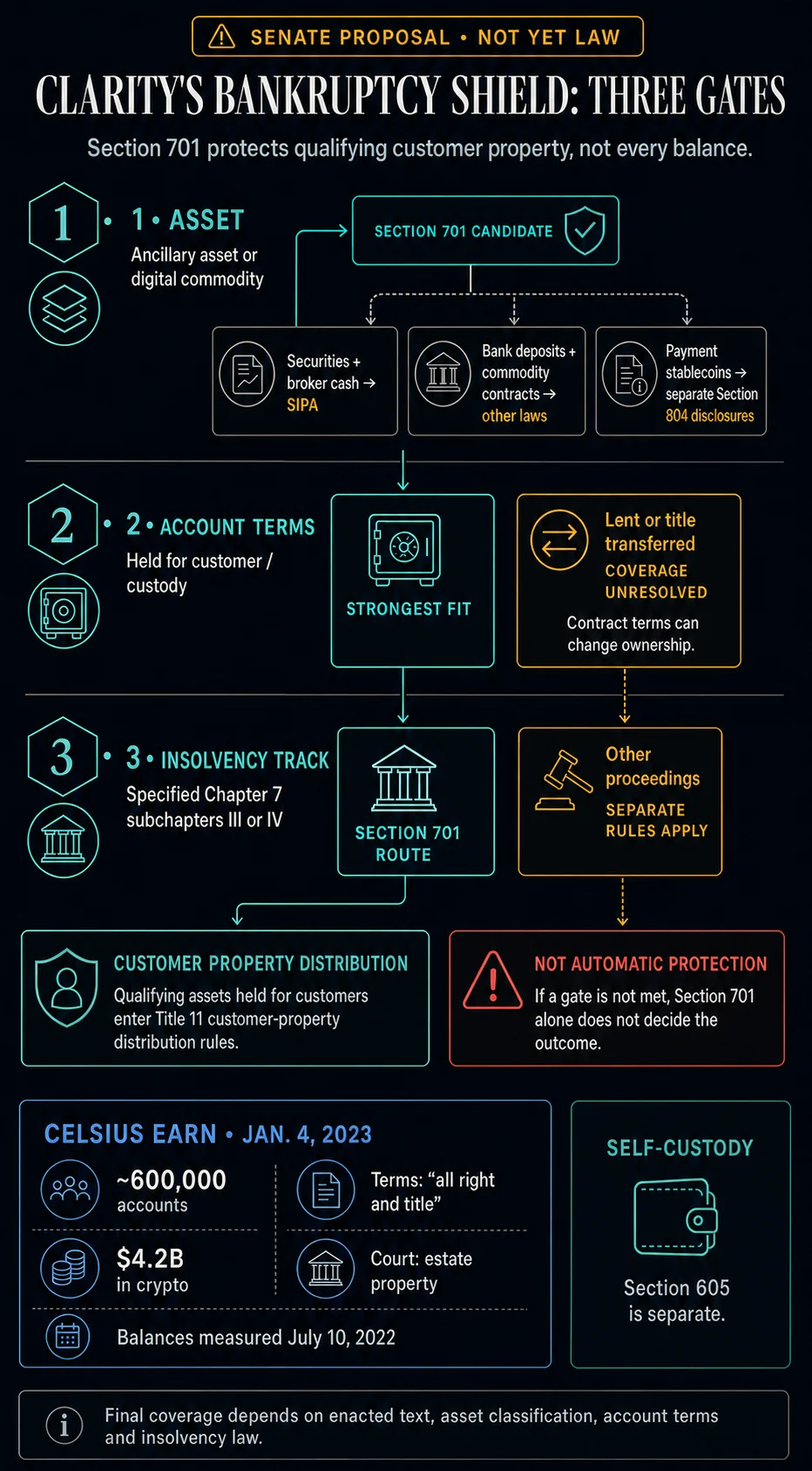
The turbulent collapse of cryptocurrency lending platforms like Celsius and Voyager left a bitter taste for countless customers who discovered that the digital assets entrusted to these entities were not truly theirs in the eyes of the law. Instead, these funds became part of the bankruptcy estate, subject to the lengthy and often disappointing process of asset recovery for creditors. In response to this widespread concern and the stark lessons learned from these high-profile failures, Senator Cynthia Lummis introduced the CLARITY Act, a legislative proposal aimed at fundamentally altering how digital assets are treated in bankruptcy proceedings. On July 20th, Senator Lummis encapsulated the bill’s core promise with a concise yet powerful declaration: "Your crypto stays yours." This sentiment, amplified through her X (formerly Twitter) post, resonated deeply with a community grappling with the uncertainty of their digital wealth.
The failures of Celsius and Voyager, in particular, served as stark case studies in the precariousness of customer crypto holdings. Celsius, arguably the most prominent legal example, saw a federal court directly adjudicate the ownership of its Earn balances. This ruling, which determined that customer funds were indeed part of the bankruptcy estate, underscored a critical gap in existing consumer protection frameworks concerning digital assets. The CLARITY Act, as presented in its May 12th Senate Banking Committee manager’s substitute, seeks to bridge this gap by integrating certain digital assets into established federal customer-property rules, specifically within the context of Chapter 7 liquidations.
Reforming Bankruptcy for the Digital Age: Section 701 of the CLARITY Act
At the heart of the CLARITY Act’s approach to this issue lies Section 701, a provision designed to rewrite the bankruptcy rules for liquidating failed stockbrokers. This section proposes to expand the definitions of "customers," "customer claims," and "customer property" to explicitly include ancillary assets and digital commodities. Crucially, when these qualifying assets are "held for customers" within specified Chapter 7 liquidation proceedings, they would be treated as customer property. This means they would be subject to distribution under Title 11 of the U.S. Bankruptcy Code, prioritizing the rightful owners rather than general creditors.
The official section-by-section summary of the bill elaborates on this, describing Section 701 as defining ancillary assets and digital commodities as customer property under Chapter 7. However, the operative text of the bill provides the nuanced boundaries of this protection. The protection offered by Section 701 is not absolute and is contingent on several factors, including the nature of the asset, the specific terms of the account agreement, and the bankruptcy process itself.
For instance, a qualifying token held in custody for a customer aligns more readily with the bill’s language than a balance that arises from a customer lending an asset or transferring title to the platform. The bill leaves the precise definition and treatment of lending arrangements and title transfers open for future legislative refinement and judicial interpretation. This ambiguity in the lending boundary is a critical point, as it was precisely these types of arrangements that led to the downfall of customer claims in cases like Celsius.
Navigating the Complexities: Asset Classification and Account Terms
The effectiveness of Section 701 hinges significantly on how an asset is classified. The provision specifically names ancillary assets and digital commodities. Other asset types remain under their existing regulatory frameworks. For example, securities and cash held by a broker-dealer continue to be governed by the Securities Investor Protection Act (SIPA). Similarly, bank deposits and commodity contracts fall under their respective applicable laws.
Payment stablecoins, a significant category of digital assets, are addressed separately in Section 804 of the bill. This section mandates disclosures from broker-dealers regarding the insolvency treatment of payment stablecoins, digital commodities, and securities involving units of digital commodities. This compartmentalized approach means that Section 701, on its own, cannot establish a uniform rule for all stablecoin balances.
Equally important are the account terms agreed upon by the customer and the platform. The phrase "held for customers" strongly implies a custodial relationship, where the customer retains ownership. Lending and yield-generating products, however, operate differently. If the account agreement transfers ownership of the asset to the platform, the customer might be relegated to holding a claim for repayment, an unsecured creditor in the event of bankruptcy.

The Celsius Precedent: A Cautionary Tale
The Celsius bankruptcy case vividly illustrates the high cost of this distinction. In a Jan. 4, 2023, order, the U.S. Bankruptcy Court for the Southern District of New York revealed that as of July 10, 2022, Celsius held approximately 600,000 Earn accounts with an estimated $4.2 billion in cryptocurrency. For the court, the question of ownership ultimately hinged on the contract between Celsius and its customers. The terms of service for Celsius’s Earn program granted the company "all right and title" to the crypto deposited. Consequently, the court ruled that the crypto remaining in these accounts belonged to the bankruptcy estate. Earn users, in effect, became unsecured creditors, their recovery dependent on the outcomes of the bankruptcy distribution. The familiar balance displayed on their Celsius app masked the reality that they had traded ownership of their crypto for an IOU from Celsius.
While the Celsius case involved explicit title-transferring Earn terms, Section 701 aims to protect qualifying customer property in specific Chapter 7 proceedings. The Celsius case serves as a potent illustration of the ownership question at stake but does not definitively establish how Section 701 would apply to a similar yield-generating product under its proposed framework.
Categorizing Risk: A Framework for Protection
The proposed categories within the CLARITY Act create distinct risk profiles for customer assets. Understanding these distinctions is crucial for evaluating the potential impact of the legislation.
| Account Relationship | Section 701 Relevance | Main Limitation |
|---|---|---|
| Qualifying Intermediary Custody | The clearest scenario where an ancillary asset or digital commodity is held for the customer in a covered Chapter 7 liquidation. | The asset, intermediary, and liquidation must align with the provision’s definitions and scope. |
| Lending, Earn, or Yield Account | Coverage remains unresolved when the agreement transfers title or makes the platform a borrower. | Contract language can convert a customer’s balance into an unsecured claim, as demonstrated by the Celsius case. |
| Independently Controlled Self-Custody | Section 605 addresses this separately, protecting lawful self-custody for defined covered users. | This provision preserves existing enforcement authorities related to illicit finance, anti-money laundering, terrorism financing, and sanctions. |
| Broker-Dealer Securities or Cash, Bank Deposits, and Commodity Contracts | Section 701 directs these categories to other existing legal regimes. | Protection follows SIPA, banking law, commodities law, or other applicable frameworks. |
If a platform acts solely as a custodian for qualifying crypto assets on behalf of a customer, Section 701 would likely place these assets into the customer-property pool during bankruptcy. However, loan arrangements present a more complex scenario. Once a contract transfers ownership to the platform, a judge might be required to determine whether the customer retains ownership of the crypto or merely possesses an IOU.
Self-custody, where customers maintain full control over their assets through self-hosted wallets, falls outside the scope of intermediary relationships addressed by Section 701. Section 605 of the bill specifically protects lawful self-custody for defined covered users, while importantly retaining existing enforcement powers related to illicit finance, anti-money laundering, terrorism financing, and sanctions. The inclusion of this provision reinforces the bill’s fundamental distinction between assets directly controlled by their owners and those entrusted to financial intermediaries.
The Path Forward: A Legislative Journey
The CLARITY Act’s journey through Congress is ongoing. The Senate Banking Committee advanced H.R. 3633, the bill encompassing the CLARITY Act, by a 15-9 vote on May 14th. This committee passage is a significant step, but the bill still requires Senate floor approval and subsequent legislative action to become law. As of July 14th, the broader Senate package remained unfinished, with no floor vote yet scheduled.
The customer-property provision, Section 701, is but one component of a larger legislative effort to establish a comprehensive market structure for digital assets. The May 12th draft of the bill also tackles critical issues such as token classification, stablecoin rewards, decentralized finance (DeFi), and banking powers.
The immediate legislative hurdle for Section 701 is whether its current wording will be maintained as the broader package progresses through the legislative process. The ultimate practical test will occur within platform contracts themselves. It will be incumbent upon exchanges and other digital asset intermediaries to clearly define their customer relationships: whether they are acting as custodians, lenders, or in some other capacity. Furthermore, the clarity of their terms of service will be paramount in determining whether the platform holds the asset for the customer or receives ownership of it.
Senator Lummis’s succinct promise, "Your crypto stays yours," effectively captures the intent of Section 701 and distills its complex conditions. If enacted as proposed, qualifying ancillary assets and digital commodities held in a custodial capacity would be integrated into customer-property distribution rules during bankruptcy. However, for balances arising from title-transferring loans or similar arrangements, the legal outcome of "your crypto stays yours" will ultimately depend on the interplay of asset classification, contract terms, and the applicable insolvency regime, a scenario that the Celsius case demonstrated can be a difficult and costly battle for consumers. The CLARITY Act represents a significant attempt to provide much-needed clarity and protection in the evolving landscape of digital asset finance, but its final form and ultimate impact remain subject to the legislative process and future judicial interpretation.