James Watt
The Cardano Foundation officially entered a strategic partnership with the German-based Reef Data eG on July 28, marking a significant milestone in the integration of blockchain technology within the European Union’s evolving data economy. Supported by a robust consortium of institutional and private sector backers—including Hamburger Volksbank, the Artificial Intelligence Center Hamburg (ARIC), VALIO, and Disruptive Elements—the initiative seeks to redefine how individual consumers manage, license, and profit from their personal digital footprints. At its core, the project utilizes the Cardano blockchain to provide a transparent, immutable accounting layer for a data cooperative model, aiming to transform personal information from a corporate-owned commodity into a member-governed asset.
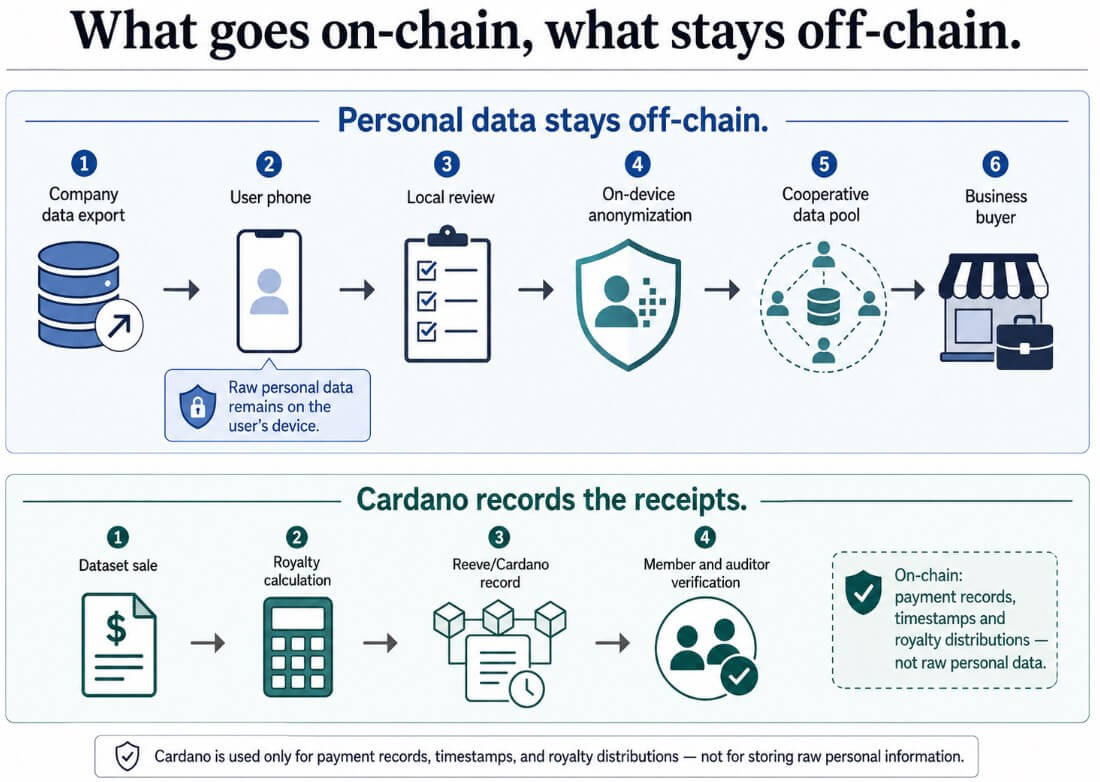
Under the terms of the partnership, Reef Data eG plans to function as a data intermediary, pooling the personal information of its members and licensing that data to businesses for research, marketing, and industrial applications. The economic engine of this cooperative is the distribution of royalties back to the contributors. To facilitate this complex flow of value, the Cardano Foundation has deployed the "Reeve" system. Reeve operates specifically at the accounting and settlement layer, recording payment flows and managing the intricate logic of royalty distributions. Critically, the underlying personal data is never stored on the Cardano blockchain itself; instead, it remains decentralized or stored in secure, off-chain environments, ensuring that the project adheres to strict privacy standards while leveraging blockchain for financial integrity.
The Regulatory Framework: The EU Data Governance Act and Data Intermediaries
The emergence of Reef Data eG comes at a pivotal moment for European digital policy. The European Commission’s Joint Research Centre (JRC) has recently identified six distinct models of data intermediaries designed to facilitate the flow of information while protecting individual rights: personal-information management systems (PIMS), data cooperatives, data trusts, data unions, data marketplaces, and data-sharing pools. Each model serves a specific niche in the digital ecosystem, ranging from pure privacy management to collective commercial bargaining.
The regulatory backbone for these entities is the EU Data Governance Act (DGA), which establishes a rigorous framework for data intermediation services. The DGA requires recognized providers to register with national competent authorities and be included in a public register maintained by the European Commission. This registration is intended to foster trust among consumers and businesses by ensuring that intermediaries are neutral, transparent, and legally accountable. As of July 28, the official list of registered providers included 36 entities across 10 EU member states. Notably, Germany’s only entry at the time of the update was Law & Innovation Technology GmbH, operating under the brand name Consenter. While Reef Data eG has positioned itself as a major player in this space, it remains an open question whether the cooperative intends to seek its own formal listing under the DGA or if it will operate under a different legal classification within the German cooperative framework.
A Comparative Analysis of Data Intermediary Models
To understand Reef’s position in the market, it is necessary to examine how its approach differs from traditional and emerging data management models. While many systems focus on either privacy or commercialization, Reef attempts to synthesize these goals through a cooperative structure.
- Personal-Information Management Systems (PIMS): These systems prioritize user control over data access. Reef adopts this control but adds a layer of pooled commercialization to generate revenue.
- Data Cooperatives: Traditionally focused on member-governed data sharing and collective bargaining, Reef enhances this model by utilizing Cardano-recorded royalties to ensure transparent and automated payouts.
- Data Trusts: These entities act as fiduciary-style stewards of data. Reef, by contrast, is more explicitly commercial in its cooperative goals, focusing on the monetization of assets rather than just stewardship.
- Data Unions: These organizations pay users for permitted data sharing. Reef frames these payouts as "cooperative royalties," which implies a more formal ownership stake for the members.
- Data Marketplaces: While marketplaces facilitate the direct exchange of datasets between buyers and sellers, Reef acts as the supplier of consented, aggregated member data, serving as a buffer between the individual and the buyer.
- Data-Sharing Pools: These pools aggregate data for research or shared use. Reef differs by actively monetizing these pools for the financial benefit of the contributors rather than solely for public or academic utility.
Historical Context and the Cooperative Movement
The partnership between the Cardano Foundation and Reef is not occurring in a vacuum. It is part of a broader, global movement toward data sovereignty that has been gaining momentum for over a decade. In Switzerland, the MIDATA Cooperative has long allowed members to store their personal health records and grant researchers access under a member-governance model. However, MIDATA operates primarily as a non-profit, prioritizing scientific progress over individual financial gain.

In the private sector, platforms like Swash have attempted to reward users for their browsing activity, paying out rewards in cash or cryptocurrency when businesses purchase insights derived from that data. Similarly, DataVaults—an EU-funded project involving 17 partners across nine countries—developed personal data hubs that allow contributors to control sharing and receive direct compensation. In Spain, SalusCoop has focused on the donation of health data for research, emphasizing the "civic donation" aspect of data sharing.
Reef Data eG distinguishes itself from these predecessors by pushing further into the commercial sphere. By selling datasets to corporate buyers and distributing royalties through a published, auditable blockchain workflow, Reef is attempting to prove that personal data can be a sustainable source of passive income for the average citizen.
Technical Implementation and the "Off-Chain" Mandate
One of the most significant technical hurdles for any blockchain-based data project is the conflict between the immutability of the ledger and the "right to be forgotten" enshrined in the General Data Protection Regulation (GDPR). The European Data Protection Board (EDPB) recently adopted final guidance on blockchain technologies on July 7, warning that immutable ledgers sit awkwardly against GDPR rights such as erasure and correction. The EDPB’s recommendation is clear: companies should keep personal data off-chain whenever possible.
Reef’s architecture appears to have been designed with these regulatory constraints in mind. The Reef application is engineered to keep personal information on the user’s device at the source. The data is reviewed and anonymized locally before the member makes a conscious choice to send specific information into the cooperative’s pool. From that point, the Cardano-based Reeve system takes over, logging the sale, timestamping the royalty payment, and anchoring the financial record cryptographically. This allows for a high degree of auditability without compromising the privacy of the individual.
However, a technical caveat remains regarding the definition of "anonymization." EU data protection authorities maintain a strict distinction between true anonymization—which removes data from the scope of GDPR entirely—and pseudonymization. Pseudonymized data is still considered personal information if it can be linked back to an individual through combination with other datasets. Because Reef has published limited technical documentation regarding its on-device process, it remains to be seen whether its methods meet the high legal bar for total anonymization or if the data remains subject to GDPR as pseudonymized information.
Economic Projections: Payout Math and Market Realities
The success of the Reef-Cardano partnership will ultimately be measured by its ability to deliver meaningful financial returns to its members. Global estimates for the data monetization market vary, but the trend is undeniably upward. Reef’s own case studies project the market will grow from approximately $3.95 billion in 2025 to over $19.32 billion by 2032. Independent analysts, such as Grand View Research and Stratistics MRC, offer similar forecasts, placing the current market between $3.9 billion and $5.29 billion, with potential growth reaching nearly $30 billion by the early 2030s.
Within the specific category of "organized data marketplace platforms," the market was valued at approximately $1.5 billion in 2024. This niche is expected to grow at a compound annual growth rate (CAGR) of 25.2%. However, the actual payout to an individual member depends on the ratio of buyer demand to the total number of participants.
In a conservative "bear case" scenario, if 25 corporate buyers sign contracts worth $5,000 each, and a 50% royalty share is split among 100,000 active members, the annual payout would be a mere $1.25 per person. In this instance, the project functions more as a proof-of-concept for data provenance than a source of income. Conversely, in a "bull case" scenario, where 500 buyers sign contracts worth $50,000 each and the membership grows to 2 million, a 60% royalty share would result in roughly $30 per member annually. While not a life-changing sum, $30 represents a tangible "digital dividend"—the equivalent of a few coffees or a monthly streaming subscription—earned from data that was previously harvested for free.
The premium on "consented" data is a critical factor in these calculations. Industry studies have shown that when advertisers lose access to user-level tracking, the value of ad impressions can drop by 18% to 23%. This suggests that high-quality, permissioned, and auditable data should, in theory, command a premium price from buyers who are increasingly wary of the legal and ethical risks associated with "gray market" data.
Strategic Implications and Future Outlook
The partnership between the Cardano Foundation and Reef Data eG represents a sophisticated attempt to align blockchain technology with European democratic and regulatory values. By utilizing Cardano as a "boring" but essential bookkeeping tool, the project avoids many of the speculative pitfalls associated with the broader cryptocurrency market. Instead, it focuses on the utility of the ledger to solve a specific problem: the lack of transparency in the data economy.
As the EU Data Act becomes fully applicable in September 2025, the focus on data generated by connected products—such as smart home devices, industrial machinery, and autonomous vehicles—will intensify. Reef’s workflow, which allows members to request their own information from companies under these new laws, positions the cooperative as a vital tool for exercising digital rights.
The ultimate test for Reef and Cardano will be the scale of adoption. For the model to be viable, Reef must attract a critical mass of users to create valuable, diverse datasets, while simultaneously convincing corporate buyers that its consented data is worth the premium price. If successful, this partnership could serve as a blueprint for a more equitable digital future, where the value of information is shared with those who generate it, and blockchain serves as the silent, trusted guarantor of that exchange. For now, the project stands as a significant experiment in the practical application of blockchain for social and economic reform within the European Union.