admin
admin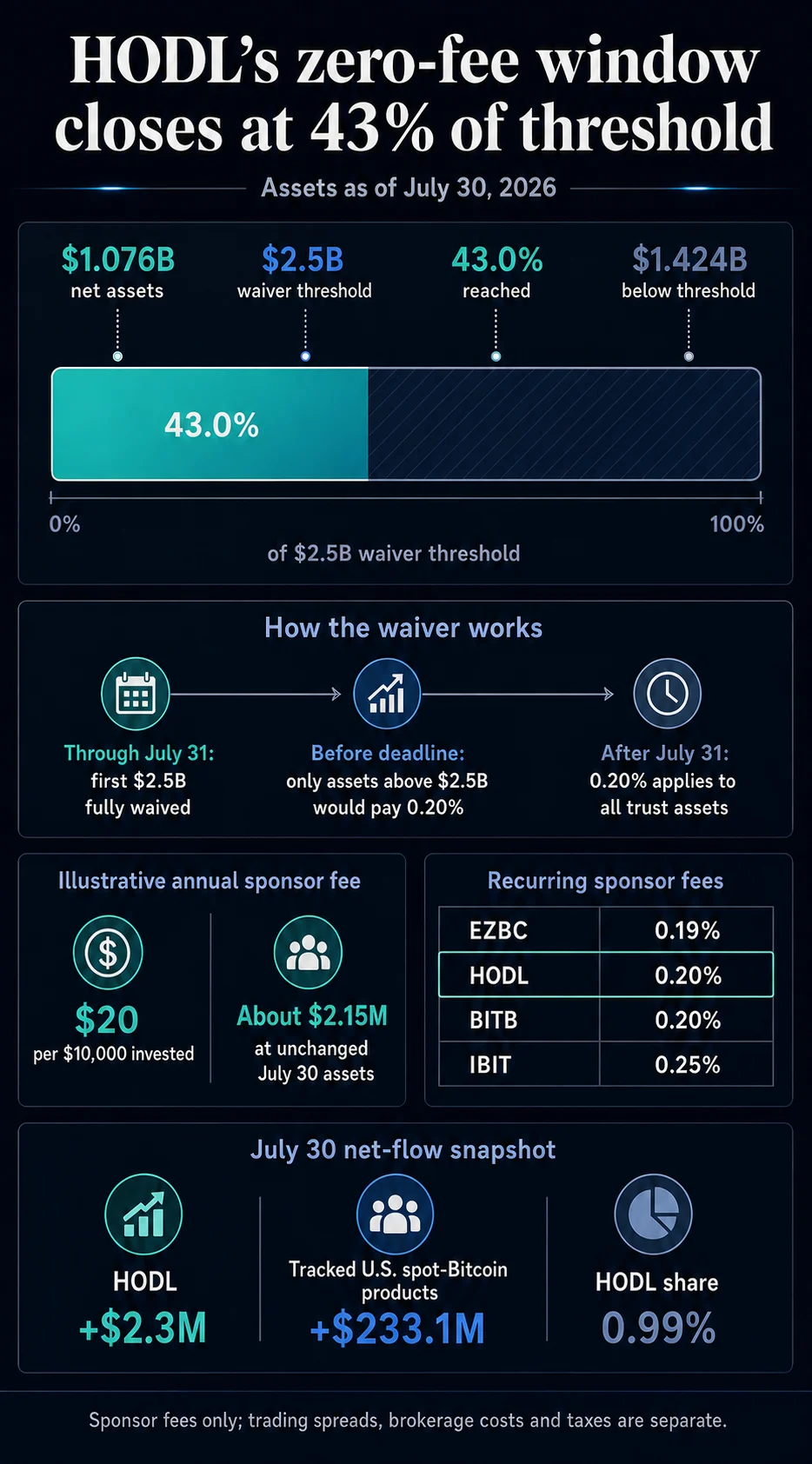
The zero-sponsor-fee period for VanEck’s Bitcoin ETF (HODL) officially concluded on July 31, marking a significant transition for the fund and its investors. As of July 30, HODL held $1.076 billion in net assets, representing 43.0% of the $2.5 billion asset threshold that was initially covered by the sponsor fee waiver. This means the fund fell approximately $1.424 billion short of the target that would have triggered a partial fee application during the waiver period. Consequently, HODL remained fully under the sponsor fee waiver until its expiration on July 31.
Following the expiration of the waiver, a sponsor fee of 0.20% will now apply to all of HODL’s trust assets. This marks a return to a standard fee structure after an extended period of fee relief designed to attract initial investment and build assets under management. VanEck had not announced any further extensions to the fee waiver by Friday morning, and regulatory filings did not indicate any new fee-related disclosures.
A Strategic Rollout and Asset Accumulation
VanEck’s strategy with HODL involved a substantial sponsor fee waiver, a common tactic employed by new ETF issuers to gain a competitive edge in a crowded market. The initial waiver was set to cover the sponsor fee on the first $2.5 billion of trust assets. This structure was designed to be dynamic: had the fund’s assets surpassed $2.5 billion before the July 31 deadline, only the assets exceeding that threshold would have incurred the 0.20% fee, resulting in a weighted average sponsor fee. However, HODL’s asset growth did not reach this level, ensuring the full waiver remained in effect until its scheduled end date.
The SEC filings reveal that the latest extension of the fee waiver was filed on November 25, 2025. This filing superseded an earlier announcement that had extended the waiver until January 10, 2026. The subsequent extension to July 31, 2026, underscores VanEck’s commitment to providing a period of cost-free investing to establish HODL’s market presence.
Financial Implications for Investors and the Fund
With $1.076 billion in assets as of July 30, the implementation of the 0.20% annual sponsor fee would translate to approximately $2.15 million in fees if assets remained at that level. For individual investors, this equates to an annual cost of roughly $20 for every $10,000 invested, before accounting for any fluctuations in the ETF’s share price.

It is crucial for investors to understand that this sponsor fee is just one component of the total cost of ownership. Other expenses, such as brokerage commissions, bid-ask spreads, potential premiums or discounts to the net asset value (NAV), and applicable taxes, can further influence an investor’s overall return.
Analysis of HODL’s performance during the waiver period, as tracked by Farside Investors, reveals a net outflow of $87.6 million across 169 trading sessions from November 25, 2025, through July 30, 2026. While these outflows occurred, they do not solely reflect investor sentiment or predict future performance. Net asset values are also influenced by the fluctuating price of Bitcoin, as well as the ETF’s creation and redemption activities, and operational expenses.
Despite the outflows, HODL did experience some inflows on July 30, attracting $2.3 million. This represented approximately 0.99% of the total net inflow of $233.1 million across all tracked U.S. spot-Bitcoin ETFs on that day. Farside data indicates HODL’s cumulative net inflows reached $1.146 billion, a figure distinct from its $1.076 billion in net assets, highlighting the complex interplay of inflows, outflows, and asset valuation.
Competitive Fee Landscape in the Spot Bitcoin ETF Market
The introduction of the 0.20% sponsor fee positions HODL competitively within the U.S. spot Bitcoin ETF market. This fee is now on par with the Bitwise Bitcoin ETF (BITB), which also charges a 0.20% sponsor fee.
In comparison to other major Bitcoin ETFs, HODL’s new fee structure places it favorably against the iShares Bitcoin Trust ETF (IBIT), which has a 0.25% sponsor fee. However, it is slightly higher than the Franklin Bitcoin ETF (EZBC), which boasts a 0.19% sponsor fee. This places HODL in a middle ground, tied with one competitor, more expensive than another, and cheaper than a third, based on their recurring sponsor fees.
The end of HODL’s zero-fee period signifies a shift from a promotional phase to a more standard operational phase, where its fee structure will be evaluated against a backdrop of established competitors. The success of this transition will likely depend on HODL’s ability to maintain investor interest and attract new capital despite the introduction of its sponsor fee.

Historical Context and Market Entry
The launch of spot Bitcoin ETFs in the United States in January 2024 marked a watershed moment for the cryptocurrency industry, opening up a new avenue for traditional investors to gain exposure to Bitcoin through regulated investment vehicles. VanEck was among the first issuers to bring its Bitcoin ETF to market, leveraging the initial enthusiasm and competitive landscape to offer a fee-free period.
This period was strategically designed to allow the ETF to accumulate assets and build a track record without the immediate burden of management fees. The $2.5 billion threshold was a significant target, and falling short indicates the intense competition and the challenges of rapid asset growth in a market with multiple similar offerings. The decision to extend the waiver multiple times points to VanEck’s efforts to maximize this initial advantage and solidify its position.
Broader Market Implications and Investor Considerations
The conclusion of HODL’s zero-fee period is not an isolated event but part of a broader trend in the ETF market. As the initial promotional periods for many new ETFs expire, investors will increasingly face standard fee structures. This necessitates a careful evaluation of not only the stated sponsor fee but also the overall expense ratio, tracking error, and liquidity of any ETF.
For HODL, the 0.20% sponsor fee is a reasonable figure in the current market. However, its ultimate success will hinge on factors beyond just fees, including Bitcoin’s price performance, the ETF’s trading volume and liquidity, and VanEck’s ongoing marketing and product development efforts. The inflows and outflows observed during the waiver period provide valuable insights into investor behavior, but the post-waiver era will offer a clearer picture of HODL’s long-term appeal.
The comparison of HODL’s fee with its peers – BITB at 0.20%, IBIT at 0.25%, and EZBC at 0.19% – highlights the tight competition among Bitcoin ETFs. Investors have a variety of choices, and subtle differences in fees, while seemingly small, can accumulate over time, especially for long-term holdings.
As the market matures, the focus is likely to shift from aggressive fee-cutting to product differentiation and investor education. VanEck’s approach with HODL, while successful in providing an initial period of cost-free investment, now enters a phase where its value proposition will be tested against a more standard fee environment. The performance of HODL in the coming months will be closely watched by industry observers as a barometer of the competitive dynamics within the burgeoning spot Bitcoin ETF market. The ETF’s ability to navigate this new fee landscape while continuing to attract assets will be a key determinant of its future success.