admin
admin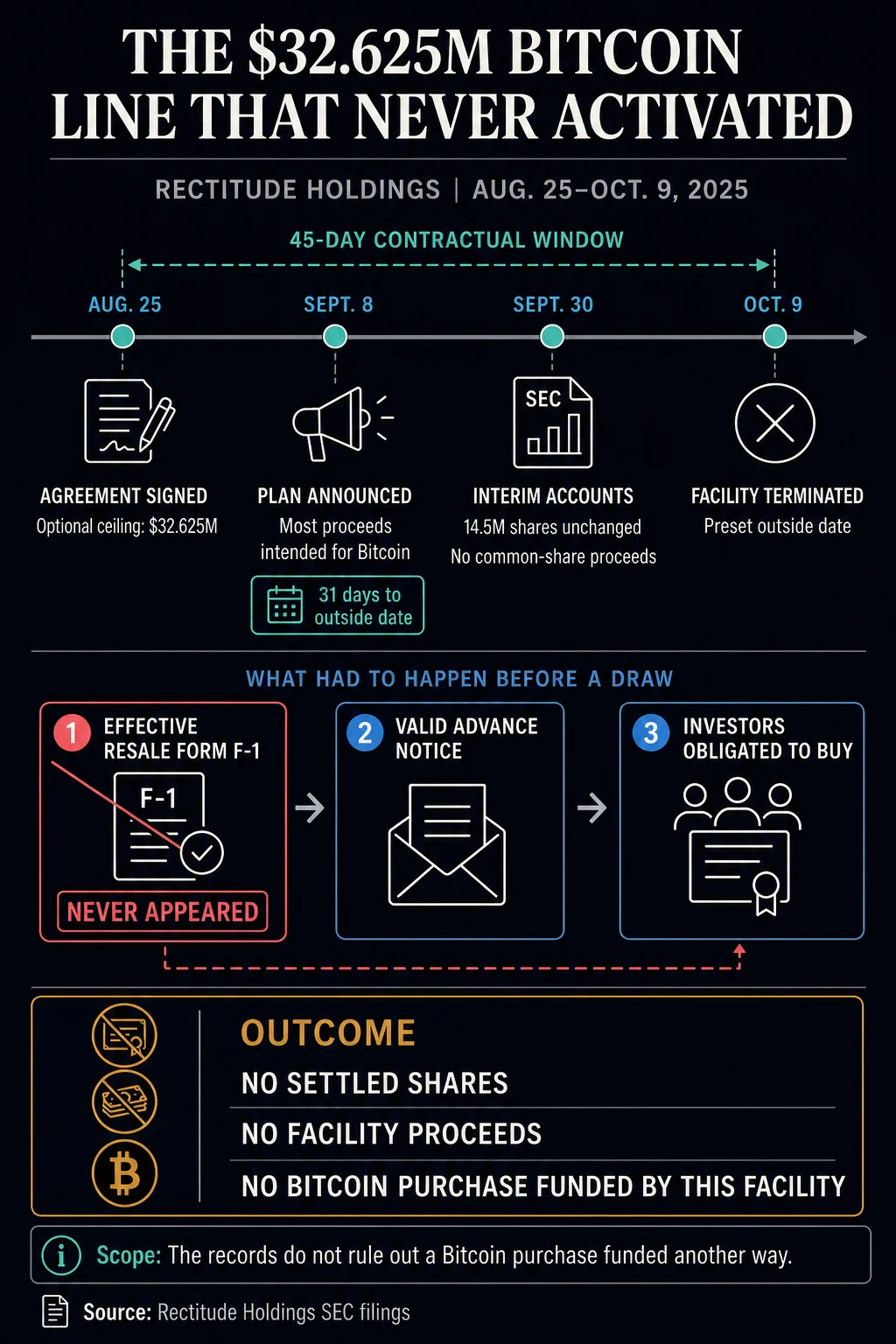
Rectitude Holdings, a Singapore-based supplier of personal protective equipment (PPE), saw its ambitious $32.625 million financing facility, largely earmarked for Bitcoin acquisitions, expire on October 9, 2025, without a single share being issued, cash being received, or any cryptocurrency being purchased. The company’s recently filed annual report detailed the quiet dissolution of this much-touted strategy, highlighting a series of procedural prerequisites that were never met, ultimately rendering the agreement null and void. This development marks a significant anticlimax for a plan that had garnered considerable attention within the financial and cryptocurrency spheres, underscoring the complex and often stringent requirements of such financing arrangements, particularly when venturing into novel asset classes like digital currencies.
The financing facility, established on August 25, 2025, with an expiration date of October 9, 2025, provided Rectitude Holdings with a 45-day window to potentially leverage its stock for capital. The agreement was structured to allow Rectitude to sell shares to Constantinople Limited and Chen Zhiqiang at a 2.5% discount relative to a three-day pricing benchmark. The explicit intention behind this arrangement was to allocate the majority of the proceeds towards the acquisition of Bitcoin, with any remaining funds designated for general corporate purposes. The upper limit of the facility was set at $32.625 million, a figure that represented the maximum potential capital infusion. Crucially, the cash injection was contingent upon Rectitude’s active decision to initiate a draw, allowing the company full discretion over the timing and the quantum of funds it wished to access. The terms stipulated that not utilizing the facility incurred no cost, presenting it as a flexible, on-demand capital option.
The Unfulfilled Prerequisites: A Cascade of Missed Steps
The primary impediment to the execution of the financing agreement lay in the failure of Rectitude Holdings to fulfill essential regulatory and procedural requirements. For the investors, Constantinople Limited and Chen Zhiqiang, to be obligated to purchase shares, two critical conditions had to be met. Firstly, Rectitude was required to have an effective resale registration statement on Form F-1 filed with the relevant authorities. This form is a crucial regulatory document that allows a company to resell securities previously acquired by certain holders. Secondly, Rectitude needed to submit a valid advance notice to trigger the purchase obligation. The contract explicitly detailed these prerequisites, leaving no room for ambiguity.
A thorough review of Rectitude Holdings’ Securities and Exchange Commission (SEC) filing history reveals a conspicuous absence of a Form F-1 filing, or any amendments thereof, within the stipulated 45-day commitment period. Furthermore, no effectiveness notice pertaining to such a filing was issued during this critical timeframe. Consequently, one of the fundamental conditions precedent for the investors’ purchase obligation never materialized. Without this foundational step being completed, the contractual mechanism that would have compelled the investors to acquire Rectitude’s shares and provide capital simply never engaged.
Financial Records Corroborate the Inaction
The company’s financial statements provide a secondary, yet equally compelling, layer of evidence confirming the non-activation of the financing facility. Interim financial statements released by Rectitude Holdings, covering periods extending up to September 30, 2025, which encompassed the majority of the 45-day commitment window, indicated no changes in the company’s issued share count, which remained at 14.5 million. Similarly, the additional paid-in capital remained unchanged from the figures reported at the end of March 2025. Crucially, these interim statements reported no proceeds derived from the sale of common shares.

The audited annual financial statements, which extended to cover the entire commitment period of the facility and an additional five months thereafter, further reinforced this observation. These comprehensive statements maintained the identical equity figures and continued to report an absence of proceeds from common share sales. The settlement of an advance under the facility would have necessitated the issuance of new Rectitude shares in exchange for cash. Therefore, the static equity figures and the consistent lack of reported proceeds serve as strong indicators that no such transaction took place.
Moreover, the annual financial statements also provided a clear picture of the company’s asset holdings. They reported no balance of Bitcoin or any other digital assets. Furthermore, there was no recorded cash flow activity related to the purchase of such assets. This absence of digital asset holdings and related transactional activity aligns perfectly with the conclusion that the financing facility, intended to facilitate Bitcoin purchases, was never utilized.
The Strategic Context: Why Bitcoin?
Rectitude Holdings’ decision to explore a Bitcoin-centric financing strategy was indicative of a broader trend among some publicly traded companies seeking to diversify their treasury holdings and capitalize on the perceived long-term appreciation potential of digital assets. Bitcoin, as the premier cryptocurrency by market capitalization and liquidity, often serves as the initial entry point for institutional investors and corporate treasuries exploring this asset class.
Companies that have publicly announced plans to allocate corporate treasury funds to Bitcoin, such as MicroStrategy, have often cited reasons including hedging against inflation, seeking uncorrelated returns, and positioning themselves for the future of digital finance. For a company like Rectitude Holdings, which operates in the PPE sector, a historically more traditional industry, the move towards Bitcoin acquisition represented a significant strategic pivot. Such a strategy could have been aimed at enhancing shareholder value through potential capital gains on Bitcoin holdings, or by signaling a forward-thinking approach to financial management.
The Mechanics of the Facility: A Closer Look
The structure of the facility, as detailed in the agreement, reveals the specific mechanisms that were intended to govern the flow of capital. The facility provided Rectitude with the option to sell shares, implying that the company held the power to initiate the transaction. The discount of 2.5% to a three-day pricing benchmark was designed to offer investors an incentive to participate, while still providing Rectitude with a favorable valuation for its shares. The stipulation that "most proceeds" would fund Bitcoin purchases highlights the primary objective of the capital raise.

The $32 million figure represented the ceiling of the financing. The cash would only materialize if Rectitude "turned on the tap," meaning it actively requested the funds. This feature provided Rectitude with significant flexibility, as it could choose when and how much to draw, and crucially, it could refrain from drawing altogether without incurring any financial penalty. This "free option" aspect of the facility made it an attractive proposition for companies looking for contingent capital.
The Broader Implications: Navigating the Regulatory Landscape
The quiet expiration of Rectitude Holdings’ Bitcoin financing facility serves as a salient reminder of the complexities inherent in navigating the intersection of traditional finance, corporate law, and the burgeoning cryptocurrency market. The reliance on regulatory filings, such as the Form F-1, underscores the fact that even for companies with established financing agreements, compliance with securities laws remains paramount. The SEC’s oversight of such transactions is designed to protect investors and ensure market integrity.
For companies considering similar strategies, the Rectitude Holdings case highlights the critical importance of meticulous planning and execution. This includes ensuring all regulatory prerequisites are understood and met in a timely manner. Failure to do so can lead to the collapse of potentially lucrative financing opportunities, as demonstrated in this instance.
Furthermore, the incident may also prompt further scrutiny of the due diligence processes undertaken by both the issuing companies and the investors in such arrangements. While the facility itself was seemingly well-structured, the ultimate failure to execute points to potential gaps in understanding or managing the procedural requirements.
Looking Ahead: The Future of Corporate Crypto Strategies
Despite this particular facility’s unfulfilled potential, the broader trend of companies exploring digital assets for their treasuries is likely to continue. As the cryptocurrency market matures and regulatory frameworks evolve, more streamlined and effective pathways for corporate engagement with digital assets may emerge. However, the Rectitude Holdings episode serves as a cautionary tale, emphasizing that even with well-intentioned strategies, the devil is often in the details of execution and regulatory compliance. Companies venturing into this space must be prepared for a landscape that demands both financial acumen and a deep understanding of legal and procedural intricacies. The pursuit of diversification and novel investment opportunities remains a strong motivator, but the path forward requires careful navigation and unwavering adherence to established protocols. The story of Rectitude Holdings’ expired Bitcoin strategy is a testament to the challenges and the learning opportunities inherent in this evolving financial frontier.