admin
admin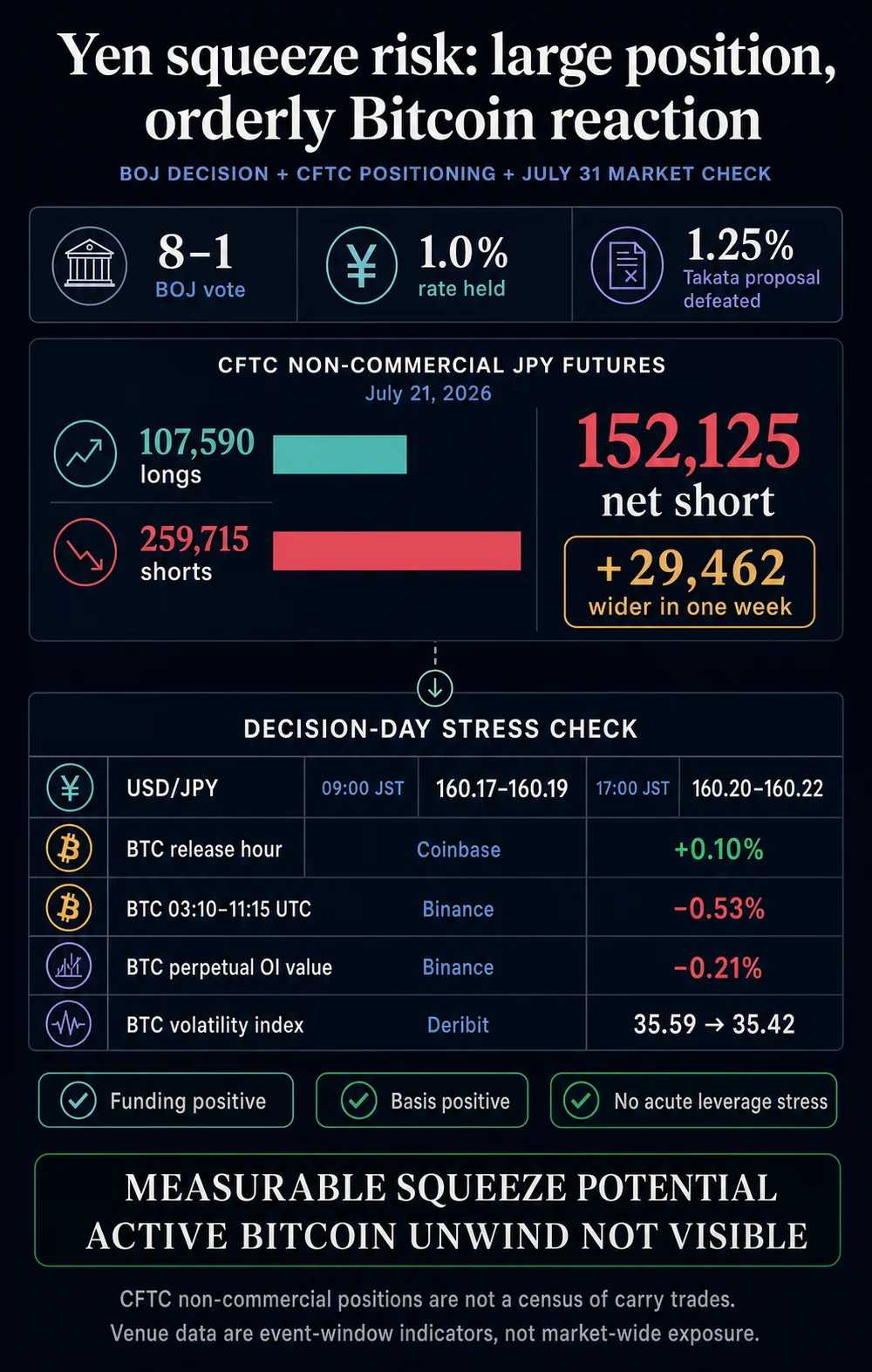
Bitcoin’s leverage gauges barely registered the Bank of Japan’s (BOJ) latest monetary policy announcement on Friday, August 1, 2026. Despite a notable increase in yen short positions leading up to the decision, the cryptocurrency market appeared largely unfazed. However, a dissenting vote from board member Hajime Takata, who advocated for a 1.25% interest rate hike, has emerged as a potential pressure point for traders, particularly those holding leveraged positions in both the yen and Bitcoin.
The BOJ’s Monetary Policy Meeting (MPM) concluded with the board voting 8-1 to maintain the overnight call rate in the vicinity of 1.0%. This decision contrasted sharply with the stance of Takata, who was the sole dissenter, proposing a more aggressive rate hike to 1.25%. This divergence in opinion within the central bank’s leadership is significant, especially in the context of Japan’s ongoing economic landscape, which has been characterized by persistent low inflation and the need for supportive monetary policies. The yen’s performance in the foreign exchange markets, coupled with its interplay with digital asset trading, suggests a developing narrative that could have wider implications for leveraged financial instruments.
The Growing Yen Short and its Potential Ripple Effects
Data from the Commodity Futures Trading Commission (CFTC) reveals a steadily growing net short position in yen futures. As of July 21, 2026, yen shorts stood at 152,125 contracts. By July 28, just days before the BOJ decision, this figure had climbed to 163,412 contracts, representing an increase of 11,287 contracts in a single week. This surge in short positions indicates a growing conviction among speculators that the yen would weaken further, likely in anticipation of continued accommodative monetary policy from the Bank of Japan.
The CFTC’s latest report for the week ending July 28, 2026, detailed a total of 264,683 short positions against 101,271 non-commercial long positions. This imbalance resulted in a net short of 163,412 contracts, a substantial increase from the previous week. The decrease in long positions by 6,319 and the concurrent rise in short positions by 4,968 underscore the prevailing sentiment in the yen futures market.
These positions are categorized by the CFTC as "non-commercial," a broad classification that encompasses large speculators and hedge funds. While this label obscures the specific strategies of individual market participants, it highlights a significant concentration of bearish bets on the yen. The concern for the broader financial markets, including cryptocurrency, is the potential for a rapid unwinding of these short positions. A sudden shift in sentiment or an unexpected policy change could trigger a sharp rally in the yen, forcing leveraged traders to cover their positions. This "short squeeze" could have a cascading effect, potentially impacting other markets where these same entities hold leveraged positions, such as Bitcoin.
Bitcoin’s Apparent Indifference to the BOJ Decision
In stark contrast to the escalating yen short, Bitcoin’s price action remained remarkably subdued around the time of the BOJ’s announcement. The foreign exchange market also showed minimal reaction. The USD/JPY pair experienced little fluctuation in the hours surrounding the BOJ’s reference rate releases. Official BOJ reference rates indicated a narrow trading range between 160.17 and 160.19 at 9 a.m. Tokyo time, and between 160.20 and 160.22 at 5 p.m. The broader Tokyo trading session saw a range of 159.39 to 160.90, with the policy release occurring within this span, thus limiting its utility as a clear indicator of market sentiment.
On cryptocurrency exchanges, the response was equally muted. Coinbase’s BTC-USD pair saw a marginal gain of approximately 0.1% between 3 a.m. and 4 a.m. UTC on August 1, 2026. Binance’s BTCUSDT pair experienced a slight dip of about 0.53% between 3:10 a.m. and 11:15 a.m. UTC. The price movements throughout the remainder of the trading day remained modest, suggesting that the BOJ’s decision did not significantly alter the market’s perception of Bitcoin’s immediate trajectory.
Derivatives Markets Show No Immediate Leverage Break
Analysis of crypto derivatives markets further supports the observation of Bitcoin’s calm reaction. On Binance, dollar-valued perpetual open interest saw a modest decrease of approximately 0.21%. Funding rates remained positive, indicating that long positions were being paid, while the quarterly futures basis stayed above the spot price, suggesting a general bullish sentiment or at least a lack of significant bearish pressure within the futures market.
Deribit, a major options and futures exchange, exhibited even less activity. Funding rates on Deribit faded towards zero, and its Bitcoin volatility index saw a slight decline from 35.59 at 3 a.m. UTC to 35.42 at 11 a.m. UTC. A snapshot of futures at the end of this period showed a positive term structure, reinforcing the notion of stability. While these eight-hour, venue-specific windows provide a limited view, they collectively indicate that the BOJ’s decision did not trigger a noticeable increase in leverage unwinding or heightened volatility in Bitcoin derivatives.
The Significance of Takata’s Dissent and Future Implications
Hajime Takata’s lone dissent at the BOJ meeting is a crucial element to consider. His push for a 1.25% interest rate, while unsuccessful this time, signals a potential shift in thinking among some policymakers. The BOJ’s July outlook report projected inflation, excluding fresh food, to climb clearly above the 2% target from the second half of fiscal year 2026. This forecast, coupled with the acknowledgment of upside risks to the Consumer Price Index (CPI), lends greater weight to Takata’s more hawkish stance.
The divergence of opinion within the BOJ could become a focal point in future meetings. If Takata finds allies for his proposed rate hike, it could signal a more rapid normalization of monetary policy than currently anticipated. Such a development would likely strengthen the yen. If this strengthening of the yen coincides with a significant unwind of the existing yen short positions, it could create a powerful financial shockwave.
The scenario that market observers are closely watching is a potential spillover effect into the cryptocurrency market. A confluence of a significantly stronger yen and a decline in crypto open interest, accompanied by weakening funding rates and rising volatility in digital assets, would signal a major shift. This would indicate that leveraged traders, potentially those with significant exposure to both yen shorts and Bitcoin longs, are being forced to liquidate their positions across multiple markets.
A Look at the Yen’s Performance and Historical Context

The yen has been under considerable pressure for an extended period, influenced by the Bank of Japan’s prolonged commitment to ultra-loose monetary policies, including negative interest rates and yield curve control, even as other major central banks have tightened their stances. This policy divergence has contributed to a significant weakening of the yen against major currencies like the U.S. dollar. As of early August 2026, the USD/JPY pair has been trading at levels not seen in decades, reflecting this fundamental imbalance.
The large accumulation of yen shorts can be seen as a bet against the BOJ’s ability or willingness to normalize its policy in a timely manner. However, the persistent inflation concerns highlighted in the BOJ’s outlook report suggest that the central bank may be under increasing pressure to adjust its course. Any indication of a pivot towards tighter monetary policy, even a gradual one, could trigger a substantial appreciation of the yen.
The Interconnectedness of Global Markets
The relationship between currency markets and digital asset markets, particularly Bitcoin, has become increasingly intertwined. Large institutional players often manage diversified portfolios that include both traditional financial instruments and cryptocurrencies. When significant leverage is involved in one asset class, such as the yen futures market, and those positions are threatened, it can necessitate the liquidation of assets in other, seemingly unrelated markets to meet margin calls.
The "hidden" nature of who is carrying both the yen short and the Bitcoin leveraged positions remains a key unknown. If a substantial portion of these trades are concentrated among a few large entities, a forced liquidation in one market could have a disproportionately large impact on the other. This highlights the interconnectedness of the global financial system and the potential for systemic risk to emerge from unexpected corners.
Conclusion: A Waiting Game for the Markets
For now, the cryptocurrency market appears to have weathered the Bank of Japan’s latest policy decision without significant disruption. The yen short, while substantial, has not yet triggered a decisive market event. However, the dissenting vote from Hajime Takata serves as a reminder that the economic landscape is dynamic, and policy stances can evolve.
Traders and analysts will be closely monitoring future BOJ meetings for any signs of a shift in consensus towards a more hawkish policy. The growing yen short position remains a significant speculative bet, and any reversal in its trajectory could have far-reaching consequences. The coming weeks and months will likely reveal whether the current stability in Bitcoin markets is a testament to its resilience or merely a pause before a potentially turbulent period driven by the unwinding of leveraged trades in the Japanese yen market. The silent threat of a massive margin call looms, contingent on future policy decisions and market sentiment.