admin
admin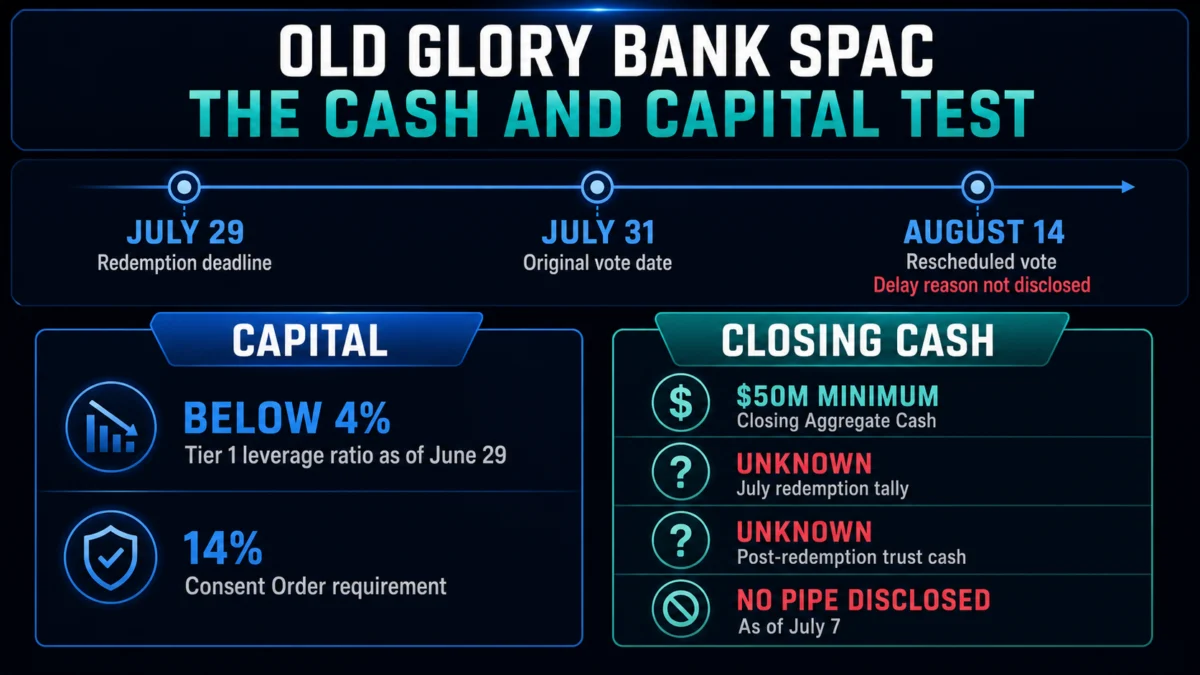
Digital Asset Acquisition Corp. (DAAQ), a special purpose acquisition company (SPAC) aiming to merge with the parent of Old Glory Bank, has unexpectedly postponed its critical shareholder vote. The decision, announced on July 31, pushes the decision from its originally scheduled July 31 date to 10 a.m. Eastern Time on August 14, a move that leaves Old Glory Holding Company, the bank’s parent, in a precarious financial position and further clouds the prospect of a much-needed $50 million capital infusion.
The abrupt delay comes at a critical juncture for Old Glory Bank, which has been struggling to meet key regulatory capital requirements. The SPAC’s filing with the Securities and Exchange Commission (SEC) provided no explicit reason for the postponement, nor did it offer an update on the number of shares that have been redeemed by DAAQ’s shareholders, a figure that is crucial for determining the amount of cash available at the closing of the proposed merger.
A Timeline of Uncertainty
The original meeting date, July 31, was scheduled just two days after the stated redemption deadline of July 29. This proximity suggested that DAAQ’s management was likely pushing to secure shareholder approval with a clear understanding of the financial landscape post-redemption. However, the decision to extend the proxy solicitation period indicates that either insufficient shareholder support was secured, or the financial projections became even more uncertain in the immediate lead-up to the vote.
According to DAAQ’s final prospectus, investors who had requested to redeem their shares were permitted to withdraw those requests only through the redemption deadline. After July 29, any further withdrawal would require the company’s explicit consent before the merger’s closing. The latest filing does not specify whether DAAQ has granted such post-deadline withdrawals, adding another layer of ambiguity to the deal’s financial viability.
The Looming Capital Gap

The core of the issue lies with Old Glory Holding Company, the entity that owns Old Glory Bank. As the merger vote window opened, the bank was demonstrably below two significant capital thresholds. Its Tier 1 leverage ratio, as of June 29, remained below the standard 4% benchmark for being adequately capitalized. This situation placed Old Glory in technical noncompliance with a covenant within the merger agreement. While Old Glory’s management deemed this noncompliance to be non-material, regulatory scrutiny paints a more concerning picture.
A May 2024 consent order issued jointly by the Federal Deposit Insurance Corp. (FDIC) and the Oklahoma State Banking Department imposes a significantly higher requirement. This order mandates a Tier 1 leverage ratio of 14% for as long as the order remains in effect. Furthermore, it necessitates regulator-approved capital and business plans, as well as prior consent for any dividend payments or bonus distributions. In parallel, prompt corrective action rules restrict the bank’s growth, capital distributions, acquisitions, branch expansion, and the introduction of new business lines while it remains undercapitalized.
The holding company’s consolidated financial disclosures have painted a stark reality: its capital is not projected to cover anticipated operating losses and essential minimum regulatory capital needs over the next twelve months. This projection creates "substantial doubt about its ability to continue as a going concern," a phrase that signals serious financial distress.
The Merger as a Lifeline, But Not a Guarantee
Old Glory’s management has identified the cash infusion from the DAAQ merger as a critical mitigating factor for these financial concerns. However, they have explicitly stated that the successful closing of the deal is contingent upon the actions of other parties involved and prevailing market conditions, and is therefore "not assured." It is important to note that this warning, while serious, is not a formal declaration of the bank’s insolvency or an imminent closure.
The merger agreement itself includes a crucial condition: at least $50 million in aggregate cash must be available at closing. This sum is calculated based on the cash remaining in DAAQ’s trust account after redemptions, proceeds from any Private Investment in Public Equity (PIPE) financing that are actually received, and any additional funds secured through other transaction financing. The party benefiting from this condition, Old Glory Holding Company, has the legal right to waive it in writing, provided it is lawful to do so.
Transparency Lacking on Key Financials

As of March 31, DAAQ reported holding $178.58 million in trust securities, with 17.25 million public shares eligible for redemption. However, this historical balance offers no insight into the funds available at the potential closing date. The SPAC’s most recent filing on July 31 failed to disclose the redemption tally from July, nor did it provide an updated figure for the remaining cash in trust. This lack of transparency leaves investors and observers guessing about the true financial standing of the deal.
Adding to the uncertainty, the July 7 prospectus indicated that no PIPE financing or other forms of transaction financing had been secured or finalized. A prior filing in June had mentioned DAAQ’s intention to negotiate non-redemption agreements, but the attached documentation did not identify any executed investor agreements or committed share amounts. This suggests a significant gap in securing alternative funding to offset potential redemptions.
Regulatory Hurdles Remain
Beyond the financial considerations, the merger faces ongoing regulatory approvals. As of the final prospectus filing, an application with the Federal Reserve remained pending. Additionally, Nasdaq approval for the combined company’s initial listing was a necessary closing condition. The July 31 filing did not provide any updates on these crucial approvals, although the absence of news does not definitively indicate their status.
The Road Ahead: Awaiting Clarity
With the shareholder vote now rescheduled to August 14, DAAQ has been granted an additional two weeks to garner the necessary support. However, the critical issue of the deal’s cash component remains opaque. Investors are keenly awaiting the redemption count and confirmation of firm funding commitments to ascertain whether the $50 million closing cash test can be met. Furthermore, an updated assessment of Old Glory Bank’s capital ratios, particularly in light of the consent order, is essential for a complete understanding of the bank’s financial health and the implications of this protracted merger process. The delay, while granting more time, has amplified the existing concerns surrounding the financial viability of Old Glory Bank and the ultimate success of this SPAC transaction.