admin
admin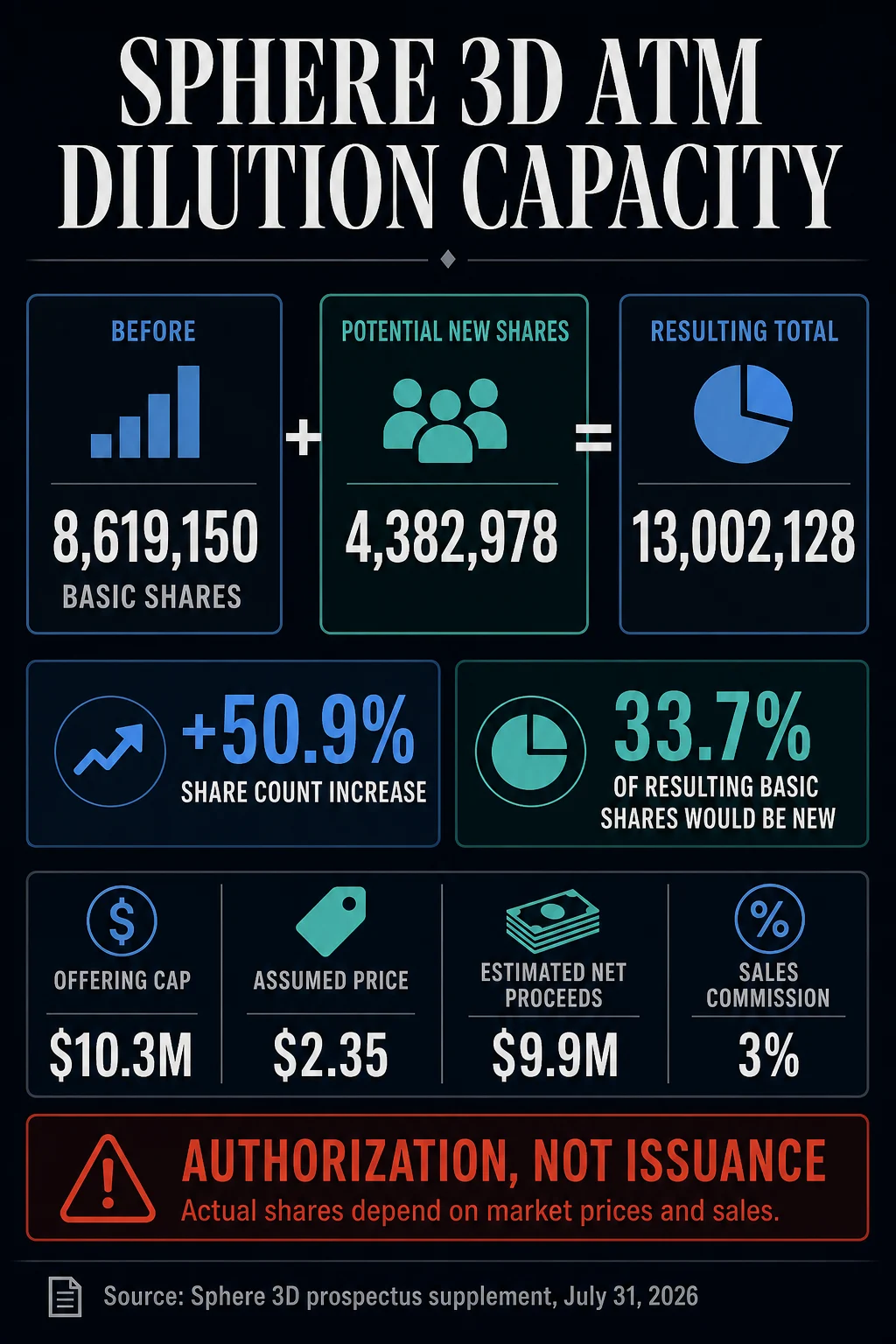
Bitcoin miner Sphere 3D is poised to undertake a substantial dilution of its existing shareholders, potentially increasing its basic share count by as much as 50.9%. This move comes as the company grapples with considerable cash flow challenges, necessitating the raising of up to $10.3 million through an amended at-the-market (ATM) stock sale facility. The financial maneuver, detailed in a recent prospectus supplement filed on July 31, reveals a critical juncture for the publicly traded miner as it seeks to bolster its working capital and ensure operational continuity.
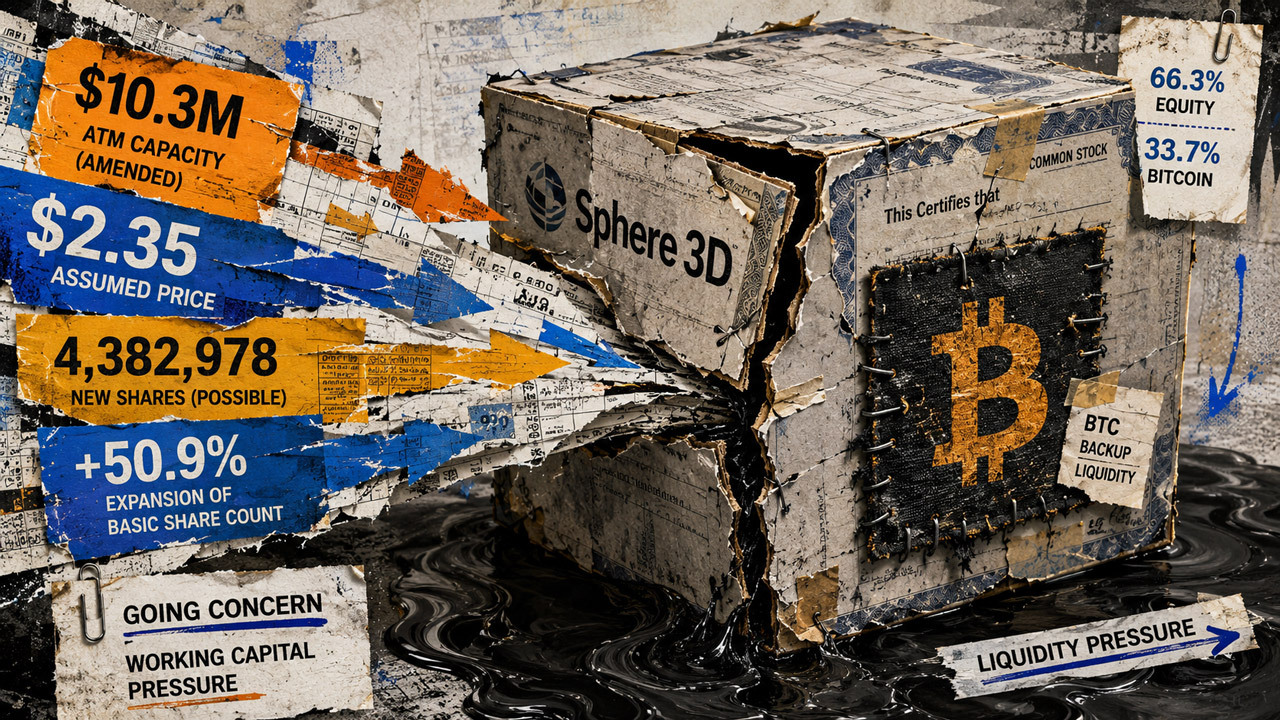
The core of the impending dilution lies in the company’s authorization to sell shares at prevailing market prices. Based on an assumed share price of $2.35, the full utilization of this facility would result in the issuance of approximately 4,382,978 new common shares. This influx of shares would expand the company’s basic share count from its current 8,619,150 to a projected 13,002,128. Such an expansion represents a nearly 51% increase, a figure that carries significant implications for existing investors regarding their proportional ownership and potential earnings per share.
It is crucial to understand that this ATM facility represents authorization, not a completed issuance. The designated sales agents, A.G.P. and Maxim, are not bound by any minimum sales obligation. Consequently, the actual number of shares issued and the total capital raised will be contingent upon market conditions and the execution strategy employed by these agents. Nevertheless, the disclosed capacity underscores the company’s immediate need for liquidity.
The filing further clarifies the scope of this potential dilution. The 4,382,978 new shares, if fully issued, would constitute approximately 33.7% of the resultant basic share total. This leaves the previously outstanding shares representing roughly 66.3% of the expanded base. However, this calculation is based on "basic" shares and does not account for a multitude of other equity instruments. The company’s filings explicitly exclude stock options, restricted stock units, restricted stock awards, shares issuable upon conversion of preferred stock, warrants, and shares reserved for future equity compensation plans. The actual dilution could therefore be considerably higher once these additional dilutive instruments are factored in.
Sphere 3D projects net proceeds of approximately $9.9 million if the full assumed offering is successfully completed, after accounting for a 3% sales agent commission and other estimated offering expenses. This financial recourse has already seen some utilization under a prior program. A companion Form 8-K filing indicates that through July 30, the company had already sold 2,172,789 shares under a superseded prospectus, generating $5.13 million in gross proceeds. These prior sales, however, are distinct from the currently amended facility.
The Strategic Role of Bitcoin as Working Capital
Beyond equity financing, Sphere 3D’s operational strategy includes the ongoing sale of mined Bitcoin as a fallback for working capital or for strategic growth initiatives. This policy provides an additional layer of financial flexibility, allowing the company to convert its digital asset holdings into immediate liquidity when required.
Recent financial disclosures paint a picture of a company operating under tight financial constraints. As of March 31, combined pro forma accounts for Sphere 3D and Cathedra (following their merger) indicated cash reserves of $3.38 million and digital currencies valued at $2.06 million. It is important to note that these figures represent a hypothetical scenario as if the merger had occurred on that date and do not reflect the most up-to-date post-merger balances.
Sphere 3D’s standalone quarterly accounts for the period ending March 31 reported $3.15 million in cash and 26.2 Bitcoin, which held a balance sheet fair value of $1.79 million. During that same quarter, the company generated $2.79 million in proceeds from Bitcoin sales, all of which were explicitly stated to have funded operations. This reinforces the company’s reliance on its Bitcoin holdings to meet immediate operational needs.
The company’s July prospectus further elaborates on this strategy, stating that management reserves the right to continue selling mined Bitcoin as needed for working capital or growth. This indicates a deliberate policy choice rather than an ad-hoc reaction to a singular event, though no specific Bitcoin sale order has been publicly announced under this policy.
A History of Financial Precariousness
The current equity issuance and the emphasis on Bitcoin sales as operational liquidity are underscored by a history of financial challenges. Sphere 3D’s 2025 audit report contained a going-concern explanatory paragraph, a strong indicator of management’s concerns about the company’s ability to continue operating for the foreseeable future. Similarly, Cathedra’s independent audit also included a separate going-concern matter.
Further compounding these concerns, Cathedra’s interim accounts as of March 31 reported a working-capital deficiency of C$4.35 million and indicated net cash used in operating activities totaling C$1.17 million during the first quarter of 2026. These figures highlight significant operational expenditures outpacing incoming cash flows, necessitating external financing or asset liquidation.

As of an August 3 review of Sphere 3D’s filings with the U.S. Securities and Exchange Commission (SEC), no subsequent disclosures had been made regarding sales conducted under the newly amended ATM facility. This does not preclude the possibility of trades that may be reported retrospectively, but it means the most concrete measure of potential dilution remains the publicly declared capacity.
Broader Implications for the Bitcoin Mining Sector
The situation at Sphere 3D is not an isolated incident within the broader Bitcoin mining industry. Many miners have faced significant financial headwinds due to fluctuating Bitcoin prices, increasing energy costs, and substantial capital expenditures required to maintain and upgrade mining operations. The industry has seen a trend of consolidation, with larger, well-capitalized entities acquiring smaller, struggling miners.
The ATM facility, while a common tool for publicly traded companies to raise capital, can be a double-edged sword for shareholders. While it provides essential liquidity, the resultant dilution can significantly impact the value of existing shares, especially if the company’s future performance does not justify the increased share count. Investors often scrutinize the terms and necessity of such offerings, particularly when they signal underlying financial distress.
The dual strategy of equity issuance and Bitcoin sales as working capital reflects the complex financial landscape faced by many Bitcoin miners. Their business model is intrinsically tied to the volatile price of Bitcoin, making capital management a perpetual challenge. The ability to effectively navigate these cycles often dictates long-term survival and success.
Sphere 3D’s decision to utilize its ATM capacity, coupled with its standing policy on Bitcoin sales, points to a proactive approach in managing its liquidity crisis. However, the magnitude of the potential dilution raises questions about the company’s long-term financial strategy and its ability to generate sufficient returns to offset the impact on its existing shareholder base. The coming months will be critical in observing how effectively Sphere 3D utilizes these capital-raising measures and whether it can stabilize its financial position in the dynamic cryptocurrency market. The transparency of future filings will be paramount for investors seeking to understand the evolving financial health of the company.