admin
admin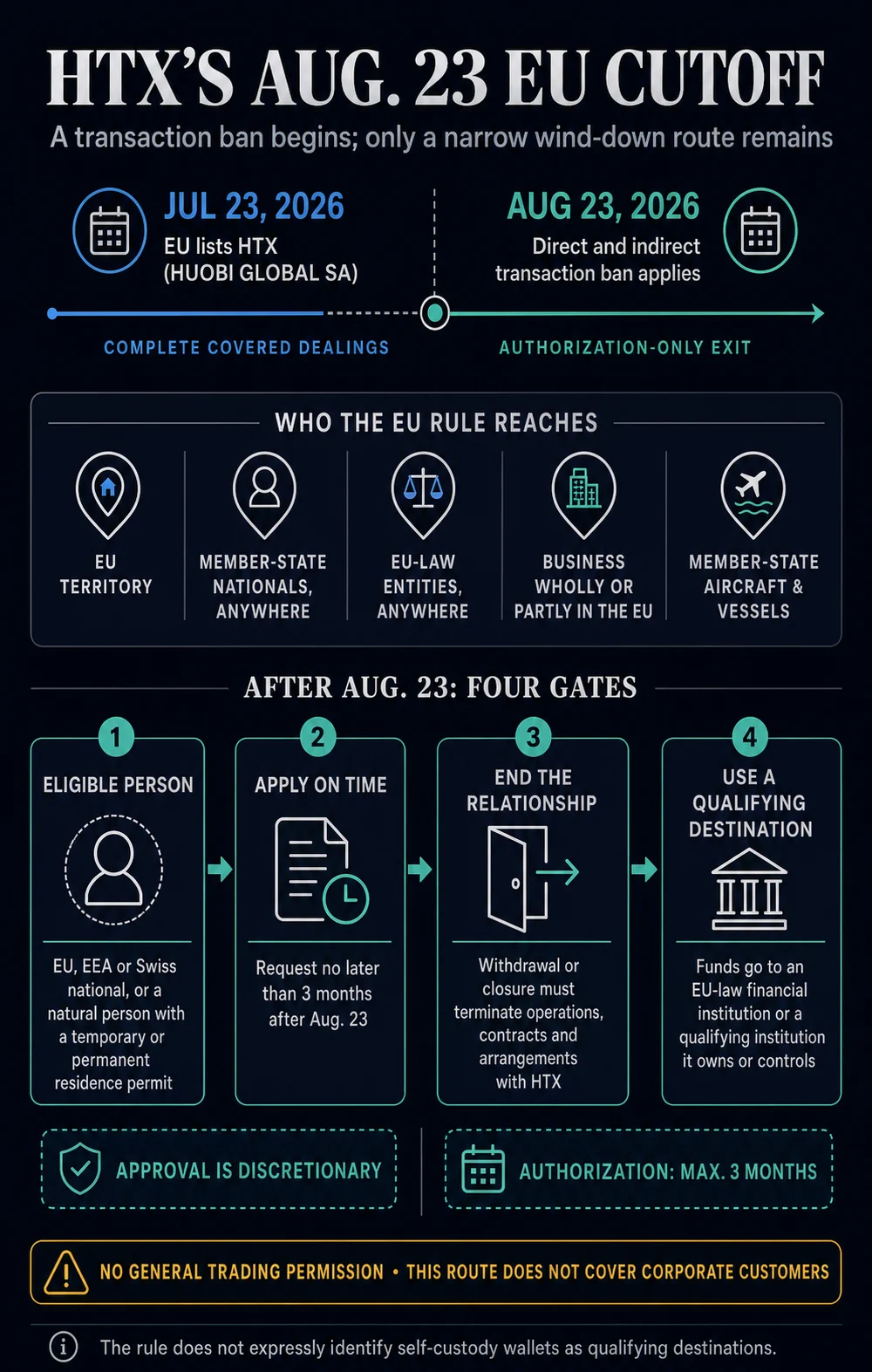
European Union sanctions are set to sever direct and indirect transactional ties with HTX (formerly Huobi) from August 23, 2026, impacting a broad spectrum of entities and individuals operating within the bloc’s jurisdiction. This stringent measure, codified in Council Regulation (EU) 2026/1848, designates "HTX (HUOBI GLOBAL SA)" within Annex XLV, establishing a hard deadline for all relevant dealings. For those still holding assets or positions on the exchange, navigating the post-sanction landscape will be fraught with complexity, requiring narrow discretionary approval from national authorities for any subsequent withdrawal, and mandating a complete cessation of engagement with the platform.
The implications of this regulation are far-reaching, effectively creating a financial impasse for corporate entities and individuals caught within its scope. Article 5ad of the EU regulation unequivocally prohibits transactions with listed entities. Crucially, subsequent amendments extend this prohibition to encompass entities acting on behalf of or at the direction of a designated entity, as well as qualifying crypto-asset or payment service providers that function as mirror or successor entities. This comprehensive approach aims to prevent any circumvention of the sanctions regime. Consequently, any withdrawal, payment, or other financial dealing subject to these rules must be concluded prior to the August 23 application date, or qualify for a specific, narrowly defined exception or authorization.
The Reach of EU Sanctions and the August 23 Deadline
The extraterritorial reach of these sanctions is significant. Article 13 of Regulation 833/2014, which lays the groundwork for these measures, applies the rules not only within EU territory but also to transactions conducted aboard aircraft or vessels under the jurisdiction of a member state. Furthermore, it extends to member-state nationals, regardless of their physical location, as well as companies and other entities established under member-state law, irrespective of where they operate. Crucially, the regulation also governs any entity conducting business wholly or partly within the Union.
It is important to note that a mere European Economic Area (EEA) or Swiss connection does not automatically place a transaction under the purview of Article 13. However, EEA or Swiss nationality, or qualifying residency status within these jurisdictions, can make an individual eligible for a separate, albeit restricted, exit provision. This distinction is vital, as it delineates who might still have recourse to withdraw funds, even after the general transaction ban comes into effect.
Navigating the Post-Cutoff Withdrawal Landscape
The period following August 23, 2026, presents a formidable challenge for those needing to divest from HTX. While the general prohibition on transactions with HTX will be in full force, a limited window of opportunity for withdrawal exists for specific individuals, subject to stringent conditions and discretionary approval. A member-state competent authority may authorize a transaction if it is deemed strictly necessary for an eligible person to withdraw funds or close an account with HTX. This authorization, however, is not a blanket permission for continued engagement.

To qualify for such an authorization, the individual must commit to terminating all operations, contracts, and other agreements with the exchange. The approval process is discretionary, meaning there is no guarantee of a favorable outcome, and any granted authorization may come with specific conditions attached. Critically, such approvals will not permit any form of continued trading or ongoing financial activity on the HTX platform. The intent of this provision is solely to facilitate the orderly closure of accounts and the repatriation of funds, not to allow for continued business with a sanctioned entity.
The eligibility for this post-cutoff withdrawal provision is specifically delineated. It covers EU, EEA, and Swiss nationals, as well as natural persons who hold a temporary or permanent residence permit in one of these jurisdictions. Notably, this particular exit provision does not extend to corporate customers. This exclusion significantly limits the recourse for businesses that may have held substantial assets on the exchange. Furthermore, there are strict time constraints associated with these applications. A request for authorization must be filed no later than three months after the ban commences on August 23, 2026. Even if an authorization is granted, it will remain valid for a maximum period of three months, underscoring the urgency and the finite nature of this exception.
The regulation also specifies the destination for authorized fund transfers. Funds withdrawn under this provision must be moved to a credit or financial institution established under the law of an EU member state, or to a third-country institution that is owned or controlled by an entity within an EU member state. The provision does not explicitly recognize a self-custody wallet as a qualifying destination, which could present an additional hurdle for individuals seeking to move their assets to decentralized storage solutions.
Background and Context: A Widening Net of Sanctions
The inclusion of HTX on the EU’s sanctions list follows a broader trend of increasing regulatory scrutiny and action against entities perceived to be facilitating illicit activities or operating in contravention of international norms. The cryptocurrency sector, with its inherent global reach and often opaque operational structures, has become a particular focus for regulators worldwide. The EU’s designation of HTX is not an isolated event but rather part of a coordinated effort to tighten financial controls and enhance compliance within the digital asset space.
The specific timing of the August 23 deadline suggests a period of grace intended to allow for the orderly unwinding of existing relationships. However, the strict conditions attached to any post-deadline transactions indicate a firm intent to sever ties. The regulation’s explicit naming of "HTX (HUOBI GLOBAL SA)" suggests a direct targeting of the exchange’s corporate entity, aiming to prevent its continued operation within the EU’s financial ecosystem.
The existing user agreement of HTX, last updated on June 18, 2026, already prohibits users in all EU member states from accessing its services. This pre-existing restriction implies that the new EU regulation may not impact a vast swathe of currently active EU-based users who have already been barred. However, potential exposure could still include residual accounts held by EU nationals who are currently abroad, or other "covered counterparties" who may not have fully divested their holdings. Publicly available data does not yet quantify the exact size of these potentially affected groups.

HTX’s Stance and Previous Actions
In response to a separate UK sanctions action in May 2026, HTX issued a statement asserting that Huobi Global S.A. was distinct from the online exchange. However, the subsequent EU regulation specifically names "HTX (HUOBI GLOBAL SA)" together, leaving ambiguity as to how HTX will internally manage the distinction and the implications for its EU-facing operations and user base. This past statement, while intended to clarify corporate structure, does not definitively address how the exchange will comply with the EU’s stringent transaction ban. The lack of a clear, public communication from HTX specifically addressing the EU sanctions and their impact on corporate accounts adds to the uncertainty for affected parties.
Broader Implications and Analysis
The EU’s decisive action against HTX highlights the increasing interconnectedness of traditional finance and the cryptocurrency market, and the growing assertiveness of regulatory bodies in policing this nexus. For corporate clients of HTX, the situation represents a significant operational and financial challenge. The lack of a straightforward legal exit route post-August 23 for corporate accounts means that any assets held on the exchange could effectively become inaccessible, or at the very least, subject to a highly complex and uncertain authorization process.
This regulatory move underscores the critical importance of robust compliance frameworks for all entities operating in the digital asset space, particularly those with a global customer base. It also serves as a stark reminder to businesses that regulatory landscapes can shift rapidly, and proactive risk management is paramount. The inability for corporate entities to utilize the discretionary withdrawal provision means that any assets held by such entities on HTX after August 23 will likely remain frozen unless further clarification or alternative regulatory pathways emerge.
The distinction between individual and corporate eligibility for withdrawal is a significant point of concern. While individual users may have a path, albeit a narrow one, to recover their funds, corporate entities appear to be facing a complete financial roadblock. This could lead to significant financial losses for businesses that relied on HTX for their cryptocurrency operations.
The August 23 deadline is therefore a critical dividing line. For transactions falling within the EU rule’s reach, individuals must ensure their dealings are completed before this date. For those who cannot, the only recourse is to seek a discretionary authorization that will facilitate a complete and final exit from the exchange, rather than enabling any continued engagement. The coming weeks will be crucial for affected parties to understand their specific eligibility and to initiate the necessary application processes, should they qualify, to mitigate potential financial repercussions. The absence of a clear and accessible exit for corporate entities suggests that this regulatory action is designed to be a decisive and impactful measure.