Lina Irawan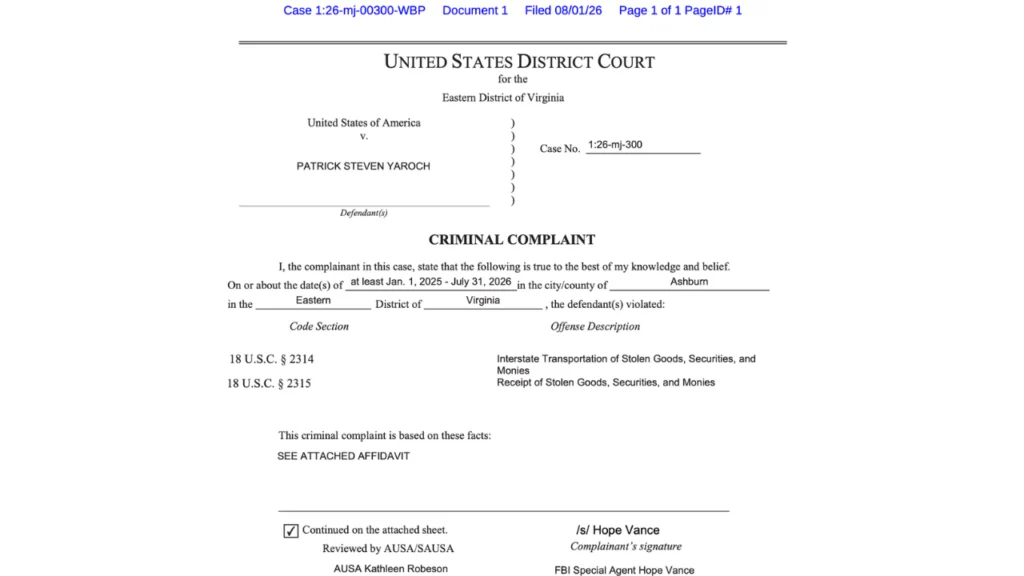
A senior official within the Federal Bureau of Investigation, Patrick Steven Yaroch, a former supervisory special agent with extensive experience in counterintelligence, has been arrested and charged with a stunning act of betrayal: the alleged theft of nearly $1 million in cryptocurrency. The digital assets, reportedly siphoned from wallets meticulously monitored as part of a sensitive national security probe, underscore a growing vulnerability within law enforcement agencies grappling with the increasing reliance on digital currencies in complex investigations. The case, detailed in court documents unsealed on August 1st, paints a grim picture of insider abuse at the highest levels of federal law enforcement.
The charges against Yaroch, which include interstate transportation of stolen property and receipt of stolen property, stem from allegations that he exploited his privileged access to sensitive FBI systems and intelligence. Authorities report that Yaroch, who held a top-secret security clearance and served in the FBI’s Counterintelligence Division, utilized his authorized access to obtain recovery seed phrases for cryptocurrency wallets under FBI observation. These wallets were tied to an ongoing investigation into an unnamed “adversarial nation,” according to the criminal complaint filed in the U.S. District Court for the Eastern District of Virginia. Instead of facilitating the seizure of these assets, the FBI had been employing a strategy of prolonged monitoring to gather intelligence, track illicit financial flows, and identify key players within the foreign operation.
Prosecutors allege that Yaroch grew increasingly frustrated with what he perceived as governmental inaction regarding the continued use of these crypto accounts by the target. This perceived inertia appears to have fueled his decision to personally seize the assets. Over the course of more than a year, Yaroch is accused of executing approximately ten unauthorized transfers, moving the cryptocurrency from the monitored wallets into personal accounts under his direct control. The value of the stolen assets, initially estimated at over $900,000, reportedly appreciated to approximately $1 million by the time of his alleged confession.
A Confidential Investigation Unravels
The counterintelligence investigation that formed the backdrop for Yaroch’s alleged illicit activities focused on sophisticated financial operations linked to a foreign adversary. Within this highly classified environment, Yaroch was privy to information concerning specific cryptocurrency wallets being utilized by individuals or entities associated with this nation-state. The FBI’s strategy, a common practice in modern financial investigations, involved allowing these digital wallets to remain active. This allowed investigators to meticulously track the movement of funds, build comprehensive timelines of illicit transactions, and potentially uncover broader networks of illicit actors. The decision of when and how to seize such assets is a critical and complex part of these investigations, often balancing intelligence gathering against the risk of tipping off targets.
Yaroch’s alleged transgression involved circumventing these established protocols. Court filings indicate that he leveraged his authorized access to FBI databases to obtain the critical recovery seed phrases—essentially the master keys—for these monitored wallets. With these phrases in hand, he was reportedly able to create his own digital wallets and systematically transfer the substantial cryptocurrency holdings into them, effectively diverting assets intended for national security purposes into his personal wealth. The timeline of these alleged transfers spans over a year, suggesting a sustained period of deception and exploitation of his position.

The Confession and the Fallout
The investigation into Yaroch’s activities reached a critical juncture on July 28th, when he allegedly initiated contact with a Department of Justice employee via the encrypted messaging application Signal, requesting a discreet meeting. This overture led to a meeting at FBI headquarters, where, according to prosecutors, Yaroch became visibly emotional and confessed to stealing the cryptocurrency. The gravity of his admission prompted immediate action.
Following this confession, agents conducted an interview at Yaroch’s residence in Virginia. During this interview, the affidavit states that Yaroch acknowledged his actions, reportedly uttering, “I fucked up.” A subsequent search of his home uncovered significant evidence supporting the allegations: a Trezor hardware wallet, which is used to store cryptocurrency offline, handwritten cryptocurrency seed phrases, and a Kraken exchange account. This exchange account contained approximately $188,570 in various digital assets, including a substantial amount of USDC stablecoin and smaller holdings of Bitcoin and other cryptocurrencies, alongside approximately $166,000 in cash.
Upon confirmation of the allegations and the evidence gathered, the FBI promptly suspended Yaroch’s employment, followed by his termination and subsequent arrest. In a statement, an FBI spokesperson emphasized the bureau’s swift response: "As soon as the FBI became aware of these allegations, we immediately took action, began an investigation, and ultimately executed an arrest warrant. The bureau added that it holds employees to the highest ethical standards and does not tolerate misconduct." This swift action highlights the FBI’s commitment to addressing breaches of trust, particularly those involving sensitive national security investigations.
Digital Footprints and AI in Evidence
Adding a novel and potentially precedent-setting dimension to the case, prosecutors have incorporated Yaroch’s interactions with the artificial intelligence chatbot ChatGPT into the evidence against him. During the examination of his personal phone, investigators discovered a series of prompts that suggested a preoccupation with managing significant wealth and planning an international relocation.
According to the affidavit, Yaroch’s inquiries to ChatGPT began with a question about how to best invest approximately $1 million to maximize returns. Days later, he posed a more direct question: "If you had a bucket of money (around $1 million) and you wanted to leave the USA and become a resident or citizen of an EU country, what would you do?" The AI’s responses, which reportedly offered tailored recommendations based on factors like age and family circumstances, including suggestions for relocating to Portugal or southern Italy, are now part of the evidentiary record.
Further digital forensics revealed searches related to travel routes through Turkey, inquiries about moving to Greece, and the drafting of emails concerning overseas employment opportunities. Investigators also uncovered travel plans for Yaroch and his family to visit Portugal in September 2026, alongside documents pertaining to Portuguese residency and records of several foreign trips. These trips, prosecutors contend, were not properly reported internally as required by FBI regulations, indicating a pattern of clandestine activity and potential evasion of oversight. The inclusion of AI-generated conversations as evidence marks a significant development in criminal investigations, illustrating how readily available advanced technologies can leave traceable digital footprints that can be used in court.

Broader Implications for Crypto Investigations and Insider Threats
The arrest and charges against Patrick Steven Yaroch send ripples through the national security and financial crime landscapes, highlighting several critical issues. Firstly, it underscores the persistent threat of insider abuse within government agencies, even those tasked with safeguarding national security. The ability of a single individual, armed with privileged access and knowledge, to compromise sensitive investigations and illicitly divert substantial assets is a stark reminder of the vulnerabilities that exist.
Secondly, the case amplifies the growing importance and complexity of cryptocurrency in national security and financial crime investigations. As digital assets become more deeply embedded in global finance, they also become more attractive targets and tools for illicit actors, including state-sponsored groups. Federal agencies are increasingly employing sophisticated techniques to monitor, trace, and ultimately seize these assets, often employing strategies that require prolonged observation. Yaroch’s alleged actions demonstrate how an insider could exploit this very strategy for personal gain.
The FBI’s approach of allowing wallets to remain active, while crucial for intelligence gathering, also inherently carries risks. The case suggests that robust internal controls, oversight, and potentially advanced technical safeguards are paramount to prevent such breaches. The FBI’s swift response and public statement reinforce their commitment to upholding ethical standards, but the incident itself raises questions about the effectiveness of existing security protocols and vetting processes for personnel in positions of high trust.
Furthermore, the integration of ChatGPT conversations into the prosecution’s evidence signals a new frontier in the use of digital forensics. As artificial intelligence tools become more sophisticated and widely adopted, their outputs are likely to become increasingly scrutinized in legal proceedings. This case could set a precedent for how such interactions are collected, analyzed, and presented as evidence in future criminal cases, particularly those involving complex financial schemes and international planning.
Yaroch remains in federal custody in Virginia as the criminal proceedings against him continue. The presumption of innocence applies, and he will have the opportunity to defend himself against the charges. However, if convicted, this case would stand as one of the most significant insider theft cases involving cryptocurrency prosecuted by the FBI, and potentially one of the first major U.S. criminal cases where conversations with an AI chatbot play a notable role in the government’s evidence, underscoring the evolving challenges and complexities of law enforcement in the digital age. The FBI’s commitment to transparency in acknowledging the incident and reaffirming its ethical standards will be crucial in maintaining public trust amidst this unsettling revelation.