admin
admin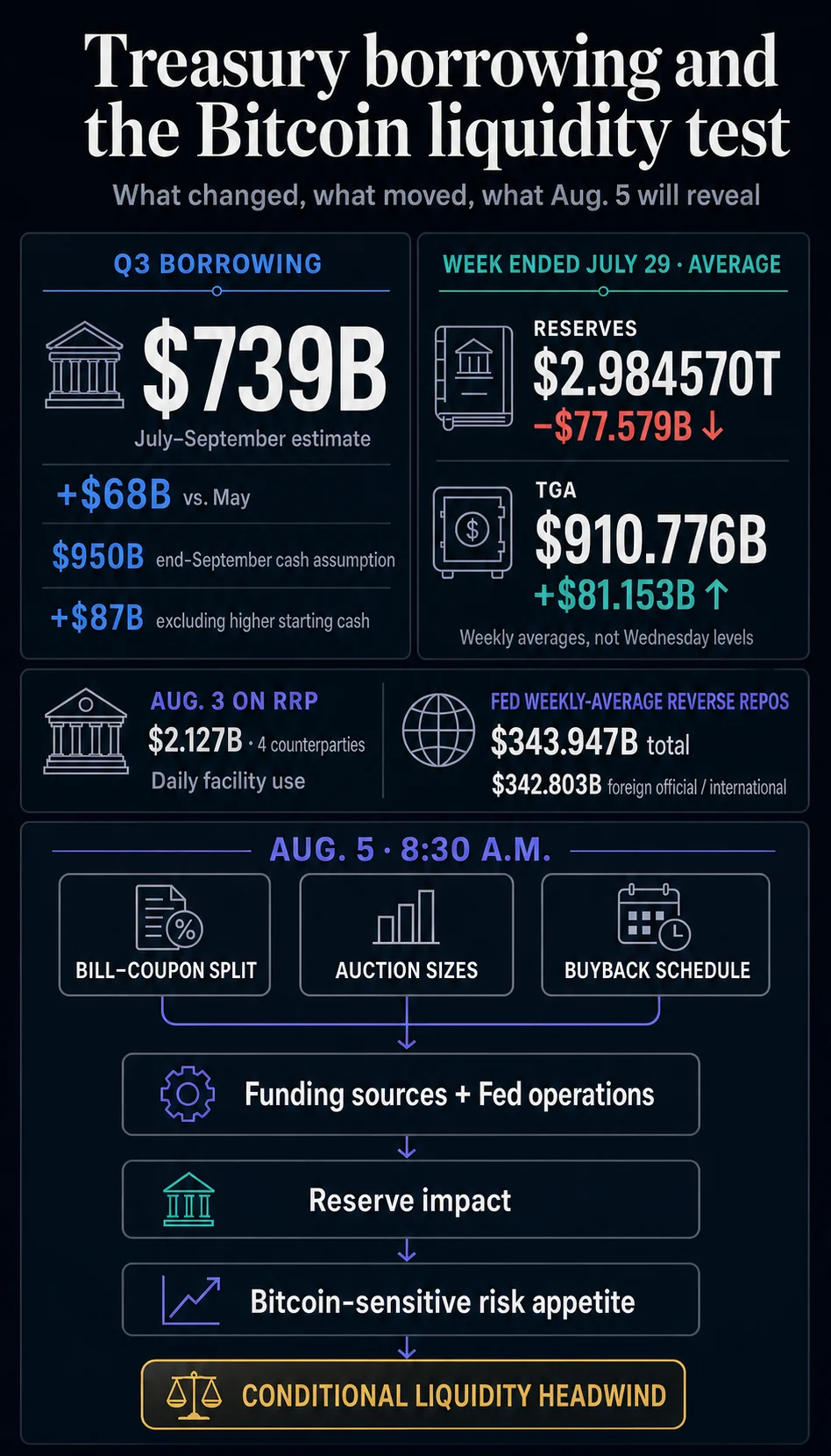
The financial markets are bracing for a significant liquidity event on August 5th, as the U.S. Treasury prepares to unveil its financing plan for the third quarter. This announcement, particularly the composition of its debt issuance—specifically the mix between short-term bills and longer-term coupon bonds—will be closely scrutinized for its potential impact on bank reserves and, by extension, the risk appetite for assets like Bitcoin. Recent data reveals a substantial drain of $77.579 billion from bank reserves on a weekly-average basis for the period ending July 29th. This decline, coupled with an increased U.S. Treasury borrowing estimate for the July-September quarter, signals a tightening of liquidity that could ripple through the financial system and affect cryptocurrency markets.
The Mechanics of Liquidity Drain: Treasury Borrowing and Reserve Balances
The U.S. Treasury’s increased borrowing needs are a key driver of this liquidity shift. On August 3rd, the Treasury released its updated borrowing estimate, projecting an end-September cash balance of $950 billion. This represents an increase of $68 billion from its May 4th baseline. However, when accounting for a higher starting balance in May ($19 billion), the net revision to anticipated borrowing climbs to $87 billion. This upward revision is primarily attributed to lower projected net cash flows, indicating a greater reliance on market financing to meet the government’s obligations.
This borrowing activity directly impacts bank reserves, the funds that commercial banks hold at the Federal Reserve. The Federal Reserve’s H.4.1 release, which details the Fed’s balance sheet, provides critical insights. For the week ending July 29th, weekly-average reserve balances stood at $2.984570 trillion, a notable decrease from $3.062149 trillion for the week ending July 22nd. This $77.579 billion decline represents a significant withdrawal of liquidity from the banking system.
Concurrently, the Treasury General Account (TGA), the U.S. government’s primary checking account at the Federal Reserve, saw an increase. Over the same comparison period, the TGA balance rose from $829.623 billion to $910.776 billion. The snapshot on Wednesday, July 29th, specifically showed reserves at $2.944541 trillion and the TGA at $970.442 billion. The substantial $81.153 billion increase in the TGA on that single day was a major contributor to the overall $89.880 billion weekly-average increase in deposits other than reserve balances.

It is crucial to note that the decline in bank reserves is not solely attributable to the TGA’s growth. Various other movements within the Federal Reserve’s balance sheet can influence reserve levels. For instance, Federal Reserve operations, such as open market operations or changes in its holdings of securities, can either inject or withdraw liquidity. Therefore, while Treasury cash management is a significant factor, it is part of a more complex interplay of monetary policy and fiscal operations.
The August 5th Financing Mix: A Critical Juncture for Markets
The forthcoming August 5th financing announcement is pivotal because it will detail how the Treasury intends to raise the necessary funds. The package will provide a granular breakdown of the debt issuance, including the proportions allocated to Treasury bills (short-term debt) and Treasury coupon bonds (longer-term debt), as well as the schedule for any debt buybacks.
The composition of this financing mix has direct implications for market liquidity and, consequently, for risk assets like Bitcoin. A heavy emphasis on bill issuance, for example, typically requires more immediate cash from investors. The sources of this cash—whether from existing bank reserves, money market funds, or other financial intermediaries—will determine the pressure on bank reserves. If investors tap into reserves to purchase these bills, it can lead to a tightening of liquidity. Conversely, a greater reliance on coupon issuance generally appeals to investors with longer-term horizons and can draw capital from different pools of funds, potentially having a less immediate impact on short-term bank reserves.
Historical Context and Expert Insights
This situation is not entirely unprecedented. In July 2026, remarks from Roberto Perli, SOMA Manager at the Federal Reserve Bank of New York, highlighted concerns about the potential for tight money markets. Perli, speaking in his personal capacity on July 9th, noted that reserves were ample but cautioned that heavy net bill issuance in July and August 2026 could indeed lead to tighter financial conditions. He also indicated the Fed’s flexibility to adjust reserve-management purchases based on evolving market conditions, suggesting a watchful eye on liquidity dynamics.
The Federal Reserve’s use of overnight reverse repurchase agreements (ON RRP) also offers a gauge of liquidity conditions. On August 3rd, the New York Fed’s ON RRP operation accepted $2.127 billion from four counterparties. While this represents a single day’s activity, the weekly average for the period ending July 29th shows the Fed’s broader reverse-repo program holding $343.947 billion. A significant portion of this, $342.803 billion, was held by foreign official and international accounts, indicating a substantial amount of liquidity parked with the Fed outside of domestic banking channels. This facility acts as a floor for short-term interest rates by providing a safe place for institutions to lend cash overnight, and its utilization can reflect the availability of excess liquidity in the system.

Broader Implications for Risk Appetite and Bitcoin
The interplay between Treasury financing, bank reserves, and broader market liquidity has a direct bearing on risk appetite, which is crucial for assets like Bitcoin. When liquidity is abundant, investors are generally more willing to allocate capital to higher-risk, higher-return assets. Conversely, a tightening of liquidity can lead to a deleveraging process, where investors reduce their exposure to riskier assets to preserve capital or meet margin calls.
Bitcoin, often viewed as a high-beta asset, is particularly sensitive to these macro-financial shifts. A significant drain on bank reserves, if it translates into reduced availability of credit or increased borrowing costs, could dampen investor sentiment and lead to outflows from Bitcoin and other cryptocurrencies. The market will be closely watching how the Treasury’s August 5th financing plan is received and whether it exerts downward pressure on reserve balances, potentially creating a "liquidity trap" for Bitcoin and other risk-sensitive investments.
The upcoming announcement from the U.S. Treasury on August 5th is more than just a fiscal update; it is a critical macroeconomic signal. The way the government chooses to finance its operations will reveal its immediate liquidity needs and provide a roadmap for how these needs will be met. The subsequent movements in bank reserves and the broader financial markets will offer a stark indicator of whether the current liquidity environment can absorb this financing without triggering significant headwinds for risk assets, including the digital asset space. The "bill-coupon mix" will be the key determinant in understanding the immediate impact, offering a clear signal of the pressure points within the financial plumbing and their potential to affect Bitcoin’s price trajectory.