
 admin
admin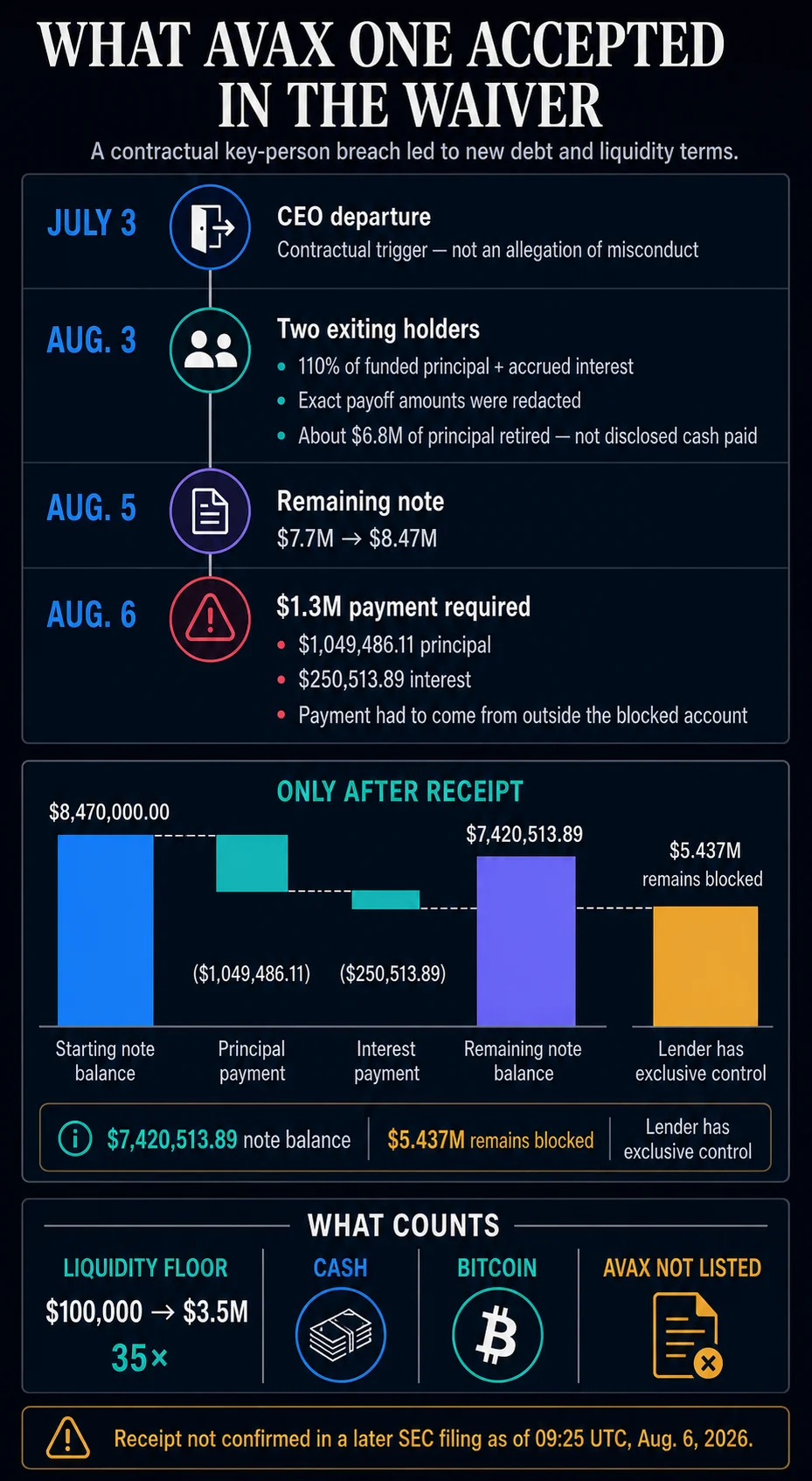
An unnamed institutional investor has dramatically intensified its liquidity demands on AVAX One, a Nasdaq-listed crypto firm, effectively necessitating a 35-fold increase in its minimum liquidity requirement to $3.5 million. This stringent new condition, stipulated in an August 5th Securities and Exchange Commission (SEC) filing, pointedly excludes the company’s substantial holdings of its namesake Avalanche (AVAX) token, forcing AVAX One to re-evaluate its treasury management and potentially seek alternative liquid assets. The drastic shift follows the abrupt departure of former CEO Jolie Kahn, an event that triggered a default on a crucial key-person covenant and compelled the digital asset treasury company to renegotiate its debt obligations.
The restructuring agreement, finalized on August 5, 2026, represents a significant recalibration of the financial relationship between AVAX One and its lender. The institutional investor, whose identity remains undisclosed, has agreed to waive the breach of the key-person covenant in exchange for a substantial cash payment and the acceptance of significantly more rigorous financial covenants. This waiver, however, comes at a steep price for AVAX One, fundamentally altering the definition of its liquid assets and placing immense pressure on its cash reserves.
A Dramatic Escalation of Liquidity Requirements
The most impactful change mandated by the restructuring is the dramatic surge in AVAX One’s minimum liquidity requirement. Previously set at a modest $100,000, the new covenant demands a minimum of $3.5 million in readily available liquid assets. Crucially, this bolstered liquidity threshold is exclusively recognized in the form of bank cash and Bitcoin held in custody. This means that AVAX One’s extensive holdings of nearly 14 million AVAX tokens, valued at approximately $88 million according to CoinGecko data, are now effectively disqualified from contributing to the satisfaction of this critical financial metric. This exclusion is particularly striking given that AVAX tokens represent the vast majority of the company’s digital asset treasury.
The implications of this exclusion are profound. With its core asset now devalued for liquidity purposes, AVAX One faces a significant challenge in meeting the new $3.5 million requirement. While the company’s total AVAX holdings are substantial, converting them to the lender-approved assets—cash or Bitcoin—at a pace sufficient to meet the new threshold could prove difficult and potentially trigger adverse market movements if attempted on a large scale.
The Shadow of CEO Departure and Corporate Pivot

The catalyst for these stringent new conditions appears to be the departure of Jolie Kahn, the former CEO, in July 2026. Kahn was instrumental in orchestrating AVAX One’s strategic pivot from its agricultural roots, under the former moniker AgriFORCE, to its current focus on digital assets. Her exit triggered a default on a key-person covenant, a contractual clause that typically requires the continued employment of specific individuals deemed critical to a company’s success. The breach of this covenant provided the lender with grounds to call for immediate repayment or to renegotiate the terms of the debt, leading to the current restructuring.
Since Kahn’s departure, AVAX One’s stock performance has reflected market uncertainty. The company’s shares have experienced a notable decline, falling approximately 42% to $3.20. This downturn underscores the market’s sensitivity to leadership changes and the perceived stability of the company’s strategic direction in the volatile digital asset space.
A Broader Debt Restructuring Initiative
The intensified liquidity requirements are part of a larger debt restructuring effort undertaken by AVAX One. In parallel with the revised covenants, the company announced on August 5th that it had successfully retired $6.8 million in outstanding principal debentures. This move was intended to strengthen the company’s balance sheet and reduce its overall debt burden. However, the terms of the new agreement reveal a complex interplay between debt reduction and increased financial obligations.
Navigating the New Financial Landscape
To secure the waiver of the key-person covenant breach, AVAX One was required to make an immediate payment of $1.3 million to the institutional investor. This payment, coupled with the acceptance of the significantly tougher financial conditions, has reshaped the company’s immediate financial priorities.
Beyond the liquidity covenant, the restructuring agreement also imposes a strict 180-day deadline from Kahn’s departure for AVAX One to appoint a permanent CEO. This new chief executive must be deemed acceptable by the lender, indicating a desire for continuity and a degree of oversight from the institutional investor. In the interim, Peter Wylie Jr. has assumed the role of interim chief executive, tasked with navigating the company through this critical transition period.

The principal amount of the remaining debentures has also seen an adjustment. Prior to the $1.3 million payment, the outstanding principal was raised from $7.7 million to $8.47 million. This increase, the specific rationale for which was not detailed in the SEC filing, suggests a complex negotiation process that may have involved repayment premiums or other adjustments related to the extended debt terms. After the $1.3 million payment, approximately $7.42 million remained outstanding on the debentures.
Furthermore, the lender has accelerated its capital recovery strategy by increasing monthly redemptions. These redemptions, which allow the lender to gradually recoup its investment, have been raised to one-tenth of the original principal, a substantial increase from the previous rate of one-twenty-fifth. This accelerated redemption schedule will place greater demands on AVAX One’s cash flow.
In another significant concession, the accelerated conversion price for the debt has been reduced. It now stands at 82.5% of a benchmark tied to the three lowest trading prices of AVAX One’s stock over the preceding ten trading days, a decrease from the previous 85%. This deeper discount offers a more favorable conversion rate for the lender, potentially allowing them to acquire a larger number of shares when converting the debt. This could, in turn, lead to increased dilution for existing AVAX One shareholders, a factor that may be a cause for concern among current investors.
Analysis of Implications and Potential Strategies
The stringent new liquidity requirements underscore a significant shift in how AVAX One’s assets are perceived by its primary lender. The explicit exclusion of AVAX tokens from the liquidity calculation suggests a de-risking strategy by the investor, who may be seeking to minimize exposure to the inherent volatility of cryptocurrencies. This could indicate a lack of confidence in AVAX as a reliable store of value for debt servicing purposes, or simply a preference for more traditional forms of liquidity.
For AVAX One, this presents a strategic dilemma. The company must now devise a plan to accumulate the required $3.5 million in cash or Bitcoin. Potential strategies could include:
- Phased Token Sales: Gradually selling portions of its AVAX holdings in the open market. However, large-scale sales could depress the price of AVAX, potentially leading to further losses and complicating the goal of meeting the liquidity target.
- Strategic Partnerships: Seeking new equity investments or debt financing from entities that are more amenable to accepting AVAX as collateral or that can provide immediate cash infusions.
- Treasury Optimization: Aggressively managing its operational expenses and exploring opportunities to generate revenue from its existing digital asset holdings, if any non-AVAX assets are available.
- Bitcoin Acquisition: If sufficient cash reserves can be generated, AVAX One could consider acquiring Bitcoin to meet the liquidity requirements, leveraging the lender’s explicit acceptance of this asset.
The 180-day deadline to appoint a new CEO also adds a layer of urgency. The company’s ability to attract a qualified and lender-approved candidate will be crucial for restoring confidence and navigating the company through its current challenges. The market will be closely watching AVAX One’s moves in the coming months as it works to comply with these new, demanding financial covenants and chart a path forward in the evolving digital asset landscape. The company’s future financial stability hinges on its capacity to adapt to these significantly altered terms and demonstrate its ability to meet the lender’s expectations for liquidity and leadership.








