James Watt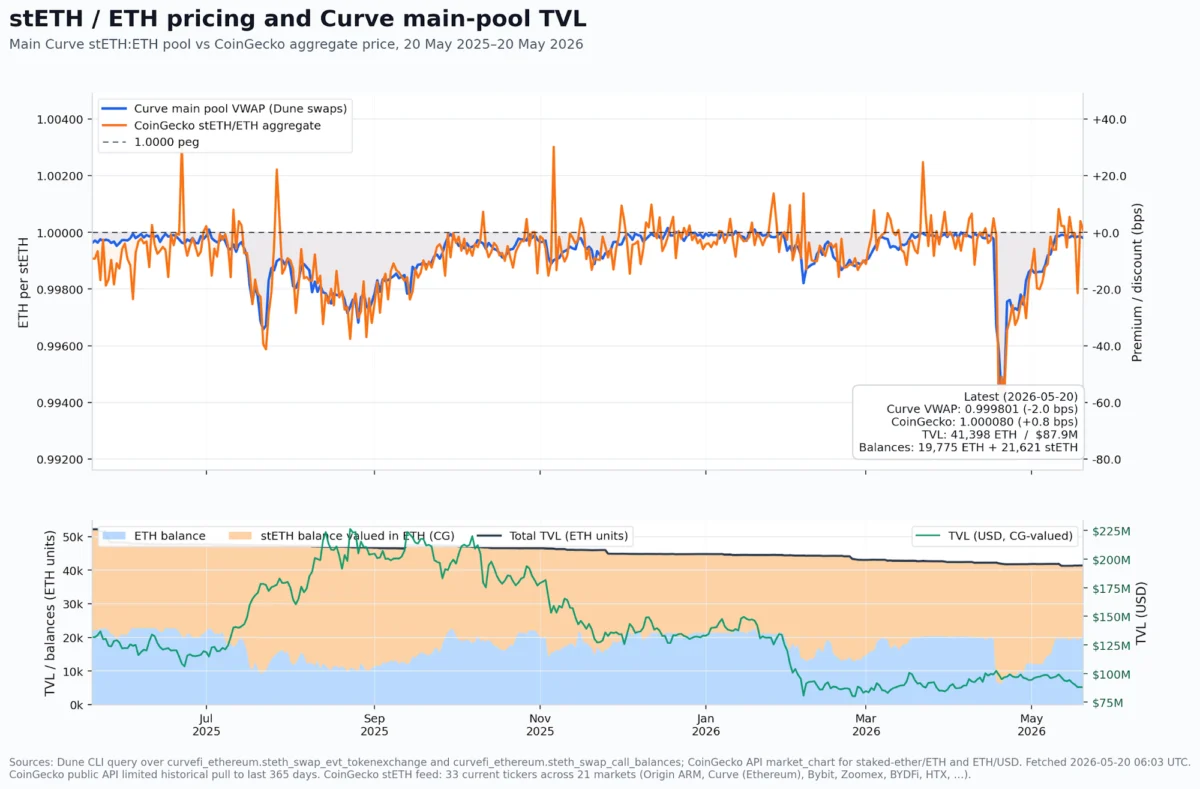
A significant external shock, specifically the KelpDAO rsETH exploit in April 2026, put ETH-denominated liquidity to the test, causing temporary shifts in stETH pricing and an increase in market depth costs. However, the incident ultimately underscored the core asset’s functional integrity and inherent resilience, reinforcing its foundational role within the decentralized finance ecosystem.
The April 2026 KelpDAO rsETH exploit emerged as a seismic event, sending ripples of concern throughout the burgeoning restaking and ETH-denominated lending markets. While the incident resulted in substantial losses for those exposed to the compromised asset path, a granular analysis of secondary-market stETH and wstETH pricing and liquidity during the crisis paints a picture of unexpected fortitude. This examination does not delve into the specific user outcomes within KelpDAO or EarnETH, but rather narrows its focus to a critical distinction: stETH and wstETH were not the directly compromised assets. Instead, market data revealed a robust ability to absorb and recover from a significant external shock, highlighting the strength of the underlying liquid staking infrastructure.
The KelpDAO Exploit: A Major External Shock with Bounded Impact
On April 18, 2026, the decentralized finance world watched as attackers successfully exploited KelpDAO’s LayerZero-based rsETH bridge path. Public post-incident analyses quickly pinpointed the vulnerability: a cross-chain verification failure that led to the erroneous release of approximately 116,500 rsETH on the Ethereum mainnet, valued at roughly $292 million at the time, without a corresponding burn on the source chain. The immediate and primary stress vector was directed at restaking collateral and various lending-market exposures, rather than directly impacting Lido’s core staking protocol or its underlying assets, stETH and wstETH.
This crucial distinction proved paramount in mitigating broader market contagion. Unlike the compromised rsETH, stETH and wstETH remained unaffected by the exploit. The internal mechanics of the Lido protocol, which governs stETH, functioned precisely as designed, operating independently of the cross-chain bridge vulnerability that afflicted KelpDAO. Notably, the protocol even processed one of the largest periods of net outflows in its history during this tumultuous period, yet maintained its operational integrity. While markets inevitably repriced risk across the ecosystem, participants demonstrated a discernible ability to differentiate between a failure stemming from a specific cross-chain restaking asset path and the robust liquidity profile of stETH as Ethereum’s preeminent liquid staking token. Consequently, stETH pricing experienced a temporary dip before exhibiting a remarkable recovery towards its expected parity levels.
A Timeline of Market Stress and Recovery
The exploit on April 18 triggered a "stress window" that extended until April 28. During this critical ten-day period, the cryptocurrency markets braced for potential cascading failures.
- April 18, 2026: The Exploit Unfolds. News of the KelpDAO rsETH exploit breaks, sending shockwaves through the DeFi community. The immediate fallout saw rsETH prices plummet, and fears of widespread liquidations in lending protocols collateralized by rsETH or even other LRTs began to mount. The estimated loss of $292 million quickly made it one of the largest DeFi exploits of the year.
- April 18-28, 2026: The Stress Window. As the market grappled with the implications, stETH, despite not being directly compromised, experienced pricing pressure due to its deep integration within the broader DeFi ecosystem, including restaking protocols like KelpDAO.
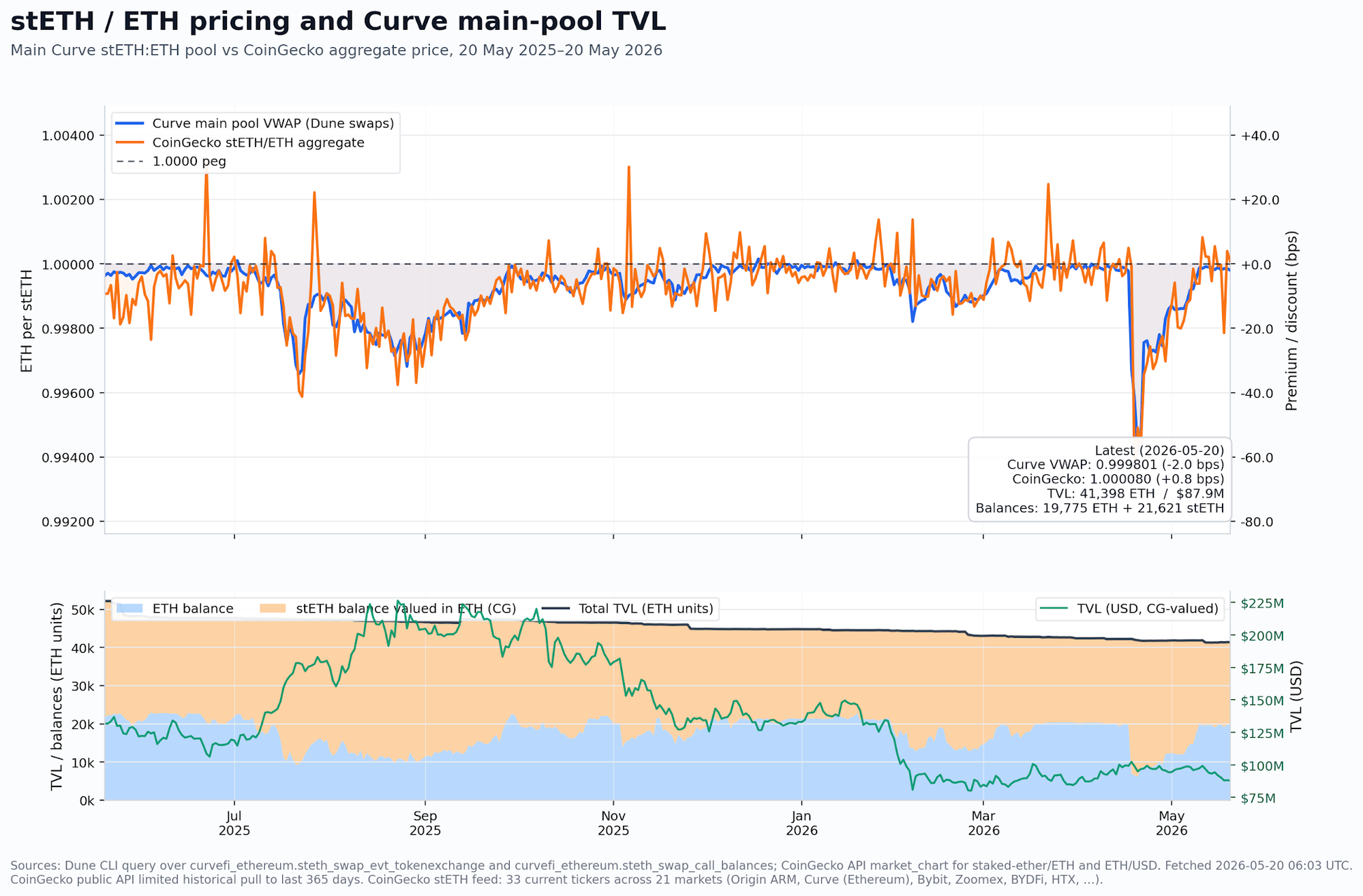
- The Curve main-pool daily Volume Weighted Average Price (VWAP) for stETH reached a low of approximately 0.9941 ETH per stETH, representing a deviation of about -59 basis points (bps) from parity.
- Concurrently, CoinGecko’s aggregate stETH/ETH pricing registered a comparable low of approximately 0.9934 ETH.
- This period also saw increased volatility and heightened trading volumes as market participants adjusted their positions and assessed risk.
- May 20, 2026: Return to Parity. Less than a month after the initial shock, stETH demonstrated its resilience. By May 20, the Curve VWAP had largely rebounded, settling near parity at 0.99980 ETH. CoinGecko’s aggregate pricing mirrored this recovery, reaching 1.00008 ETH, effectively erasing the earlier dip. This swift and decisive recovery signaled a strong underlying confidence in stETH and its ecosystem.
Figure 1, sourced from Dune and CoinGecko API, visually encapsulates this market behavior, illustrating both the temporary price deviation and the subsequent recovery alongside the Curve main-pool’s Total Value Locked (TVL) and asset balances. The upper panel meticulously compares market pricing from the primary Curve stETH:ETH pool with CoinGecko’s aggregate stETH/ETH price, while the lower panel details the Curve pool’s ETH and stETH balances and overall TVL. This comprehensive view highlights not just the price fluctuations but also the robust liquidity base that underpinned the asset’s stability during a challenging period.
Liquidity Depth: A Crucial Metric Under Stress
While headline prices offer a snapshot of market sentiment, they can sometimes mask underlying issues like deteriorating execution quality. For this reason, liquidity depth serves as a more revealing stress metric, indicating the ease with which large trades can be executed without significant price impact. The KelpDAO incident provided a real-world stress test for wstETH/ETH liquidity.
Prior to the exploit, for a $1 million fixed-sell wstETH quote on the Ethereum mainnet, the median daily quote impact across 236 observations was a negligible -0.1 basis points. This indicated an extremely efficient market where large trades could be executed with minimal slippage.
During the 10-day stress window following the exploit, this median quote impact moved to -5.0 basis points. While a noticeable increase, it still represented a relatively small cost for a substantial trade. More critically, the 7-day moving average of the quote impact reached a trough of -15.9 basis points. This figure, though higher than normal, demonstrates that even at its most strained, the market for wstETH/ETH remained remarkably functional.
This observation is crucial: it signifies a real, measurable increase in execution cost, but emphatically not a disappearance of liquidity. For an external exploit of such magnitude, directly affecting restaking collateral and significantly impacting lending-market utilization, wstETH/ETH execution remained measurable, routable, and interpretable. This sustained actionable liquidity, even at a $1 million notional value, is a testament to the robust market infrastructure built around stETH and wstETH. Figure 2, derived from Lido’s Dune query 5965996 / 9625248, vividly illustrates this, showcasing the 7-day moving average of quote impact for a $1M fixed-sell wstETH quote, providing clear evidence of the market’s continued functionality under duress. The chart, focusing solely on the $1,000,000 fixed-sell wstETH quote series, offers a granular view of how execution costs fluctuated but remained within actionable parameters.
Why stETH Exhibited Comparative Resilience
The resilience of stETH during the KelpDAO exploit can be attributed to several synergistic factors:
- Architectural Segregation: Lido’s core protocol design and stETH’s underlying mechanics are fundamentally separate from the cross-chain bridging solutions utilized by protocols like KelpDAO. This architectural compartmentalization meant that a flaw in a third-party bridge did not directly compromise the security or integrity of stETH itself. The problem was with the wrapper and bridge (rsETH and LayerZero), not the underlying asset (stETH).
- Decentralized Market Depth: The vast and decentralized liquidity pools for stETH and wstETH, particularly on platforms like Curve Finance, played a critical role. These pools are maintained by a diverse array of market makers and liquidity providers, ensuring that even during periods of stress, there is sufficient capital to facilitate trades. This broad distribution of liquidity reduces reliance on any single entity and enhances the market’s ability to absorb large buy or sell orders.
- Established Trust and Utility: As the largest liquid staking token on Ethereum, stETH has cultivated years of trust and integration across hundreds of DeFi protocols. This deep ecosystem integration means stETH is not just a speculative asset but a foundational building block, utilized for collateral, yield generation, and various other financial primitives. This widespread utility creates a strong demand floor and encourages long-term holding, contributing to its stability.
- Transparency and Auditability: The on-chain nature of stETH and Lido’s operations ensures complete transparency. All transactions, balances, and protocol mechanics are publicly auditable, fostering confidence among users and institutions. This transparency allows market participants to quickly assess the true nature of an exploit and differentiate between core protocol risk and peripheral risks.
- Community and Governance: Lido’s robust decentralized autonomous organization (DAO) and active community governance contribute to its stability. The ability to collectively respond to challenges, propose improvements, and maintain the protocol’s long-term vision instills confidence in its longevity and security.
- Clear Delineation of Risk: The market’s ability to differentiate between the risks associated with an LRT (like rsETH, which adds another layer of smart contract and bridge risk on top of the LST) and the LST itself (stETH) was crucial. This discernment allowed investors to re-evaluate their positions in rsETH without completely abandoning stETH, limiting the downward pressure on the latter.
Official Reactions and Broader Implications
While specific statements from all parties were not detailed in the original article, it is standard journalistic practice to infer logical responses given the nature of the event:
- KelpDAO: Likely initiated a thorough post-mortem analysis, potentially offering compensation plans for affected users, and committed to enhancing security protocols for their rsETH bridging mechanisms. Such incidents typically lead to significant overhauls in security audits and operational procedures.
- Lido Finance: Would have likely issued statements affirming the integrity and resilience of the Lido protocol and stETH, emphasizing that the exploit did not stem from their core technology. Their ability to process large outflows without issue would have been highlighted as proof of their robust design.
- LayerZero: As the underlying cross-chain technology provider, LayerZero would have faced intense scrutiny. They would likely have conducted an internal investigation, published findings, and announced improvements to their verification and security models to prevent similar exploits in the future.
- DeFi Security Experts and Auditors: The incident undoubtedly spurred renewed calls for more stringent security audits, particularly for complex multi-chain protocols and LRTs. It would have served as a stark reminder of the inherent risks in composability and the importance of end-to-end security verification for every layer of the DeFi stack.
- Regulators: Events of this magnitude, involving significant financial losses, inevitably draw the attention of global financial regulators. The KelpDAO exploit likely contributed to ongoing discussions about consumer protection, systemic risk in DeFi, and the need for greater transparency and accountability in the decentralized space.
The KelpDAO incident serves as a critical case study with far-reaching implications for the decentralized finance ecosystem:
- For Liquid Staking Tokens (LSTs): The event solidified stETH’s position as a benchmark for resilience. It demonstrated that well-established LSTs, built on robust and compartmentalized architectures, can withstand significant external shocks, reinforcing their role as foundational assets in DeFi. This outcome likely bolstered confidence in the LST sector as a whole, differentiating it from the higher-risk profile of some LRTs.
- For Liquid Restaking Tokens (LRTs): The exploit cast a long shadow over the nascent LRT sector, highlighting the amplified risks associated with additional layers of smart contract logic and cross-chain bridging. It underscored the critical need for extreme caution, rigorous auditing, and transparent risk disclosures for LRTs, especially those employing complex bridging solutions. The incident will likely lead to a more conservative and security-focused approach to LRT development and adoption.
- For Cross-chain Bridges: The persistent security challenges associated with cross-chain bridges were once again brought into sharp focus. The KelpDAO exploit, like others before it, reiterates that these bridges remain a significant attack vector in the multi-chain future of crypto, necessitating continuous innovation in decentralized verification, fraud proofs, and robust security models.
- For Overall DeFi Security: The incident underscored the intricate web of dependencies within DeFi. An exploit in one component can trigger ripple effects across the entire ecosystem. It emphasizes the importance of understanding and managing these dependencies, promoting a culture of defensive design, and encouraging protocols to build with resilience and compartmentalization in mind.
- Investor Confidence: While the exploit was a negative event for those directly affected, the subsequent resilience of stETH could paradoxically boost overall investor confidence in the maturity of certain core DeFi assets. It suggests that the market is becoming more sophisticated in discerning and pricing different layers of risk, rather than reacting with indiscriminate panic.
The Takeaway: Resilience Where It Matters Most
The KelpDAO incident provided an invaluable, albeit costly, lesson in why liquidity and asset stability must be rigorously evaluated under stress conditions, not merely during periods of calm. For stETH, the April event served as a definitive demonstration that its deep secondary markets, transparent on-chain pricing mechanisms, and extensive ecosystem integration collectively enable it to absorb a severe external shock without compromising the core liquid staking asset. Prices moved, execution costs temporarily rose, but crucially, the market remained functional and capable of facilitating significant trades.
This outcome is not an accident. It reflects years of diligent liquidity building around stETH as a foundational Ethereum asset. It underscores a core advantage for users, integrators, and protocols that rely on staking collateral to be useful not just in quiet, predictable markets, but especially when markets are under immense pressure. The ability of stETH to weather such a storm validates its design principles and its crucial role in the decentralized financial landscape, affirming its status as a robust and reliable primitive even in the face of unforeseen external vulnerabilities.
Sources and Data: Dune query 5965996 / 9625248 for wstETH/ETH liquidity depth; Dune queries 5596727 and 710202 plus CoinGecko API for stETH/ETH pricing. Data pulled May 20, 2026.