admin
admin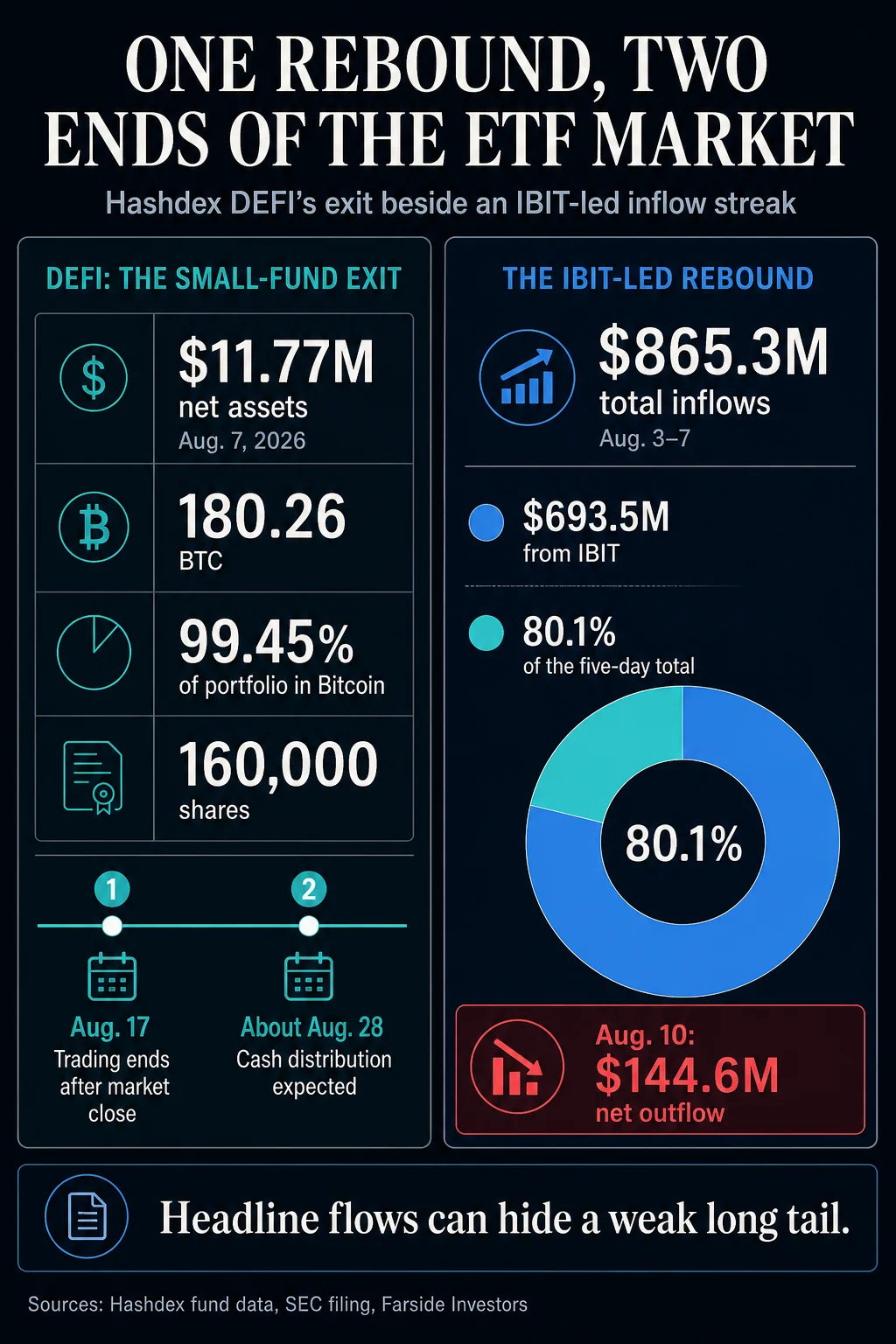
Hashdex’s Decentralized Finance (DEFI) Bitcoin Exchange-Traded Fund (ETF) is set to cease trading on August 17, marking a significant development for its investors as the fund undergoes liquidation. This closure comes despite a recent surge of $865 million in inflows into U.S. spot Bitcoin ETFs in the preceding week. The DEFI ETF has experienced a substantial 25% decline in its shares outstanding since August 7, signaling a rush of investors exiting their positions ahead of the August 17 deadline. Those who do not liquidate their holdings by this date will have their investments converted to cash by August 28, reflecting the net asset value after accounting for Bitcoin price fluctuations, transaction costs, and liquidation expenses.
The stark contrast between the DEFI ETF’s shrinking asset base and the robust inflows into other spot Bitcoin ETFs underscores a growing divergence in investor interest within the burgeoning digital asset ETF market. While institutional and retail investors have shown renewed confidence in Bitcoin through established ETF products, Hashdex’s DEFI fund appears to have failed to capture this renewed enthusiasm, leading to its impending closure.
The Approaching Deadline and Investor Exodus
The imminent cessation of trading for the DEFI ETF has triggered a noticeable contraction in its holdings. As of August 11, Hashdex reported that the DEFI ETF held approximately $8.7 million in assets under management, equivalent to 134.95 Bitcoin (BTC). This represents a significant decrease from its position on August 7, when the fund managed $11.77 million in assets, comprising 180.26 BTC. The most striking indicator of investor sentiment, however, is the precipitous drop in shares outstanding. Over the same three-day period, the number of outstanding shares plummeted from 160,000 to 120,000, a decline of 25%. This substantial reduction strongly suggests that investors have been actively redeeming their shares, seeking to exit the fund before its final trading day.
The liquidation process, as outlined in a filing with the Securities and Exchange Commission (SEC), will involve the sale of the fund’s Bitcoin holdings. Investors who remain invested after the August 17 trading halt will receive the net asset value of their shares, determined after the sale of Bitcoin, less any associated costs. This includes market price fluctuations of Bitcoin, transaction fees for selling the underlying assets, and other administrative expenses related to the fund’s closure. The final cash payout is scheduled to be distributed by August 28.

A Rebound in Bitcoin ETFs That Bypassed DEFI
The DEFI ETF’s struggles are particularly noteworthy given the strong performance of the broader U.S. spot Bitcoin ETF market in the week preceding August 11. Data from Farside Investors revealed that between August 3 and August 7, U.S. spot Bitcoin ETFs collectively attracted $865.3 million in net inflows. This influx of capital signaled a renewed investor appetite for Bitcoin exposure through regulated financial products.
Within this overall positive trend, BlackRock’s iShares Bitcoin Trust (IBIT) emerged as a dominant force, accounting for an impressive $693.5 million, or approximately 80.1%, of the total inflows during that week. This significant contribution highlights the concentrated demand for Bitcoin ETFs, with a substantial portion of the market’s inflows flowing into a few key products. The remaining $171.8 million was distributed among the other spot Bitcoin ETFs in the market.
This period of strong inflows, however, was not sustained indefinitely. The streak of positive net inflows for the group of Bitcoin ETFs concluded on August 10, with aggregate outflows of $144.6 million recorded. While the dominance of IBIT in attracting capital does not directly explain Hashdex’s decision to close its DEFI ETF, the stark contrast in performance serves as a clear illustration of how headline-grabbing Bitcoin ETF flows can mask underlying weaknesses in individual fund performance. The market, it appears, is experiencing a bifurcation, with strong overall demand but selective investor interest in specific products.
A History of Underperformance for the DEFI ETF
The challenges faced by Hashdex’s DEFI ETF are not a recent development. The fund’s struggles to attract and retain capital predate the current liquidation efforts. Initially launched as a Bitcoin futures ETF, Hashdex converted the DEFI ETF to permit direct holdings of Bitcoin on March 27, 2024. Despite this strategic shift, aimed at aligning with the burgeoning spot Bitcoin ETF market, the fund did not record its first daily inflow until December of the same year.
This delayed and infrequent inflow activity paints a picture of consistent underperformance. Since its conversion to a spot Bitcoin ETF, DEFI has only experienced inflows on six separate days, contrasted with three days of outflows. This pattern underscores a persistent difficulty in attracting fresh capital, even as the broader spot Bitcoin ETF market expanded significantly.

Financial filings further corroborate this narrative of subdued investor engagement. In 2025, the DEFI ETF issued $2.14 million in new shares but simultaneously saw redemptions totaling $4.61 million. This resulted in a net capital outflow of $2.47 million for the year, leaving approximately $11.90 million in net assets by the end of the year, according to its annual filing.
The first quarter of 2026 showed a further deceleration in activity. The fund reported no share creations or redemptions during this period. Management fees also saw a steep decline, dropping to $6,453 from $20,385 in the corresponding period of the previous year. The annualized gross expense ratio similarly decreased from 0.56% to 0.25%, as indicated in its quarterly report. This consistent lack of growth and declining operational metrics likely contributed to the decision to liquidate the fund.
Hashdex’s Continued Commitment to the U.S. Market
Despite the closure of its DEFI Bitcoin ETF, Hashdex has emphasized that this move does not signify an abandonment of the U.S. market. In a statement, the firm indicated that it remains committed to serving U.S. investors and continues to manage over $200 million in various investment products available to them. This suggests that the decision to liquidate DEFI was a strategic response to the specific underperformance of that particular fund, rather than a broader withdrawal from the U.S. regulatory landscape.
The liquidation of the DEFI ETF serves as a cautionary tale in the competitive and rapidly evolving world of cryptocurrency-linked financial products. While the broader market for spot Bitcoin ETFs has experienced significant growth and investor interest, individual products must demonstrate sustained demand and competitive performance to thrive. Hashdex’s experience with DEFI highlights the challenges of capturing market share and maintaining investor confidence in a space that is increasingly dominated by a few well-established players. The firm’s ability to navigate this landscape and potentially introduce new, successful products in the future will be closely watched by industry observers.