
 admin
admin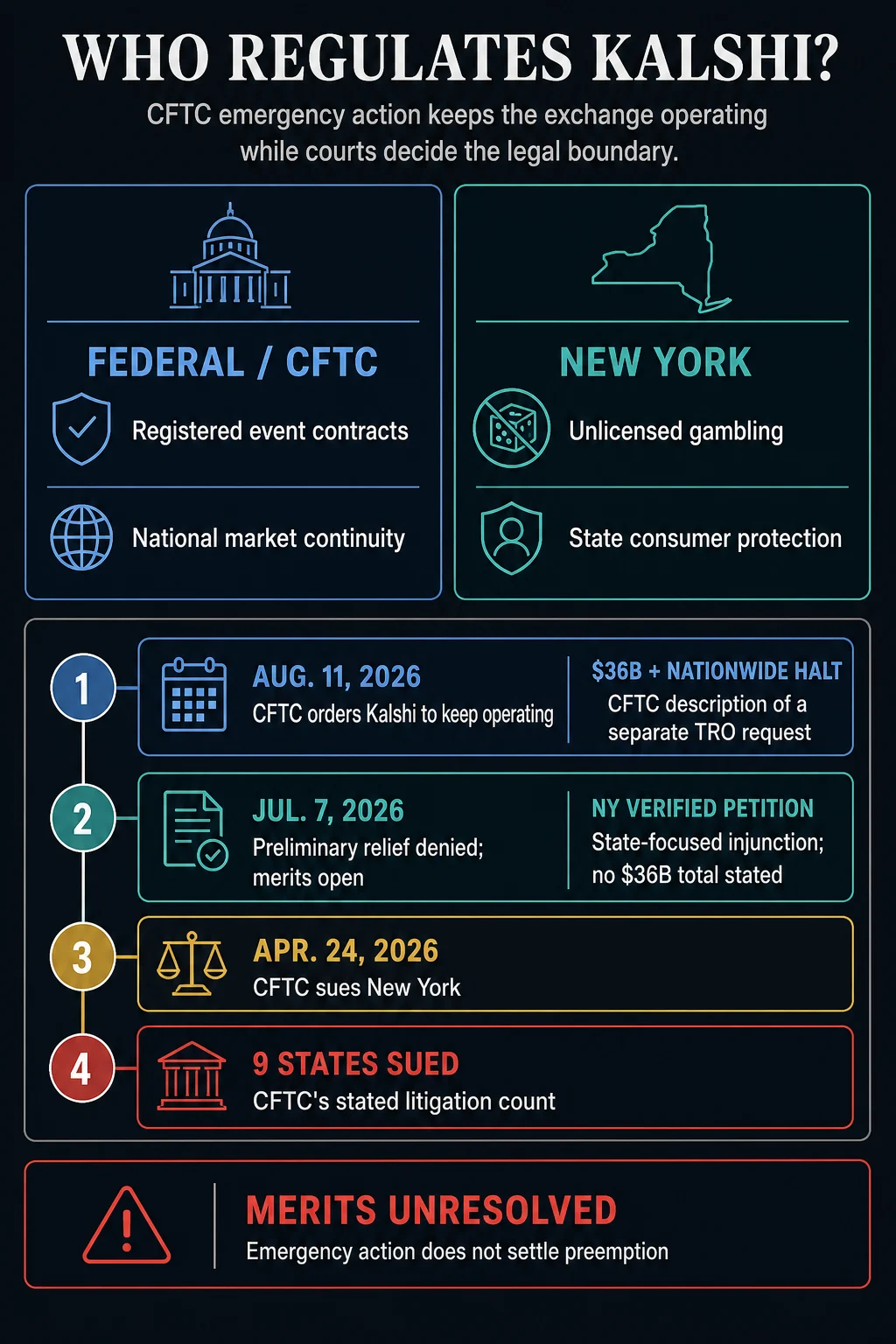
The Commodity Futures Trading Commission (CFTC) has issued a directive compelling Kalshi, a prominent prediction market exchange, to continue its operations, a significant federal intervention following the company’s declaration of a market emergency. This emergency was directly linked to New York’s aggressive enforcement campaign targeting the platform. This decision represents the most robust federal involvement to date in the escalating dispute over whether state-level gambling laws can be applied to event contracts offered on exchanges regulated by the CFTC. The intervention occurs as New York authorities intensify their scrutiny of prediction markets, extending beyond Kalshi’s legal standing, even as the company experiences remarkable growth and aims for a substantial valuation.
CFTC Declares New York Action a Threat to National Derivatives Market Integrity
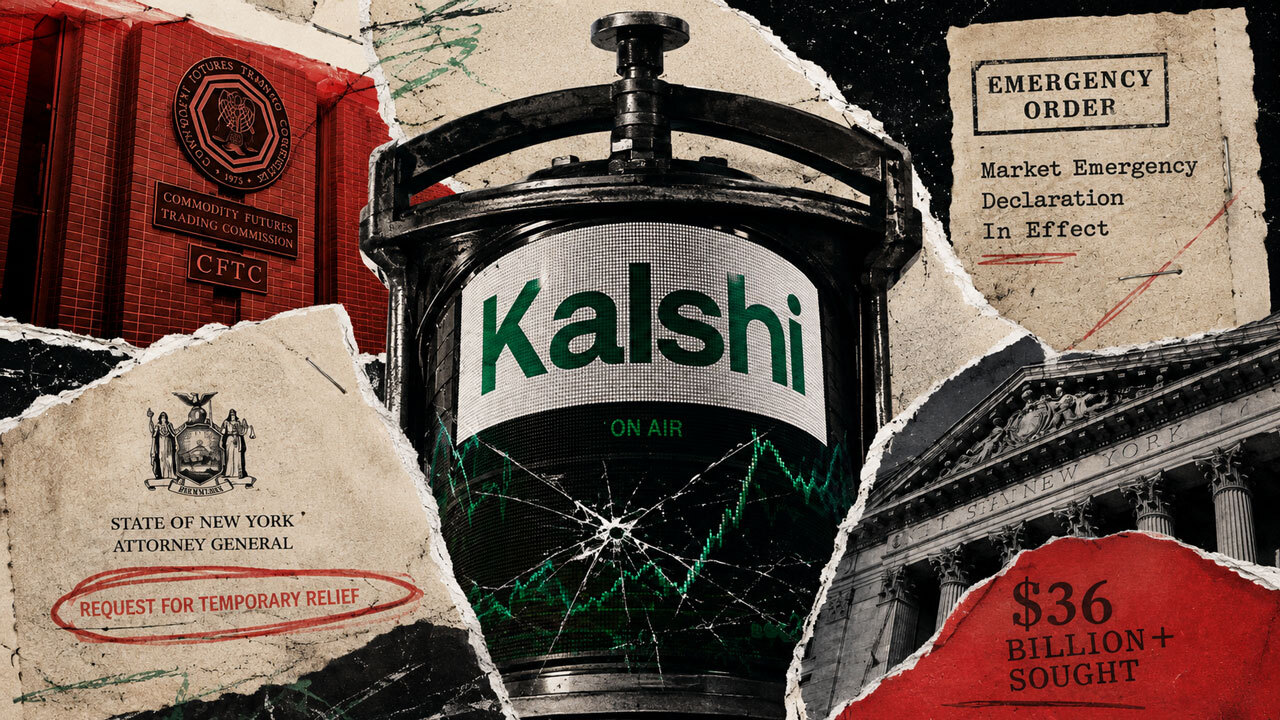
On August 11, the CFTC formally directed KalshiEX LLC to maintain its operational status under the Commodity Exchange Act’s Core Principles. This directive came after Kalshi informed the regulator that New York’s enforcement actions had precipitated a market emergency. The federal agency articulated concerns that New York’s pursuit of temporary relief could effectively prevent Kalshi from offering its event contracts across the nation, potentially exposing the exchange to damages exceeding $36 billion.
The core of this escalating conflict originates from a lawsuit filed on July 31 by New York Attorney General Letitia James. The lawsuit alleges that Kalshi is operating sports prediction markets without the requisite license from the New York State Gaming Commission. The Attorney General’s office contends that Kalshi is functioning as an unlicensed gambling business, thereby circumventing the stringent regulatory obligations, including taxation and consumer protection mandates, imposed upon licensed casinos and sportsbooks. New York is seeking judicial intervention to compel Kalshi to forfeit all gains derived from these alleged violations, provide restitution to affected consumers, and pay penalties equivalent to three times the amount of those gains.
CFTC Chairman Michael Selig has strongly opposed this regulatory approach, characterizing New York’s actions as an attempt to "make event-contract derivatives waste away under its iron curtain of state gaming laws" before definitive legal rulings can be established. Selig posited that Congress did not intend for federally regulated derivatives exchanges to be subject to a fragmented landscape of state gambling laws. He emphasized that platforms like Kalshi operate across state lines, facilitating the matching of bids and offers from users in diverse jurisdictions before transmitting trades to clearinghouses that guarantee nationwide transaction backing.
"New York has no business regulating these interstate financial markets," Selig stated, underscoring the CFTC’s statutory obligation to uphold order within them. This firm stance has propelled the CFTC into a broader regulatory conflict with states concerning prediction markets. In recent months, the agency has initiated legal actions against several U.S. states, including Arizona, Connecticut, Illinois, New York, Rhode Island, and Wisconsin, and has also submitted amicus briefs in related cases before federal appellate courts and the Massachusetts Supreme Judicial Court. The CFTC’s assertion is that maintaining Kalshi’s operational capacity is crucial for preserving market resilience, ensuring orderly trading, and facilitating price discovery. The agency argues that any disruption to a federally regulated exchange could undermine its mandate to cultivate a uniform national derivatives market. However, this emergency order does not definitively resolve the fundamental legal question of whether federal derivatives law preempts state gambling regulations.
New York Expands Regulatory Pressure Beyond Legal Filings
New York’s campaign against prediction markets is now extending beyond the Attorney General’s gambling-related lawsuit. On August 12, New York City Council Speaker Julie Menin announced that the Council had been investigating allegations of "false, deceptive, unconscionable, and objectionable marketing practices" prevalent across the prediction market industry for several months. Menin dispatched letters to Kalshi, Polymarket, Coinbase, and Gemini Titan, requesting detailed information on their promotional strategies for contracts tied to events in sports, politics, culture, weather, and other domains.
The City Council is also planning to convene a hearing to assess the adequacy of existing consumer protection regulations. The objective is to determine whether new legislation, enhanced enforcement measures, public awareness campaigns, or other safeguards are necessary to address potential consumer harms. This inquiry is particularly focused on whether prediction market platforms are employing marketing tactics that could mislead younger consumers. The Council cited allegations of undisclosed influencer endorsements, fabricated depictions of profitable trades, and other advertising methods designed to encourage participation in event contracts.
Speaker Menin highlighted that the rapid proliferation of prediction markets has amplified the urgency of this review, especially given that these platforms are not subject to certain marketing restrictions applicable to casinos and online sportsbooks. "Prediction markets aggressively entice consumers to bet and wager on sports, politics, culture, weather, and pretty much anything," Menin remarked, adding that the Council is committed to utilizing its authority to combat deceptive and predatory marketing practices. This investigation introduces a second significant point of pressure for Kalshi within New York. At the state level, officials are questioning the legality of offering certain contracts without a gambling license. Concurrently, at the city level, lawmakers are examining the methods by which Kalshi and other prediction market platforms attract and market their products to consumers.
Kalshi’s Growth Trajectory Continues Amidst Intensifying Regulatory Scrutiny
Despite the escalating regulatory pressures, these challenges have thus far had a negligible impact on Kalshi’s commercial expansion. The company is reportedly in advanced discussions to secure a Series G funding round that would value it at approximately $40 billion, nearly double the $22 billion valuation achieved in its May funding round. This prospective surge in valuation follows a dramatic acceleration in revenue. Kalshi’s annualized revenue surpassed $4 billion in July, a substantial increase from over $2 billion just two months prior. Trading activity surrounding the World Cup was a significant driver of this growth.
Sports have become an increasingly vital component of Kalshi’s expansion. During the World Cup, the platform processed approximately $27 billion in trading volume and attracted around 3 million users throughout the tournament. More recently, data from DefiLlama indicates that the platform handled approximately $11 billion in trading over the preceding 30 days. This sustained momentum sharply contrasts with the ongoing regulatory battles the company is navigating. New York is intensifying its efforts to integrate prediction markets into existing gambling and consumer protection frameworks, while the CFTC is leveraging its federal authority to prevent these state-level actions from destabilizing a nationally regulated derivatives exchange.
Meanwhile, Kalshi continues to onboard new users, boost revenue, and pursue a valuation that would position it among the most highly valued private fintech companies. The central unresolved question remains whether this upward trajectory can be sustained if judicial decisions ultimately conclude that federal derivatives oversight does not fully insulate Kalshi’s fastest-growing markets from state gambling laws. The implications of this ongoing regulatory tug-of-war extend beyond Kalshi, potentially shaping the future landscape of event contracts and prediction markets across the United States.
Historical Context and Broader Market Implications
The current regulatory standoff is not an isolated incident but rather a culmination of evolving market dynamics and differing interpretations of existing legal frameworks. Prediction markets, which allow individuals to trade contracts based on the outcomes of future events, have existed in various forms for decades. However, their recent surge in popularity, particularly with the advent of cryptocurrency-linked platforms and increased accessibility, has drawn the attention of regulators concerned about consumer protection, market integrity, and the potential for unregulated gambling.
The CFTC’s mandate, established by the Commodity Exchange Act, is to regulate derivatives markets, including futures and options contracts. These markets are designed to facilitate risk management and price discovery for commodities and financial instruments. The CFTC views event contracts, when offered on a regulated exchange, as a form of derivative, subject to its oversight. This perspective is rooted in the belief that these contracts can serve legitimate economic purposes and that a unified federal regulatory approach is necessary to ensure stability and fairness.
New York’s stance, conversely, aligns with a more traditional interpretation of gambling laws. The state’s Attorney General and City Council are focusing on the consumer-facing aspects of these markets, emphasizing the potential for addiction, deceptive marketing, and the absence of protections afforded to patrons of licensed gaming establishments. The argument is that regardless of the underlying structure, if the activity resembles gambling and is not licensed as such, it falls under state jurisdiction.
The timeline of events leading to the current crisis highlights a growing tension. For years, prediction markets operated in a somewhat grey area, with regulatory bodies cautiously observing their development. However, as platforms like Kalshi gained traction and began to offer contracts on a wider array of events, including political outcomes and economic indicators, the regulatory spotlight intensified. This culminated in more direct enforcement actions by states like New York, prompting the CFTC to assert its preemptive authority to protect federally regulated markets.
The potential implications of this regulatory battle are far-reaching. If state gambling laws are deemed to preempt federal derivatives regulations for prediction markets, it could lead to a fragmented and potentially stifled market. Companies might be forced to navigate a complex web of state-specific rules, potentially limiting their reach and innovation. Conversely, if the CFTC’s assertion of federal authority prevails, it could establish a clear regulatory pathway for prediction markets, potentially fostering further growth and integration into mainstream financial markets.
Furthermore, the debate raises fundamental questions about the definition of a financial derivative versus a gambling instrument. As technology blurs these lines, regulators and policymakers face the challenge of adapting existing legal frameworks to new market realities. The outcome of the Kalshi case and the broader regulatory disputes involving the CFTC and various states will likely set important precedents for the future of prediction markets and other innovative financial products. The continued growth of Kalshi, even amidst this regulatory storm, underscores the market’s demand for such platforms, presenting a complex dilemma for regulators seeking to balance innovation with protection.








