
 admin
admin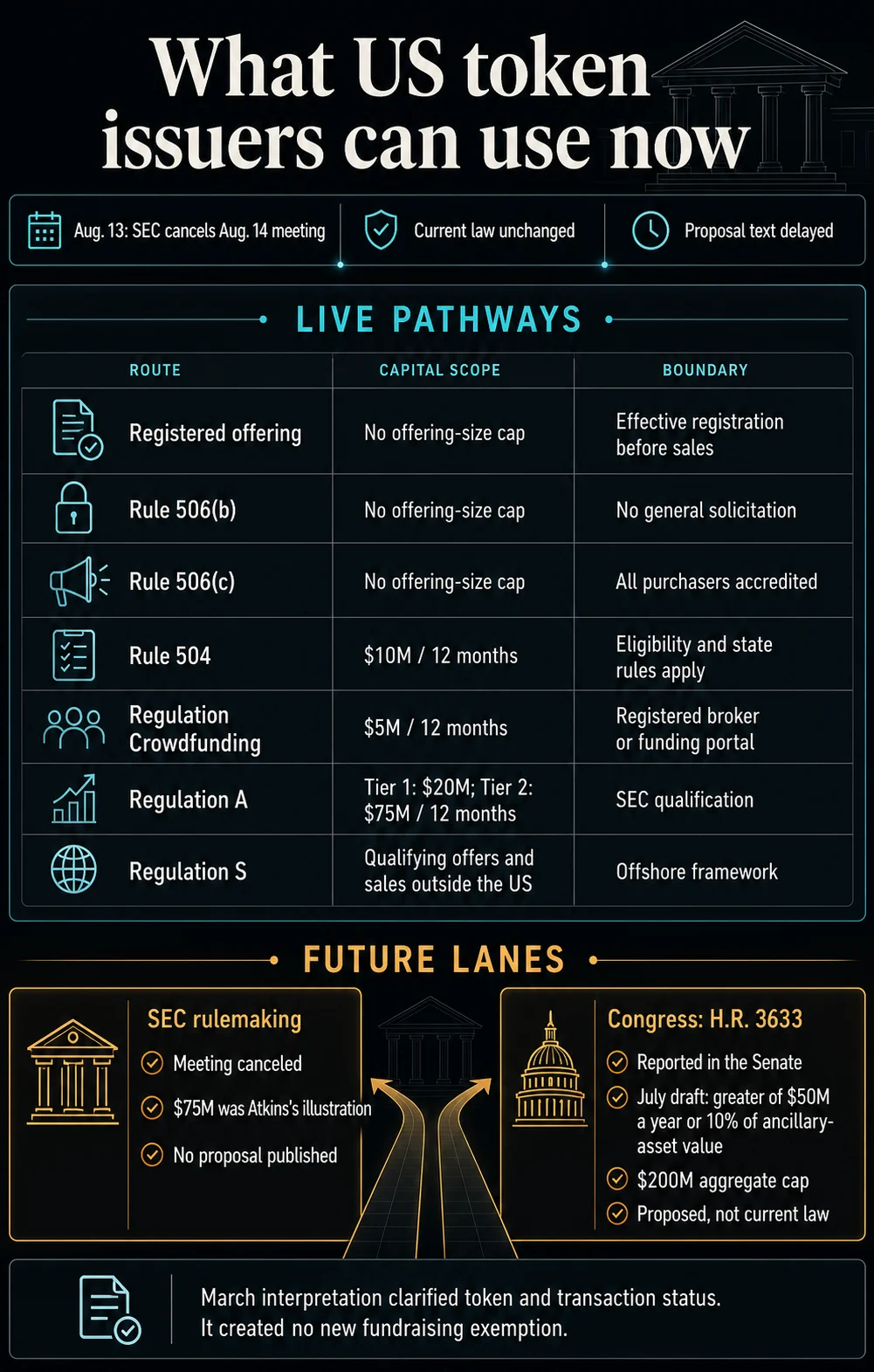
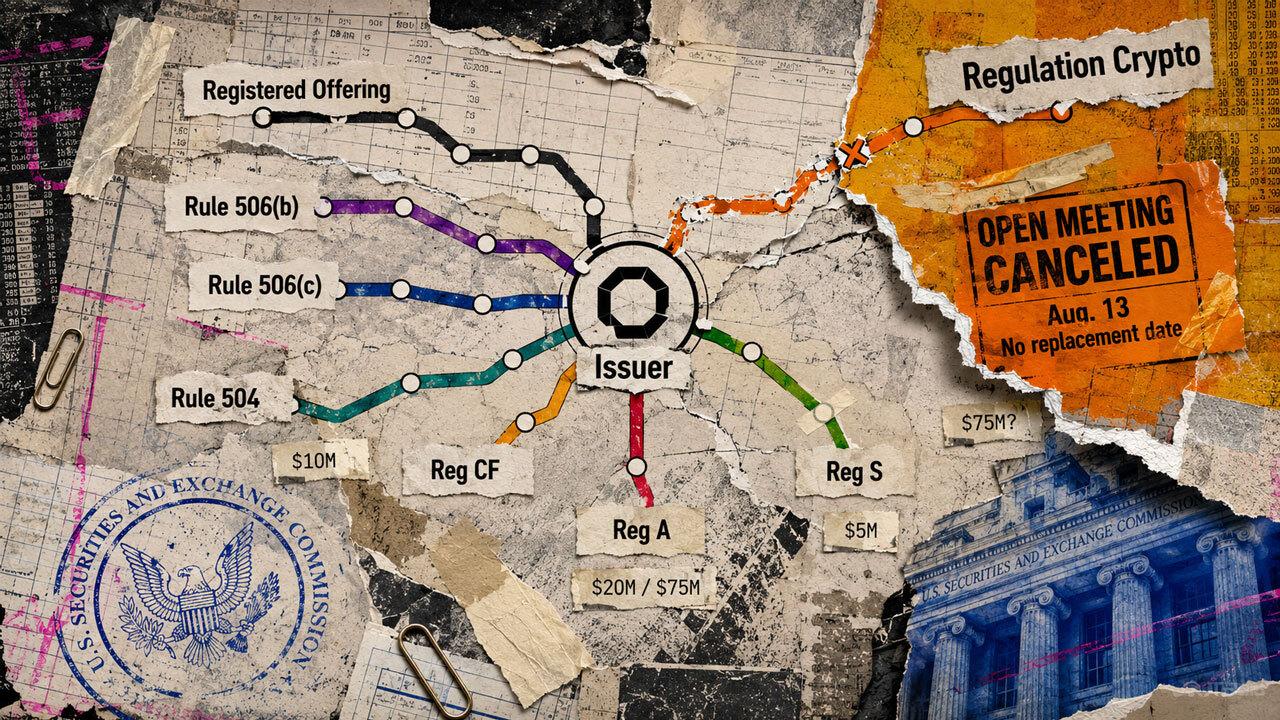
The U.S. Securities and Exchange Commission (SEC) abruptly canceled an open meeting scheduled for Friday morning, indefinitely delaying the public’s first glimpse into a potential new regulatory regime for cryptocurrency fundraising. The Aug. 13 cancellation notice, issued by the agency without providing a reason or a rescheduled date, had been set to feature commissioners deliberating on a proposal for a tailored offering framework specifically designed for certain investment contracts involving crypto assets.
This postponement means that the proposed rule text, which could have illuminated crucial details such as eligibility standards for issuers, mandatory disclosure duties for token sales, and conditions governing the resale of these digital assets, will not be made public as anticipated. While the cancellation does not alter the existing legal landscape, it significantly pushes back the timeline for potential clarity and new avenues for crypto-based capital formation. Issuers currently remain in a position where they possess greater clarity on when a token might be considered distinct from an investment contract, as per recent SEC guidance, but lack any new, specific pathways for development funding. The available routes for launching crypto projects continue to be the existing registration and exemption framework under the Securities Act.
Understanding the SEC’s March Interpretation: A Foundation for Crypto Fundraising
The SEC’s March interpretation, detailed in Release No. 33-11412, marked a significant development in how the agency views the application of federal securities laws to crypto assets. This interpretation sought to decouple the crypto asset itself from the transaction in which it is offered and sold. Under this guidance, a crypto asset that is not inherently a security can still be considered part of an investment contract if purchasers invest in a common enterprise with a reasonable expectation of profits derived from the issuer’s essential managerial efforts. The SEC’s accompanying press release emphasized this critical distinction between the asset and the surrounding transaction.
The relationship between a token and an investment contract is not static; it can evolve as a project matures. Once an issuer fulfills its promised development work, or when purchasers can no longer reasonably anticipate future managerial efforts driving profits, the token may indeed separate from the initial investment contract. However, the interpretation makes clear that any obligations arising from the original investment-contract transaction persist even after this later separation. This means that the initial offer and sale of the token must have been conducted in compliance with either registration requirements or an available exemption at the time of the capital raise.
Consequently, the March interpretation addresses a classification question, aiming to provide clarity on the nature of crypto assets in investment contexts. While it encourages transparent public disclosure of issuer promises and milestones crucial for the investment contract analysis, it does not, in itself, create a new fundraising exemption or a standardized disclosure document specifically for token launches.
The "Regulation Crypto" Concept and Personal Reflections
Adding another layer to the evolving landscape of crypto regulation, SEC Chair Paul Atkins had, in March, articulated his personal views on potential safe harbors for startups, fundraising, and investment contracts within the digital asset space. He outlined specific ideas, including a proposed fundraising limit of "say $75 million" within a 12-month period. It is crucial to note that Chair Atkins explicitly presented these concepts as his own personal reflections and not as official SEC policy. The $75 million figure, therefore, remains illustrative rather than a formally adopted Commission ceiling. As of Aug. 14, the SEC’s official rulemaking index did not indicate any published proposal related to "Regulation Crypto."
Implications for Development-Stage Issuers
For issuers in the development stage, the distinction clarified in the March interpretation has significant implications for the timing of capital raises. When investors provide funds for promised software development, network expansion, or ongoing management activities, they may be purchasing an investment contract, even if the transferable unit is a non-security crypto asset. Compliance with securities laws attaches to the launch transaction itself, at the point where capital is raised. The mere possibility that the token may later trade independently on secondary markets does not negate the need for registration or an exemption for that initial transaction.
Navigating the Current Crypto Fundraising Landscape
Issuers whose token sales are deemed to create investment contracts still have pathways to raise capital, although each route dictates specific parameters regarding who can invest, whether the offering can be publicly marketed, the maximum capital that can be raised, and the required disclosures or intermediaries. These established pathways provide a framework for compliant fundraising.
| Pathway | Capital Available | Main Boundary |
|---|---|---|
| Registered Offering | No offering-size cap | Registration statement must become effective before sales; subsequent public company obligations apply. |
| Rule 506(b) | No offering-size cap | Prohibits general solicitation; purchaser and disclosure conditions apply if non-accredited investors participate. |
| Rule 506(c) | No offering-size cap | Permits general solicitation, but all purchasers must be accredited, and issuers must take reasonable verification steps. |
| Rule 504 | $10 million in 12 months | Subject to issuer eligibility, state-law requirements, and specific offering conditions. |
| Regulation Crowdfunding | $5 million in 12 months | Offerings must utilize a registered broker-dealer or funding portal. |
| Regulation A | $20 million (Tier 1) or $75 million (Tier 2) in 12 months | SEC qualification required, along with applicable disclosure and reporting obligations. |
| Regulation S | Qualifying offers and sales outside the United States | Domestic retail sales require an alternative legal basis. |
The SEC’s guidance on "Offering Pathways" and "Exempt Offerings" illustrates these practical distinctions. Rules 506(b) and 506(c), for instance, facilitate capital raises from private or accredited investors without an upper limit on the offering size. In contrast, Regulation Crowdfunding and Regulation A offer broader access to capital but come with specific dollar ceilings and more involved procedural requirements. Rule 504 is designed for smaller capital raises, while Regulation S provides a distinct avenue for qualifying offers and sales conducted internationally, with domestic retail sales necessitating a separate legal justification.
Beyond these general frameworks, token projects may also encounter crypto-specific disclosure obligations within these established routes. A nonbinding Division of Corporation Finance staff statement has indicated that the scope of relevant disclosures is fact-dependent and determined by materiality. Such disclosures can encompass a wide range of topics, including development milestones, funding requirements, holder rights and transfer restrictions, token supply mechanics, technical and cybersecurity risks, financial statements, and code exhibits where the code itself memorializes holder rights.
The fundamental dividing line for compliance remains the nature of the fundraising transaction. A sale that clearly falls outside the definition of an investment contract may be able to avoid Securities Act registration for that specific transaction. However, a project team that is financing unfinished work through promises that necessitate essential managerial effort from the issuer must utilize a registered or exempt offering at the time of the launch, irrespective of whether the token may later function independently from the initial investment contract.
Congressional Initiatives: A Potential Alternative Pathway
Beyond the SEC’s direct regulatory actions, Congress has also explored establishing a tailored crypto fundraising route. While currently not available for immediate use by issuers, legislative text has been introduced. The Senate Banking Committee, for example, released the text of H.R. 3633 ahead of a markup session and subsequently advanced the measure by a vote of 15-9 in May. The official record on GovInfo identifies this as a reported bill in the Senate, not yet enacted law.
Senator Cynthia Lummis, in July, released updated text for what is referred to as the "Clarity Act." This draft legislation proposes directing the SEC to establish "Regulation Crypto." For qualifying investment-contract transactions that involve ancillary assets, the draft outlines an exemption that would permit fundraising of the greater of $50 million per calendar year for up to four years, or 10% of the outstanding ancillary-asset value, with an aggregate cap of $200 million. The proposed exemption also includes requirements for initial disclosures and a notice of reliance to be filed with the SEC at least 30 days prior to the commencement of any covered offer.
These proposed legislative mechanics are distinct from SEC Chair Atkins’s illustrative $75 million concept and from any future rulemaking proposals that the SEC itself might introduce. They would only become relevant and actionable upon enactment of the legislation and the subsequent rulemaking process mandated by the bill.
For the present, the SEC’s March guidance remains the primary tool for discerning when a token is distinct from an investment contract. Crypto fundraising activities aimed at financing promised development work continue to be governed by existing offering rules. The next significant signal from the agency regarding a potential new framework would likely come in the form of a rescheduled meeting date or the publication of a formal proposal on the SEC’s meeting page or its rulemaking index. Until such developments occur, the eligibility of investors, the requirements for intermediaries, the costs associated with disclosures, and the conditions governing resales will continue to be the primary determinants shaping the viability of new token launches. The ongoing regulatory uncertainty underscores the need for issuers to maintain a thorough understanding of current securities laws and to consult with legal counsel to ensure compliance.








