James Watt
Cactus Custody, a leading institutional digital asset custodian and a subsidiary of BIT (formerly Matrixport), has announced its comprehensive support for Lido V3 stVaults through its dedicated DeFi connector, Cactus Link. This strategic integration enables Cactus Custody’s diverse institutional client base to directly create and manage stVaults from their existing custody accounts, marking a significant advancement in facilitating secure, controlled, and flexible access to Ethereum staking for large-scale entities. The move is poised to deepen institutional engagement with decentralized finance (DeFi) by addressing critical concerns around security, operational control, and regulatory compliance.
The Evolution of Institutional Staking Access
The digital asset landscape has witnessed an escalating demand from institutional investors for sophisticated and secure mechanisms to participate in emerging Web3 opportunities, particularly staking. Ethereum’s transition to Proof-of-Stake (PoS) with the Merge has opened new avenues for yield generation, but traditional financial institutions, asset managers, and corporate treasuries often face inherent challenges. These include the complexities of managing validator infrastructure, ensuring the security of staked assets, navigating regulatory ambiguities, and maintaining liquidity.
Lido Protocol, a pioneer in liquid staking, has been at the forefront of innovating solutions to these challenges. Its flagship product, stETH, provides users with staked ETH while retaining liquidity, allowing participants to use their staked assets across various DeFi protocols. However, for institutions with specific risk mandates, jurisdictional requirements, and a preference for greater control over their staking operations, pooled liquid staking, while efficient, may not always be the ideal fit. This gap led to the development of Lido V3 stVaults.
Lido V3 stVaults: A New Paradigm for Institutional Staking
Lido V3 stVaults represent a significant architectural evolution in the liquid staking ecosystem. Unlike traditional pooled staking models where assets are commingled and validators are managed collectively, stVaults introduce a novel single-operator architecture. This design empowers large staking entities – including institutional funds, exchange-traded funds (ETFs), exchange-traded products (ETPs), and sophisticated asset managers – to deploy dedicated, customizable staking vaults. This modular infrastructure grants these entities unparalleled control over crucial operational parameters.
With stVaults, institutions can now dictate their choice of validator operators, negotiate specific fee terms, and even select their preferred underlying infrastructure. Critically, the system retains the on-demand liquidity characteristic of Lido’s offerings through optional stETH minting. This innovation directly confronts the long-standing "control-versus-liquidity" tradeoff that has often hindered institutional participation in staking. Previously, institutions had to choose between maintaining full control over their staking setup (often at the cost of liquidity and operational overhead) or sacrificing some control for the ease and liquidity of pooled solutions. stVaults offer a hybrid approach, allowing customization and control while benefiting from Lido’s robust liquidity mechanisms.
The flexibility of stVaults extends to critical risk management parameters. Institutions can define geographical or jurisdictional boundaries for their validator operations, configure specific Maximal Extractable Value (MEV) routing strategies to align with their ethical and operational guidelines, and implement tailored insurance mandates. This granular control is essential for meeting stringent internal risk and policy requirements, which are paramount for any regulated financial entity considering exposure to digital assets.
Cactus Custody: A Pillar of Institutional Trust
The integration with Cactus Custody is a testament to the growing convergence of institutional finance and decentralized protocols. Cactus Custody, established in February 2019 as the institutional digital asset custody solution of BIT (formerly Matrixport), has rapidly become a trusted custodian in the digital asset space. The platform boasts an impressive portfolio, safeguarding digital assets across more than 60 blockchain ecosystems for over 400 institutional clients worldwide. Its client roster includes a diverse range of entities, such as investment funds, asset managers, cryptocurrency exchanges, over-the-counter (OTC) providers, payment platforms, mining pools, and increasingly, institutional DeFi participants. This broad client base underscores its reputation as a versatile and reliable partner for institutional engagement with digital assets.
Central to Cactus Custody’s appeal are its robust security framework and comprehensive regulatory compliance. The firm holds a Hong Kong Trust or Company Service Provider (TCSP) license, a crucial credential for operating in a regulated financial hub. Furthermore, it possesses a Bhutan Gelephu Mindfulness City Authority (GMCA) Financial Services Licence (FSL), indicating its commitment to expanding its regulated footprint. Beyond licensing, Cactus Custody has undergone rigorous independent attestations, achieving SOC 1 Type II and SOC 2 Type II certifications from Deloitte. These attestations provide independent assurance regarding the effectiveness of its internal controls over financial reporting and security, availability, processing integrity, confidentiality, and privacy of its custody operations.
Cactus Custody’s security architecture is a sophisticated blend of hardware security module (HSM)-backed cold storage and an institutional-grade multi-party computation (MPC) offering. This hybrid model provides clients with a critical choice between qualified-custodian configurations, offering the highest level of third-party oversight, and self-custody-style configurations, which grant greater client control while still leveraging institutional-grade security infrastructure. This flexibility caters to the varying risk appetites and operational preferences of its diverse institutional clientele.
Seamless Integration through Cactus Link
The operational mechanics of this integration are designed for institutional efficiency and security. Cactus Custody clients can access Lido V3 stVaults through Cactus Link, its proprietary DeFi connector. Cactus Link operates as a browser extension, mirroring the functionality of a standard hot wallet but with the added layer of institutional security and policy enforcement.
The setup process is streamlined, typically involving two key steps: connecting the Cactus Link browser extension to the Lido stVaults interface and then authorizing transactions through the custodian’s established multi-signature or policy-based approval workflows. Once connected, vault owners gain the ability to perform a full suite of day-two operations. These include supplying or withdrawing ETH to and from their stVaults, minting or repaying stETH, continuously monitoring vault health, triggering rebalancing operations, initiating vault closure procedures, and executing emergency protocols as needed. Comprehensive setup instructions are provided in the Cactus Custody user guide for stVaults, ensuring clear guidance for institutional users.
A crucial security measure for institutional clients is the mandatory whitelisting of stVaults smart contract addresses before any interaction. This pre-approval mechanism ensures that all on-chain actions are directed only to verified and authorized smart contracts, mitigating risks associated with malicious or unauthorized contract interactions. The full list of whitelisted addresses is made available in the Qualified Custodians overview documentation.
It is important to note that the availability of this service, along with specific policy settings, may vary by jurisdiction, entity type, and the scope of the onboarding agreement. Institutions are advised to confirm these details with their dedicated Cactus account manager prior to creating a stVault. This jurisdictional nuance underscores the complex regulatory environment surrounding digital assets and the need for tailored solutions.
Security and Risk Considerations
While the integration offers enhanced security and control, participants must acknowledge the inherent risks associated with Ethereum staking and smart contract interactions. Standard Ethereum staking risks, such as slashing penalties for validator misbehavior, protocol-level vulnerabilities, and market volatility affecting the underlying assets, continue to apply. Lido provides a comprehensive "Risk Assessment Framework for stVaults" that institutions are strongly encouraged to review.
To mitigate these risks, Lido V3 and its associated infrastructure have implemented several layers of security. These include rigorous smart contract audits by independent third-party security firms, ongoing bug bounty programs to incentivize the identification and reporting of vulnerabilities, and robust operational controls designed to minimize human error and unauthorized access. It is crucial to emphasize that while these measures are designed to reduce risk, they do not entirely eliminate underlying protocol or market risks, and additional, presently unidentified risks may still exist.
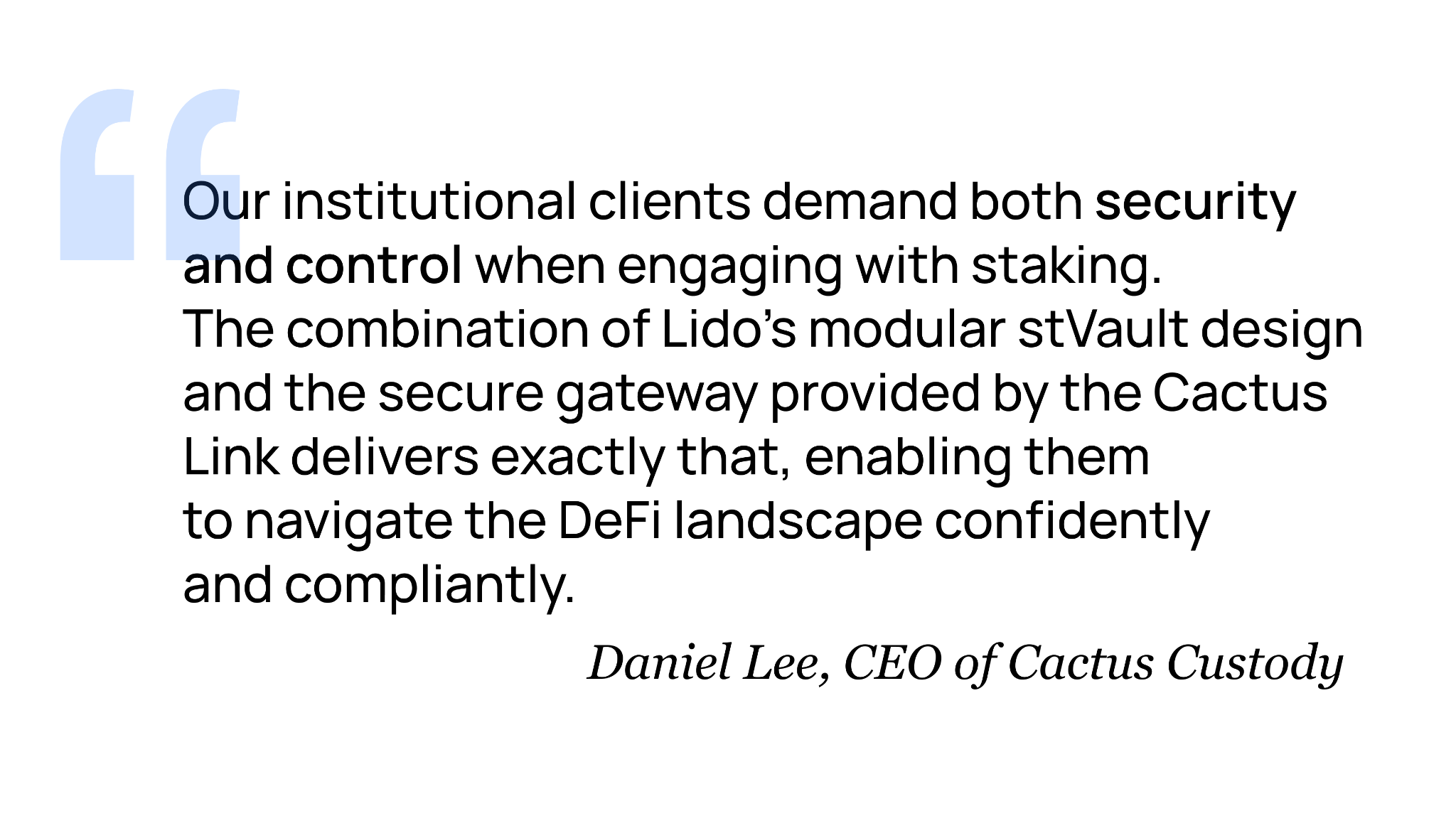
For institutional clients, a key advantage of operating stVaults through Cactus Custody is the ability to integrate on-chain actions with their existing, familiar security models. This means that critical staking operations can be gated by the institution’s established Cactus Custody policies, leveraging multi-signature approvals, time locks, and transaction limits. This aligns the DeFi staking experience with the stringent internal controls common in traditional finance. However, institutions are still expected to conduct their own thorough due diligence on smart contract risks, operational procedures, and regulatory implications. Ensuring internal approvals and establishing robust monitoring systems are essential prerequisites before going live with stVault operations.
Industry Reactions and Future Implications
The integration has been met with positive sentiment from industry stakeholders. Sam, a representative from Cactus Custody, commented on the significance of the collaboration, stating, "Cactus Custody is dedicated to expanding institutional access to the DeFi ecosystem securely and compliantly. Our support for Lido V3 stVaults, building on our existing stETH and wstETH custody, provides our clients with an unparalleled blend of control, security, and liquidity. This partnership is a testament to our commitment to bridging traditional finance with innovative Web3 solutions, empowering institutions to confidently participate in the future of staking."
This partnership has profound implications for both Lido and Cactus Custody, as well as the broader institutional digital asset market. For Lido, securing a qualified custodian like Cactus Custody for stVaults significantly enhances its appeal to a wider range of institutional clients who require robust custody solutions to meet their internal governance and compliance standards. It validates Lido’s modular staking infrastructure as a viable and secure option for large-scale capital deployment.
For Cactus Custody, the integration solidifies its position as a forward-thinking custodian that not only safeguards digital assets but also facilitates secure and compliant access to complex DeFi primitives. By enabling institutions to manage staking directly from their custody accounts, Cactus Custody is lowering the barrier to entry for institutional DeFi participation, potentially attracting new capital flows into the ecosystem.
More broadly, this collaboration represents a critical step in the maturation of the digital asset market. As regulatory clarity slowly emerges and institutional infrastructure continues to develop, the ability to combine the flexibility and yield potential of DeFi with the security and compliance frameworks of traditional finance becomes increasingly vital. Solutions like stVaults, supported by qualified custodians, are essential for institutionalizing DeFi and driving mainstream adoption. The market for institutional staking is projected to grow substantially in the coming years, driven by the attractive yields and the increasing professionalization of the validator landscape. Integrations like this ensure that institutions can capture this growth within a secure and regulated environment.
Institutions interested in exploring the capabilities of Lido V3 stVaults through Cactus Custody are encouraged to book a call with the Lido Institutional team for further details and personalized guidance. This direct line of communication will facilitate a deeper understanding of the technical, operational, and regulatory aspects of this innovative staking solution, paving the way for confident and compliant institutional engagement with Ethereum’s Proof-of-Stake network.