admin
admin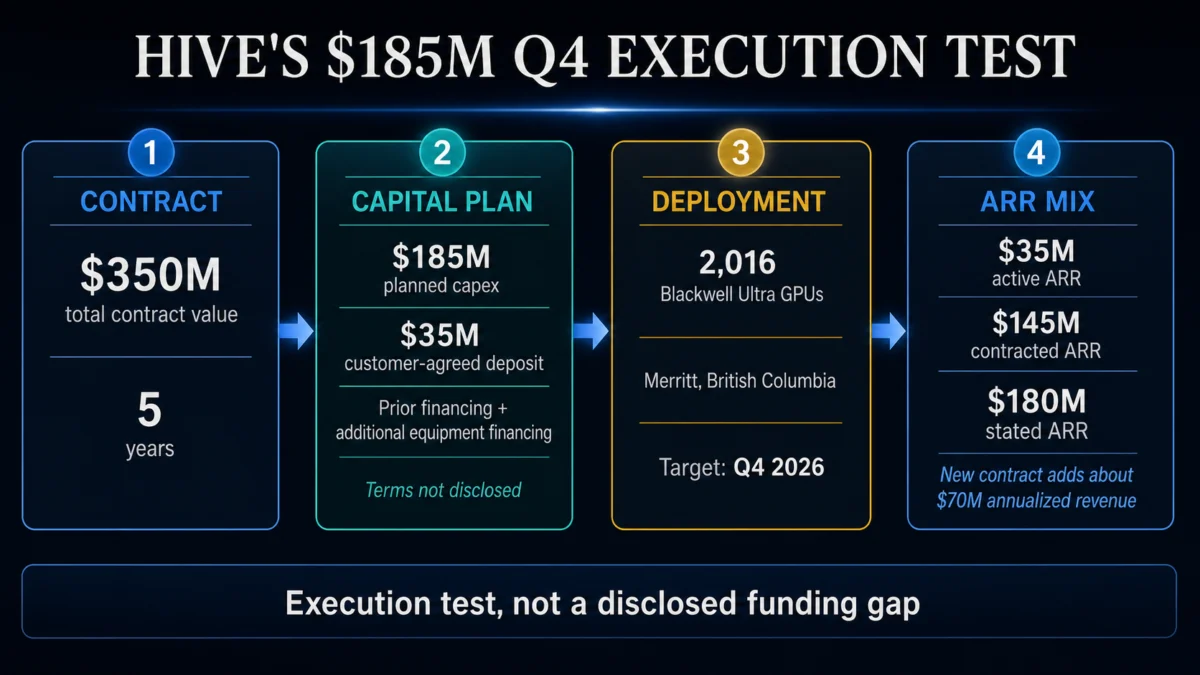
The landmark deal, secured by HIVE’s BUZZ High Performance Computing unit with an unnamed investment-grade enterprise customer, is projected to generate approximately $70 million in annualized revenue once the necessary infrastructure is fully deployed. This strategic pivot underscores a broader trend within the cryptocurrency mining industry, where companies are increasingly diversifying their operations to capitalize on the immense demand for computing power driven by AI advancements.
The Core of the Deal: GPU Infrastructure and Capital Requirements
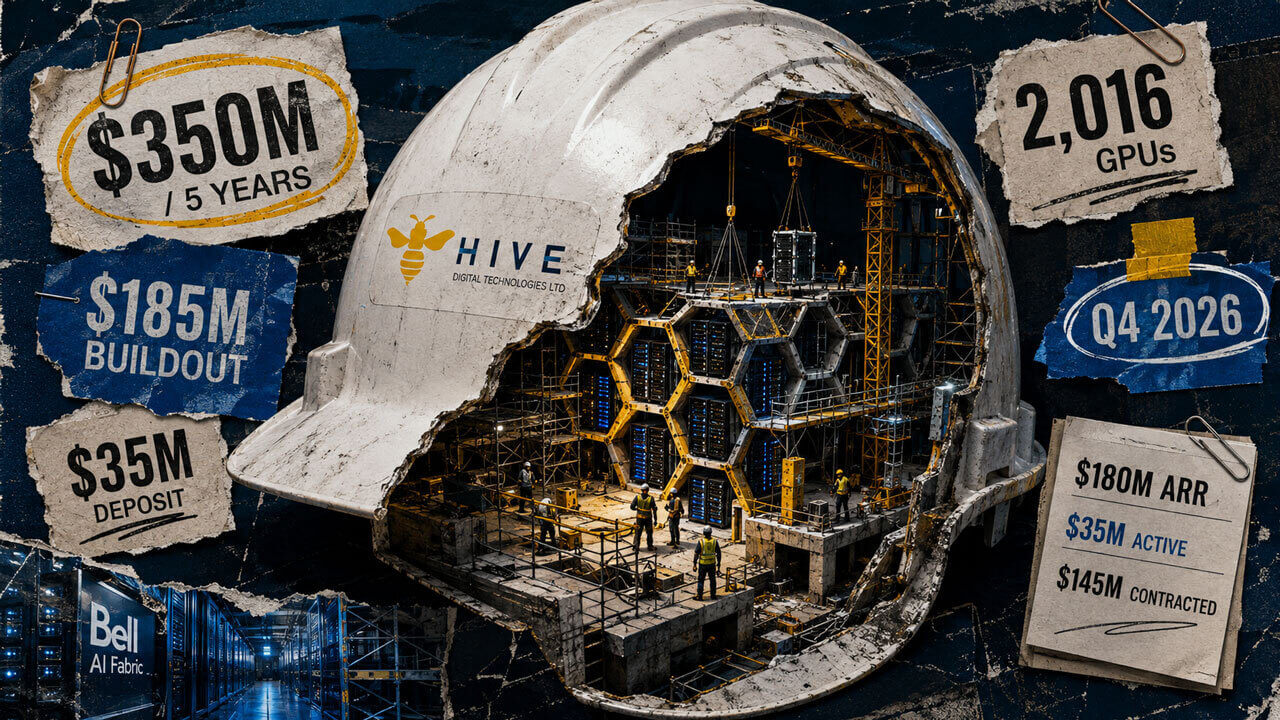
At the heart of this agreement lies the planned installation of 2,016 NVIDIA Blackwell Ultra GPUs, integrated within GB300 NVL72 systems. These state-of-the-art GPUs will be housed at HIVE’s Bell AI Fabric facility, located in Merritt, British Columbia. The total cost for this essential hardware, along with related equipment and service warranties, is estimated to be around $185 million. The company has set an aggressive deployment target for calendar year Q4 2026, indicating a tight timeline for project completion and revenue generation.
To facilitate this significant investment, the enterprise customer has committed to an upfront deposit equivalent to approximately 10% of the contract’s total value, amounting to $35 million. While HIVE has confirmed this deposit, the company has not publicly disclosed whether this payment has already been received. This initial contribution, while substantial, still leaves a considerable funding gap that HIVE must bridge through existing financial resources and potentially additional equipment financing.
HIVE’s Financial Strategy and Funding Landscape
HIVE has been actively engaged in shoring up its financial position to support this expansion. In June, the company successfully raised $130 million through the issuance of zero-percent exchangeable senior notes due in 2031. Furthermore, during the preceding quarter, HIVE secured an additional $245 million from similar zero-percent note offerings. Chief Executive Officer Aydin Kilic has indicated that the proceeds from these bond and debt financings are intended to be allocated towards the acquisition of the crucial GPU hardware.
However, the exact allocation of these funds towards the GPU purchase, as well as the precise terms and current status of any additional equipment financing arrangements, remain undisclosed. This lack of transparency raises questions about the company’s ability to fully fund the $185 million expenditure without further financial maneuvers or delays. The success of the $350 million AI contract is thus heavily reliant on HIVE’s capacity to secure the remaining capital and execute its financing strategy efficiently.
Unlocking the AI Revenue Stream: A Phased Approach
The announced deal significantly boosts BUZZ’s reported annual recurring revenue (ARR) to an impressive approximately $180 million. However, a critical distinction must be made: only about $35 million of this ARR is currently active and generating revenue. The remaining $145 million is contracted but contingent upon the successful deployment of the new GPU infrastructure. This means that the vast majority of HIVE’s projected AI revenue is still in a pre-revenue phase, awaiting hardware delivery, installation, and commissioning.
HIVE’s definition of ARR is based on annualized weekly, daily, or quarterly revenue, and the company itself cautions that these projected figures are subject to potential future cancellations, discounts, or service reductions. Therefore, the realization of the full $180 million ARR is not guaranteed and depends on sustained client engagement and operational stability.
Once the new AI infrastructure is fully operational, HIVE anticipates its High-Performance Computing (HPC) and AI business segment to generate approximately $500,000 in daily revenue. This projected daily revenue stream, if realized, would represent a significant diversification away from its traditional Bitcoin mining activities.
Financial Position and Execution Risks
HIVE recently reported having $208 million in cash reserves. While this provides a buffer, it is not explicitly stated how much of this cash is earmarked for the GPU deployment. This leaves the company’s ability to meet the $185 million capital requirement somewhat ambiguous, underscoring the importance of the previously mentioned financing efforts.

The contract with the investment-grade enterprise customer offers HIVE a substantial pipeline of committed AI demand, a significant advantage in a competitive market. However, the economic viability of this venture hinges critically on HIVE’s execution capabilities. Key challenges include:
- Securing Remaining Financing: The company must ensure it has access to the full $185 million required for the GPU buildout, potentially through additional debt, equity, or strategic partnerships.
- Hardware Delivery and Commissioning: Meeting the Q4 2026 deadline for receiving and installing over 2,000 high-end NVIDIA GPUs is a complex logistical and technical undertaking. Any delays in the supply chain or installation process could impact revenue timelines.
- Converting Capacity to Revenue: The successful commissioning of the hardware must translate directly into live, billable revenue. This involves ensuring the infrastructure is stable, reliable, and meets the performance expectations of the enterprise client.
Broader Industry Context and Implications
HIVE’s strategic move into AI infrastructure is emblematic of a wider trend among Bitcoin miners. As the profitability of Bitcoin mining can be volatile and subject to market fluctuations, many companies are seeking to leverage their existing infrastructure, technical expertise, and access to large-scale power to diversify into AI computing. The demand for powerful GPUs, like NVIDIA’s Blackwell series, is surging due to the rapid advancements in AI, machine learning, and large language models.
The ability of companies like HIVE to secure these large AI contracts and then execute on the necessary infrastructure buildouts will be a key determinant of their future success. The high capital expenditure required for GPU clusters means that only well-capitalized companies with robust financing capabilities can effectively compete in this space.
The unnamed enterprise customer’s decision to partner with a Bitcoin miner for AI cloud services also highlights the evolving perception of these companies as viable providers of computing power. This trend could lead to increased collaboration between the cryptocurrency and AI industries, potentially creating new synergies and accelerating innovation in both fields.
Navigating the Transition: A Calculated Risk
HIVE Digital Technologies is undertaking a calculated risk by channeling significant capital into AI infrastructure. The potential rewards are substantial, offering a path to diversify revenue streams and tap into a rapidly growing market. However, the success of this venture is not guaranteed and will depend on the company’s ability to navigate complex financial, logistical, and technical challenges. The coming quarters will be crucial in determining whether HIVE can successfully execute its ambitious AI expansion plan and unlock the full revenue potential of its $350 million contract. The company’s transparency regarding its financing and deployment progress will be closely watched by investors and industry observers alike.