admin
admin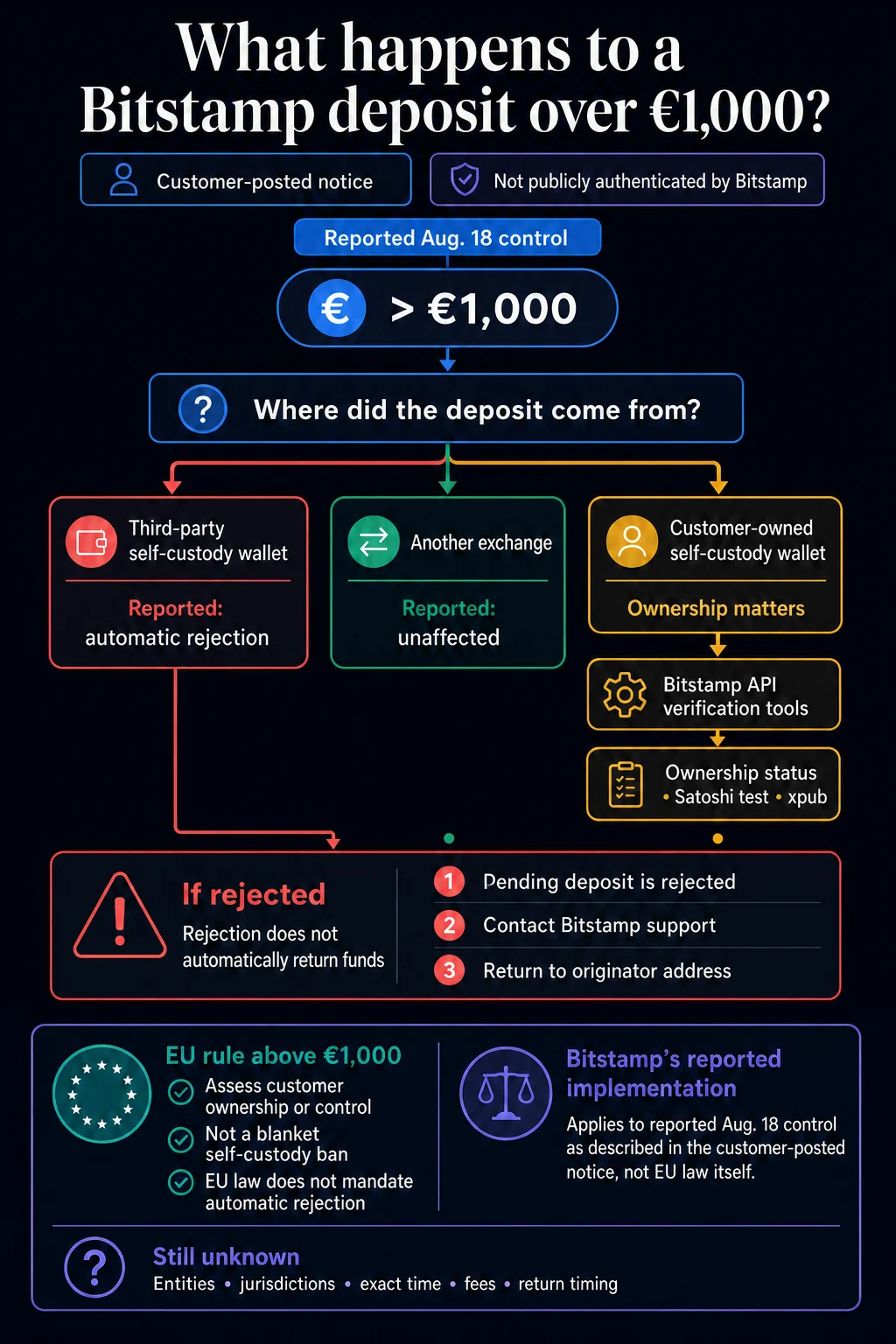
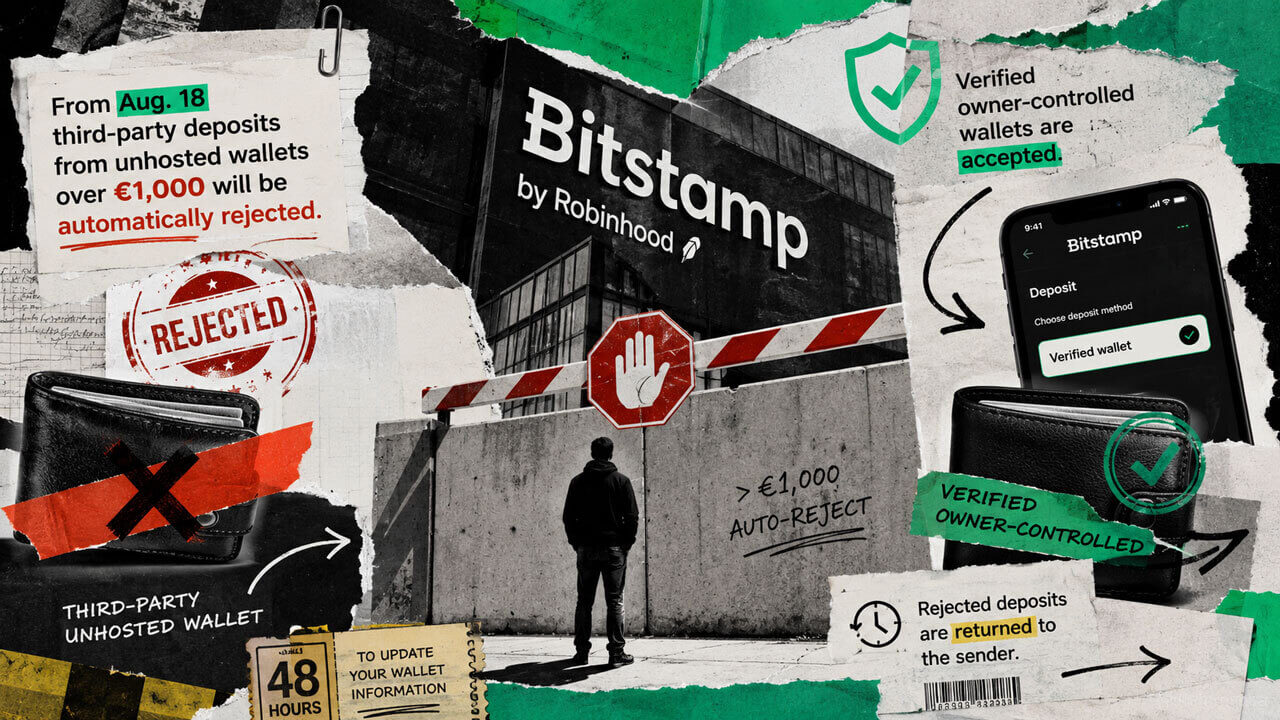
Effective August 18, cryptocurrency exchange Bitstamp is implementing a new policy that will reportedly reject all crypto deposits exceeding €1,000 originating from unhosted third-party wallets. This significant shift in deposit protocol, which has not been officially confirmed by Bitstamp through a public statement but has been communicated to users via customer-facing notices, aims to enhance regulatory compliance and security by scrutinizing the origin of funds. While transfers from other exchanges and from wallets demonstrably controlled by the Bitstamp account holder are expected to remain unaffected, the new rule introduces a significant hurdle for individuals seeking to move assets from their personal, self-custody wallets above a certain threshold.
The genesis of this change appears to be rooted in evolving regulatory landscapes, particularly within the European Union. EU Regulation 2023/1113, which came into effect in June 2023, mandates that crypto-asset service providers (CASPs) assess whether their customers own or control self-hosted addresses when a transfer from such an address exceeds €1,000. This regulation provides a framework for CASPs to adopt a risk-based approach, which can include requesting additional information, executing, rejecting, returning, or suspending transfers that lack necessary accompanying details. Bitstamp’s reported policy appears to be a proactive, albeit stringent, interpretation of these requirements, focusing on outright rejection for certain categories of deposits.
Timeline of Developments and User Observations
The implementation of this new policy, slated for August 18, follows a series of technical and operational updates by Bitstamp. Examination of Bitstamp’s official API documentation reveals a phased introduction of features designed to better track and verify deposit origins. In March, the exchange introduced a rejection endpoint, providing the technical capability to block incoming transactions. Subsequently, in May, address-verification and extended public key (xpub) tools were integrated, enabling more sophisticated methods for confirming wallet ownership. Finally, in June, deposit-originator address data became available through the API. These developments suggest that Bitstamp has been building the infrastructural capacity to manage and enforce such deposit-origin rules for some time, culminating in the reported policy change.
The policy itself began to surface through user communications. One notable instance involved a Reddit user on the r/Bitcoin subreddit sharing a Bitstamp-branded notice that detailed the new deposit restrictions. Shortly thereafter, another user on the r/BitstampOfficial subreddit reported receiving a similar email notification. These customer-posted communications have become the primary source of information regarding the specifics of the policy, as Bitstamp has yet to issue a formal, public announcement. This lack of official communication has contributed to uncertainty and concern among the user base.
Understanding the Mechanics of the New Policy
At the core of Bitstamp’s new rule is the distinction between third-party unhosted wallets and wallets directly controlled by the account holder. According to Bitstamp’s API documentation, a deposit is classified as originating from a third party if the sending address is not in the customer’s name. This classification applies irrespective of whether the wallet is hosted by a service provider or managed directly by the customer. For deposits originating from third-party wallets, especially those identified as being managed by a Virtual Asset Service Provider (VASP), specific VASP identifiers are required.
The exchange’s API outlines several methods for verifying a customer’s control over an external address. These include ownership-status checks, Satoshi tests (a method of proving ownership by sending a small, specific amount of Bitcoin from the address in question), and xpub registration. These mechanisms are designed to differentiate between wallets genuinely under the customer’s command and those that are not. However, the precise implementation and interaction of these verification tools with the newly reported Aug. 18 rule remain somewhat opaque. The documentation does not explicitly detail how every verified address will be treated under the new policy, nor does it clarify whether the €1,000 threshold applies to individual transactions or aggregated transfers within a specific period.
The implications of a rejected deposit are also a point of concern. Bitstamp’s API clarifies that a rejection does not automatically reverse a blockchain transfer. This means that if a deposit is flagged and rejected, the assets do not instantly return to the originator address. Customers are required to contact Bitstamp support to initiate the process of returning the funds. Information regarding the timeframe for these returns, any associated fees, or the method used to value the €1,000 threshold in different cryptocurrencies is not publicly available. This process could potentially lead to delays and added complexity for users affected by the new policy.
Broader Regulatory Context and Potential Implications
The EU Regulation 2023/1113 provides a crucial backdrop to Bitstamp’s policy. The regulation’s emphasis on assessing customer control over self-hosted wallets above a certain monetary threshold is designed to combat money laundering and terrorist financing by improving the traceability of crypto transactions. However, the regulation itself does not mandate an outright ban on self-custody or necessitate the automatic rejection of every deposit exceeding €1,000. Instead, it permits a flexible, risk-based approach, allowing CASPs to implement a range of measures from information requests to outright rejection.

Bitstamp’s reported decision to implement a blanket rejection for third-party unhosted deposits above €1,000, while potentially compliant with the spirit of the regulation, represents a more conservative stance compared to the flexibility offered by the EU framework. The fact that deposits from other exchanges are reportedly unaffected suggests a targeted approach, focusing on the perceived higher risk associated with direct transfers from unhosted wallets.
The implications of this policy are multifaceted:
- Increased Friction for Self-Custody Users: Individuals who actively manage their own private keys and prefer to keep their assets in self-custody wallets will face a more cumbersome process when depositing funds to Bitstamp above the €1,000 limit. This could lead some users to explore alternative exchanges or to consolidate their holdings differently.
- Potential for Misinterpretation and Errors: The distinction between "third-party" and "customer-controlled" wallets can be nuanced. Users might inadvertently send funds from a wallet they believe they control, only to have it rejected, leading to confusion and the need to engage with customer support.
- Impact on Decentralized Finance (DeFi) Users: Individuals actively participating in DeFi ecosystems and utilizing various self-hosted wallets for those activities may find it more challenging to move their earnings or assets back to a centralized exchange like Bitstamp.
- Competitive Landscape: Other exchanges may choose to adopt different approaches to compliance, potentially offering more user-friendly deposit options for self-custody users, which could influence market share.
- Regulatory Interpretation and Industry Standards: Bitstamp’s approach could set a precedent for how other European CASPs interpret and implement the EU’s new regulations. This could lead to a broader trend towards stricter deposit verification processes across the industry.
Unanswered Questions and Future Outlook
Several key questions remain unanswered regarding Bitstamp’s new deposit policy. The exact legal entities or jurisdictions to which this policy will apply have not been specified. Furthermore, the precise launch time for the policy on August 18 remains unconfirmed, adding to the uncertainty for users. The mechanism for combining related transfers to determine the €1,000 threshold is also unclear, which could lead to unexpected rejections if multiple smaller transactions are aggregated.
While the policy appears to be driven by a desire to align with regulatory mandates, the lack of clear, public communication from Bitstamp has generated significant user concern. The company’s historical API developments indicate a strategic build-up of capabilities for such controls, suggesting a well-considered, albeit restrictive, operational decision. The success of this policy will hinge on Bitstamp’s ability to effectively communicate its nuances to its user base, provide robust support for rejected transactions, and clearly demonstrate how this measure contributes to a safer and more compliant trading environment. As August 18 approaches, the cryptocurrency community will be closely watching how Bitstamp navigates this new era of enhanced deposit scrutiny.