admin
admin
The global financial landscape witnessed a significant synchronized rally on Friday as Bitcoin (BTC) and gold both surged to multi-month highs, driven by a complex interplay of U.S. fiscal policy, inflationary pressures, and shifting global liquidity. Following the opening of Wall Street, Bitcoin successfully consolidated its position above the $77,000 threshold, marking its most robust performance since mid-May. Simultaneously, gold—the traditional safe-haven asset—mirrored this upward trajectory, reaching 14-week highs and reinforcing a growing market narrative that investors are increasingly seeking refuge in "hard assets" to hedge against currency debasement and sovereign debt concerns.
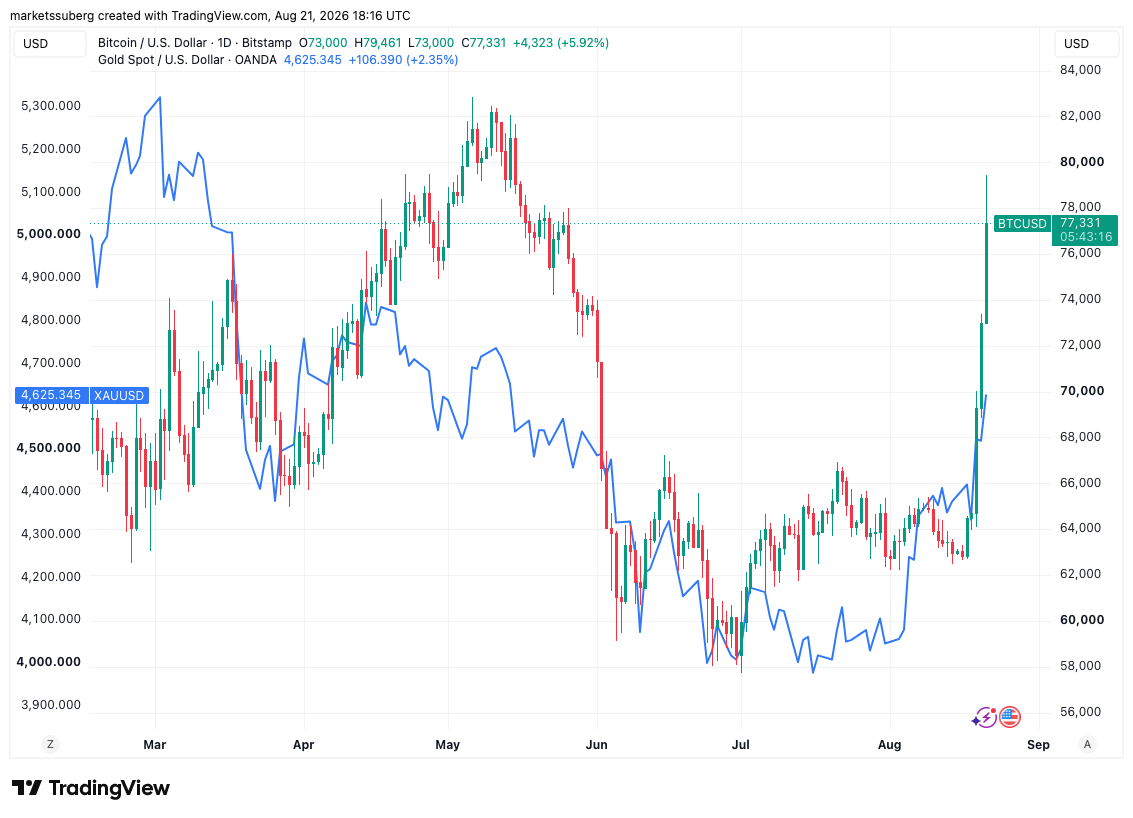
Data provided by TradingView highlights a significant momentum shift during the Friday session. Bitcoin’s climb past $77,000 represented a nearly 6% intraday gain, a move that surprised some casual observers but was viewed by seasoned market analysts as a logical consequence of recent macroeconomic developments. Gold’s performance was equally notable, with the precious metal reaching $4,632 per ounce, an intraday increase of 2.2%. On a broader monthly timeframe, the correlation between the two assets became even more apparent, with Bitcoin and gold posting gains of 13% and 16%, respectively.
The Convergence of Fiscal Policy and Market Momentum
The simultaneous rise of the world’s leading cryptocurrency and its oldest precious metal is being attributed to a "perfect storm" of fiscal and monetary factors. Market commentary from The Kobeissi Letter suggests that these gains should not be viewed as an anomaly. Instead, they are the direct result of record government deficit spending and a pivotal shift in U.S. Treasury Department policy.
A primary catalyst for the rally was the Treasury Department’s recent announcement regarding its debt management strategy. The Treasury pledged to at least double the size of its debt buyback operations, increasing the scale to approximately $4 billion. Debt buybacks are often perceived by the market as a mechanism to inject liquidity into the financial system and stabilize the bond market. When the government buys back its own debt, it effectively puts cash back into the hands of investors, who then seek higher returns in alternative asset classes like Bitcoin and gold.

Furthermore, the backdrop of persistent inflation and an ever-widening federal deficit has fueled the "debasement trade." As the total U.S. national debt continues to climb, the perceived value of fiat currency faces downward pressure. In this environment, assets with a finite supply—such as Bitcoin’s 21 million coin cap and the physical scarcity of gold—become increasingly attractive to institutional and retail investors alike.
Global Liquidity Flux and the Japanese Intervention
The current market volatility is not confined to the United States. Trading firm QCP Capital pointed to significant "cross-asset signals" that emerged earlier in the month, particularly following a rare joint currency intervention by Japanese authorities to support the yen. This intervention led to a surge in Japanese government bond yields, creating a ripple effect across global markets.
According to QCP Capital’s "Market Color" analysis, the divergence between traditional Treasuries and alternative assets has become a focal point for traders. Initially, U.S. Treasuries rallied following the Treasury Department’s announcement, but they quickly retraced those gains. Bitcoin and gold, however, maintained their upward trajectory, showing a resilience that traditional bonds lacked.
"That does not establish a new liquidity or monetary regime, but it does highlight the sensitivity of alternative assets to changes in long-end rates and the dollar," QCP Capital noted. This sensitivity suggests that as long as the U.S. dollar remains under pressure and interest rate expectations remain volatile, Bitcoin and gold may continue to act as the primary beneficiaries of global liquidity shifts.
A Chronology of the Week’s Market Movements
To understand the magnitude of Friday’s rally, it is essential to look at the sequence of events that led to the $77,000 breakout for Bitcoin:
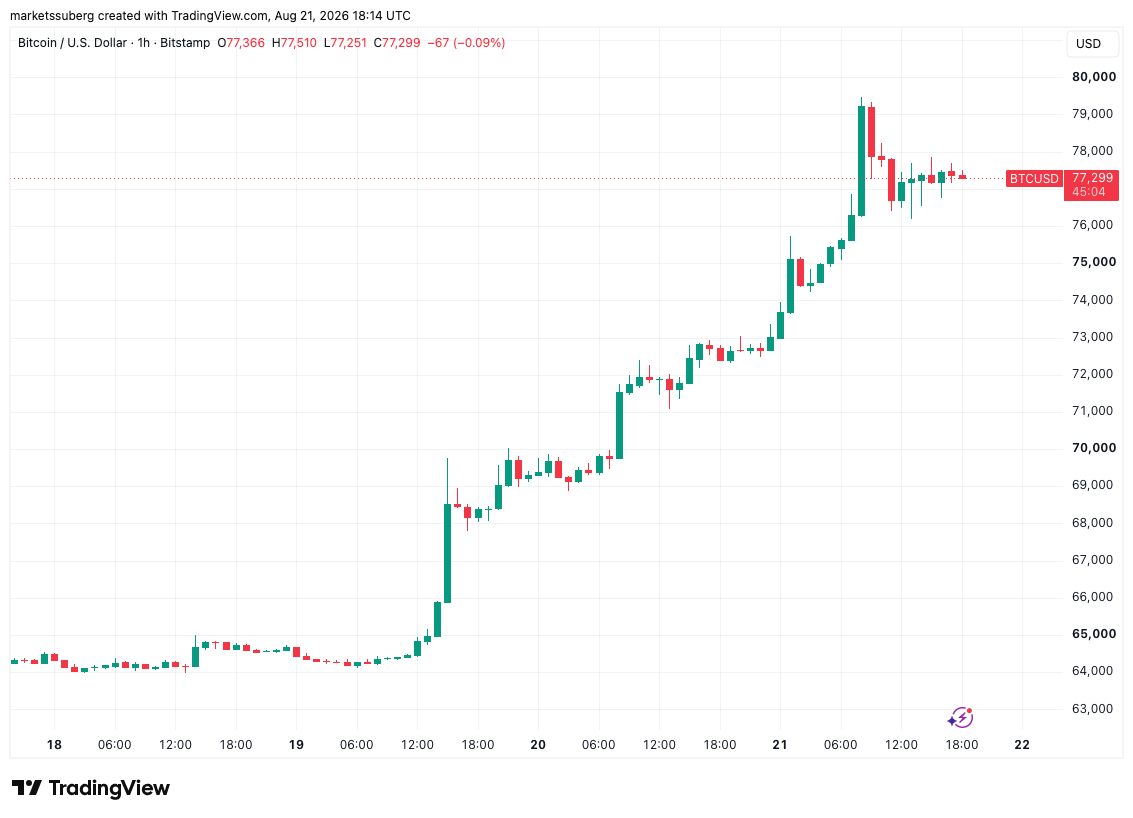
- Monday-Tuesday: Bitcoin began the week with steady accumulation, hovering near the $65,000–$68,000 range. Market participants remained cautious ahead of Treasury announcements.
- Wednesday: The U.S. Treasury Department confirmed its intention to scale up debt buybacks. This news acted as the initial spark, causing a decoupling of Bitcoin from the broader equities market.
- Thursday: Inflation data signaled that while price increases were cooling in some sectors, core costs remained "sticky." This reinforced the narrative for gold as an inflation hedge.
- Friday Morning: As Wall Street opened, a wave of institutional buying pushed Bitcoin through the $75,000 resistance level. Within hours, the price consolidated above $77,000, its highest level since May 15.
- Friday Afternoon: Gold reached its 14-week peak of $4,632, completing a dual-asset breakout that dominated financial headlines.
Technical Analysis and the 50-Week EMA
Despite the bullish price action, some technical analysts are urging caution. Popular trader and analyst Rekt Capital emphasized that Bitcoin is currently facing a critical technical hurdle. For the current rally to evolve into a sustained "Macro Uptrend," Bitcoin must decisively reclaim its 50-week Exponential Moving Average (EMA), which currently sits at approximately $77,232.
This specific trend line has historically served as a major pivot point for the market. In January, Bitcoin attempted to break above this level but was ultimately rejected, leading to a period of consolidation and lower highs.
"Break the Downtrend and Bitcoin will confirm entry into a new technical Macro Uptrend," Rekt Capital informed his followers. "Reject from here, however, and price will maintain its series of Lower Highs. History suggests there’s still time for price to continue its Downtrend."
The struggle at the $77,232 mark represents a battle between short-term momentum and long-term structural resistance. If Bitcoin can close the week above this level, it would signal a shift in market psychology, potentially opening the door for a run toward previous all-time highs.
Polymarket Odds and Future Price Targets
The sudden price surge has significantly shifted market sentiment regarding year-end and long-term targets. Prediction markets, which often serve as a gauge for collective investor expectations, have turned increasingly optimistic.
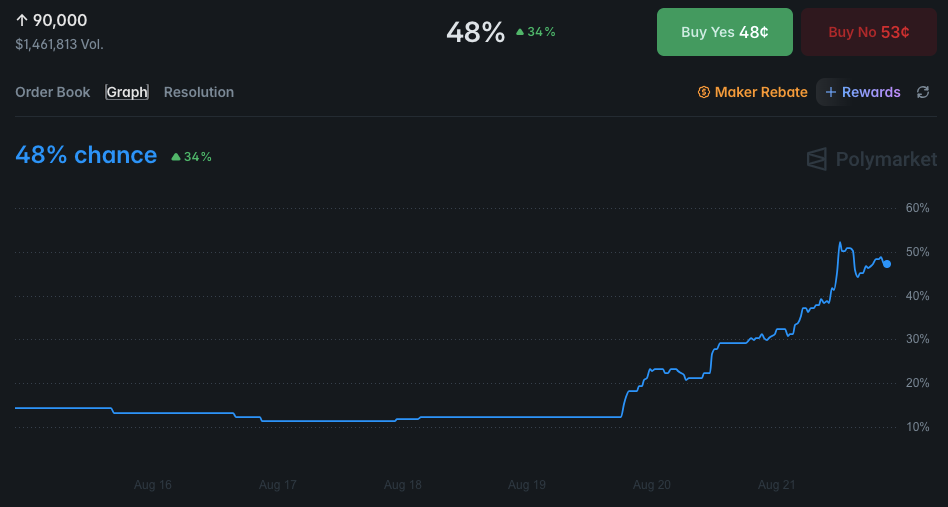
Data from Polymarket, a leading decentralized prediction platform, shows that the odds of Bitcoin hitting $90,000 before the year 2027 have surged to 48%. This represents a sharp increase from the start of the week, when the odds were positioned significantly lower. This shift in the "betting" market reflects a growing consensus that the current macro environment—characterized by high debt and central bank intervention—is structurally favorable for Bitcoin.
Additionally, the rally has had a profound impact on corporate balance sheets. Publicly traded companies that have adopted a "Bitcoin Treasury" strategy, most notably MicroStrategy, have seen their holdings reach significant breakeven or profit points as the price crossed the $77,000 mark. This corporate validation continues to provide a "floor" for the market, as institutional holders appear less likely to sell during periods of volatility compared to retail speculators.
Broader Implications for the Global Monetary System
The simultaneous record-breaking moves in Bitcoin and gold suggest a broader loss of confidence in traditional monetary policy. When both the "old world" hedge (gold) and the "new world" hedge (Bitcoin) rally together, it typically indicates that investors are worried about the underlying health of the fiat currency system.
The U.S. Treasury’s decision to double its debt buybacks is a double-edged sword. While it provides necessary liquidity to ensure the smooth functioning of the bond market, it also signals to the world that the government must actively intervene to manage its massive debt load. This interventionism is often viewed as a form of "stealth" quantitative easing, which is historically bullish for hard assets.
Furthermore, the divergence noted by QCP Capital—where Bitcoin and gold failed to retrace alongside Treasuries—suggests that these alternative assets are starting to be viewed not just as speculative vehicles, but as essential components of a modern diversified portfolio.
Conclusion: A New Technical Frontier
As Bitcoin consolidates above $77,000 and gold maintains its 14-week highs, the financial markets are entering a period of heightened sensitivity. The coming days will be crucial in determining whether this rally is a temporary spike driven by Treasury policy or the beginning of a new macro cycle.
Investors will be closely watching the 50-week EMA and further updates from the U.S. Treasury. If the current support levels hold, the path toward $90,000 and beyond may become increasingly clear. However, as cautioned by analysts like Rekt Capital, the market remains at a technical crossroads where the risk of rejection is as real as the potential for a breakout.
In this environment, the only certainty is that the traditional boundaries between crypto-assets and precious metals are blurring, as both asset classes unite under a single banner: the search for stability in an era of unprecedented fiscal expansion.