admin
admin
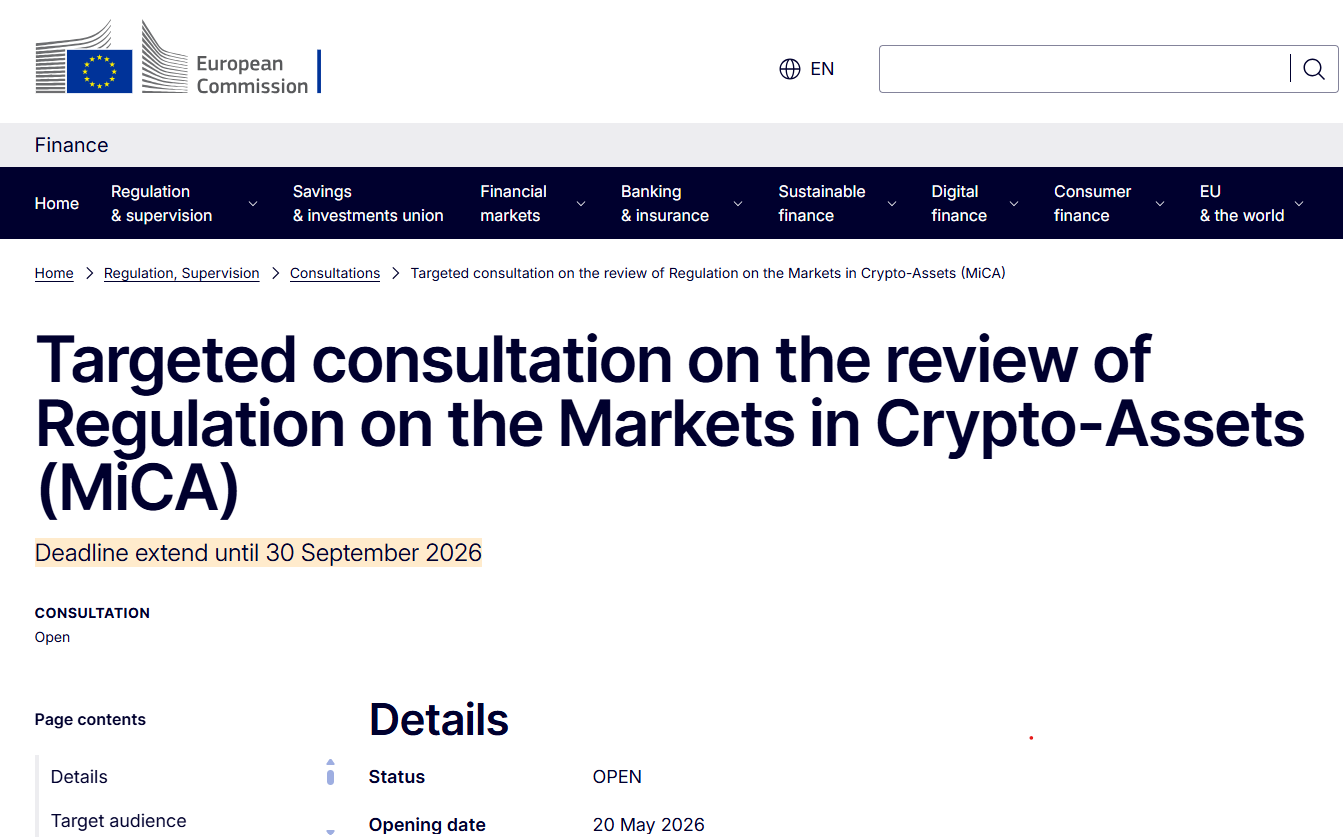
The European Commission has officially initiated a high-level review to determine whether the Markets in Crypto-Assets (MiCA) regulation should be expanded to encompass decentralized finance (DeFi) and the rapidly growing sector of crypto lending and borrowing. On May 20, 2024, the Commission launched a targeted consultation inviting stakeholders, including financial institutions, blockchain developers, and legal experts, to provide feedback on regulatory gaps that were intentionally left unaddressed during the initial drafting of the MiCA framework. This move signals a significant shift in Brussels, as policymakers grapple with the challenge of supervising financial activities that operate without traditional intermediaries or centralized corporate structures.
The core of the current debate centers on the legal and systemic status of "lending vaults"—automated smart contract systems that facilitate billions of dollars in on-chain credit. Unlike traditional banks or even centralized crypto exchanges, these vaults do not always have a clear "service provider" at the helm. Instead, they function through decentralized protocols, leading to a complex web of jurisdictional and definitions-based questions. As the European Union seeks to cement its position as a global leader in digital asset regulation, the outcome of this consultation could redefine the operational landscape for DeFi protocols across the continent.
The Genesis of MiCA and the DeFi Exclusion
To understand the current regulatory crossroad, one must look at the chronology of the MiCA framework. Proposed in 2020 and entering into force in June 2023, MiCA was designed to provide legal certainty for crypto-asset issuers and service providers. However, during the legislative process, the European Parliament and Council recognized that the decentralized nature of DeFi presented unique challenges that the standard "service provider" model could not easily solve. Consequently, Recital 22 of MiCA explicitly stated that where crypto-asset services are provided in a "fully decentralized manner without any intermediary," they should fall outside the scope of the regulation.
However, the "fully decentralized" clause has become a point of contention. In practice, very few protocols are entirely autonomous. Most involve some level of governance by DAO (Decentralized Autonomous Organization) members, core developers, or specialized service providers. The Commission’s new consultation, which remains open for feedback until September 30, 2024, seeks to clarify whether the current "wait-and-see" approach is still viable or if the risks associated with lending and borrowing—such as leverage cycles and contagion—warrant a dedicated regulatory chapter.
The Problem of Defining Lending Vaults
A primary area of concern for Brussels is the rise of lending vaults. These are on-chain structures that allow users to deposit assets into a pool, which are then lent out to borrowers or used in yield-generating strategies. Yuriy Brisov, an EU digital assets lawyer and partner at Digital & Analogue Partners, notes that the lack of a formal legal definition for a "vault" creates a vacuum. Under current EU law, there is no specific category for such an entity. Instead, regulators must look at the function of the code. If a vault performs the economic function of a bank or an investment fund, regulators may argue it should be treated as such, regardless of its digital-native label.

The challenge is that these vaults often disaggregate the roles typically held by a single financial institution. In a traditional bank, the entity takes deposits, manages risk, and allocates capital. In a DeFi vault, these tasks might be split between a smart contract (which holds the assets), a "curator" (who sets the risk parameters), and an "allocator" (who moves the capital). This fragmentation makes it difficult for the Commission to identify a single "obligor" or regulated entity to hold accountable for compliance, consumer protection, or anti-money laundering (AML) requirements.
Case Study: Morpho and Modular Infrastructure
The complexity of modern DeFi is perhaps best illustrated by the Morpho protocol and its Vault V2 architecture. Morpho’s lending infrastructure allows for the creation of various vaults that do not map neatly onto existing regulatory models. Its architecture divides responsibilities among several distinct roles:
- The Owner: Usually the entity or DAO that initializes the vault.
- The Curator: A party responsible for configuring the strategy and risk parameters, such as which assets can be used as collateral.
- The Allocator: A role tasked with executing the actual movement of funds based on the curator’s strategy.
- The Sentinel: A specialized role with the power to intervene or "pause" activities to mitigate immediate risks or exploits.
This modular approach demonstrates the difficulty of the Commission’s task. If the EU decides to regulate lending, which of these participants is the "lender"? Is it the person who wrote the code, the DAO that voted on the parameters, or the user who provided the liquidity? Jonathan Galea, a partner at Cahill Gordon & Reindel, argues that policymakers must avoid a "one-size-fits-all" label. Galea emphasizes that different vaults serve different economic purposes; some are merely liquidity aggregators, while others function more like actively managed funds. Treating them all as a single category of "DeFi lending" could result in unintended consequences, such as stifling innovation in liquidity management while failing to address actual risks in speculative lending.
Market Context and the Scale of On-Chain Credit
The push for regulation is driven in part by the sheer scale of the DeFi lending market. According to industry data, the Total Value Locked (TVL) in DeFi lending protocols has fluctuated between $30 billion and $100 billion over the last two years, depending on market conditions. Protocols like Aave, Compound, and Morpho handle volumes that rival mid-sized traditional financial institutions.
In the wake of the 2022 collapses of centralized lending platforms like Celsius and Voyager, EU regulators are particularly wary of "shadow banking" in the crypto space. While those entities were centralized and would have been covered by MiCA’s rules for service providers, the Commission is concerned that decentralized alternatives could pose similar systemic risks if they reach a certain "critical mass" without oversight. The goal of the current consultation is to assess whether these protocols require prudential requirements—such as capital buffers or liquidity ratios—similar to those found in traditional banking (Basel III) or investment fund (UCITS/AIFMD) frameworks.
Perspectives from the Decentralization Spectrum
A recurring theme in the feedback from the industry is the "decentralization spectrum." Many experts argue that decentralization is not a binary state but a process that happens over time. Galea points out that a strict regulatory test based on decentralization could inadvertently penalize newer, more innovative protocols that require a degree of centralized control during their "alpha" or "beta" phases for security reasons. Conversely, mature protocols that have successfully distributed control might escape regulation entirely, creating an uneven playing field.
Michael Egorov, the founder of Curve Finance—one of the largest decentralized exchanges and lending infrastructures—suggests that if DeFi lending is to be regulated, it must be under a framework that acknowledges its technological differences. "DeFi doesn’t need some of the safeguards which traditional lending requires," Egorov stated, referring to the fact that most DeFi lending is over-collateralized and managed by transparent, immutable code rather than human discretion. However, he admitted that DeFi might need other safeguards, perhaps focusing on smart contract audits, oracle reliability, and "circuit breakers" to prevent flash-loan attacks.
Legal Analysis: Structural vs. Functional Regulation
The legal community is currently debating two main paths for the EU: functional regulation or structural regulation.
Functional regulation would imply that if an activity looks like lending, it should be regulated as lending. However, Yuriy Brisov argues for a structural approach. He suggests that the focus should be on whether a user has a "direct coded claim" on a pool of assets. In a truly decentralized vault, there is no "undertaking" or manager who can disappear with the funds; the user’s relationship is with the code. Brisov suggests that if Brussels moves forward, they should add "lending and borrowing" to the list of regulated crypto-asset services under MiCA, but only when there is a clear intermediary exercising control.
Implications and Future Timeline
The European Commission’s consultation period ends on September 30, 2024. Following this, the Commission is expected to prepare a report for the European Parliament and the Council. This report will likely form the basis for "MiCA 2.0" or a supplementary directive specifically targeting DeFi.
If the EU decides to bring lending vaults into the regulatory perimeter, the implications will be profound:
- Compliance Costs: Protocols may need to appoint legal representatives within the EU, conduct regular audits, and implement "Know Your Customer" (KYC) protocols, which could clash with the permissionless nature of blockchain.
- Institutional Adoption: On the positive side, a clear legal framework could encourage conservative institutional investors and European banks to integrate with DeFi lending protocols, knowing they are operating within a sanctioned environment.
- Jurisdictional Arbitrage: There is a significant risk that if EU rules are too stringent, developers and capital will simply migrate to jurisdictions with more permissive regimes, such as the UAE or parts of Asia.
The challenge for Brussels remains a delicate balancing act: protecting consumers and financial stability without extinguishing the technical innovation that makes decentralized finance unique. As the September deadline approaches, the global crypto industry is watching closely, as the EU’s decision will likely set the precedent for how DeFi is treated by regulators worldwide.