Lina Irawan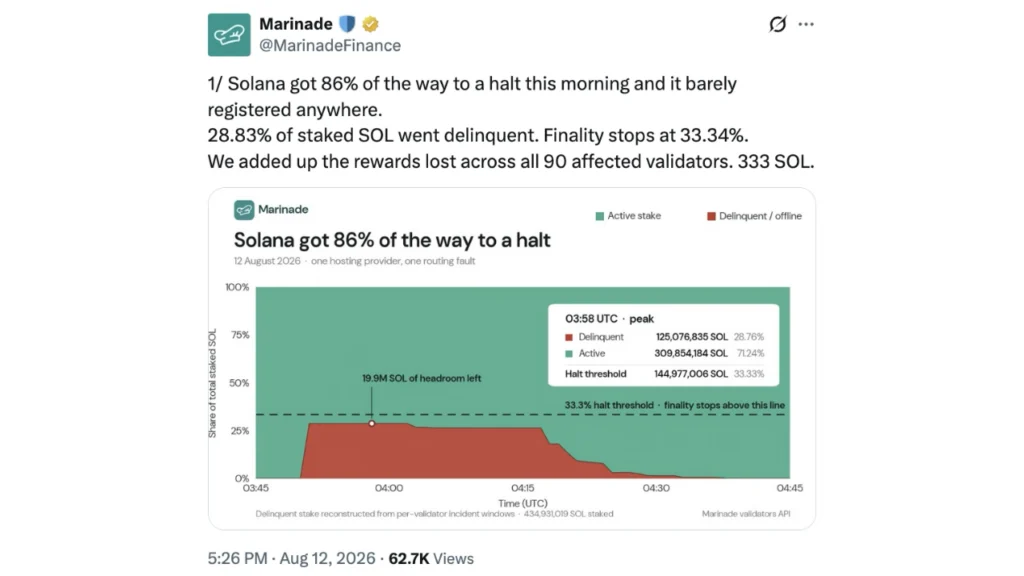
On August 12, the Solana blockchain teetered on the brink of a network-wide finality halt, a critical state where transactions can no longer be irreversibly confirmed. The near-catastrophe was triggered by a widespread routing failure at TeraSwitch, a key infrastructure provider, which temporarily rendered nearly 29% of the network’s staked SOL inaccessible. While the incident did not halt block production or prevent transaction processing, it starkly illuminated Solana’s vulnerability to external infrastructure dependencies and brought the network perilously close to a consensus breakdown.
The severity of the situation was underscored by data from Marinade Finance, a prominent staking platform. According to their analysis, approximately 28.83% of Solana’s staked SOL became temporarily delinquent due to the connectivity issues. This significant portion of offline stake pushed the network to within a precarious margin of the 33.34% threshold. Beyond this critical point, Solana’s consensus mechanism would have been unable to achieve finality, meaning new transactions could not be guaranteed as permanent. The disruption directly impacted around 90 validators, a notable fraction of the network’s operational validators, while a substantial majority of 597 out of 699 staked validators continued to function normally. This event highlighted a crucial distinction in blockchain reliability: Solana itself did not cease to function in terms of block production, but its fundamental guarantee of irreversible transactions was severely tested.
The Genesis of the Outage: A Cascade of Routing Failures
The incident originated in TeraSwitch’s Miami data center, where a misconfigured internet route was inadvertently advertised. This faulty advertisement, according to details later cited by Marinade Finance, propagated rapidly through TeraSwitch’s global network. A crucial route reflector located in Amsterdam played a pivotal role in disseminating the problematic routing information, extending the reach of the failure to data centers across Europe and Asia. Consequently, major internet hubs including London, Amsterdam, Dublin, Frankfurt, Singapore, and Tokyo experienced significant connectivity disruptions. While North American data centers were largely spared, the global reach of the routing failure had a profound impact on Solana validators relying on TeraSwitch’s services.
TeraSwitch’s technical teams identified the root cause of the issue within approximately 10 minutes of its onset. Restoration of normal traffic flow was achieved around 4:16 a.m. UTC. The incident’s significance for Solana stemmed from the interconnectedness of its validators. Despite operating as independent entities, a substantial number of these validators shared a common point of failure through their reliance on TeraSwitch’s infrastructure. When these validators lost connectivity, they were automatically classified as delinquent, ceasing to participate in the voting process necessary for network consensus. During the approximately 33-minute disruption, Marinade estimated that affected validators collectively missed around 333 SOL in staking rewards. While this financial loss was relatively minor, it underscored the immediate economic impact of such outages, though it was expected to be covered through validator bonds, a standard mechanism for mitigating such risks.
Understanding the Critical 33.34% Finality Threshold
The most alarming statistic emerging from the incident was not the 29% of staked SOL that went offline, but the proximity to the 33.34% threshold. Solana’s Proof-of-Stake (PoS) consensus mechanism, known as Tower BFT, requires a supermajority of staked SOL to participate in voting for blocks to achieve finality. Specifically, more than two-thirds of the network’s total staked SOL must be actively voting for a block to be considered irrevocably confirmed.
Should validators representing more than one-third of the total staked SOL simultaneously become unable to participate in the consensus process, the remaining voting stake would be insufficient to reach the necessary supermajority. In such a scenario, blocks might still be produced, but the network would lose its ability to confidently assert that transactions are irreversible. At the peak of the TeraSwitch incident, with 28.83% of staked SOL offline, Solana was left with only approximately 4.5 percentage points of buffer before reaching this critical finality threshold.

Marinade Finance issued a stark warning: if the delinquent stake had surpassed one-third, transactions across the entire Solana network would have ceased to reach finality. The platform drew a parallel to Solana’s February 2024 network halt, which lasted for roughly five hours, as an example of the potential ramifications of a more severe consensus failure. This distinction is crucial: the TeraSwitch incident was not akin to a typical validator outage, which is an expected occurrence in any decentralized network. The danger arises when a synchronized failure incapacitates enough stake to prevent the remaining active validators from achieving consensus.
Solana’s Resilience: Operational Continuity Amidst Near Miss
Despite the unprecedented proximity to a consensus breakdown, Solana’s network remained operational throughout the duration of the TeraSwitch incident. Jacob Creech, Vice President of Technology at the Solana Foundation, highlighted this operational continuity as a testament to the network’s inherent resilience and the benefits of infrastructure diversity. He emphasized that block production continued unabated, and transactions were successfully processed even while a significant portion of the underlying infrastructure was experiencing connectivity issues.
Creech further elaborated, stating that 597 out of 699 staked validators—approximately six out of every seven—remained active and continued to vote. This robust participation from the majority of validators ensured that the network’s core functions were preserved. The affected validators successfully reconnected and resumed their duties within approximately 40 minutes. Notably, validators participating in the Solana Foundation Delegation Program reportedly remained unaffected, suggesting a degree of insulation for that specific subset of the network.
Therefore, the August 12 event should not be characterized as another full Solana blockchain outage, which implies a complete cessation of network activity. Instead, it served as a compelling demonstration of how an external infrastructure failure, originating outside Solana’s core protocol, could push the network perilously close to a consensus-level disruption without fundamentally stopping block production. This nuanced understanding is vital for appreciating the nature of the risk encountered.
The Growing Concern of Infrastructure Concentration
The TeraSwitch incident brought to light a more profound structural weakness within the Solana ecosystem: the critical distinction between validator decentralization and infrastructure decentralization. While Solana boasts a large and distributed base of validators, the event revealed that many of these independent entities are reliant on a concentrated set of underlying infrastructure providers.
Marinade Finance reported that a single autonomous system, identified as AS20326, accounted for approximately 27.34% of Solana’s total staked SOL. Alarmingly, about 94% of the stake associated with this specific autonomous system went offline during the TeraSwitch routing failure. This statistic alone underscores the systemic risk posed by such concentrated dependencies.
Further analysis revealed that an additional 14.1 million SOL became delinquent across validators hosted by other providers, including Latitude.sh, Limestone, Butterfly Research, and Allnodes. While Marinade stated it could not definitively ascertain whether these simultaneous outages were directly linked to the TeraSwitch incident, their occurrence in close proximity raised concerns about potential broader infrastructure vulnerabilities.

These figures illustrate why simply counting the number of validators can provide an incomplete picture of a blockchain’s resilience. A network may appear highly decentralized at the validator level, with hundreds of independent operators. However, if a significant portion of these validators are hosted by the same cloud provider, data center, or rely on similar routing infrastructure within a particular geographic region, a single point of failure in that infrastructure can impact a much larger share of the network’s staked capital than the number of directly compromised validators might suggest.
Marinade acknowledged this broader concentration issue, admitting that a small number of autonomous systems control a significant portion of the stake allocated through its platform. The incident is expected to intensify pressure on staking providers and validator operators to actively pursue diversification of their hosting arrangements and infrastructure dependencies. This move towards greater infrastructure decentralization is crucial for bolstering the long-term security and reliability of the Solana network.
A Wake-Up Call: The Implication of the Near Miss
For the Solana network, the immediate outcome of the August 12 incident was positive: finality was never interrupted, block production continued uninterrupted, and the network ultimately recovered without a full halt. However, the event served as a potent warning, vividly demonstrating how quickly an external infrastructure problem, lying outside Solana’s core protocol design, can escalate into a network-level concern. The fact that nearly 29% of staked SOL became inaccessible simultaneously, leaving only a razor-thin margin before the critical finality threshold, highlights the inherent fragility in such dependencies.
This near miss reinforces a critical lesson for all proof-of-stake networks: true decentralization must be assessed not only by the ownership and distribution of validators but also by the underlying infrastructure that supports them. Solana’s architecture, with its inherent redundancies and the continued operation of a vast majority of its validators, ultimately absorbed the shock. This outcome supports the Solana Foundation’s ongoing argument that geographic and infrastructure diversity can indeed provide meaningful resilience.
However, the TeraSwitch failure starkly illustrated that hidden concentrations of infrastructure can still create significant systemic risk. With billions of dollars deployed across Solana’s burgeoning decentralized finance (DeFi) ecosystem, the consequences of crossing the finality threshold would have been far-reaching, extending well beyond the validators themselves and potentially impacting the entire digital asset landscape built upon the network. While Solana avoided that catastrophic outcome this time, the narrow escape serves as a clear and pressing warning. The ongoing pursuit of enhanced infrastructure diversity will undoubtedly remain a critical pillar in safeguarding Solana’s long-term security, stability, and continued reliability.