admin
admin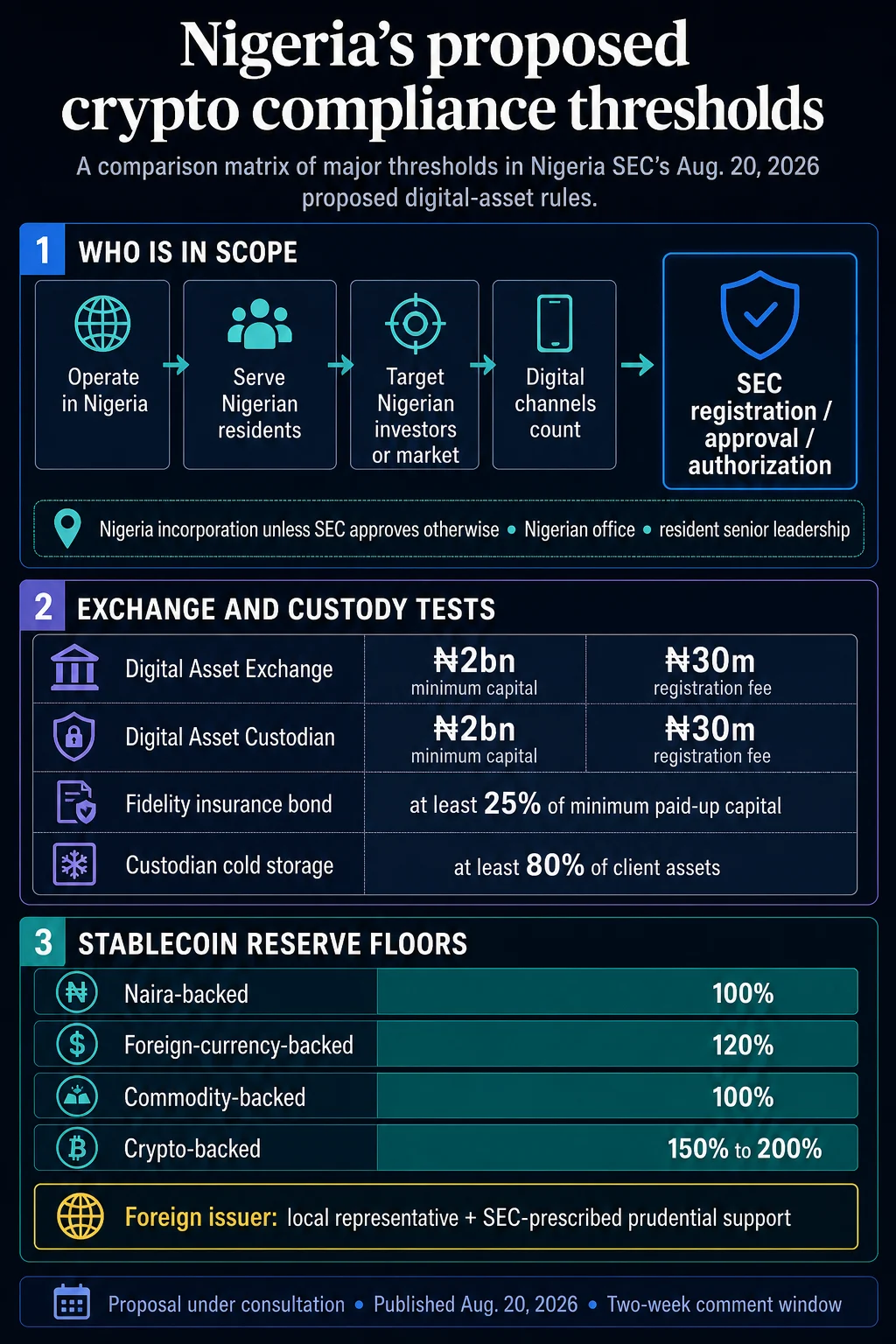
Nigeria’s Securities and Exchange Commission (SEC) has unveiled a sweeping set of proposed regulations poised to dramatically reshape the nation’s burgeoning digital asset landscape. The ambitious rules, published on August 20th and open for a two-week public consultation period ending September 3rd, aim to bring both domestic and offshore crypto businesses operating within Nigeria under the direct purview of the SEC. If enacted, these measures would impose significant capital requirements, stringent operational mandates, and robust reserve backing for stablecoins, potentially altering the accessibility of global crypto platforms for Nigerian users.
The proposed framework is characterized by its expansive scope, reaching beyond geographical incorporation to encompass any entity that operates in Nigeria, provides services to Nigerian residents, or targets the Nigerian investment market through any direct, indirect, or digital channel. This broad definition suggests that even platforms based entirely outside of Nigeria could be subject to its regulations if they engage with the country’s populace or financial ecosystem. The SEC’s objective appears to be a comprehensive integration of digital asset operations into its existing regulatory perimeter, ensuring investor protection and market integrity within the Nigerian context.
A Broad Regulatory Net: Scope and Local Presence Requirements
Central to the proposed rules is the requirement for digital asset businesses to obtain SEC registration, approval, or authorization. A key stipulation within the draft text is the mandatory incorporation of applicants within Nigeria, unless the Commission grants a specific waiver. Furthermore, entities would be required to maintain a registered physical office in the country and appoint a resident chief executive, managing director, or an equivalent principal officer, alongside designated resident sponsored individuals. This emphasis on local presence underscores the SEC’s intention to foster tangible operational ties and accountability within Nigeria. The proposed rules also acknowledge the possibility of foreign entities securing registration or authorization through specific SEC frameworks, provided they meet prescribed conditions.
For foreign stablecoin issuers, a distinct pathway is outlined. Any issuer targeting the Nigerian market, or whose tokens are intended for use by a regulated entity within Nigeria, would be mandated to establish a local representative and adhere to a comprehensive set of prudential requirements. These requirements include maintaining adequate reserves, ensuring sufficient liquidity, providing redemption support, and complying with any other prudential measures stipulated by the SEC. This approach aims to mitigate risks associated with foreign-issued stablecoins and ensure their stability and reliability for Nigerian users.
Significant Capital Infusions: The ₦2 Billion Capital Floor and Beyond
The proposed regulations introduce substantial capital requirements, with different thresholds applied to various classes of digital asset businesses. The most significant mandate, a capital floor of ₦2 billion (approximately $1.3 million USD, based on current exchange rates), is designated for Digital Asset Exchanges and Digital Asset Custodians. These entities would also face a registration fee of ₦30 million each.

Other categories of digital asset businesses are subject to lesser, yet still considerable, capital mandates. Digital Asset Platforms, Digital Asset Offering Platforms, and Real World Asset Tokenization Offering Platforms would each be required to maintain a minimum capital of ₦500 million, with an identical registration fee of ₦30 million. The general category of Virtual Asset Service Providers (VASPs) would be subject to a capital requirement of ₦200 million and a registration fee of ₦15 million.
Beyond these capital infusions, Schedule I of the proposed rules mandates that entities secure a current fidelity insurance bond. This bond must cover at least 25% of the stipulated minimum paid-up capital. This insurance requirement acts as an additional layer of financial security, complementing the minimum capital and registration fees.
Custodial Safeguards and Stablecoin Backing
In addition to capital requirements, custodians are subject to stringent operational protocols, particularly concerning asset storage. The proposed rules stipulate that at least 80% of client digital and virtual assets must be held in cold storage. This measure is designed to enhance security by minimizing exposure to online threats. Any deviation from this percentage would require explicit approval from the SEC. Hot and warm wallets would be strictly limited to operational needs, further emphasizing the focus on safeguarding client assets.
The reserve requirements for stablecoin issuers are tiered, reflecting different asset-backing structures. Naira-backed and commodity-backed stablecoins would necessitate a minimum of 100% backing. A more stringent requirement of 120% backing is proposed for foreign-currency-backed stablecoins. For crypto-backed stablecoins, the backing requirement begins at 150%, with Schedule II outlining a dynamic collateral range of 150% to 200%. This range is contingent upon an assessment of volatility, liquidity, concentration risk, and the overall quality of the collateral supporting the stablecoin. This tiered approach acknowledges the varying risk profiles of different stablecoin types and aims to ensure adequate backing for each.
Background and Chronology of Regulatory Evolution
The SEC’s proactive stance on regulating digital assets is not entirely new. Nigeria has been gradually increasing its oversight of the crypto space. In September 2022, the SEC issued a circular defining digital assets as securities, a move that signaled a shift towards stricter regulation. This was followed by the establishment of a regulatory framework for the issuance, exchange, and custody of digital assets in December 2023, which laid the groundwork for the current proposals.
The publication of these comprehensive rules on August 20th, 2026, marks a significant acceleration in this regulatory journey. The two-week consultation period, ending on September 3rd, 2026, indicates a desire for swift implementation, albeit with an opportunity for stakeholder feedback. This timeline suggests that the SEC is keen to solidify its regulatory authority over the digital asset market in response to its rapid growth and evolving nature.

The visual representation accompanying the proposed rules, depicting an offshore platform chained towards Nigeria under SEC registration, local office, CEO, and 120% reserve requirements, metaphorically illustrates the core challenges and implications of these new regulations. It suggests that for offshore entities to continue serving the Nigerian market, they will need to navigate a complex web of domestic compliance, essentially being "chained" to the local regulatory framework.
Potential Implications and Stakeholder Reactions (Inferred)
If adopted, these proposed rules would undoubtedly impose a significant compliance burden on existing and prospective digital asset businesses operating in or targeting Nigeria. The substantial capital requirements, particularly the ₦2 billion floor for exchanges and custodians, could act as a barrier to entry for smaller firms and potentially lead to consolidation within the industry. This could also compel some offshore platforms to re-evaluate their operational strategies concerning Nigeria, potentially leading to a reduced offering of services to Nigerian residents if the cost of compliance becomes prohibitive.
For Nigerian users, the implications could be twofold. On one hand, the increased regulatory oversight and capital requirements are intended to enhance investor protection, reduce fraud, and foster a more stable and trustworthy digital asset ecosystem. On the other hand, if a significant number of global platforms withdraw or restrict their services due to the new regulations, Nigerian users might experience a diminished access to a wider range of digital asset products and services.
While official statements from specific digital asset platforms have not yet been released, industry bodies and legal experts are likely to be scrutinizing the proposals closely. A common concern in such regulatory overhauls is the potential for unintended consequences, such as driving activity into less regulated, informal channels. However, proponents of the regulations would argue that the long-term benefits of a regulated and secure market, attracting institutional investment and fostering consumer confidence, outweigh the short-term challenges.
The SEC’s move reflects a global trend of increased regulatory scrutiny over the digital asset space. As countries grapple with the rapid evolution of cryptocurrencies and blockchain technology, regulators are increasingly seeking to balance innovation with the need for financial stability and consumer protection. Nigeria’s proposed framework, with its specific emphasis on capital, local presence, and reserve backing, presents a detailed blueprint for how a major African economy intends to navigate this complex terrain. The coming weeks will be crucial in determining the final shape and impact of these landmark proposals on Nigeria’s digital asset future.