James Watt
United States spot Bitcoin exchange-traded funds (ETFs) have extended their current inflow streak to six consecutive trading days, signaling a robust return of institutional and retail interest in the digital asset sector. On Monday, these investment vehicles collectively added $337.6 million in net inflows, bringing the total capital injection over the past six trading sessions to approximately $2.26 billion. This sustained momentum has positioned August 2026 as a potentially historic month for the crypto-linked products, which are now on a trajectory to record their strongest monthly performance of the calendar year.
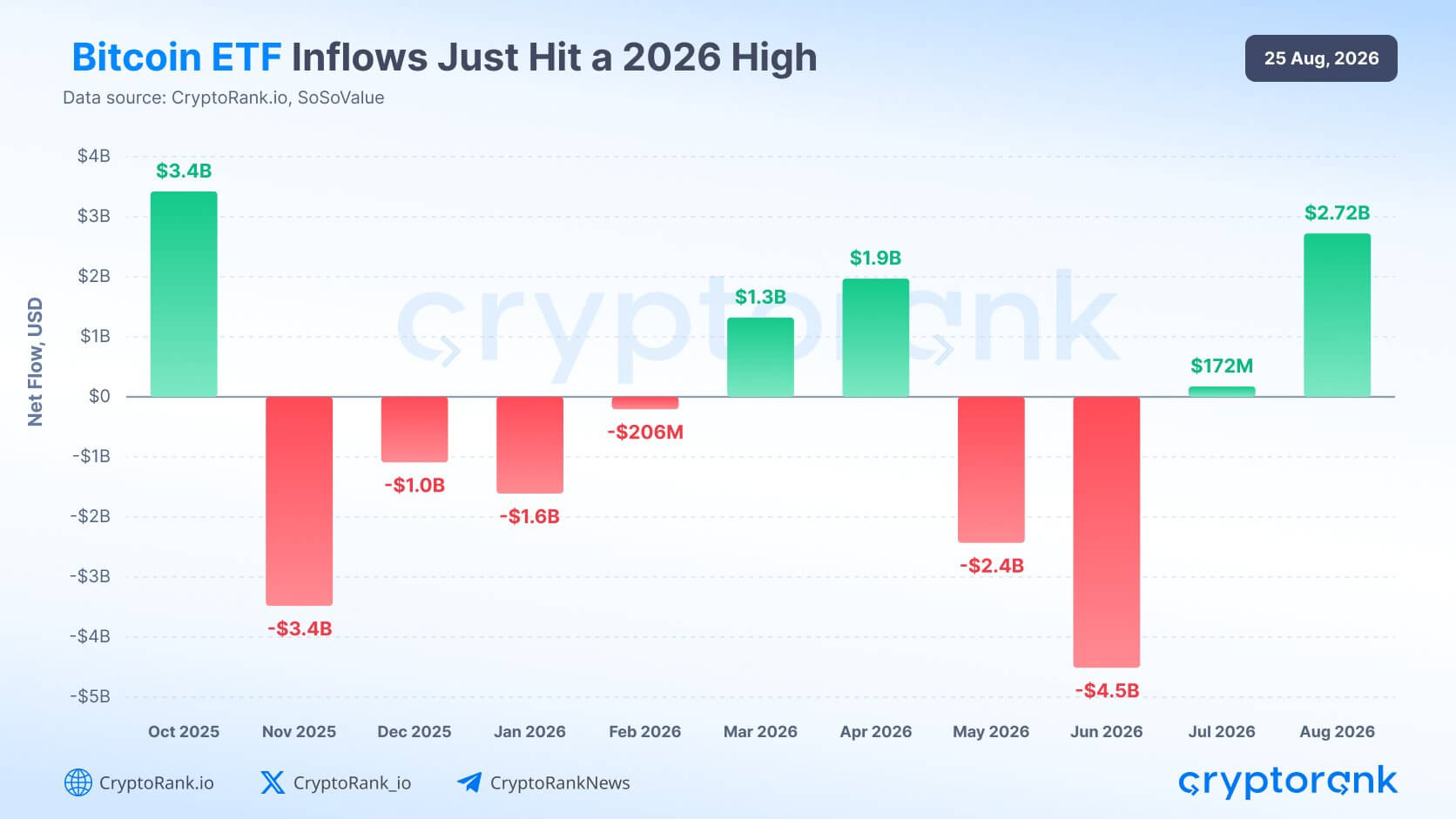
According to data compiled by CryptoRank, spot Bitcoin ETFs have attracted roughly $2.72 billion in new capital throughout August. This figure significantly surpasses the previous monthly high for 2026, which was recorded in April with approximately $1.97 billion in net inflows. The acceleration of capital entry reflects a broader market recovery as Bitcoin continues to reclaim key psychological and technical price levels, bolstered by shifting macroeconomic conditions and increased liquidity in the global financial system.
The August Momentum and Price Recovery
The surge in ETF demand has been closely correlated with Bitcoin’s price performance. Last week alone, nearly $1.92 billion in capital flowed into the funds as Bitcoin breached the $70,000 mark and began its ascent toward the $80,000 threshold. On Tuesday, the cryptocurrency successfully extended its rally above $80,000 for the first time since May, marking a monthly gain of approximately 28%.
Market analysts suggest that the rally is being fueled by a combination of factors, including the U.S. Treasury’s management of its cash reserves. Reports indicate that the Treasury is weighing the use of a $950 billion cash pile for bond buybacks, a move that would inject significant liquidity into the banking system and historically benefit risk-on assets like cryptocurrencies. This liquidity backdrop, combined with the successful absorption of sell-side pressure earlier in the summer, has created a fertile environment for the current ETF expansion.

Despite the recent success, the broader context for 2026 remains complex. Even with the massive intake in August, the spot Bitcoin ETF category as a whole still faces net outflows of approximately $2.57 billion for the year to date. This deficit is largely the result of a prolonged drawdown observed during the second quarter, where a combination of regulatory uncertainty and shifting interest rate expectations led to significant redemptions. However, the current six-day streak provides the strongest evidence yet that the tide has turned, with capital returning to the market at a faster pace than previously anticipated.
Institutional Leadership: BlackRock and Fidelity Dominate
BlackRock’s iShares Bitcoin Trust (IBIT) continues to be the primary engine of growth for the U.S. ETF market. Last week, IBIT alone captured $1.33 billion in new investments. On Monday, the fund recorded another $208.9 million in inflows, accounting for approximately 62% of the total daily intake across all U.S. spot Bitcoin ETFs.
Fidelity’s Wise Origin Bitcoin Fund (FBTC) has also maintained a strong second-place position, recording $104.6 million in inflows on Monday. The concentration of capital within these two "heavyweight" funds highlights a trend toward "flight to quality," where investors prefer established financial institutions with deep liquidity and competitive fee structures. While other funds in the category have seen intermittent growth, the dominance of BlackRock and Fidelity suggests that institutional money managers are increasingly standardizing their crypto exposure through these specific vehicles.
The reversal of the months-long trend of weak demand is particularly notable for fund managers. The mid-year slump had led some skeptics to question the long-term viability of spot crypto products, but the August data suggests that the demand was merely dormant, waiting for a catalyst such as the recent price breakout to re-engage.
Exponential Growth in Trading Turnover
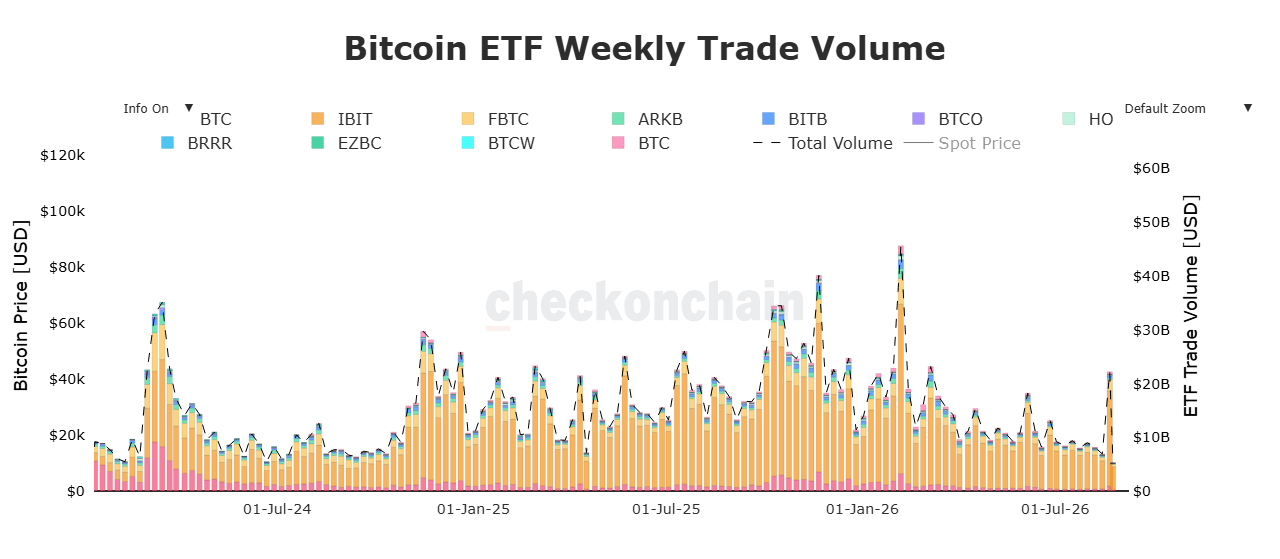
Beyond the headline inflow numbers, the underlying health of the ETF market is being demonstrated through a sharp increase in trading turnover. Data from CheckOnChain reveals that U.S. spot Bitcoin ETFs generated approximately $22.1 billion in trading volume last week. This represents a more than three-fold increase compared to the previous week’s turnover of roughly $6.9 billion.
The momentum continued into the current week, with Monday alone contributing $5.36 billion in trading volume. It is important to distinguish between "net flows" and "turnover." While net flows represent the actual creation of new shares and the entry of new capital into the funds, turnover measures the frequency with which shares are traded between market participants. The fact that both metrics are rising simultaneously indicates a highly liquid and active secondary market. High turnover suggests that the ETFs are being used not just for long-term "HODLing," but also for active hedging and tactical positioning by professional traders.
Derivatives and the Bullish Demand in IBIT Options
The renewed vigor in the spot market has spilled over into the regulated derivatives market. According to the Kobeissi Letter, call-option volume for BlackRock’s IBIT fund reached a record-breaking 1.58 million contracts on Wednesday. Call options are financial contracts that give the buyer the right, but not the obligation, to buy an asset at a specified price, typically reflecting a bullish outlook on the underlying asset’s value.
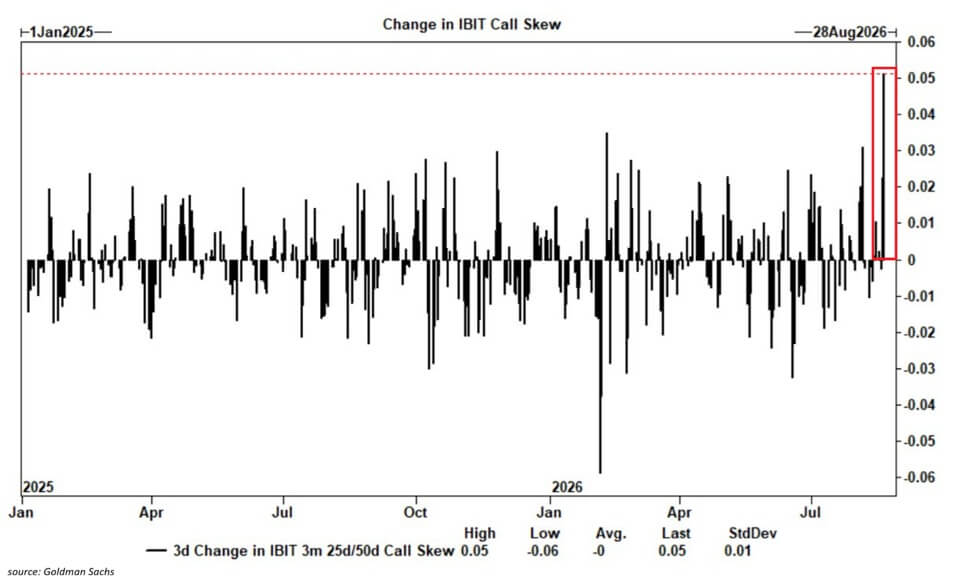
For three consecutive sessions from Wednesday through Friday, call volume remained above the 1-million-contract mark. Simultaneously, the "call skew"—a metric that compares the cost of bullish options to bearish ones—rose by 0.05 points. This was the largest three-day increase in the skew in over two years. The rise in call skew indicates that traders are willing to pay a higher premium for upside exposure, suggesting that the market is bracing for further gains rather than hedging for a potential crash.
This activity in the options market is a critical indicator of institutional sentiment. Professional money managers often use options to gain leveraged exposure or to protect existing portfolios. The record-breaking activity in IBIT options suggests that Wall Street is moving beyond simple spot ownership and is now engaging with Bitcoin through sophisticated multi-layered strategies.
Reclaiming the $100 Billion Milestone
The combined effect of $2.26 billion in new capital and the 28% appreciation in Bitcoin’s price has pushed the total assets under management (AUM) for U.S. spot Bitcoin ETFs back toward a historic milestone. As of the close of trading on Monday, the funds collectively held $98.56 billion in assets. This leaves the category just $1.44 billion short of the $100 billion threshold.
The recovery in AUM has been remarkably swift. In mid-August, the funds held approximately $76.6 billion. In just six trading sessions, the asset base expanded by nearly $22 billion. While the $2.26 billion in net inflows provided a solid foundation, the majority of this AUM growth—roughly $19.7 billion—is attributed to the rising value of the Bitcoin already held by the trusts.
This distinction is vital for understanding the current market phase. It shows a "double-whammy" effect: existing portfolios are gaining value rapidly, while new investors are simultaneously buying in at the higher prices. Historically, Bitcoin ETFs held more than $104 billion in assets in mid-May 2026 before the market underwent a sharp correction. Reclaiming the $100 billion mark would represent a significant psychological victory for the industry, potentially triggering another wave of "fear of missing out" (FOMO) among institutional laggards.
Broader Market Implications and Future Outlook
The current data suggests that the U.S. spot Bitcoin ETF market has matured into a resilient component of the broader financial landscape. The ability of these funds to attract billions of dollars in a single week, coupled with record-breaking options activity, indicates that Bitcoin is increasingly viewed as a legitimate asset class within a diversified portfolio.
The transition from a period of net outflows to the strongest month of the year highlights the cyclical nature of the crypto markets. However, the 2026 turnaround is characterized by deeper institutional involvement than previous cycles. The participation of firms like BlackRock and Fidelity has provided a level of transparency and regulatory comfort that was absent in earlier years.
Looking forward, market participants will be watching the $100 billion AUM mark closely. If Bitcoin maintains its position above $80,000, the organic appreciation of current holdings alone could push the ETFs past this milestone within days. Furthermore, if the U.S. Treasury proceeds with its bond buyback program, the resulting liquidity could provide the necessary tailwind for Bitcoin to test even higher price targets, potentially drawing in the remaining $2.57 billion needed to turn the entire year of 2026 into a net-positive period for ETF flows.
In summary, the confluence of record-breaking monthly inflows, tripling trading volumes, and unprecedented activity in the derivatives market points toward a significant structural shift. The "drawdown phase" of early 2026 appears to be in the rearview mirror, replaced by a high-conviction rally supported by both capital and price appreciation. As the industry nears the $100 billion AUM mark, the focus shifts from whether Bitcoin ETFs can survive to how high they can propel the underlying asset in this new era of regulated digital finance.