James Watt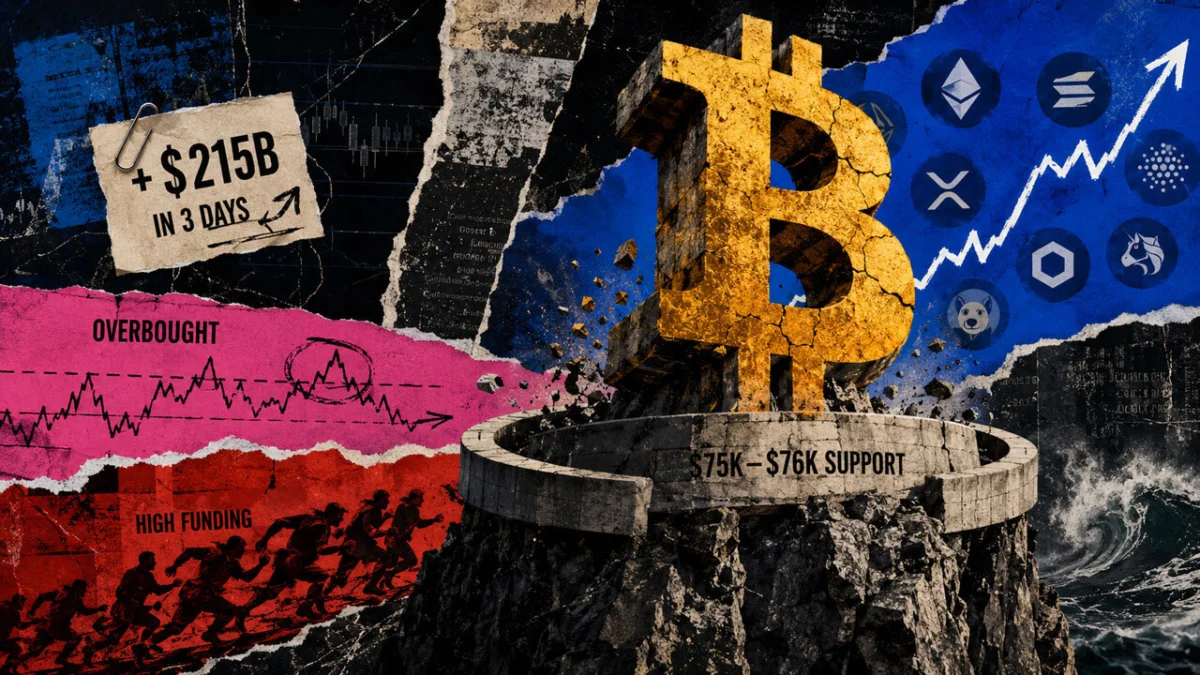
The digital asset market experienced a significant structural shift between August 19 and August 22, as the total market capitalization of altcoins—defined as all cryptocurrencies excluding Bitcoin—surged by approximately $215 billion. This aggressive capital influx propelled the TOTAL2 index, which tracks the combined value of these non-Bitcoin assets, back above the psychologically significant $1 trillion mark. According to recent data provided by CryptoQuant analyst Darkfost, this 24% expansion in a three-day window represents one of the most concentrated periods of altcoin growth in recent months, signaling a potential transition in market leadership from Bitcoin to the broader alternative asset class.
This recovery follows a prolonged period of stagnation for secondary tokens. Darkfost’s analysis highlights a material improvement in market breadth, noting that 56% of altcoins listed on Binance have now reclaimed their 200-day moving averages (DMA). This metric is widely considered a barometer for long-term trend health. The current reading marks a sharp reversal from the preceding months, during which 80% to 85% of the altcoin market traded consistently below this critical technical line. While the analyst characterized this move as an early-stage "altseason" signal, he also cautioned that the velocity of the three-day rally has left the market in a short-term overbought condition, potentially necessitating a period of consolidation before further gains can be realized.
Chronology of the August Recovery
The path to the $1 trillion milestone began on August 19, following a period of deep "washout" where altcoin valuations reached multi-month lows relative to Bitcoin. As Bitcoin began to stabilize and reclaim key support levels, capital began moving out the "risk curve" into mid-cap and small-cap assets. By August 20, the TOTAL2 index showed signs of accelerating momentum, driven by a combination of short-covering and renewed spot demand.
On August 21, the rally broadened as high-beta assets in the decentralized finance (DeFi) and infrastructure sectors began to outperform the market leader. By the close of August 22, the $215 billion in added value was fully realized, bringing the total non-BTC market cap above the $1 trillion threshold for the first time since the early summer corrections. This rapid appreciation has fundamentally altered the technical landscape, moving a majority of top-tier altcoins from a bearish "underwater" state to a tentative bullish posture above their 200-day moving averages.
Bitcoin as the Foundation for Altcoin Rotation
Despite the impressive performance of alternative assets, the current market environment is best described as a "rotation attempt" rather than a fully independent altcoin bull market. As of August 23, the Altcoin Season Index sat at 49, significantly below the 75-point threshold required to declare a confirmed "altseason." Furthermore, Bitcoin dominance remained high at 59.69%, suggesting that while altcoins are gaining ground, Bitcoin continues to command the lion’s share of market interest and liquidity.
The stability of the altcoin rally appears intrinsically linked to Bitcoin’s own price action. Over the same period that altcoins rallied, Bitcoin climbed from roughly $63,000 to nearly $80,000. Data from Glassnode suggests this move was underpinned by aggressive spot buying and record-breaking inflows into U.S.-based spot Bitcoin Exchange-Traded Funds (ETFs). Last week alone, over $1.9 billion flowed into these ETFs, marking the strongest period of institutional demand since Bitcoin last traded at record highs.
Glassnode’s "True Market Mean," an on-chain metric that estimates the average cost basis of the broader active investor base, currently sits at approximately $75,800. After spending several months trading below this level, Bitcoin’s ability to reclaim and hold this "fair value" line has provided the necessary confidence for traders to seek higher returns in more volatile altcoins. Market analysts suggest that as long as Bitcoin maintains the $75,000 to $76,000 zone as support, the structural environment remains conducive for continued capital rotation into the broader crypto ecosystem.
Analyzing Market Breadth and Technical Indicators
The health of the current rally is being measured through several key indicators that separate organic growth from purely speculative, leverage-driven pumps. The recovery of the 200-day moving average for over half of Binance-listed altcoins is a primary indicator of improving market health. When a vast majority of tokens trade below this line, it typically indicates a "risk-off" environment characterized by capital preservation. The shift to 56% of tokens trading above the 200-DMA suggests that investors are once again willing to hold positions for longer durations.
However, the rapid nature of the TOTAL2 move—gaining 24% in 72 hours—introduces the risk of a "mean reversion" event. In technical analysis, such vertical moves often lead to a "cooling off" period where price stabilizes to allow moving averages to catch up. For the altcoin rally to broaden into a sustained season, analysts are looking for a transition where mid- and small-cap tokens begin to move independently of Bitcoin’s immediate price fluctuations.
The Role of Funding Rates and Leverage
A critical component of the current market structure is the state of the perpetual futures market. Glassnode’s data reveals that 85% of altcoins are currently carrying funding rates that exceed their historical averages. Funding rates represent the cost of holding a long position relative to a short position; highly positive rates indicate a market crowded with leveraged "long" bets.
While elevated funding rates can persist for weeks during a genuine bull market, they also represent a vulnerability. If Bitcoin were to lose its $75,000 support level, the high leverage in the altcoin market could trigger a "long squeeze," where cascading liquidations force prices down rapidly. This makes the current rally a "durability test" for the market.
Santiment’s analysis of Ethena’s ENA token provides a blueprint for identifying healthy altcoin growth versus speculative bubbles. During its recent 69% price increase, ENA saw its trading volume expand eight-fold and its daily active addresses reach nearly 2,000. Crucially, while open interest doubled, funding rates remained relatively restrained compared to the rest of the market. This suggests that the price move was supported by actual network utility and spot demand rather than just traders chasing momentum with borrowed funds.
Broader Implications and Future Outlook
The immediate future of the altcoin market depends on a delicate balance between Bitcoin’s stability and the continued expansion of network activity. If Bitcoin consolidates between $75,000 and $80,000, it creates a "low-volatility" environment that encourages traders to move further out the risk curve. In this scenario, the breadth signal identified by Darkfost could extend from 56% toward 70% or higher, drawing in a wider range of assets that have yet to participate in the recovery.
Conversely, the "bear case" involves a failure of the Bitcoin breakout. Should spot demand cool and Bitcoin slip back below the $75,000 mark, the altcoins that led the recent 24% surge would likely experience the sharpest corrections. Because small-cap tokens are more sensitive to liquidity shifts, they carry the highest downside risk in the event of a market-wide deleveraging.
Market participants are currently monitoring three primary signals to determine the rally’s longevity:
- Volume and Participation: Are price increases accompanied by rising trading volumes and active on-chain addresses, or is the move driven by low-volume manipulation?
- Bitcoin Support: Can Bitcoin establish a firm floor above its $75,800 True Market Mean?
- Funding Normalization: Will funding rates stabilize at lower levels, or will they continue to climb, signaling an overheated speculative environment?
As the market tests these levels, the distinction between "participation" and "speculation" will become the defining factor for the next phase of the 2024 crypto market. For now, the reclamation of the $1 trillion TOTAL2 level stands as a significant milestone, confirming that despite the dominance of Bitcoin ETFs, the appetite for the broader altcoin ecosystem remains a potent force in the digital asset industry.