James Watt
The digital asset market experienced a significant deleveraging event over the last 24 hours as Bitcoin’s brief retreat below the $78,000 threshold sparked more than $300 million in total liquidations. This sudden price correction followed a historic rally that saw the world’s largest cryptocurrency breach the $80,000 milestone for the first time, fueled by a combination of robust institutional exchange-traded fund (ETF) inflows, favorable Treasury developments, and a massive short squeeze that had previously decimated bearish positions. As traders began to lock in profits at record highs, the resulting downward pressure exposed a market that had become heavily tilted toward leveraged long positions, leading to a rapid succession of forced exits.
According to market data provided by CryptoSlate, Bitcoin reached a local low of $77,870 before finding support and recovering to trade above $79,000 at the time of writing. The volatility was not confined to Bitcoin alone; the broader altcoin market saw similar retreats. XRP, which had been enjoying a period of renewed momentum, fell 4% to settle at $1.43. Solana, a perennial favorite for high-frequency traders, slid 3% to approximately $97 after briefly flirting with levels above $101. Ethereum, the second-largest cryptocurrency by market capitalization, dipped to $2,467, while Zcash saw a more pronounced decline of 7%, falling to $789. Other major assets, including Cardano (ADA) and Dogecoin (DOGE), each recorded losses of roughly 5%, with ADA hovering near the $0.20 mark.
Detailed Breakdown of the Liquidation Event
Data aggregated by CoinGlass highlights the scale of the carnage in the derivatives market. Over the 24-hour period, approximately 80,000 individual traders saw their accounts liquidated, with total losses reaching $324.4 million. The most striking aspect of this event was the shift in who was bearing the brunt of the losses. Long positions—bets that the price would continue to rise—accounted for approximately $270 million of the total wipeout. This marks a stark reversal from the previous week’s price action, where a sharp upward rally forced bearish short-sellers to absorb the majority of the market’s forced selling.
The single largest liquidation event occurred on the Binance exchange, involving a Bitcoin long position valued at $11.91 million. In terms of asset-specific losses, Bitcoin longs were hit the hardest, totaling roughly $109 million in forced closures. Ethereum long-position holders followed with approximately $70 million in losses. The volatility also reached the altcoin derivatives market, where XRP and Zcash long liquidations totaled $16 million and $11 million, respectively.
This massive flush of leverage suggests that the market’s recent ascent to $80,000 had encouraged a high degree of "complacency" among bullish traders, who utilized high levels of margin to chase the rally. When the price failed to maintain its momentum above $80,000, a cascading effect took hold: as the price dropped, it hit the "stop-loss" or "liquidation" price of leveraged traders, forcing them to sell their assets, which in turn drove the price down further, hitting the next tier of leveraged positions.
From Short Squeeze to Long Squeeze: A Shift in Market Mechanics
The transition from a market dominated by short liquidations to one dominated by long liquidations provides critical insight into the current state of investor sentiment. During the initial phase of the rally, which saw Bitcoin climb from the low $60,000s to over $72,000, the market was characterized by a "short squeeze." Crypto market maker Wintermute noted that during that period, short-sellers represented nearly 92% of all liquidations. As Bitcoin broke through its established trading ranges, these bearish traders were forced to buy back Bitcoin to cover their losses, providing the "fuel" for the price to blast higher.
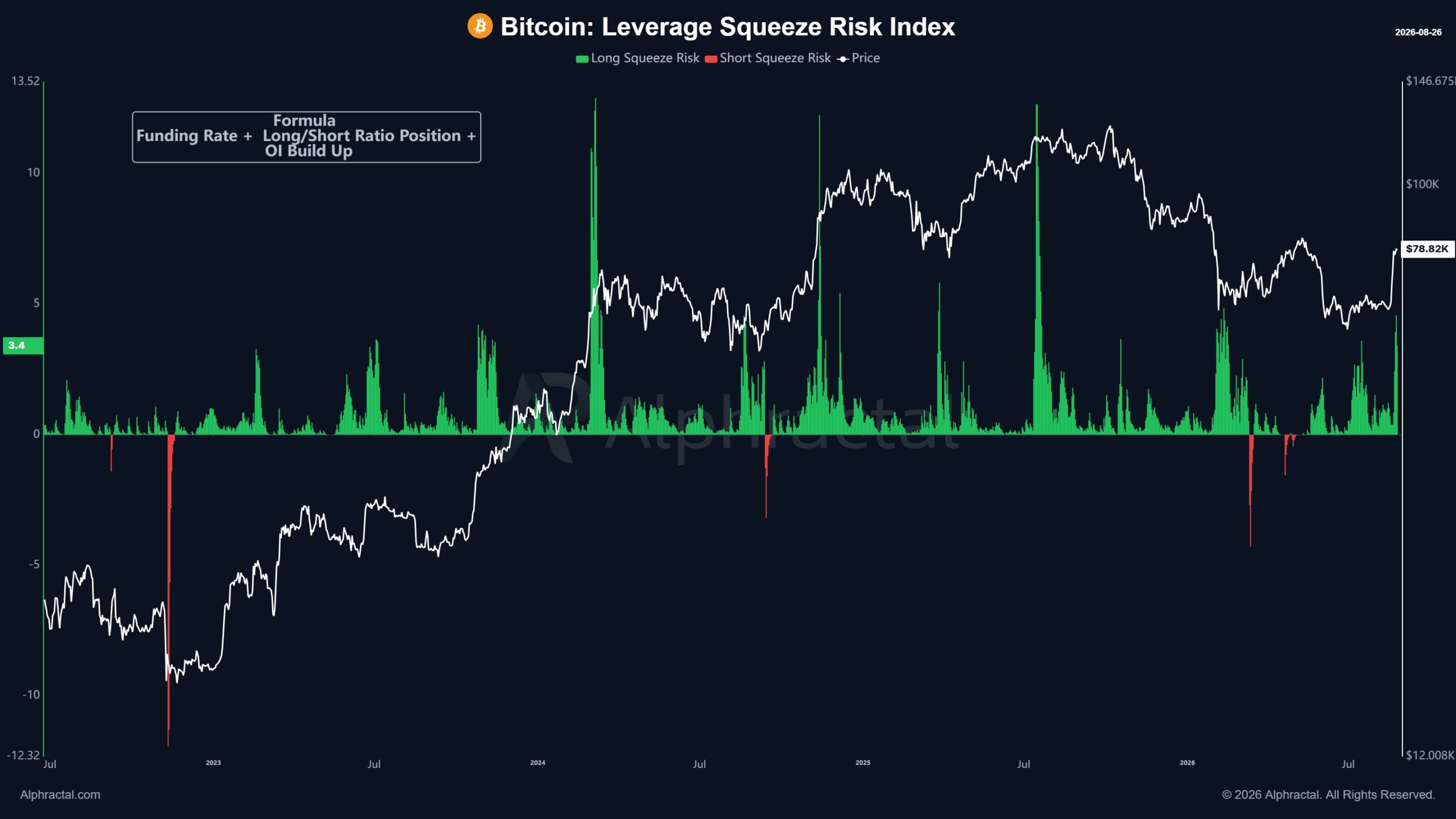
However, once the short-sellers were largely purged from the market, the leverage dynamics shifted. Encouraged by the break above $80,000 and $2.6 billion in fresh capital entering crypto investment products, traders began to build aggressive long positions. Alphractal CEO Joao Wedson warned that the probability of a "long squeeze" was rising as these positions became increasingly concentrated.

A key indicator of this risk was the "funding rate" across major exchanges. Funding rates are periodic payments made between long and short traders to keep the price of perpetual futures contracts aligned with the spot price. When funding rates are positive, it indicates that long traders are paying a premium to shorts to maintain their positions—a classic sign of a market that is "overheated" or "over-leveraged" on the bullish side. When a price decline occurs in such an environment, it forces these high-cost long positions to close quickly to avoid further losses, resulting in the "liquidation wave" witnessed this Wednesday.
The Critical Role of Institutional ETF Flows
As the market enters a period of consolidation, the burden of proof for the next leg of the rally now falls on spot buyers and institutional ETF participants. The recent surge to $80,000 was underpinned by an impressive seven-session inflow streak for US-based spot Bitcoin ETFs, which attracted more than $2.5 billion in new capital. This institutional demand provided the necessary "absorption" to counter initial profit-taking from long-term holders.
Wintermute’s analysis suggests that the market has reached a turning point where forced short-covering is no longer the primary driver of price appreciation. Instead, additional gains will depend on the willingness of buyers to enter the market at these historically high prices. The firm noted that it would adopt a more cautious outlook if Bitcoin ETFs began to record negative weekly flows or if Bitcoin’s price fell back into its previous consolidation range below $67,000.
Despite the recent pullback, other demand indicators remain constructive. Data from CryptoQuant indicates that both spot and futures demand have been rising in tandem, with total Bitcoin demand increasing by approximately 170,000 BTC over the past 30 days. Historically, synchronized growth in both spot and derivatives markets has been a hallmark of Bitcoin’s most durable bull markets. However, analysts warn that if futures exposure continues to outpace spot buying, the market will remain vulnerable to further "flush-outs" of leveraged traders.
On-Chain Support and the Short-Term Holder Cost Basis
Glassnode, a leading blockchain analytics firm, has identified several key on-chain metrics that could determine the depth of any further retracement. One of the most significant levels is the "short-term holder cost basis," which currently sits near $70,000. This figure represents the average price at which investors who have held Bitcoin for less than 155 days acquired their coins.
In a healthy bull market, the short-term holder cost basis often acts as a psychological and technical support level. If Bitcoin remains well above $70,000, recent buyers stay in profit and are less likely to panic-sell during minor dips. However, if the price were to drop toward or below this level, a much larger percentage of the market’s "new money" would find itself "underwater," significantly increasing the risk of a broader capitulation. For the time being, Bitcoin’s ability to hold the $78,000–$79,000 range suggests that the current pullback is being viewed by many as a healthy correction rather than the start of a trend reversal.
Macroeconomic Headwinds: PCE Inflation and Nvidia Earnings
The timing of this week’s crypto volatility coincides with a dense schedule of macroeconomic events that could dictate risk appetite across all asset classes. On Wednesday, the US Bureau of Economic Analysis is set to release updated data on second-quarter GDP and, more importantly, the July Personal Consumption Expenditures (PCE) price index. The PCE is the Federal Reserve’s preferred gauge of inflation, and its results will be scrutinized for clues regarding the central bank’s next interest-rate decision.
In recent months, Bitcoin has benefited from falling Treasury yields and a softening of inflation data, which led markets to price in a more accommodative monetary policy. However, a stronger-than-expected core PCE reading could reignite fears that inflation remains "sticky," potentially pushing Treasury yields higher and putting pressure on "risk-on" assets like cryptocurrencies and technology stocks.
Simultaneously, the broader financial world is awaiting the fiscal second-quarter results from Nvidia. As a bellwether for the artificial intelligence sector and a primary driver of the recent equity market rally, Nvidia’s performance has become a proxy for global risk sentiment. A disappointing outlook from the chipmaker could trigger a sell-off in tech stocks, which often correlates with downward movements in the crypto market as investors reduce their overall exposure to volatile assets.
The Jackson Hole Symposium and the Fed’s Next Move
Following the inflation and earnings data, the focus will shift to the Jackson Hole Economic Policy Symposium, scheduled for August 27-29. This year’s theme, “Financial Innovation: Implications for Payments and Policy,” is particularly relevant for the digital asset industry. Federal Reserve Chair Kevin Warsh is expected to deliver keynote remarks on Friday, providing the first major update on the Fed’s thinking since its July meeting.
Markets are currently sensitive to any indication of whether the Fed will pursue a 25 or 50 basis point rate cut in September. Any hawkish signals from Warsh—suggesting that rates may need to stay "higher for longer"—could derail the current crypto recovery. Conversely, a dovish tone confirming the start of a rate-cutting cycle would likely provide the liquidity injection needed to push Bitcoin back toward and potentially through the $80,000 resistance level.
Looking Ahead: A Timeline of Key Market Drivers
As August draws to a close, the cryptocurrency market faces a series of high-stakes milestones in early September that will likely determine the trajectory for the remainder of the year:
- September 9: The US Treasury is scheduled to begin expanded long-term bond buybacks. This move is expected to increase liquidity in the financial system, a condition that has historically been bullish for Bitcoin.
- September 15: The US Senate is expected to hold a cloture vote on the CLARITY Act. This legislation aims to provide a clearer regulatory framework for stablecoins and digital assets. A positive outcome would be seen as a major step toward institutional adoption and regulatory certainty.
- September 16: The Federal Open Market Committee (FOMC) will announce its interest-rate decision. This is perhaps the most anticipated event of the quarter, as it will signal the official start of a new phase in US monetary policy.
Conclusion: Market Resilience or the Start of an Unwind?
Bitcoin’s quick rebound from the Wednesday low of $77,870 toward the $79,500 level suggests that the market currently views the liquidation event as a necessary "clearing of the decks." By removing excess leverage, the market can establish a more sustainable foundation for future growth. However, the exhaustion of short-covering fuel means that the "easy gains" of the previous weeks are likely over.
The coming days will test the resolve of spot buyers. If Bitcoin can maintain its footing above the $78,000 mark despite the looming macro volatility, it will signal that the transition from a retail-driven speculative market to an institutionally-supported asset class is well underway. Conversely, if the PCE data or Fed remarks disappoint, the market may see a deeper retracement to test the $70,000 support level. For now, the crypto market remains in a state of "cautious optimism," waiting for the next catalyst to define its path forward.