James Watt
The recent two-week surge in the price of Bitcoin, which saw the digital asset briefly eclipse the $81,000 threshold, has fundamentally altered the financial trajectory of MicroStrategy, the enterprise software firm that has transformed into the world’s largest corporate holder of the cryptocurrency. This sharp recovery has not only returned Michael Saylor’s aggressive Bitcoin treasury strategy to a position of significant unrealized profit but has also propelled the company’s common stock (MSTR) to gains that substantially outpace the underlying digital asset. As of late August, the firm’s strategic maneuvers suggest a pivot from aggressive accumulation toward a phase of balance sheet fortification and liquidity management, designed to insulate the company against future market volatility.
The Macroeconomic Catalyst: Treasury Buybacks and Policy Shifts
The acceleration of Bitcoin’s price rebound can be traced to a confluence of macroeconomic factors and shifting sentiment regarding the regulatory landscape in the United States. A pivotal moment occurred when the U.S. Treasury Department signaled an expansion of buybacks for longer-dated government debt. This move was intended to manage the supply of Treasury securities and ease upward pressure on yields. As yields stabilized, the U.S. dollar experienced a relative softening, creating a favorable environment for "risk-on" assets like Bitcoin.
In addition to these monetary drivers, the cryptocurrency market has been buoyed by renewed optimism regarding U.S. crypto policy. Investors have increasingly priced in the possibility of a more structured and supportive regulatory framework, which has encouraged institutional participation. This sentiment, combined with a series of heavy short liquidations and robust demand for spot Bitcoin exchange-traded funds (ETFs), provided the necessary momentum to lift Bitcoin from its early August lows in the $60,000 range to a peak of $81,000 on Tuesday. Although the price has since retraced slightly to approximately $78,772, the recovery remains a critical milestone for MicroStrategy’s capital structure.
MicroStrategy’s Portfolio: From Unrealized Losses to a $3 Billion Surplus
For MicroStrategy, the volatility of the summer months presented a significant test of its unconventional financing model. As Bitcoin prices dipped earlier in the year, questions arose regarding the firm’s ability to service its debt and maintain its preferred securities. However, the recent price action has effectively silenced many of these concerns.

MicroStrategy currently holds a massive treasury of 840,447 Bitcoin. These assets were acquired over several years for an aggregate cost of $63.36 billion, representing an average purchase price of approximately $75,385 per Bitcoin. With the market price stabilizing around the $80,000 mark, the total value of these holdings has swelled to roughly $67 billion. This shift has placed more than $3 billion in unrealized gains back onto the company’s balance sheet, providing a substantial equity cushion that was absent during the June and July downturns.
Interestingly, this return to profitability has occurred without fresh Bitcoin accumulation. MicroStrategy has not made a significant purchase of the cryptocurrency since June. Instead, the company has engaged in a monetization program initiated in May 2026, which has seen the sale of 6,948 Bitcoin for approximately $432.5 million. This tactical shift suggests that the firm is currently prioritizing the health of its internal capital framework over increasing its total coin count.
The MSTR Premium: Why Common Stock is Outperforming Bitcoin
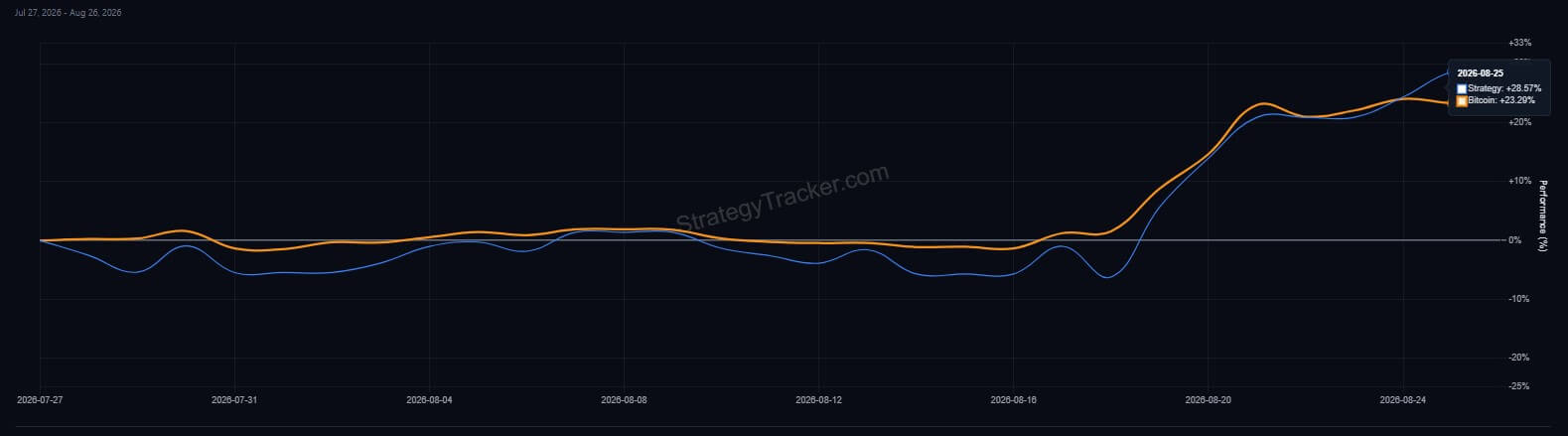
One of the most notable developments during this recovery phase has been the performance of MicroStrategy’s common stock (MSTR) relative to Bitcoin itself. Between August 18 and August 26, MSTR shares rose from a closing price of $92.52 to $126.79, representing a gain of 37%. During that same window, Bitcoin’s value increased by roughly 22%, moving from $64,700 to the $79,000–$80,000 range.
This outperformance is particularly significant given that MicroStrategy has continued to issue large amounts of new equity. Typically, the issuance of new shares exerts downward pressure on a stock’s price due to dilution. However, the market’s appetite for MSTR has been so strong that shareholders have absorbed the new supply while simultaneously driving the price higher. This "MSTR premium" suggests that investors view the stock not just as a proxy for Bitcoin, but as a leveraged play on the asset class, benefiting from the company’s ability to manage debt and generate liquidity through its capital markets activity.
Capital Markets Activity: The $2.01 Billion Equity Raise
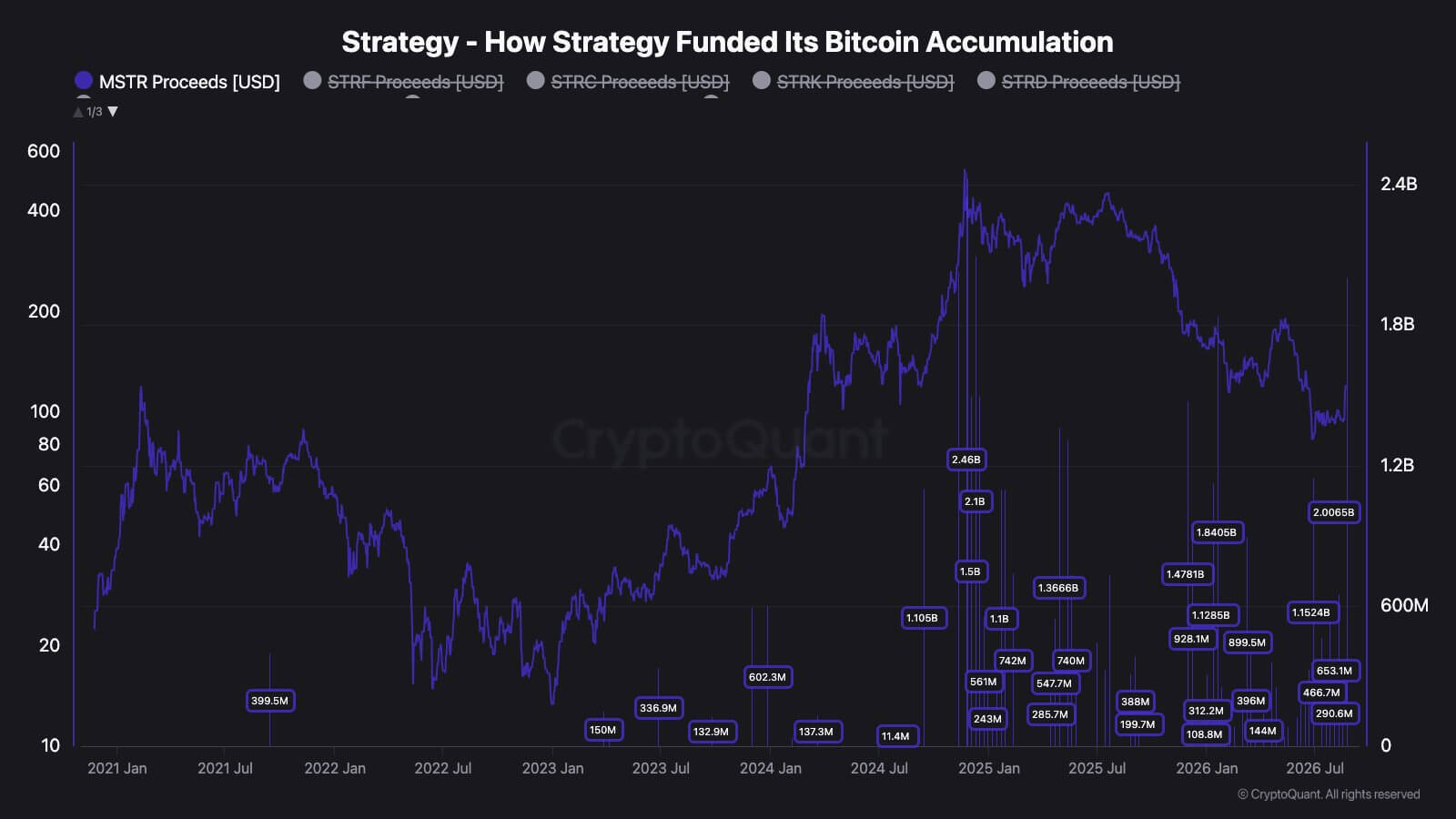
MicroStrategy has remained highly active in the capital markets to shore up its cash position. Between August 17 and August 23, the company utilized its at-the-market (ATM) equity program to sell 18.26 million shares of MSTR common stock. This move generated approximately $2.01 billion in net proceeds. Since the inception of its Bitcoin-centric treasury strategy, the company has raised a staggering $42.12 billion through the sale of 139.45 million common shares.
The strategic trade-off of this model is clear: by selling common stock, MicroStrategy can raise vast sums of liquidity without being forced to liquidate its Bitcoin holdings. While this dilutes existing shareholders if the proceeds are not immediately used to increase the "Bitcoin-per-share" ratio, it provides the firm with the dry powder necessary to manage its complex debt obligations and maintain its preferred stock structure. This strategy has successfully reduced the company’s net leverage to near zero, a stark contrast to the conditions that fueled market anxiety earlier in the summer.
Repairing the Dividend Engine: The Recovery of STRC Preferred Stock
A central component of MicroStrategy’s recovery strategy has been the rehabilitation of its flagship variable-rate preferred stock, known as STRC. This security is a vital financing channel that the company has previously used to fund the acquisition of over 100,000 Bitcoin. However, the STRC structure came under severe pressure during the market stress of June, with shares falling as low as $71.25—well below their $100 par value.
To defend the integrity of this instrument, MicroStrategy directed $136.4 million of its recent $2.01 billion raise toward repurchasing 1.43 million STRC shares. This intervention, combined with the broader market recovery, has pushed the price of STRC back to approximately $97.2, a 35% gain from its lows. The security is now within 3% of the $100 par level that the company seeks to maintain.
Restoring STRC to par is a strategic necessity for Michael Saylor. The company has stated that it does not intend to issue new STRC shares below the $100 mark. By bringing the price back toward par, MicroStrategy reopens a critical funding channel that allows it to raise capital for future Bitcoin purchases without relying solely on common stock issuance. The company still has $516.6 million remaining under its $1 billion Digital Credit Securities Repurchase Program to continue supporting the STRC price if necessary.
Building a $6.69 Billion Liquidity Fortress
The result of these coordinated financial maneuvers is a significantly strengthened liquidity position. MicroStrategy has partitioned its capital into two primary pools:
- The USD Reserve: Currently standing at $5.10 billion, this pool is specifically earmarked for preferred stock dividends and interest payments on outstanding debt. The company recently added $300 million to this reserve.
- The USD Cash Pool: A newly established $1.59 billion pool that offers broader flexibility. These funds can be used for Bitcoin acquisitions, further security repurchases, debt management, or general corporate purposes.
Combined, these pools give MicroStrategy a total of $6.69 billion in dollar-denominated liquidity. According to the company’s internal "USD Duration" metric, this cushion is sufficient to cover approximately 3.9 years of fixed obligations under its current capital framework. This duration provides a significant buffer against potential "crypto winters" or prolonged periods of price stagnation, allowing the firm to hold its Bitcoin without the threat of forced liquidations.
Chronology of a Recovery: From June Stress to August Stability
The path to the current stability was marked by several key phases over the summer of 2026:
- Early June: Bitcoin prices faced downward pressure, causing STRC preferred shares to decouple from their $100 par value, eventually hitting a low of $71.25.
- Late June/July: MicroStrategy paused Bitcoin accumulation and focused on internal liquidity. The company began utilizing its ATM program to raise cash while the market questioned the sustainability of its leverage.
- Early August: Bitcoin traded in the low-$60,000 range. MicroStrategy’s Bitcoin holdings briefly dipped into an aggregate unrealized loss position based on its $75,385 average cost basis.
- Mid-August: The U.S. Treasury announced bond buyback expansions. Bitcoin began a rapid ascent. MicroStrategy launched a massive $2.01 billion share sale.
- Late August: Bitcoin briefly topped $81,000. MSTR stock outperformed the rally with a 37% gain. STRC recovered to $97.2, and the company’s total liquidity reached $6.69 billion.
Strategic Implications and the Road Ahead
The primary takeaway from MicroStrategy’s recent performance is the resilience of its multi-tiered financing model when supported by active treasury management. By prioritizing the repair of its preferred stock and the accumulation of cash reserves over immediate Bitcoin purchases, the company has effectively "de-risked" its balance sheet.
The next stage of the company’s evolution will likely depend on the persistence of the current Bitcoin rally. If Bitcoin maintains its position above $80,000, the resulting strength in MSTR shares and the full restoration of STRC to par will provide MicroStrategy with an unprecedented amount of capital-raising power. This would allow the firm to resume its aggressive "Bitcoin flywheel"—using equity and debt to acquire more Bitcoin, which in turn drives the stock price higher and lowers the cost of future capital.
However, the strategy remains tethered to market volatility. While the $6.69 billion liquidity buffer provides a nearly four-year runway, a significant and sustained downturn in the price of Bitcoin would once again test the limits of shareholder patience regarding dilution and the firm’s ability to defend its preferred securities. For now, Michael Saylor has successfully steered the company through a summer of uncertainty, emerging with a fortress balance sheet and a treasury that is once again firmly in the black.