James Watt
Cactus Custody, a prominent institutional digital asset custodian, has announced its comprehensive support for Lido V3 stVaults via its dedicated DeFi connector, Cactus Link. This integration marks a significant advancement for institutional investors seeking secure, compliant, and customizable access to Ethereum liquid staking, enabling Cactus Custody clients to seamlessly create and manage stVaults directly from their existing custody accounts. The move underscores a growing trend of traditional financial institutions and sophisticated investors demanding more tailored and secure pathways into the burgeoning decentralized finance (DeFi) ecosystem, particularly in the context of yield-generating activities like staking.
A New Paradigm for Institutional Staking: Lido V3 stVaults
Lido V3 stVaults represent a crucial evolution in the liquid staking landscape, specifically designed to cater to the stringent requirements of large staking entities. Unlike traditional pooled staking models, which aggregate assets from numerous participants, stVaults introduce a novel single-operator architecture. This innovative design empowers institutions such as investment funds, exchange-traded funds (ETFs), exchange-traded products (ETPs), and asset managers with unprecedented control over their staking operations. Key features include the ability to select specific validators, define custom fee structures, and manage the underlying infrastructure according to their internal risk frameworks and operational preferences.
The core advantage of stVaults lies in their ability to reconcile the inherent "control-versus-liquidity" dilemma often faced by institutional stakers. While traditional staking pools offer convenience and liquidity through tokens like stETH, they typically involve relinquishing direct control over validator selection and operational parameters. stVaults, however, address this by allowing institutions to run their own validators with chosen counterparties, specify geographic or jurisdictional parameters for their operations, and configure advanced settings such as Maximal Extractable Value (MEV) routing and insurance mandates. This level of granular control is paramount for institutions navigating complex regulatory environments and internal compliance policies, ensuring that their staking activities align with their broader investment mandates and risk appetites. Furthermore, the optional stETH minting feature within stVaults ensures that institutions retain on-demand liquidity, bridging the gap between bespoke control and the flexibility offered by liquid staking derivatives.
Cactus Custody: A Pillar of Institutional Digital Asset Security
Founded in February 2019, Cactus Custody has rapidly established itself as a leading institutional digital asset custody solution. As an integral part of BIT (formerly Matrixport), a diversified crypto financial services platform, Cactus Custody brings a robust and battle-tested infrastructure to the digital asset space. The platform is engineered to safeguard digital assets across an impressive array of over 60 blockchain ecosystems, serving a diverse clientele of more than 400 institutional clients globally. This client base includes a wide spectrum of financial players, from investment funds and asset managers to cryptocurrency exchanges, over-the-counter (OTC) providers, payment platforms, mining pools, and sophisticated institutional DeFi participants.
Cactus Custody’s commitment to security and regulatory compliance is evident in its comprehensive suite of licenses and attestations. The custodian holds a Hong Kong Trust or Company Service Provider (TCSP) license, a critical regulatory approval in a jurisdiction known for its stringent financial oversight. Additionally, it possesses a Bhutan Gelephu Mindfulness City Authority (GMCA) Financial Services Licence (FSL), further diversifying its regulatory footprint. Beyond licensing, Cactus Custody has successfully undergone rigorous independent audits, achieving SOC 1 Type II and SOC 2 Type II attestations from Deloitte. These attestations provide independent validation of the effectiveness of its internal controls related to financial reporting and security, availability, processing integrity, confidentiality, and privacy of its custody operations. The platform’s architectural design combines state-of-the-art Hardware Security Module (HSM)-backed cold storage with an institutional-grade Multi-Party Computation (MPC) offering. This hybrid approach provides clients with the flexibility to choose between configurations that align with qualified-custodian standards or those that offer a self-custody-style experience, all while maintaining institutional-grade security protocols.
The Role of Cactus Link in Bridging Custody and DeFi
The seamless integration of Lido V3 stVaults is facilitated through Cactus Link, Cactus Custody’s innovative DeFi connector. Cactus Link acts as a secure bridge, allowing institutional clients to interact with decentralized applications (dApps) and protocols, including Lido, directly from their custodial accounts without compromising security or control. This mechanism is crucial for institutions, as it mitigates the operational complexities and security risks typically associated with direct interaction with DeFi protocols using standard hot wallets.
The connection process via Cactus Link is designed for simplicity and security. Operating similarly to a standard browser extension hot wallet, its setup involves two primary steps, ensuring a streamlined user experience. Once connected, vault owners gain the ability to create new stVaults and execute a full range of day-to-day operations. These include supplying or withdrawing ETH, minting or repaying stETH, continuously monitoring vault health, initiating rebalancing actions or vault closures, and following predefined emergency procedures. This comprehensive operational control, combined with the security of Cactus Custody, empowers institutions to manage their liquid staking positions with confidence and efficiency. For enhanced security, administrators are required to whitelist the stVaults smart contract addresses prior to any interaction, with the full list available in the Qualified Custodians overview documentation. It is also important for teams to confirm availability and policy settings with their Cactus account manager, as support may vary by jurisdiction, entity type, and onboarding scope.
Broader Implications: Institutional Adoption of Staking and DeFi
This integration arrives at a pivotal moment for the digital asset industry, as institutional interest in staking and DeFi continues to surge. Staking, particularly for proof-of-stake blockchains like Ethereum, has emerged as a significant yield-generating opportunity for long-term holders. The global liquid staking market has witnessed exponential growth, with Lido Finance itself commanding a substantial share of the total value locked (TVL) in liquid staking protocols, reflecting the high demand for accessible and liquid staking solutions. As of early 2024, the total value locked in liquid staking protocols surpassed tens of billions of dollars, highlighting its increasing prominence in the crypto economy.
However, institutional participation in DeFi and staking has historically been hampered by several challenges, including a lack of regulatory clarity, perceived security risks, and the operational complexities of managing digital assets in a decentralized environment. Solutions like Lido V3 stVaults, paired with the robust custody infrastructure of Cactus Custody, directly address these pain points. By providing a compliant, secure, and customizable framework, these offerings lower the barrier to entry for large institutional players, allowing them to participate in the capital-efficient opportunities offered by DeFi while adhering to their internal governance and risk management protocols. This strategic partnership is poised to accelerate the mainstream adoption of liquid staking as a legitimate asset class for institutional portfolios.
Security and Risk Mitigation Framework
Operating in the digital asset space necessitates a robust understanding and mitigation of inherent risks. While Lido V3 stVaults introduce advanced control mechanisms, standard Ethereum staking risks still apply. These include, but are not limited to, validator slashing risks, smart contract vulnerabilities, and potential market fluctuations affecting the value of staked assets or their derivatives. Lido has proactively addressed these concerns through a comprehensive Risk Assessment Framework for stVaults, providing detailed insights into potential vulnerabilities and mitigation strategies.
Cactus Custody, as a qualified custodian, complements Lido’s security measures by integrating on-chain actions with its existing robust policy engine. This means that any transactions or operations related to stVaults can be gated by an institution’s predefined Cactus Custody policies, adding an extra layer of authorization and control. Furthermore, the Lido V3 contracts have undergone multiple independent security audits by reputable firms, enhancing their resilience against potential exploits. Clearly defined emergency procedures are also in place to address unforeseen circumstances. However, it is paramount that institutional teams conduct their own thorough due diligence on smart-contract, operational, and regulatory risks. Establishing internal approvals and continuous monitoring mechanisms before deploying live operations is crucial to ensure a secure and compliant staking environment. The combination of Lido’s audited protocol, Cactus Custody’s secure infrastructure, and an institution’s internal risk management processes forms a formidable defense against potential threats.
Strategic Alignment and Future Outlook
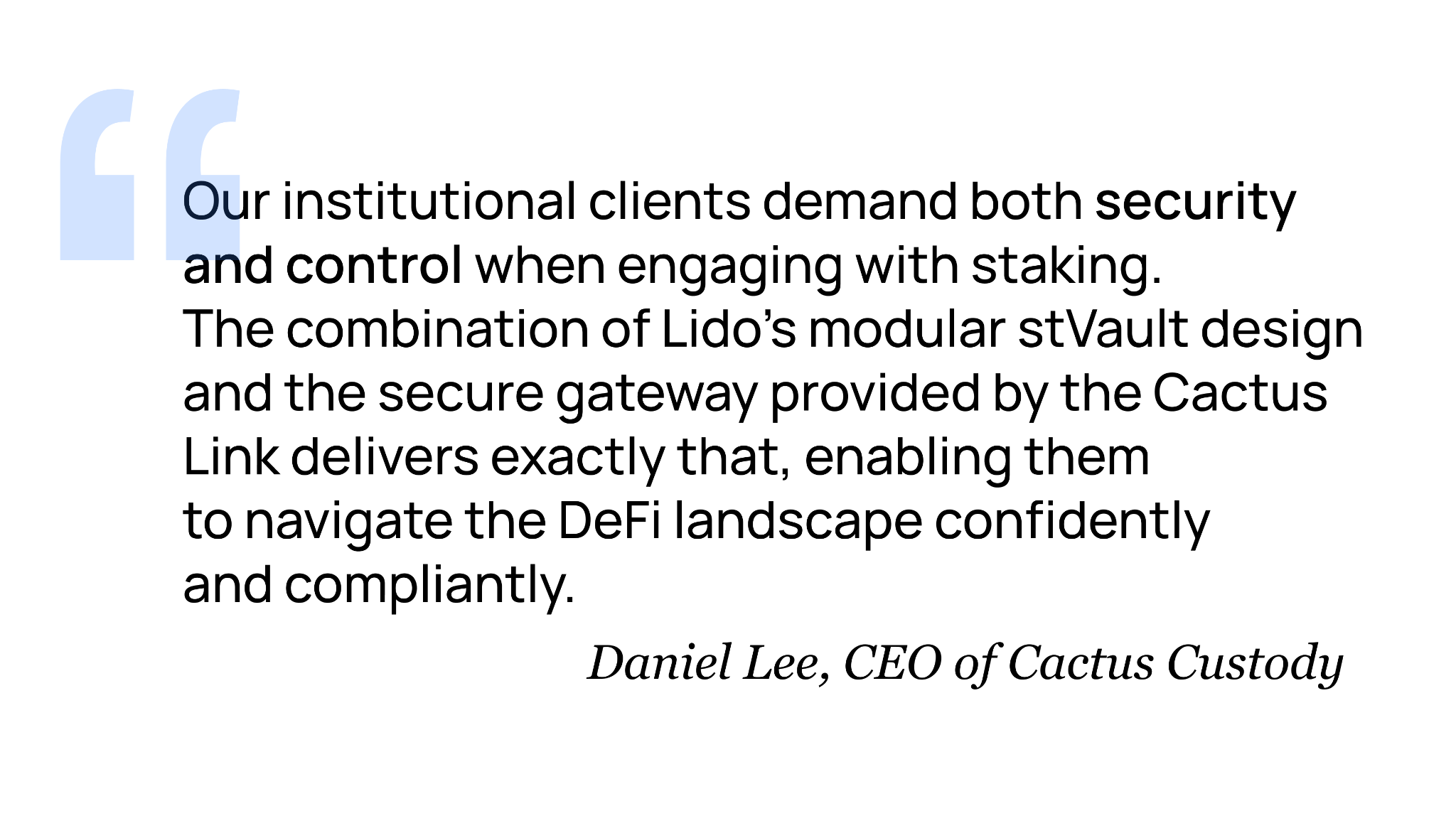
The integration between Cactus Custody and Lido’s stVaults represents a significant strategic alignment between two key players in the institutional digital asset ecosystem. For Lido, gaining support from a reputable custodian like Cactus Custody enhances the credibility and accessibility of its stVaults offering, attracting a broader institutional audience. For Cactus Custody, expanding its DeFi connector capabilities to include advanced liquid staking solutions like stVaults reinforces its position as a leading provider of institutional-grade infrastructure for engaging with decentralized protocols.
This development also builds upon Cactus Custody’s existing support for Lido’s liquid staking tokens, stETH and wstETH. Institutions already holding these tokens in custody can now seamlessly combine them with stVault operations and other DeFi protocols accessible through Cactus Link, creating a more integrated and versatile portfolio management experience. This holistic approach to digital asset management and DeFi participation is increasingly sought after by institutions looking to optimize their capital efficiency and explore new yield opportunities within a secure and regulated framework.
Looking ahead, such collaborations are vital for the continued maturation of the institutional digital asset market. As regulatory clarity improves globally and the sophistication of institutional investors in crypto grows, the demand for tailored, secure, and compliant solutions will only intensify. The partnership between Cactus Custody and Lido stVaults sets a precedent for how custodians and DeFi protocols can collaborate to unlock new frontiers for institutional capital in the decentralized economy, paving the way for further innovation and broader adoption in the years to come. Institutions interested in exploring these advanced staking opportunities are encouraged to engage directly with the Lido Institutional team for personalized consultations and detailed operational guidance.