James Watt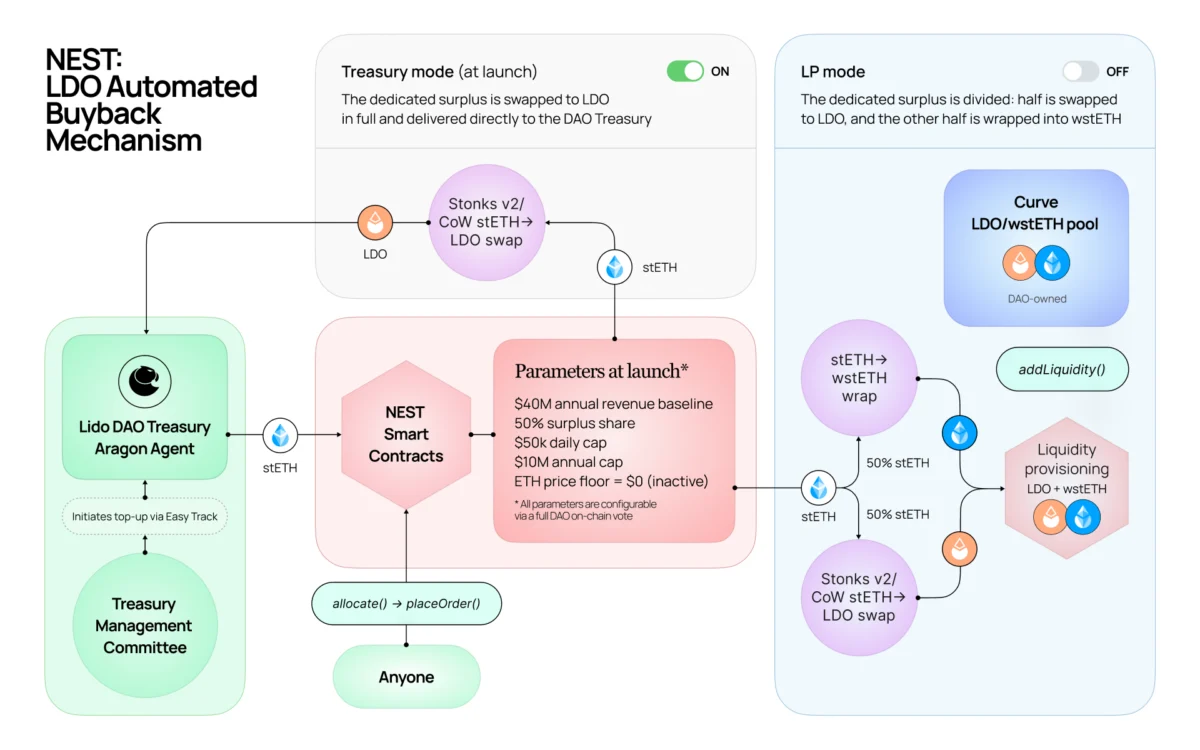
The Lido DAO has officially launched NEST (Network Economic Support Tokenomics), an innovative onchain mechanism designed to directly link the success of the Lido protocol to the value accrual of its native LDO token. This programmatic system, financed by DAO treasury surpluses, represents a significant stride in Lido’s strategic goal for 2025 and 2026: LDO alignment, ensuring the token’s utility extends beyond pure governance to encompass a more direct reflection of the protocol’s robust economic activity.
NEST operates as an automated buyback system, programmatically acquiring LDO tokens when the Lido protocol’s staking revenue surpasses a predefined operational baseline. This mechanism underscores Lido DAO’s unwavering commitment to transparency, decentralization, and robust security in its governance and financial operations. The introduction of NEST is poised to redefine the LDO token’s role within the burgeoning liquid staking ecosystem, providing a clear, onchain pathway for value distribution that is both permissionless and fully under DAO control.
Lido’s Dominance and the Evolving Role of LDO
Lido DAO stands as the undisputed leader in liquid staking, currently boasting a Total Value Locked (TVL) exceeding $30 billion across various blockchain networks, predominantly Ethereum. Its flagship product, stETH, has become a cornerstone of the decentralized finance (DeFi) ecosystem, allowing users to stake their ETH while retaining liquidity. The LDO token, initially conceived primarily for governance, has seen its utility grow alongside Lido’s expanding influence. However, as the DeFi landscape matures, there’s an increasing demand for tokenomics models that offer "real yield" and a more direct correlation between protocol performance and token value.
This evolution in market expectations prompted the Lido DAO to prioritize "LDO alignment" as a core strategic objective, first articulated in its 2025 goals and reaffirmed for 2026 through key research submissions like Hasu’s Goose 2 and Lido Labs Goose 3. These discussions highlighted the need to fortify LDO’s economic foundation, ensuring its long-term viability and attractiveness to holders beyond its governance function. With a market capitalization often fluctuating in the single-digit billions, enhancing LDO’s fundamental value proposition is critical for sustaining investor confidence and fostering broader adoption.
The decision to implement an automated buyback mechanism like NEST stems from Lido’s established governance philosophy. The DAO operates with the highest standards of transparency, security, and decentralization. All major protocol upgrades are subject to fully onchain votes, and a unique Dual Governance model grants stETH holders inherent oversight of DAO decisions. Even routine treasury allocations are managed through optimistic Easy Track motions, minimizing friction while maintaining accountability. This rigorous approach was extended to LDO buybacks, with the DAO deliberately rejecting simpler, potentially less transparent, or more centralized alternatives in favor of a robust, auditable, and fully onchain solution. Technical rails and the comprehensive mechanism design for NEST were rigorously debated and ultimately approved through community Snapshot votes, reflecting broad consensus.
How NEST Operates: A Deep Dive into Programmatic Value Accrual
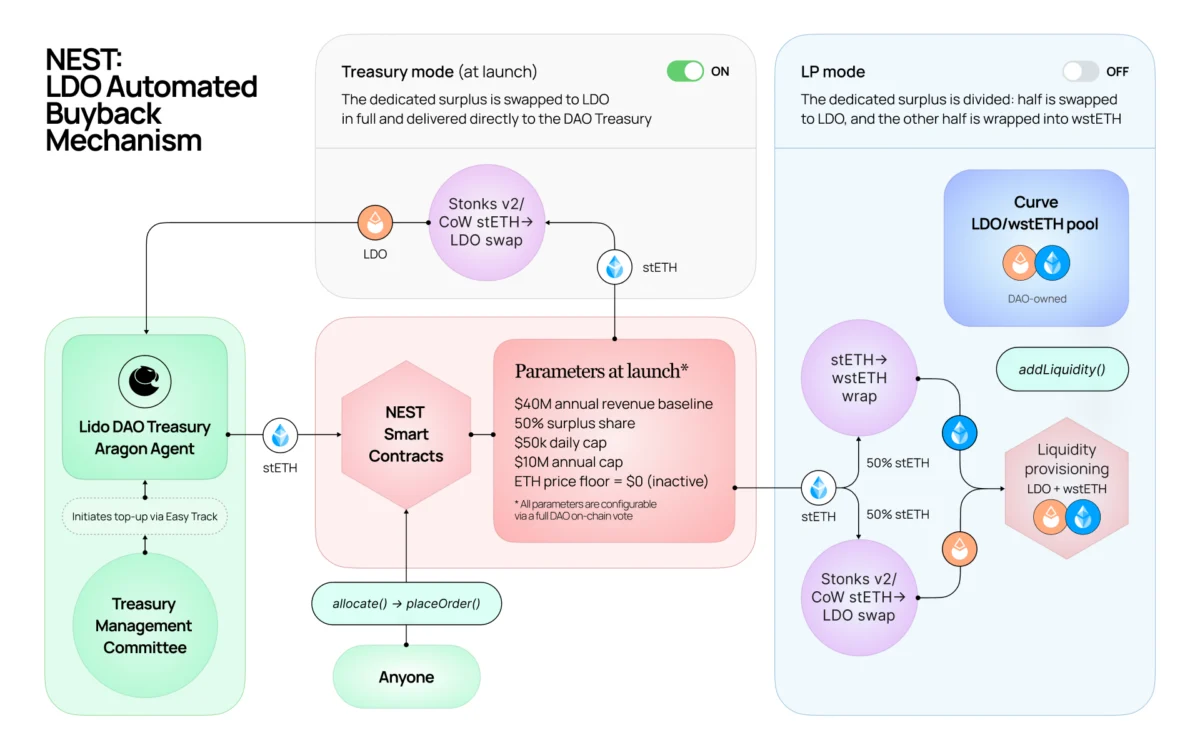
At its core, NEST is a sophisticated programmatic system designed to leverage Lido protocol revenue for LDO acquisition. The mechanism is meticulously detailed in LIP-36, a Lido Improvement Proposal that outlines its thresholds and conditions. The fundamental principle is straightforward: when the protocol’s staking revenue surpasses a predetermined "operating baseline," a bounded share of this surplus is systematically converted into LDO tokens. This conversion is executed via CoW Swap, a decentralized exchange aggregator known for its MEV (Maximal Extractable Value) protection and optimal trade execution, ensuring fairness and efficiency in the LDO acquisition process. Essentially, the more successful the Lido protocol becomes in generating revenue from its staking operations, the more LDO tokens are acquired through NEST.
The system is designed with a nuanced understanding of market dynamics, particularly regarding onchain LDO liquidity. To optimize performance and minimize market impact, NEST features two distinct operational modes:
-
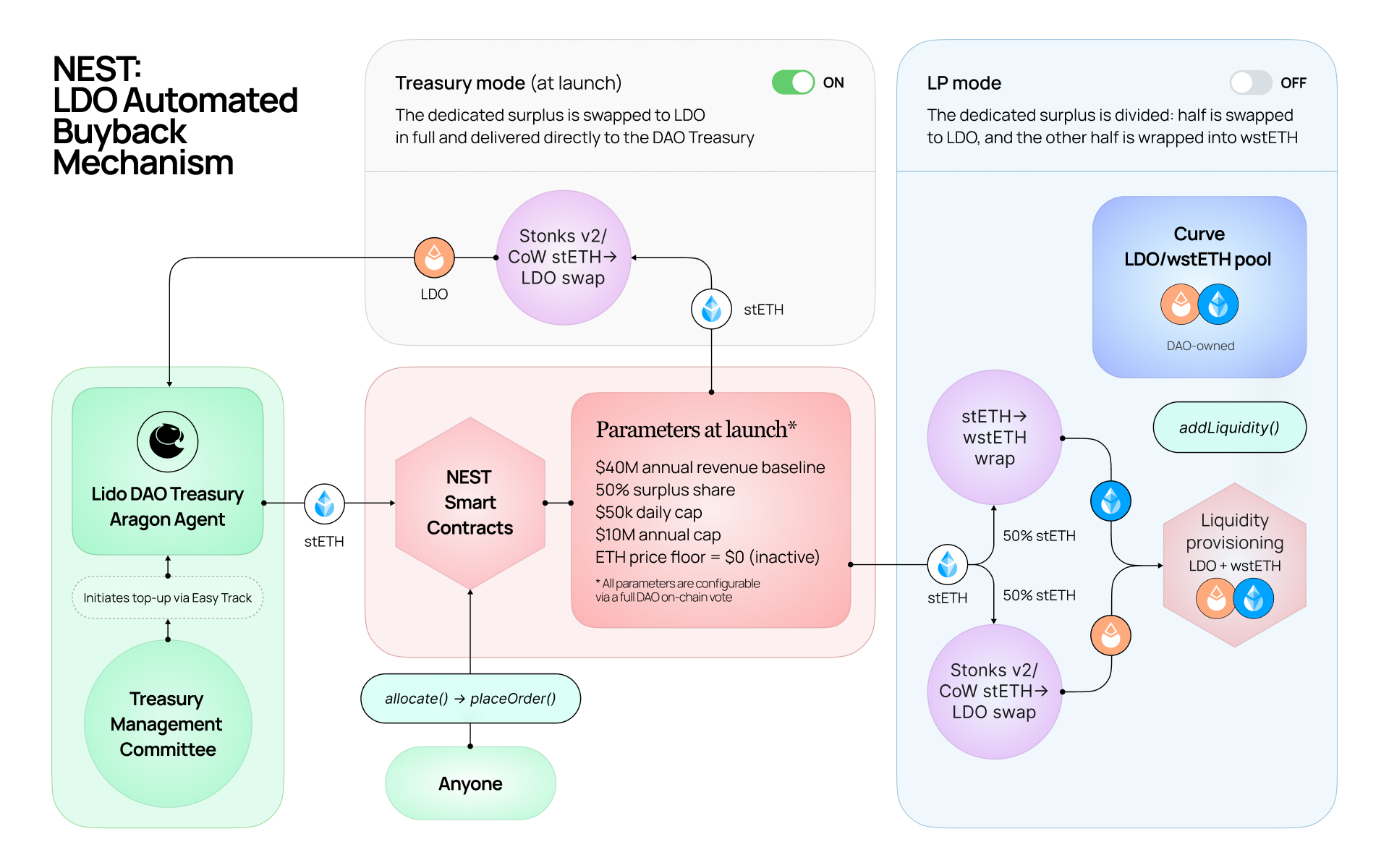
Treasury-only Mode: In its initial launch phase, NEST operates in this mode. Here, the daily allocation of surplus revenue is entirely converted into LDO tokens, which are then directly transferred to the DAO treasury via an Aragon Agent contract. This mode prioritizes direct accumulation of LDO by the DAO, strengthening its balance sheet and providing a strategic reserve of tokens that can be deployed for future initiatives or simply held as a reflection of protocol success.
-
LP (Liquidity Provision) Mode: This mode, while not active at launch, is an integral part of NEST’s future design. When activated, the daily allocation is split: half is used to purchase LDO, and the other half is wrapped into wstETH (wrapped stETH). Both components are then deposited as DAO-owned liquidity into a dedicated Curve v2 NG pool. The LP tokens generated from this deposit remain under the full ownership and control of the DAO. The LP mode aims to deepen LDO’s onchain liquidity, improve price stability, and generate additional revenue for the DAO through LP fees. Its activation is contingent on specific market conditions where it can deliver optimal benefits, and switching to this mode will only require a subsequent onchain DAO vote, highlighting the mechanism’s flexibility and adaptability.
The Lido DAO maintains full control over the NEST mechanism. As a fully onchain and permissionless system, all key parameters can be adjusted through DAO votes. While NEST currently tracks only Lido protocol staking revenue, its architectural design is forward-looking, allowing for the inclusion of additional revenue sources through future governance votes. This foresight aligns with Lido’s strategic vision of expanding its product line and diversifying its revenue streams, ensuring NEST can evolve alongside the protocol.
NEST Parameters and Robust Risk Mitigation
At launch, the NEST configuration approved by the DAO incorporates carefully calibrated parameters designed for both efficiency and security. A crucial design choice is the implementation of a cumulative model for tracking surplus revenue. Each day, NEST compares the DAO’s share of staking revenue against the established baseline. Fifty percent of the difference (the current launch share) is then added to a running NEST balance. As long as this balance is positive, NEST will execute daily LDO purchases within specified caps. If the balance turns negative, purchases are paused until new surplus revenue replenishes it.
This cumulative approach was deliberately chosen to circumvent two common pitfalls of a simple daily-spend model: potential overspending during consecutive periods of high revenue and the inability to carry forward unused purchasing capacity from days with lower surpluses. This ensures a more consistent and sustainable buyback program.
A primary safety guardrail is the daily purchase cap, set at $50,000. This conservative limit bounds the DAO’s exposure over a typical six-day governance response window to approximately $300,000, providing ample time for the DAO to react to unforeseen circumstances or adjust parameters if necessary. Backtesting the model against historical 2024–2025 revenue data demonstrated its effectiveness: it would have delivered approximately $7.09 million in LDO acquisitions from a total of $94.18 million in rewards, precisely hitting its target spend and validating its design. All parameter values, from the revenue share to the daily cap, are fully adjustable through a full DAO vote, empowering the community to fine-tune NEST as Lido’s economic landscape evolves.
The introduction of any programmatic mechanism that interacts with treasury assets on a daily basis necessitates a robust approach to risk mitigation. NEST’s design addresses these concerns comprehensively:
- Smart Contract Vulnerabilities: While not explicitly detailed in the original text, it’s standard practice for such critical mechanisms to undergo multiple independent security audits by leading blockchain security firms. The code is open-source, allowing for continuous public scrutiny and community review.
- Market Manipulation: The use of CoW Swap for LDO acquisition helps mitigate MEV and front-running risks, ensuring that trades are executed fairly and efficiently. The daily cap also limits the potential for large, manipulative trades.
- Treasury Drain: The $50,000 daily cap acts as a crucial circuit breaker, preventing rapid depletion of treasury funds. The cumulative model ensures that purchases only occur when there is a genuine surplus above the operating baseline. All NEST-purchased assets remain unequivocally DAO-owned, residing in DAO-controlled contracts. Any movement of these assets outside the mechanism’s predefined operational paths requires explicit and undeniable DAO authorization through a governance vote, adding another layer of security against unauthorized access or misuse.
- Decentralization Risk: By being fully onchain and permissionless, NEST eliminates reliance on centralized entities for execution, reinforcing Lido’s commitment to decentralization.
Distinguishing NEST from the LDO Accumulation Program
It is crucial to differentiate NEST from the LDO Accumulation Program, a separate, one-time treasury operation approved by the Lido DAO on April 13, 2026. The Accumulation Program is a discretionary, committee-executed initiative focused on strategic market opportunities for LDO acquisition. It is fundamentally different from NEST, which is a structural, automated, and continuous mechanism. This distinction highlights Lido’s multifaceted approach to LDO value accrual, combining both strategic, one-off interventions with long-term, programmatic solutions. Details regarding the Accumulation Program’s batch parameters and execution updates are published on the Lido Research forum, maintaining transparency for both initiatives.
Official Reactions and Market Implications
Representatives from the Lido Foundation have expressed strong optimism regarding NEST’s launch. "NEST represents a monumental step forward in aligning the LDO token’s economic incentives with the robust performance of the Lido protocol," stated a Lido Foundation spokesperson. "This automated, transparent, and DAO-controlled mechanism not only strengthens the LDO token’s value proposition but also reinforces Lido’s leadership in pioneering sustainable and decentralized tokenomics models within the DeFi space. It’s a testament to our community’s commitment to long-term sustainability and value accrual for all stakeholders."
Market analysts are closely watching NEST’s implementation. "The launch of NEST signals a maturation of Lido’s tokenomics," noted a senior analyst at a prominent blockchain research firm. "In an environment where ‘real yield’ is increasingly prioritized, providing an onchain, transparent mechanism for LDO holders to benefit directly from protocol revenue is a significant positive. It could potentially reduce sell pressure, increase demand, and stabilize LDO’s price in the long run, thereby enhancing its appeal to a broader investor base." The broad support seen in the Snapshot votes for NEST’s technical rails and mechanism design further underscores the community’s belief in its potential.
Broader Impact and Future Outlook
The launch of NEST carries significant implications for LDO holders, the Lido protocol, and the wider DeFi ecosystem. For LDO holders, it promises enhanced token utility, a more direct link to the protocol’s financial success, and a potential for improved long-term value appreciation. By providing a clear, programmatic pathway for revenue-based LDO acquisition, NEST aims to cultivate a more resilient and attractive ecosystem for those contributing to and holding the token.
For the Lido protocol, NEST strengthens its financial sustainability by systematically reinvesting surplus revenue back into its native token. This mechanism reinforces trust in the DAO’s governance capabilities and further solidifies Lido’s position as an innovator in the liquid staking sector. It also demonstrates a proactive approach to managing treasury assets strategically for the benefit of the entire ecosystem.
Beyond Lido, NEST sets a powerful precedent for transparent, automated, and DAO-controlled value accrual mechanisms in decentralized protocols. It contributes to the ongoing evolution of token economics, moving beyond simple inflationary models towards more sophisticated systems that distribute protocol value in a sustainable and equitable manner. As DeFi continues to mature, models like NEST will likely become benchmarks for how decentralized autonomous organizations can effectively align incentives and foster long-term growth.
In conclusion, NEST represents a pivotal milestone for Lido DAO. By meticulously designing an onchain mechanism that programmatically links protocol revenue to LDO acquisition, Lido is not only enhancing the intrinsic value of its governance token but also setting a new standard for transparency, decentralization, and sustainable economic alignment within the DeFi landscape. As the protocol continues to grow and diversify its offerings, NEST is poised to be a cornerstone of its long-term success, ensuring that the LDO token remains intrinsically tied to the robust performance of the leading liquid staking solution.