James Watt
The core innovation of stVaults, introduced as part of the broader Lido V3 upgrade, lies in its provision of modular staking infrastructure that offers optional stETH minting. This design empowers users, particularly institutions and decentralized autonomous organizations (DAOs), to deploy custom staking solutions tailored to their specific risk profiles, compliance requirements, and operational workflows. Unlike traditional liquid staking derivatives which pool assets, stVaults provide a dedicated, self-custodial or multi-custodial environment where stakers maintain greater control over their validator keys and execution layer rewards, while still benefiting from Lido’s battle-tested infrastructure and the potential for enhanced capital efficiency through stETH. The introduction of stVaults was a strategic move by the Lido DAO to further decentralize its operations, cater to a wider array of staking participants beyond individual users, and foster greater innovation within the liquid staking ecosystem by providing a foundational layer for new products and services.
Ethereum Staking Landscape and Validator Queue Dynamics
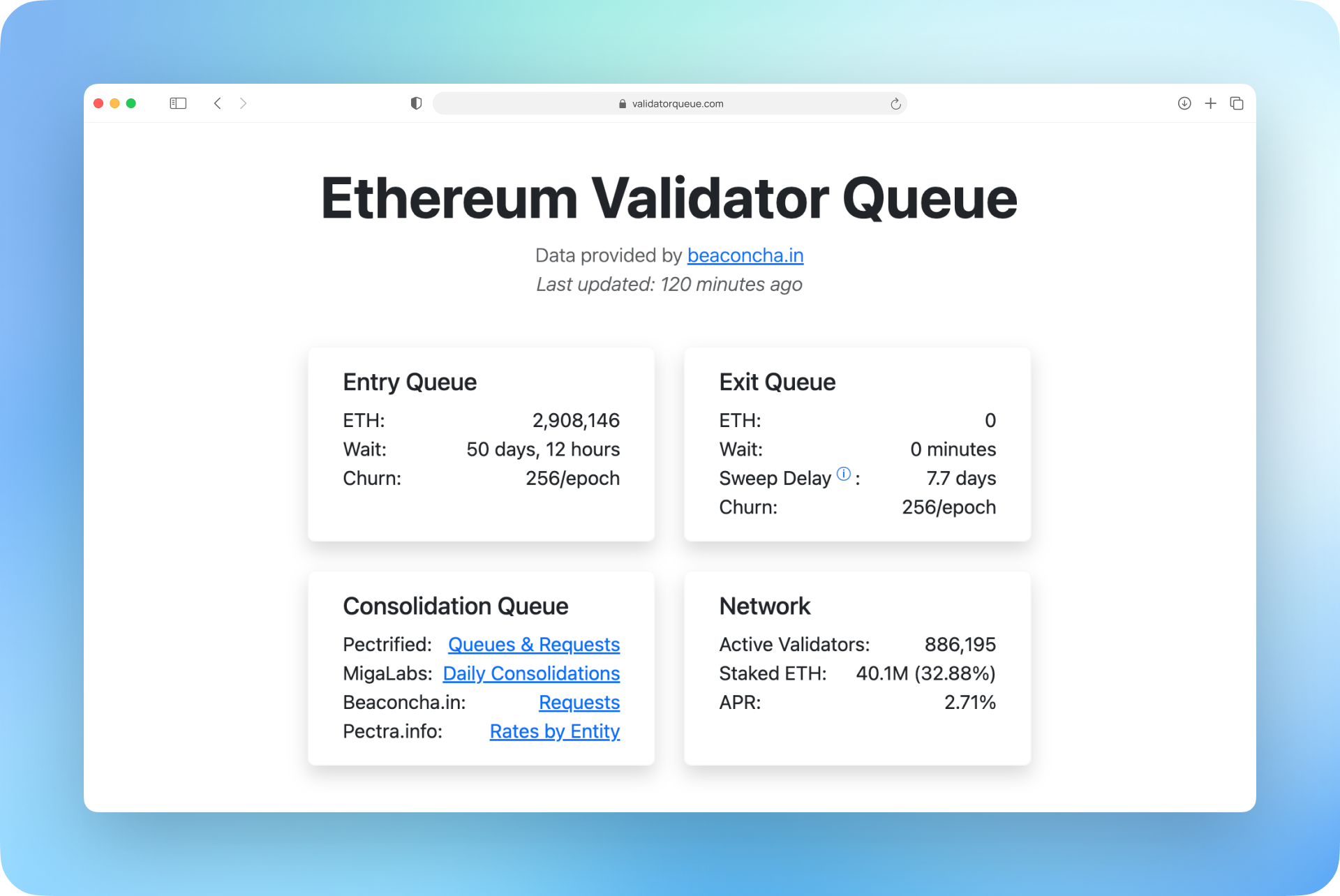
The backdrop to these stVaults enhancements is a dynamic Ethereum staking environment, characterized by fluctuating validator entry queues and sustained institutional interest. Throughout May 2026, the Ethereum validator entry queue experienced a significant surge, extending past 60 days. This lengthening queue reflected a continued influx of new stakers and validators joining the network, a trend that began in earnest following the Shapella (Shanghai/Capella) upgrade in April 2023, which enabled withdrawals of staked ETH. The ability to withdraw instilled greater confidence among potential stakers, leading to a steady increase in total ETH staked. By early 2026, the total ETH staked on the network had surpassed 35 million, representing over 29% of the total ETH supply, a substantial increase from just over 15 million ETH staked immediately post-Shapella. While the queue eased slightly to an average of 50 days in June, its prolonged state underscores the persistent demand for Ethereum staking and the operational challenges it presents for new entrants.
A protracted entry queue means that newly deposited 32 ETH batches for validator activation remain idle and unproductive for an extended period, representing an opportunity cost for stakers. For large institutional players managing hundreds or thousands of validators, this delay can translate into substantial unrealized gains and complicates capital allocation strategies. For instance, a 60-day delay for 1,000 validators represents 32,000 ETH locked without yield, a significant sum. "The sustained length of the Ethereum validator entry queue highlights both the network’s robust security and the continued appetite for staking rewards," commented a Lido DAO representative. "However, it also presents a bottleneck for efficient capital deployment. Our ongoing efforts with stVaults are designed to provide solutions that mitigate these challenges, ensuring that participants can maximize their staking efficiency without compromising on security or control."
To address the implications of this queue, particularly for existing stakers looking to migrate or optimize their positions, Lido has actively promoted validator consolidation as a capital-efficient migration pathway to stVaults. Validator consolidation allows stakers to transition their existing active validators into the stVaults framework without re-entering the lengthy queue. This process ensures that the source validators continue to accrue rewards uninterrupted throughout the migration period. Post-consolidation, stakers gain access to stETH, Lido’s liquid staking token, which unlocks a wealth of DeFi composability options, potentially enhanced rewards through yield aggregation, and critical liquidity for otherwise locked large staking positions. This mechanism is particularly beneficial for institutions that require immediate liquidity or want to integrate their staking rewards into broader DeFi strategies, such as using stETH as collateral for loans or participating in yield farming protocols.
Further incentivizing this migration and broader adoption of stVaults, Lido has extended its infra fee waiver through the end of August. This waiver temporarily removes the protocol’s infrastructure fee for stVaults participants, providing an immediate cost advantage and reducing the barrier to entry for new and migrating users. Typically, Lido’s protocol fees are distributed among node operators, the DAO treasury, and a safety fund. By waiving this fee, Lido aims to accelerate the transition of existing validators into the stVaults ecosystem, thereby increasing the overall decentralization and resilience of Lido’s operations while offering tangible benefits to its users during a critical adoption phase.
Expanding the stVaults Ecosystem: The Products Overview Hub
A significant development reflecting the growing utility and adoption of stVaults is the expansion of the stVaults Products Overview Hub. This dedicated platform showcases a burgeoning ecosystem of new products and diverse use-cases being built atop the stVaults infrastructure. While specific new products were not detailed in the announcement, the concept of a growing hub signifies Lido’s success in fostering an environment for innovation. This hub is expected to feature a variety of solutions, including:
- Institutional Custodial Staking Solutions: Integrations with qualified custodians like Anchorage Digital, Copper, or Fireblocks, enabling their institutional clients to stake ETH via stVaults with enhanced security, regulatory compliance, and streamlined reporting functionalities. These solutions often incorporate multi-party computation (MPC) or hardware security modules (HSMs) for key management.
- Decentralized Autonomous Organization (DAO) Treasury Staking: Custom stVaults setups for DAOs to stake their treasury ETH, manage liquidity, and participate in governance, often with multi-signature security requirements tailored to decentralized governance structures. This allows DAOs to generate yield on their idle assets while maintaining control.
- Bespoke DeFi Strategies: Protocols leveraging stVaults to offer unique yield generation strategies, potentially combining staking rewards with other DeFi primitives like lending protocols or structured products, creating more sophisticated financial instruments.
- Enterprise-Grade Node Operator Services: Providers building specialized services for running stVaults, offering managed infrastructure, enhanced uptime guarantees, and operational support to institutions that prefer outsourcing validator management.
The Products Overview Hub serves as a vital resource for potential stVault builders and users, demonstrating the versatility and robust capabilities of the stVaults primitive. It acts as a testament to the platform’s adaptability, illustrating how different entities can leverage its modularity to create tailored staking solutions that were previously difficult or impossible to achieve with traditional staking models. Lido encourages vault builders to reach out to their team to get their innovative products featured on this increasingly important hub, further cultivating a collaborative and expansive ecosystem that is crucial for sustained growth in the liquid staking sector.
Revolutionizing User Experience: stVaults Web UI Enhancements
Central to enhancing the accessibility and operational efficiency of stVaults are the recent additions to the stVaults Web UI. This intuitive interface is designed to provide vault builders and owners with a streamlined, well-instrumented platform for setting up, monitoring, and managing their staking positions. The team behind stVaults has shipped several critical updates, focusing on security, operational ease, and institutional-grade functionality.
One of the most critical updates involves the implementation of anti-scam protections for stakers. In the decentralized finance (DeFi) landscape, user security remains paramount, with various sophisticated scam tactics constantly emerging, ranging from phishing attempts to malicious contract interactions. The Web UI now incorporates advanced mechanisms that proactively warn stakers about potentially risky transactions and, crucially, blocks certain operations if the stVault setup is configured in a manner that could allow unauthorized third-party actors to compromise stakers’ assets or privileges. This could include detecting attempts to delegate control to unverified addresses or flagging unusual transaction patterns. These protections are vital for building trust and ensuring a safe staking environment, especially as institutional participation increases and the stakes involved grow larger. This feature demonstrates Lido’s commitment to user safety, going beyond basic security to actively prevent malicious activities originating from misconfigurations or social engineering attempts.
Another significant improvement addresses the management of protocol fees with the new capability for settling Lido fees directly within the UI. Lido fees, which typically represent a percentage of staking rewards and contribute to the protocol’s sustainability, the DAO treasury, and rewards for node operators, previously required command-line interface (CLI) interactions or direct smart contract calls for settlement. This process, while permissionless, added a layer of technical complexity that could deter less technically proficient users or introduce operational friction for institutions requiring auditable, user-friendly processes. With the update, Vault Owners and Node Operators can now conveniently review outstanding fees and initiate their settlement directly from the Web UI. This streamlines an essential operational task, integrating it seamlessly into the existing management interface and significantly reducing the technical overhead associated with maintaining an stVault, thereby improving overall operational efficiency and compliance for institutional users.
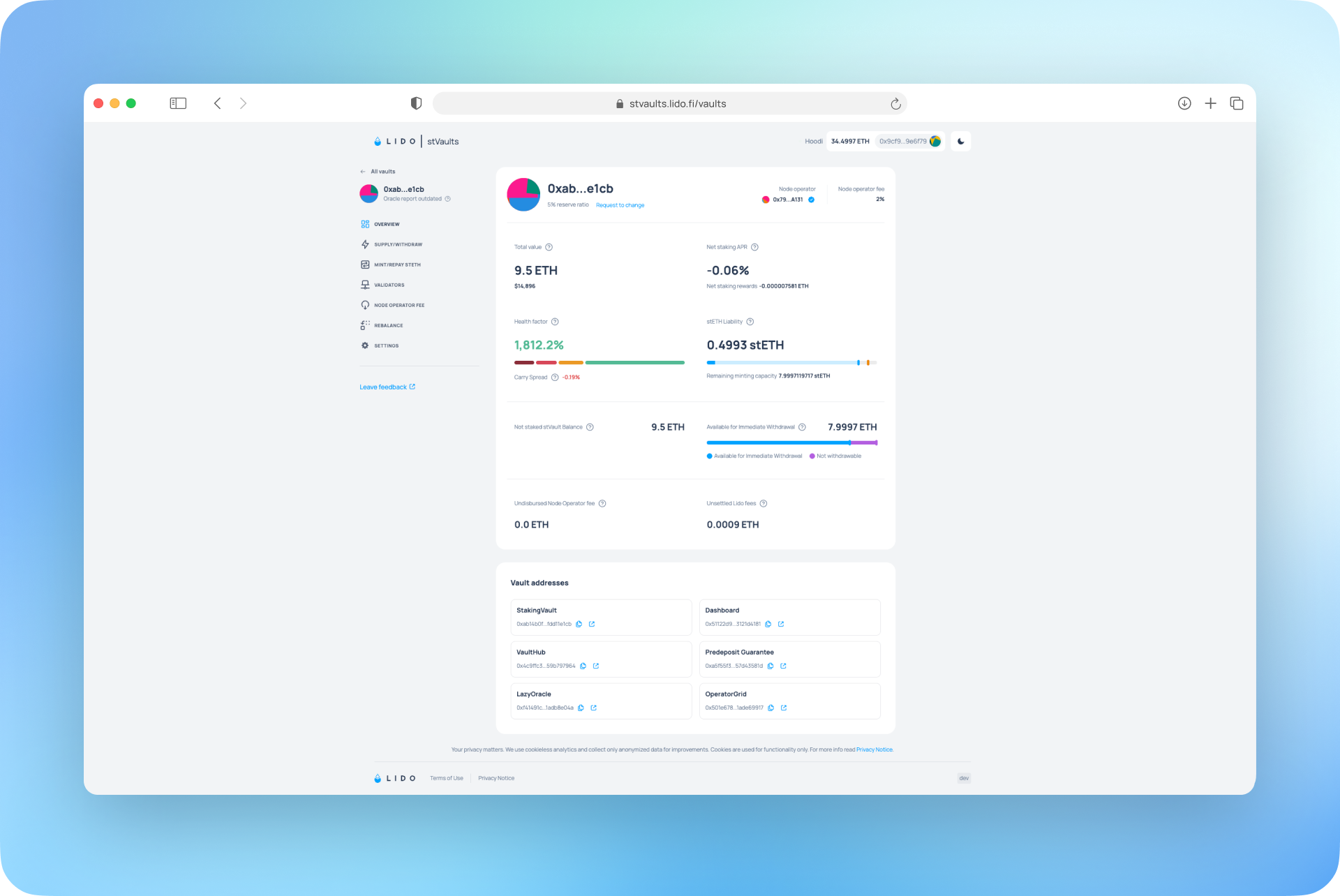
Perhaps the most impactful enhancement for institutional users is the new support for rebalancing in the Web UI. Rebalancing, in the context of stVaults, refers to the process of repaying stETH liability using ETH from the vault’s own balance. This feature profoundly simplifies the redemption fulfillment process for institutions. In a typical large-scale redemption scenario, an institution might issue a request to withdraw a substantial amount of staked ETH. This request might be fulfilled by minting new stETH from the stVault and swapping it for ETH on secondary markets to meet the withdrawal demand. This operation, while providing immediate liquidity, creates an equivalent stETH liability within the vault, representing the stETH that was minted against the vault’s underlying ETH. Previously, covering this liability — essentially squaring the vault’s books by repaying the stETH debt with ETH — necessitated complex interactions through the command-line interface or directly with the underlying smart contracts, a process often requiring specialized blockchain developers.
The integration of rebalancing into the Web UI transforms this intricate process into a user-friendly operation. Vault owners can now perform this critical financial management task themselves, within their established approval and custody setups, without requiring specialized technical expertise or relying on external development teams for custom scripts. This capability significantly reduces operational risk, improves auditability, and enhances the overall efficiency of managing large institutional staking positions, making stVaults an even more compelling solution for sophisticated market participants. "The rebalancing feature in the Web UI is a game-changer for our institutional partners," explained a Lido product manager. "It not only simplifies complex financial operations but also empowers vault owners with greater autonomy and control, aligning with enterprise-grade operational standards and reducing reliance on specialized technical staff for routine financial operations."
Empowering Users with Comprehensive Documentation: stVaults Doc Center
Complementing the platform and UI enhancements, the stVaults Doc Center has received substantial updates, further empowering users with comprehensive and accessible information. The addition of more custodian guides is a direct response to the increasing demand from institutional clients who operate within stringent regulatory and security frameworks. These guides likely detail specific integration procedures, security best practices, and operational considerations for working with various qualified custodians. This includes instructions on how to set up multi-signature wallets, integrate with specific custody APIs, and ensure compliance with regional financial regulations. By providing detailed, step-by-step instructions and best practices, Lido is lowering the barrier to entry for institutions and ensuring that they can confidently integrate stVaults into their existing custodial infrastructure, reducing the time and resources typically required for new technology adoption.
Crucially, the Qualified Custodians overview within the Doc Center now provides a centralized listing of all stVaults smart-contract addresses that require whitelisting. For institutional clients, whitelisting smart-contract addresses is a fundamental security and compliance requirement. It ensures that funds can only interact with approved, verified smart contracts, mitigating risks associated with unauthorized transactions or malicious contract interactions. Consolidating this information in one easily accessible location significantly streamlines the due diligence and setup process for institutional custody providers, reinforcing the platform’s commitment to enterprise-grade security and compliance. This move underscores Lido’s understanding of the unique operational and security needs of institutional players in the Web3 space, where explicit approval of smart contract interactions is a cornerstone of robust security protocols.
Broader Implications and Future Outlook
These comprehensive updates to Lido V3’s stVaults represent more than just incremental improvements; they signify a strategic pivot towards solidifying Lido’s position as the leading liquid staking solution for a diverse and increasingly sophisticated user base. By focusing on modularity, institutional-grade usability, and robust security, Lido is actively addressing the evolving demands of the Ethereum staking ecosystem.
The emphasis on validator consolidation and the infra fee waiver is expected to accelerate the migration of existing stakers, potentially leading to a more diversified and decentralized set of node operators within the Lido ecosystem. This not only enhances the resilience of the protocol but also contributes positively to the overall health and decentralization of the Ethereum network, a core tenet of its long-term vision. As an industry analyst specializing in DeFi noted, "Lido’s strategic focus on stVaults and institutional-grade features is not just about capturing market share; it’s about building foundational infrastructure that can support the next wave of capital entering the decentralized economy. The ability to offer tailored, secure, and operationally efficient staking solutions is paramount for unlocking enterprise adoption."
The Web UI enhancements, particularly the anti-scam protections, integrated fee settlement, and on-UI rebalancing, are critical for fostering broader institutional adoption. These features transform what were once complex, technically demanding operations into intuitive, secure processes, bridging the gap between traditional financial operational standards and the decentralized world. This ease of use, combined with enhanced security, is paramount for attracting and retaining large-scale capital, which often operates under strict internal controls and audit requirements.
Looking ahead, the expansion of the Products Overview Hub suggests a vibrant future for the stVaults ecosystem. As more innovative products and services are built on this modular primitive, stVaults could become a foundational layer for a new generation of institutional DeFi, enabling bespoke financial products, treasury management solutions, and advanced staking strategies that were previously unattainable. The continuous development and refinement of stVaults underscore Lido’s commitment to innovation and its responsiveness to market needs, positioning it as a critical player in the ongoing evolution of decentralized finance and Ethereum’s economic security. As the digital asset landscape matures, platforms like stVaults, which prioritize security, flexibility, and user experience, will be instrumental in driving mainstream and institutional adoption of blockchain technology. The Lido DAO continues to invite interested parties to engage in discussions regarding the future of stVaults, their potential products, and roadmap, signaling an open and collaborative approach to its development.