Lina Irawan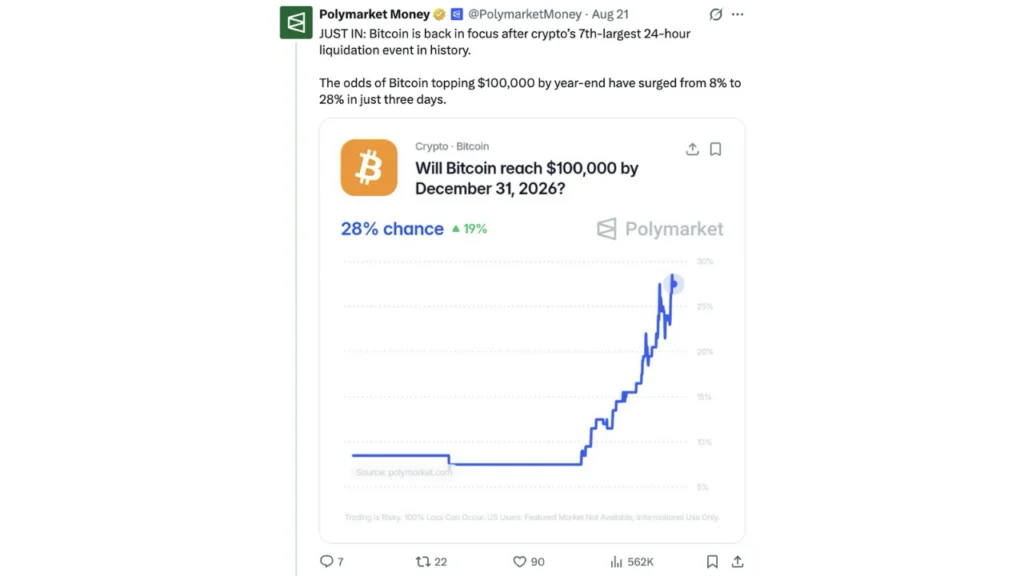
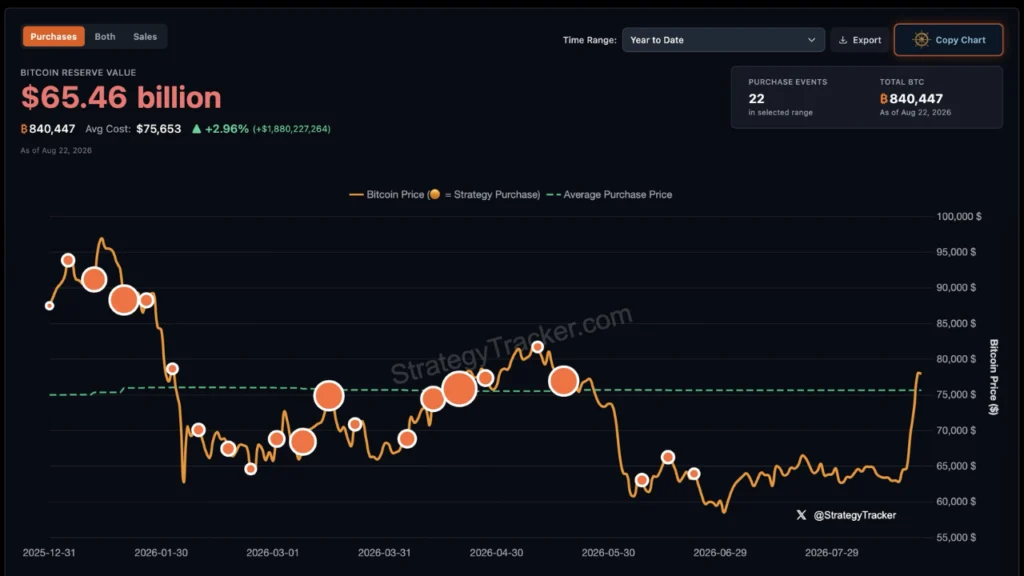
Bitcoin is once again teetering on the edge of a significant psychological and financial milestone, with traders on the prediction market platform Polymarket assigning a strong probability to the cryptocurrency breaching the $80,000 mark before the end of August. The sentiment, as reflected by Polymarket’s aggregated user bets, has seen a dramatic shift in recent weeks, mirroring Bitcoin’s impressive upward trajectory from its early August lows. Currently, the platform indicates a 59% likelihood that Bitcoin will touch $80,000 within the current month. This elevated confidence comes as Bitcoin’s price action has surged, pushing the digital asset above $77,000 and briefly flirting with $79,500, a level not seen since the early summer months.
The current rally represents a substantial turnaround from the beginning of August, when Bitcoin was trading in the mid-$60,000s. This recent surge has delivered gains exceeding 20% in a matter of weeks, reigniting market focus on the $80,000 price point as a key target. Beyond the $80,000 mark, Polymarket traders are also pricing in a 35% chance of Bitcoin reaching $82,500 and an 18% probability of it touching $85,000 by month’s end. A more ambitious target, such as $100,000, remains a distant prospect, with odds currently standing at a mere 2%.
Short Squeeze Catalyzes Bitcoin’s Rapid Rebound
A defining characteristic of Bitcoin’s recent ascent has been its remarkable speed. The cryptocurrency experienced an accelerated climb, vaulting from approximately $64,000 to nearly $79,500 in an astonishingly short three-day period. This rapid price appreciation triggered a significant wave of liquidations for bearish positions, commonly referred to as a short squeeze. Market data aggregated from various reports indicates that over $4 billion in leveraged short cryptocurrency positions were forcibly closed during this intense rally.
The underlying mechanics of a short squeeze played a pivotal role in amplifying the upward momentum. Traders who had bet against Bitcoin’s price movement, by taking short positions, were compelled to repurchase the cryptocurrency as its value increased. This forced buying activity injected additional demand into the market, driving prices through successive resistance levels with greater velocity. As Bitcoin decisively broke through the $70,000 and subsequently the $75,000 thresholds, momentum traders, recognizing the accelerating trend, began to enter the market. The confluence of short covering, new capital inflows from momentum traders, and an overall improvement in market sentiment transformed what initially appeared to be a modest recovery into a robust and aggressive rally.
However, the very dynamics that fueled this surge carry the potential to operate in reverse. As Bitcoin approached the $80,000 area, traders who had established leveraged long positions started to face increased risk. A subsequent pullback, such as the observed retreat toward $77,000, has already resulted in hundreds of millions of dollars in cryptocurrency liquidations. This shift in market pressure indicates that the burden is beginning to transfer from short sellers to overextended buyers who may be forced to liquidate their positions to cut losses.

Consequently, the price range between $79,000 and $80,000 has become a critical juncture. A decisive and sustained breakout above this level could attract another wave of momentum buying, potentially propelling Bitcoin higher. Conversely, a rejection at this resistance zone might encourage traders to secure their profits, leading to further price consolidation or a more pronounced downward correction. The market’s reaction in this immediate price band will be a key determinant of Bitcoin’s short-term trajectory.
ETF Demand: A Dual Engine for Bitcoin’s Advance
Distinguishing this latest rally from many previous ones, the current upward movement is not solely underpinned by derivatives market activity. A significant and growing demand for U.S. spot Bitcoin Exchange-Traded Funds (ETFs) has emerged as a parallel and powerful support factor. These regulated investment vehicles have attracted substantial net inflows, signaling renewed institutional interest in direct exposure to the cryptocurrency.
On a recent Thursday, U.S. spot Bitcoin ETFs collectively recorded their largest single-day net inflow since May, amounting to $606 million. The period from Monday through Thursday of that week saw combined inflows of approximately $1.6 billion, a clear indicator of escalating institutional appetite. This positive trend continued into Friday, with spot Bitcoin ETFs garnering an additional $307.5 million in net inflows on August 21st. This marked the fifth consecutive trading session of positive inflows. BlackRock’s iShares Bitcoin Trust (IBIT) led the pack, experiencing inflows of roughly $239.3 million, while Fidelity’s Wise Origin Bitcoin Fund (FBTC) added approximately $30.2 million.
The significance of these ETF flows cannot be overstated. They provide a more direct and tangible measure of demand from investors seeking regulated and accessible avenues to participate in the Bitcoin market. Had Bitcoin’s price been appreciating while ETF investors were withdrawing capital, the rally’s sustainability would have been considerably less convincing. Instead, the strengthening of institutional capital flows in tandem with price appreciation offers a robust argument for further upside potential, including a sustained move beyond the $80,000 level. This institutional endorsement lends an additional layer of credibility and stability to the current market upswing.
Macroeconomic Tailwinds and Regulatory Landscape Bolster Bullish Sentiment
Beyond the immediate market dynamics, several macroeconomic developments and evolving regulatory considerations have contributed to a more broadly bullish backdrop for Bitcoin. The U.S. Treasury’s recent announcement of its intention to increase buybacks of longer-dated government bonds had an initial calming effect on the Treasury market and contributed to a weakening of the U.S. dollar. This development was interpreted by many investors as potentially beneficial for scarce assets, including Bitcoin and gold, as it could reduce the supply of safe-haven assets and increase liquidity.
The timing of Bitcoin’s rally also coincided with a resurgence of optimism regarding cryptocurrency regulation in the United States. President Donald Trump has reportedly urged Congress to expedite the passage of the CLARITY Act, legislation designed to establish a more defined and transparent regulatory framework for digital assets. Such political and regulatory advancements, even in their nascent stages, provide an additional layer of support for the cryptocurrency ecosystem by reducing perceived risks and fostering greater clarity for both institutional and retail participants.

Despite these supportive factors, the macroeconomic landscape is not entirely devoid of potential headwinds. Long-term Treasury yields remain at elevated levels, and market participants are closely monitoring the Federal Reserve for any signals regarding future interest rate policy and the broader trajectory of financial conditions. The forthcoming Jackson Hole Economic Symposium, a highly anticipated annual gathering of central bankers, economists, and market participants, could prove to be a pivotal event for risk assets. Any indications from Fed officials suggesting a prolonged period of restrictive monetary policy could temper Bitcoin’s upside potential, particularly in the wake of its rapid recent gains.
Navigating the Path to and Beyond $80,000
While the prevailing market sentiment appears to favor further upward movement, the challenge lies not only in reaching the $80,000 mark but also in establishing it as a stable support level. Bitcoin’s recent ascent has been sufficiently powerful to reignite positive momentum, but it has also concurrently created conditions ripe for profit-taking. Investors who acquired Bitcoin at lower price points, such as $64,000 or $70,000, now hold substantial unrealized gains, making them potential sellers. Simultaneously, leveraged buyers who entered positions at higher prices are becoming increasingly vulnerable to sharp price reversals.
The weekend trading sessions often introduce an additional layer of volatility into the cryptocurrency market. While Bitcoin operates 24/7, the trading of U.S. spot Bitcoin ETFs is confined to traditional market hours. This temporal disconnect means that during weekends, when a significant source of institutional demand is temporarily offline, relatively smaller trading volumes can exert a disproportionately larger influence on price movements due to thinner liquidity.
Consequently, the initial full U.S. trading sessions of the upcoming week are likely to be particularly informative. Should ETF inflows remain robust and Bitcoin manage to reclaim and sustain prices above $80,000 on healthy trading volume, it could signal the potential for further advances towards the $82,500 to $85,000 range.
For the time being, the 59% probability assigned by Polymarket traders suggests that a test of the $80,000 level is considered more likely than not. However, given Bitcoin’s impressive gain of over 20% in a compressed timeframe, the path to higher valuations is unlikely to be without its obstacles. The immediate focus of market participants has shifted from whether Bitcoin can recover from its mid-$60,000s slump to whether the bullish sentiment can successfully transform the psychological $80,000 ceiling into a new and stable support base. The coming days will be crucial in determining the next chapter of Bitcoin’s price discovery.